To survive maximum pressure, Iran kept pumping and broke its oil company
Donald Trump’s maximum pressure is usually scored by counting tankers and tracking the rial, but Iran’s budget points to a deeper cost: more than $80 billion in NIOC bank debt and sovereign-fund arrears, repeatedly deferred as Iranians shoulder the burden.
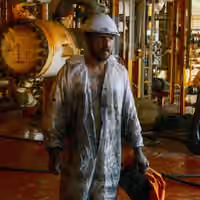
File photo released by ISNA in September 2013 shows a worker during the installation of an oil rig in Changuleh, Mehran county, Ilam province, western Iran.
Donald Trump’s maximum pressure is usually scored by counting tankers and tracking the rial, but Iran’s budget points to a deeper cost: more than $80 billion in NIOC bank debt and sovereign-fund arrears, repeatedly deferred as Iranians shoulder the burden.
On August 5, a state bank froze the accounts of the National Iranian Oil Company, NIOC, over about $1 billion owed to the sovereign wealth fund, two years past due. A separate case was already running: a $1.5 billion tax assessment the company says it simply cannot pay. Enforcement on that one stopped only when the presidency intervened.
The episode matters because the law shielding the company is also where its condition is recorded. NIOC publishes no audited accounts, and Iran's budget shows state companies only in aggregate, leaving its debt to be reconstructed from budget provisions and disclosures by other state institutions.
This year's budget sets the amount of NIOC debt to the central bank and commercial banks being deferred at 55 billion euros, about $63.5 billion, covering principal and interest on financing for upstream oil and gas development. It appears as a single sentence at the bottom of a table in which every other figure is in rials or percentages, renewed every year since 2019.
Iran's sovereign wealth fund, the National Development Fund, has separately said NIOC is its largest debtor, with $17 billion in unpaid loans.
Those two categories alone amount to more than $80 billion. No single official document presents them as one consolidated NIOC debt figure.
Iran's entire general budget this year converts to roughly $37 billion at the open-market rate. For scale, the deferred bank debt alone is about 1.7 times what the government plans to spend in a year.
That burden grows without anyone borrowing another dollar. The debt is in foreign currency, and the rial has fallen from about 900,000 to the dollar in early 2025 to nearly 2 million today, a slide President Trump celebrated in August as his administration "destroying Iran's currency." Each step down makes the same $63 billion heavier against NIOC's rial costs and the state's domestic revenues.
That burden grows in rial terms without anyone borrowing another dollar. The debt is in foreign currency, and the rial has fallen from about 900,000 to the dollar in early 2025 to nearly 2 million today, a slide President Trump celebrated in August as his administration "destroying Iran's currency.” Each step down increases the rial value of the same $63 billion obligation and makes it larger relative to the state's domestic revenues.
Maximum pressure is usually scored from the outside: barrels tracked leaving the Persian Gulf, the rial's slide, the lengthening sanctions lists. By that scorecard the campaign is working.
A clearer measure is the condition of the company at the center of the sanctioned trade, and by that measure the campaign has worked more completely than the scorecard shows. The pressure did not stop Iran's oil. It changed the terms of the business, and the new terms have broken the company that produces it, in every sense but the accounting one.
The business model was set at the top. After the United States withdrew from the nuclear deal in 2018 and reimposed sanctions, Ali Khamenei told officials not to leave the economy waiting on "decisions to be made by others." The objective instead was to plan with the sanctions in place and, in his formulation, to neutralize them.
The oil ministry's version of neutralization was to keep production alive with domestic contractors, the Revolutionary Guard's companies among them. On its own terms, that part worked. Output that had fallen below 2 million barrels a day in 2020, the lowest in almost four decades by American government estimates, was rebuilt to about 3.6 million by mid-2024, a recovery the oil minister boasted of publicly.
Selling those barrels was another matter.
"We have unofficial or unconventional sales, all of which are secret," then-oil minister Bijan Zanganeh said in 2019, "because if they are made known America would immediately stop them." His deputy called it the grey market.
In practice, that meant selling at sanctions-driven discounts that have varied widely over time, reaching $10 to $15 a barrel below Brent through 2024 and 2025, particularly to China's independent refiners; using a shadow fleet, ship-to-ship transfers and obscured vessel identities; relabeling Iranian crude as originating elsewhere; and paying intermediaries to keep the chain moving. China has at times taken roughly 90 percent of Iran's exported crude.
Payment itself became another layer of the sanctions trade. Iranian oil proceeds have been trapped or restricted in foreign banking systems, while other sales have been settled through barter or in currencies that are difficult to repatriate freely.
India created a rupee payment mechanism for Iranian crude in 2019, and the channel stalled the same year when Indian purchases stopped. Roughly $6 billion in Iranian oil proceeds frozen in South Korea were eventually transferred to restricted accounts in Qatar as part of the 2023 prisoner exchange.
Every additional discount, commission and restriction reduces what reaches Iran. NIOC's statutory share of crude and condensate export proceeds is set at 14.5 percent, so lower realized export revenue narrows the company's own take as well.
The difference between what the model earned and what production cost was covered on credit, in foreign currency, from the central bank, state banks and the sovereign wealth fund, with parliament's authorization.
By January 2019 the state knew in writing that the arrangement was not paying for itself. The parliament's research arm reported that NIOC, then about $50 billion in debt on its own count of the previous year, could not repay what it owed. The party line continued anyway: the same parliament approved fresh lending in the same budget, and two months later wrote the first deferral into law.
The dollar figures were tracked for two more years, to about $60 billion in March 2020 and about $70 billion in March 2021. Then that series went quiet.
The liabilities themselves did not vanish from the record. Two years later the Economy Ministry put NIOC's debts for 2021 at 1,683 trillion tomans, the largest of any state company in Iran, ahead of Bank Sepah and Bank Melli. At the exchange rate of the day, that is the same $60 to $65 billion the dollar series had been reporting.
What disappeared was the ability to follow it: a comparable figure, year by year, in the currency the money was owed in. The largest corporate debt in Iran's history was reduced to one renewable sentence that for six years carried no number at all. When a number finally surfaced this February, it settled what the silence had left open. The bank debt did not go away. It was rolled forward.
The meter still runs, though not at one rate. The sovereign fund's published terms for foreign-currency oil and gas facilities are 3.5 percent for the fund plus 2.5 for the agent bank, 6 percent all-in. On the $17 billion it is owed, that alone is close to $1 billion a year, almost exactly the size of the claim that froze the company's accounts in August.
The central bank has never published its contract rate, so the future cost can only be estimated. If even a 4 percent rate were applied to the $63 billion outstanding balance, it would add more than $2.5 billion in interest over a year; at the sovereign fund's 6 percent rate, the figure would approach $3.8 billion.
What the budget does establish is that the deferred bank debt already consists of principal and interest. The cost of carrying the old debt has become part of the debt.
For comparison, $1.5 billion in foreign currency is allocated for medicine this year, in a spring when pharmacy prices jumped several hundred percent, cancer and dialysis drugs ran short, and officials blamed scarce foreign currency. Depending on the rates applied to NIOC’s different debts, the annual interest burden could exceed that amount by several billion dollars.
An Iranian who misses a single loan installment pays the contract rate plus a 6-point penalty. The oil company's interest simply accrues, uncollected, year after year. A deferral, in the end, is a bet that a better year is coming, one with a surplus large enough to settle old bills. The Islamic Republic has been promising that better year that is yet to come for forty-seven years.
Because the loans are neither collected nor written off, the central bank and the state banks carry them as sound assets, the same accounting that keeps Iran's insolvent banks upright. When those banks come up short, they overdraw at the central bank, and that is where base money is created.
The transmission is not mechanical, but it is the route by which a single failed lender, Bank Ayandeh, accounted for about a quarter of the growth in Iran's monetary base in 2022-23. The bill reaches Iranians as inflation: the tax no one votes on, taking its largest share from the poorest.
Fifteen years of records say NIOC could not pay when conditions were merely bad. With its fields bombed and its exports blockaded, repayment is beyond reach in any scenario.
And the pressure is still tightening. On August 13, Treasury Secretary Scott Bessent, who runs the Economic Fury campaign against the Islamic Republic, promised measures "like have never been seen in the history of the economic isolation of a country," on top of a blockade meant to keep anything from moving in or out of Iranian ports. Whatever they turn out to be, they are aimed at the only revenue that could ever service this debt.
Nor does the optimistic case rescue the company. Even a full lifting of sanctions would not change the arithmetic quickly, because a company with damaged fields and war-hit infrastructure would have to borrow more before it could export more.
Maximum pressure set the terms of this downfall, but the decisive choices were Tehran's: to keep pumping at any margin, to stop publishing a comparable foreign-currency debt figure after 2021, and to push the bill forward one year at a time.
The company that once symbolized Iran's oil wealth was not felled by a rival or a market. It was sacrificed, quietly, by its own state, to the nuclear program and the regional ambitions that brought the sanctions, and to the business model built to outlast them, and the receipt is one sentence long, perpetually renewed every year.
File Photo: Shipping containers at Shahid Rajaei port in Chabahar, southeastern Iran.
Iran says its non-oil trade has fallen by around 30% since the war began, but figures from several of its biggest trading partners point to far steeper declines in some of the country’s most important commercial relationships.
Trade with China has fallen to roughly a quarter of last year’s level by one measure, while commerce with Turkey, India and the European Union has also contracted sharply as war and disruption in the Strait of Hormuz reshape Iran’s foreign trade.
Mohammad-Sadegh Ghanadzadeh, a senior official at Iran’s Trade Promotion Organization, said both non-oil exports and imports fell by roughly 30% during the first four months of the current fiscal year, from March 21 to July 22.
The government has stopped regularly publishing detailed foreign trade statistics since the war began, making a fuller assessment difficult.
Iranian customs data show the country recorded slightly more than $34 billion in non-oil trade during the same four-month period last year, including $15 billion in exports.
China trade plunges
China is Iran’s largest trading partner, accounting for roughly one-third of the country’s non-oil foreign trade.
Chinese data put non-oil bilateral trade at around $10 billion in 2025—substantially lower than Iranian figures, in part because the two countries classify and record parts of their trade differently, including sanctioned Iranian commodities.
According to Chinese customs records, trade with Iran totaled less than $823 million during the first four months of the war, from March through June. That is roughly one-quarter of the level recorded during the same period a year earlier.
The disruption has also sharply increased transportation costs.
Majidreza Hariri, chairman of the Iran-China Chamber of Commerce, said transporting goods from China to Iran by sea or land now costs four times as much as before the war, with shipping a container costing as much as $13,000.
Major partners hit harder
Trade with several of Iran’s other major partners has also contracted sharply.
The United Arab Emirates, Iran’s second-largest trading partner, has largely halted trade with Tehran. Before the war, annual trade between Iran and the UAE stood at around $27 billion, about 80% of it Emirati exports to Iran.
The precise impact on trade with Iraq, Iran’s third-largest trading partner, remains unclear. But official data from Turkey, its fourth largest, show Turkish exports to Iran fell by almost half between March and June to around $716 million, while imports from Iran dropped 37% to $907 million.
India has recorded a similar decline. Its exports to Iran fell by around 60% during the first four months of the war to approximately $150 million.
Indian imports from Iran moved sharply in the opposite direction, reaching around $1 billion in the first half of the year — four times the level recorded during the same period last year—after India bought several shipments of Iranian crude oil and liquefied petroleum gas.
Health Minister Mohammad-Reza Zafarghandi recently said India, Iran’s largest supplier of pharmaceutical raw materials, had stopped shipments after the IRGC closed the Strait of Hormuz.
He said India had made the resumption of pharmaceutical exports conditional on free passage for Indian vessels through the waterway.
Where has the trade gone?
Taken together, available data suggest Iran’s trade with several of its largest established partners has contracted substantially more than the 30% overall decline reported by Tehran.
The discrepancy suggests commerce with other countries may have partly cushioned those losses.
Russia, Pakistan, Iraq, Afghanistan and Central Asian states are among the possible destinations, though the absence of regularly published Iranian customs figures makes it difficult to establish how much trade has shifted or where.
The broader picture nevertheless shows the economic fallout from the war extending well beyond Iran’s oil exports, weakening some of Tehran’s most important commercial relationships even as the full extent of the shift remains obscured by the lack of detailed Iranian data.
File photo shows former IRGC chief-commander Mohsen Rezaei attending a conference in Kerman on November 26, 2025. / Photo by ISNA
The ascension of Mohsen Rezaei as secretary of Iran’s Supreme National Security Council underscores that there is much political drama beneath the surface of the Islamic Republic’s portrayal of strength as the Trump administration tries to end the war.
The resignation of Mohammad Bagher Zolghadr, the former deputy commander-in-chief of the Islamic Revolutionary Guard Corps (IRGC), from the SNSC positions his tenure as secretary as the shortest in the history of the Islamic Republic.
Zolghadr was demoted, becoming a political advisor to the supreme leader. Rezaei's appointment demonstrates both the militarization and fragmentation of the Islamic Republic’s elite.
The careers of Rezaei and Zolghadr have multiple parallels. Zolghadr served under Rezaei when he was commander-in-chief of the IRGC. Zolghadr was Rezaei’s chief of the IRGC’s joint staff.
Both men later became secretary of the Expediency Council, which advises the supreme leader and arbitrates disputes between parliament and the Guardian Council, after their long tenures in the IRGC’s top brass. The Expediency Council has traditionally been used by Iran’s supreme leaders as a landing spot for the old guard after service in more consequential positions.
The return of these figures to Iran’s top ranks reflects the hollowing out of the Islamic Republic’s military leadership following US and Israeli airstrikes in 2025 and 2026.
This is not Rezaei’s first stint on the SNSC. As commander-in-chief of the IRGC, he served as an SNSC member. But the last time he was officially part of its deliberations was in 1997.
In becoming secretary of the SNSC, he is the first former IRGC commander-in-chief to serve as secretary. He joins Ahmad Vahidi, the current IRGC chief, who was Quds Force commander under Rezaei’s tenure at the helm of the Guards, who holds a seat on the SNSC.
Rezaei also has a long history with another SNSC member Speaker of Parliament Mohammad Bagher Ghalibaf, who rose through the ranks of the IRGC—as deputy commander of the fearsome Basij and commander of the Khatam al-Anbiya Construction Headquarters—under Rezaei’s leadership. In 1997, when Rezaei departed from the IRGC’s top position, Ghalibaf signed a letter to Rezaei praising him as a “mentor.”
Both Ghalibaf and Rezaei have also been political rivals, unsuccessfully running against each other as candidates for president, for example in 2013. With a supreme leader who has largely been inaccessible and invisible to most in Iran, this sets-up the prospect of clashes within the SNSC, especially as both men have seen themselves as destined for higher office.
Like Zolghadr, Rezaei is also a hardline actor. But Rezaei has exhibited more political competitiveness than his predecessor, having run for office whereas Zolghadr spent most of his career embedded in military and security institutions.
Ghalibaf, however, could be bolstered on the SNSC with the appointment of Ali Abdollahi as chief of staff of Iran’s Armed Forces. Abdollahi served as a longtime deputy of Ghalibaf, when Ghalibaf headed the IRGC’s Air Force and Iran’s Police. Therefore, while Rezaei’s appointment can be seen as a check on Ghalibaf, the latter is not necessarily losing his influence.
Rezaei’s appointment as SNSC secretary is also likely a blow to President Masoud Pezeshkian. Traditionally, despite presidential decrees appointing the SNSC secretary, in practice, the supreme leader decides the fate of the position.
Given Rezaei’s being a longtime fixture in conservative politics in Iran, it can be safely assumed that he was not the reformist Pezeshkian’s first choice for the position. These dynamics further marginalize Pezeshkian and his Foreign Minister Abbas Araghchi. Just days ago, Iranian media reported that Pezeshkian had refused Zolghadr’s resignation as SNSC secretary.
Rezaei’s views may also lead to disagreements with Pezeshkian’s camp, which is more focused on returning to the MOU than dragging negotiations out to build deterrence and achieve a better deal.
In a 2015 state television appearance, Rezaei proclaimed that “we’ll take 1,000 Americans hostage. America will have to pay several billions to get every single one freed. This is how we can solve our economic problems.”
Rezaei’s ascension continues the trend of the SNSC being populated by men steeped in asymmetric tactics against the United States, like terrorism. Zolghadr previously commanded the IRGC’s Ramadan Headquarters which later morphed into the Quds Force.
Rezaei oversaw a particularly active period of IRGC terror plots when he was leading the IRGC—for example the bombings of the Israeli embassy in Argentina in 1992, a Jewish community center in Buenos Aires in 1994, and Khobar Towers in Saudi Arabia which killed 19 American servicemembers in 1996.
INTERPOL issued a Red Notice for Rezaei at Argentina’s request over his alleged involvement in the 1994 AMIA bombing.
Vahidi also participated in the deliberations which led to these attacks and was likewise the suject of an INTERPOL Red Notice. Thus, Iran’s SNSC will now feature two men who are the subject of an INTERPOL Red Notice.
Before, especially under Ali Khamenei’s tenure, softer faces more palatable to the international community served as secretary. Now, the Islamic Republic is broadcasting the rogue nature of the regime—a signal of its overconfidence, which is dangerous.
This raises questions over Iran’s future trajectory with respect to developing nuclear weapons—especially as it’s using the tussle over the Strait of Hormuz as a shield from having to make concessions on its nuclear program.
When he was commander-in-chief of the IRGC, Rezaei was quoted in a 1988 assessment sent to Akbar Hashemi Rafsanjani and later relayed to then-Supreme Leader Ruhollah Khomeini as suggesting that nuclear weapons, among other arms, would be needed if Khomeini chose to continue the Iran-Iraq War, which was depleting the Iranian state.
He did recognize the limits of the Islamic Republic’s power at the time—reportedly telling Khomeini that “there are no victories forthcoming in the next five years” without such weaponry. Although, for now, Rezaei appears content with leveraging the Strait of Hormuz, dubbing Iran’s control over it “more important than dozens of nuclear bombs.”
In the end, Rezaei’s ascension may lead to growing disagreements within the Islamic Republic’s establishment. It also reflects the continued domination—which started before the war—of the IRGC in decision-making.
Rezaei’s predecessors as secretary of the pre-war SNSC, include Ali Shamkhani, who headed the IRGC’s Navy, and Ali Akbar Ahmadian, a longtime IRGC commander himself. Rezaei being elevated at this time is telling given his role in past crises during wartime.
A vessel near the Strait of Hormuz, as seen from Musandam
Iran is doubling down on control of the Strait of Hormuz, with some in Tehran now arguing the strategic leverage it provides is more valuable than a nuclear weapon.
Tehran’s drive to turn that control into lasting economic and political leverage—through shipping routes, mine clearance and potentially revenues from passing vessels—is emerging as a major obstacle to extending its fragile memorandum with the United States, which expires Sunday.
Washington, meanwhile, increasingly claims it has broken Iran’s control of Hormuz.
The June 18 memorandum is formally due to expire on August 16. President Donald Trump pronounced it over after Iran attacked three ships in the Strait of Hormuz, ordering more strikes and the resumption of the US maritime blockade.
Neither side, however, has formally abandoned diplomacy. If no extension is announced before Sunday, the current state of neither war nor peace could continue. An explicit declaration that the arrangement has ended could increase the risk of renewed attacks.
‘More valuable than a nuke’
Pressure against concessions over the strait is also growing inside Tehran.
Parliament’s National Security and Foreign Policy Commission this week unanimously approved the broad outlines of legislation that would tighten Iran’s control over Hormuz.
The bill includes provisions for inspecting vessels in Iranian territorial waters, banning the passage of assets, equipment and vessels belonging to the United States, Israel and other countries Tehran deems hostile, and charging ships for maritime services.
If enacted, the legislation could constrain Tehran’s room for compromise, much as legislation passed during Hassan Rouhani’s presidency required his government to increase uranium enrichment and suspend implementation of the Additional Protocol unless banking and oil sanctions were lifted.
Alireza Salimi, a member of parliament’s presiding board, told the ISNA news agency Thursday that “the Strait of Hormuz is currently more valuable to Iran than an atomic bomb,” describing it as leverage for lifting sanctions and securing compensation for wartime losses.
Demands put talks in doubt
The tougher approach was also reflected in demands laid out shortly before his departure by Mohammad Bagher Zolghadr, the former secretary of the Supreme National Security Council.
Zolghadr said reopening the strait would require an end to attacks on Iran and its allies, the lifting of the blockade, the withdrawal of US forces from around Iran, sanctions relief, the release of frozen Iranian assets and compensation for damage caused by the wars.
It remains unclear whether those demands represented his personal position or that of the SNSC, and whether his successor, Mohsen Rezaei, will pursue the same approach.
Rezaei’s appointment this week, along with other changes at the top of Iran’s security establishment, has been welcomed by hardline opponents of the government’s approach to negotiations.
Former diplomat Kourosh Ahmadi wrote in the Shargh newspaper that if Tehran insisted on the conditions outlined by Zolghadr, “it is highly unlikely that there will be any serious negotiations between Tehran and Washington at all.”
Both sides claim control
The dispute is unfolding as Tehran and Washington offer directly competing accounts of who actually controls Hormuz.
Trump said Wednesday that the United States had complete control of the waterway and that the maritime blockade had deprived Iran of the ability to act.
The spokesman for Iran’s Khatam al-Anbiya Central Headquarters, the country’s wartime command center, rejected that assertion Thursday, saying the strait remained under Iranian control and that no vessel could pass safely without authorization from Iran’s armed forces.
Shipping-monitoring data show traffic remains a fraction of pre-war levels. Around 10 to 12 vessels have been crossing the strait daily in recent days, compared with roughly 130 to 140 before the war, with most currently using a route designated by Iran.
Tehran has also stressed that an agreement with Oman over shipping routes would not by itself be sufficient to reopen the strait.
Ali Gholhaki, a political activist close to parliament speaker and senior Islamabad negotiator Mohammad-Bagher Ghalibaf, said Iranian decision-makers currently had no intention of reopening the waterway and had blocked an agreement with Oman because of what they viewed as Muscat’s alignment with Washington.
Tehran and Muscat at odds
The disagreement with Oman offers perhaps the clearest illustration of what Tehran now wants from its control of Hormuz.
Iran has pushed for control over shipping routes and mine clearance and for mandatory payments from vessels using the waterway. Oman has instead favored a joint fund supported by voluntary contributions from governments and companies benefiting from shipping.
Few in Tehran expect Muscat to accept Iran’s terms. Ahad Azadikhah, a lawmaker aligned with Ghalibaf, recently told Khabar Online that if Oman did so, the Islamic Republic would have achieved “the victory of all victories.”
The dispute means Hormuz is increasingly intertwined with the fate of the wider Tehran-Washington dialogue. As Iran seeks to turn control of the strait into leverage over sanctions, compensation and any broader settlement, Washington may increasingly see that same leverage as something that must be neutralized before a deal can be reached.
Piles of historic cobblestones torn from central Tehran’s streets sit stacked beside traffic.
Tehran's municipality is tearing up the cobblestones of the capital's historic pedestrian zones and laying asphalt, a change officials call traffic management and that architects and urban sociologists read as something older: the redesign of a city to make protest harder.
The work, underway in District 12, Baharestan Square and 30 Tir Street, is presented by municipal officials as a routine measure to ease congestion, carried out at the request of the traffic police.
Critics in architecture and urban sociology argue it cannot be read as a merely technical decision, and belongs instead to a long historical tradition: the use of urban design as an instrument of control.
When the city takes away the barricade
The link between redrawing a city's body and engineering its security is not new. Its most famous case is the great reconstruction of nineteenth-century Paris, carried out by Baron Haussmann on the orders of Napoleon III.
Until the 1850s, Paris was a city of narrow, winding, organic streets that let protesting citizens pry up the paving stones, throw up barricades and take control of their own neighborhoods, the world Victor Hugo drew so vividly in Les Misérables.
By demolishing the old fabric and driving broad, straight, uniform boulevards through it, Haussmann pursued two entwined goals: to strip the public of the ability to barricade the streets, and to ease the rapid movement of troops and heavy artillery for the suppression of unrest.
Later theorists built the insight into the foundations of urban thought. Walter Benjamin in The Arcades Project and David Harvey in his work on the "right to the city" traced how space itself becomes a tool for reproducing ruling power and erasing the protester's presence from it.
Physical disarmament of public space
The replacement of segmented paving blocks with continuous asphalt functions, in effect, as the physical disarmament of the urban environment. Unlike uniform asphalt, cobblestones can be pried loose in a street confrontation, handing demonstrators ready material for barricades or for holding back advancing security forces.
Beyond removing potential projectiles, the smooth surface answers the operational needs of motorized units. Pedestrian infrastructure, with its uneven paving, varying widths, benches and street furniture, slows vehicles down. Coating these zones in asphalt creates uninterrupted corridors for special forces, water cannons and high-speed motorcycle patrols.
Pedestrians stroll along a cobblestone walkway in central Tehran.
Eradicating gathering points
The repaving projects coincide with heightened enforcement against public gathering spaces in central districts, including the sealing of outdoor cafes and the removal of street furniture.
Pedestrian-friendly designs naturally create pause points where citizens congregate, engage in conversation, and form initial nodes of public assembly.
Converting pedestrian hubs into vehicular thoroughfares prioritizes rapid transit over civic presence, reshaping central public areas into channels designed for continuous traffic flow.
The removal of seating and outdoor dining areas reinforces this operational shift by eliminating physical spaces that encourage citizens to linger.
Reclaiming the street
Public thoroughfares have consistently served as primary arenas for civil expression during periods of political tension in Iran.
Highlighting the symbolic and practical weight of public space, prominent Iranian actress Hedieh Tehrani addressed security forces in a public message during the 2022 nationwide protests, writing, "My only way of communicating with the people is the street."
Similarly, exiled Prince Reza Pahlavi emphasized the importance of public thoroughfares during his calls for widespread demonstrations in January 2026, framing the reclamation of street spaces as a central objective for people.
Replacing historical pedestrian infrastructure with asphalt prioritizes security deterrence and vehicular velocity over civic life and urban heritage. By converting public gathering hubs back into high-speed transit corridors, municipal authorities reduce public space from a venue for civic engagement into an infrastructure designed to prevent assembly.