Calls for action from outside Iran have been issued many times over the years and largely ignored. This one was answered, simultaneously and at scale. The precision of the call and the response to it surprised supporters and skeptics alike. Thursday night did not produce regime change, but it marked something no less significant: a visible crossing of a political threshold.
Revolutions do not begin on a single night. They surface after long periods of accumulated rupture. Iran has been politically and psychologically boiling for roughly two decades. What we are witnessing today is the outward expression of a process that began with the collapse of legitimacy in 2009.
That year’s presidential election shattered the Islamic Republic’s claim to popular consent. Until then, despite deep frustration, many Iranians still believed meaningful change was possible through participation, through the ballot, reformist candidates, and gradual adjustment within the system. The blatant manipulation of the vote and the violent suppression of mass protests ended that belief. What followed was not merely repression, but an emotional and moral divorce between society and state. The system survived, but consent did not.
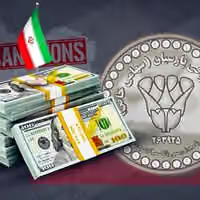
The 2015 nuclear agreement briefly altered the trajectory. It reopened the possibility that Iran might normalize and that ordinary people could reclaim what they often describe as a “normal life.” That hope proved fleeting. Billions of dollars entered the country after nuclear-related sanctions were lifted, yet resources were overwhelmingly diverted toward missile and drone programs and the expansion of proxy networks in Syria, Iraq, Lebanon, and Yemen. Meanwhile, the national currency collapsed, inflation surged, and household purchasing power steadily eroded.
These economic realities are widely known. What has been far less understood, particularly across Western media and policymaking circles, is what was happening beneath the surface. Iranian society had largely exited the Islamic Republic at the level of belief. This was no longer dissent or protest. It was post-loyalty. People were no longer asking how to reform the system. They were asking what could replace it.
Symbols matter when legitimacy erodes, especially when long-standing taboos break. A critical moment came in 2018, when a mummified body, widely believed to be that of Reza Shah, was discovered at a construction site in Shahr-e Rey, near Tehran, where his mausoleum once stood before being demolished after the revolution. Whether the remains were authentic was ultimately irrelevant. What mattered was the reaction. Public chants of “Reza Shah, may God bless your soul” emerged, chants that would have been unthinkable in public space just years earlier.
At first, these slogans were interpreted as expressions of anger toward the Islamic Republic rather than positive reassessment of the Pahlavi era. That reading did not hold. The chants returned, spread geographically, and grew more explicit. A psychological barrier had been crossed.
By the mid-2020s, this symbolic shift became increasingly evident on social media, where attention clustered around Reza Pahlavi. Some observers dismissed his prominence there as a product of manipulation or as evidence that social media itself is an unreliable gauge of political reality. Yet the pattern was unmistakable. Content linked to him consistently generated unusually high engagement across Persian-language platforms, circulating organically, resurfacing repeatedly, and sustaining visibility well beyond individual protest cycles.
The current wave of protests made this underlying reality impossible to dismiss. From the outset, calls for Pahlavi’s return were explicit and widespread. Some skeptics again attempted to discredit the scenes by claiming that videos were manipulated or that slogans had been dubbed in. That explanation did not withstand repetition or scale. The same chants were heard across multiple cities and nights in unrelated recordings, revealing in public what had been forming beneath the surface for years.
The significance of Thursday night lies not in raw numbers alone, but in coordination and credibility. Many external calls in the past produced little or nothing. This one did not. For the first time, a call issued for a specific hour was answered across the country. Demonstrations began simultaneously at the designated time, offering clear evidence of collective response rather than scattered unrest. That precision, and the response to it, marked a qualitative shift in Iran’s political dynamics.
The Islamic Republic still controls the machinery of the state. What it lost on Thursday night is exclusivity over its remaining political legitimacy, both domestically and internationally. From this point on, foreign governments are no longer dealing with an uncontested representative of the Iranian nation, but with a regime whose claim to speak for Iran is openly challenged. Power maintained by force can endure for a time. Power stripped of legitimacy does not recover it.
At the same time, Reza Pahlavi crossed a line that many before him failed to reach. This was not symbolism, nostalgia, or digital noise. It was a successful act of political command. Others issued calls from abroad and were ignored. He issued one, and it was answered nationwide and on schedule. That is not popularity. That is operational leadership.
With this, Iran’s opposition space has been fundamentally reordered. The question is no longer whether Iranians are searching for an alternative or whether a leader could emerge. Both questions have been settled. A focal point now exists, and the regime is forced to reckon with it.
From this moment on, Iranian politics operates under new constraints. The state must now respond not to spontaneous unrest, but to an identifiable center of mobilization. History shows that regimes can survive protests. They struggle far more to survive leaders.
After Thursday night, the Islamic Republic faces a reality it has long sought to prevent. It no longer confronts a crowd. It confronts a contender.