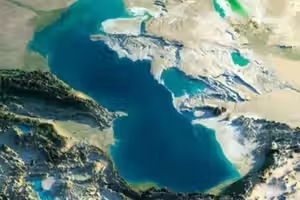
Mohammad Reza Kan’ani, head of the Environmental Protection Department in the northern province of Mazandaran, said Thursday that the Caspian’s water level was declining by around 10 to 20 centimeters annually, attributing much of the decline to rising temperatures, climate change and increased evaporation.
The Caspian’s water temperature had risen by about 1.5 degrees over the past two decades while evaporation had increased by an estimated 10% to 15%, he added.
Kan’ani warned that continued retreat of the shoreline could have serious consequences for coastal infrastructure, local economies and ecosystems dependent on the Caspian, including wetlands.
About 25% of the Caspian’s water comes from precipitation and 75% from rivers, Kanani said, with the Volga – which flows through Russia into the northern Caspian – accounting for the overwhelming majority of river inflow.
Shina Ansari, head of Iran’s Department of Environment, gave an even broader measure of the retreat this week, saying the Caspian’s level had fallen by around two to 2.5 meters over the past decade.
She described the decline as one of the region’s most serious environmental challenges and said reduced river inflows, alongside climate change, were contributing to the crisis.
Without cooperation among the five Caspian littoral states – Iran, Russia, Azerbaijan, Kazakhstan and Turkmenistan – the consequences could extend to ports, coastal communities and the wider ecosystem, Ansari warned.
Falling waters meet a renewed legal dispute
The environmental warnings come as the Caspian has returned to the center of political debate in Iran over the government’s effort to ratify the 2018 Convention on the Legal Status of the Caspian Sea.
Hossein-Ali Haji-Deligani, deputy chairman of parliament’s Article 90 Committee, criticized what he called the government’s rush to approve the convention, saying this week that it could effectively reduce Iran’s share from 20% to between 3.5% and 5%.
That claim requires important qualification.
The 2018 convention does not assign Iran – or any of the five littoral states – a fixed percentage of the Caspian or its seabed. Instead, it establishes territorial waters and fishing zones while leaving seabed boundaries to be negotiated between neighboring states.
Iran’s southern seabed boundaries with Azerbaijan and Turkmenistan therefore remain unresolved.
The frequently cited figure of 20% was a post-Soviet Iranian negotiating position based on dividing the Caspian equally among its five littoral states, rather than a previously established treaty entitlement.
Nor did the earlier Iran-Soviet treaties formally grant Iran 50% of the Caspian. Agreements concluded in 1921 and 1940 established a bilateral Iran-Soviet legal regime, including equal navigation rights and exclusive arrangements between the two countries, but did not divide the sea or its seabed into equal territorial halves.
After the Soviet Union collapsed in 1991, four former Soviet republics emerged as independent Caspian states. Russia subsequently reached agreements with several of them to divide northern seabed resources along modified median lines, while Iran resisted that approach and pushed for an equal 20% division if the seabed was to be partitioned.
Iran ultimately signed the five-state legal-status convention in 2018, but the agreement deliberately left the final division of seabed sectors unresolved. Tehran also stressed at the time that the method for drawing baselines – an important issue because Iran’s concave southern coastline can disadvantage it in maritime delimitation – remained to be negotiated.
The current ratification debate therefore does not amount to a parliamentary vote assigning Iran a specific percentage of the Caspian. The more consequential question is whether Tehran should fully commit to the five-state framework before its own seabed boundaries and the baseline methodology have been settled.
Pollution adds to pressure on a shrinking sea
The falling water level is only one of several environmental threats facing the Caspian.
Iranian environmental officials have also warned of mounting pollution, shrinking fish stocks and destruction of coastal habitats.
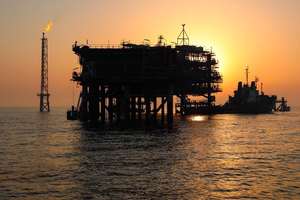
Touraj Sadeghi, head of marine ecosystem protection at the Gilan provincial environmental department, told ISNA that untreated municipal and industrial sewage, waste dumping, petroleum leaks, excessive agricultural fertilizers and pesticides, and illegal fishing were among the main sources of environmental degradation.
Many cities along Iran’s Caspian coast still lack adequate municipal wastewater treatment systems, he said, while rivers carry thousands of tons of domestic, industrial and oil-related pollution into the sea each year.
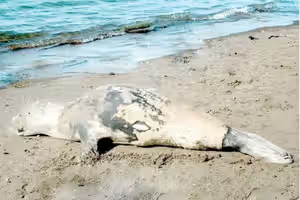
Such pollution reduces water quality, damages natural habitats and contributes to deaths among fish and bird populations, Sadeghi said.
The Caspian supports distinctive wildlife including sturgeon, Caspian seals and migratory birds, but Iranian officials warn that the combination of pollution, habitat degradation and a rapidly retreating shoreline is increasingly threatening the resilience of the ecosystem.