People drive past an anti-U.S. billboard depicting U.S. President Donald Trump and the Strait of Hormuz, in Tehran, Iran, May 17, 2026.
A US strike on a container ship approaching an Iranian port has complicated Tehran’s narrative of a strategic victory against Washington over the Strait of Hormuz.
A US Navy MH-60 helicopter carried out a strike on the Panama-flagged containership M/V Vela Nova in the Gulf of Oman on Tuesday.
President Donald Trump later said the United States now had “total control” over the Strait of Hormuz and warned that if Iran acted, “they get blown away.”
Iranian officials remained relatively quiet on the incident through Wednesday afternoon. Foreign Ministry spokesman Esmaeil Baghaei, speaking to Press TV, instead denounced the wider US blockade as “dishonorable and illegal.”
Much of the Iranian media also focused heavily on the new defense agreement between Saudi Arabia, Pakistan and Turkey, with several outlets portraying the so-called Mecca Pact as politically inflated and of limited relevance to the regional balance.
Competing narratives over Hormuz
Hardline newspaper Vatan Emrooz sought to turn the location of the US strike into evidence of Iranian deterrence rather than American dominance.
The paper argued that the attack, carried out well outside the Strait of Hormuz, showed that US forces remained reluctant to operate within range of Iran’s coastal defenses.
It portrayed Washington’s decision to strike a merchant vessel farther out at sea as a sign of tactical caution and urged Iran to stand by the demands it has set for any reopening of the strait.
The argument reflects a broader theme in Iranian commentary over the past week.
Several outlets and officials have portrayed the confrontation over Hormuz as evidence that Tehran has succeeded in shifting the center of negotiations away from the nuclear issue and toward control of the waterway.
Some commentary also interpreted a temporary easing in Trump’s rhetoric and talks with Oman over shipping arrangements as signs that Washington was adjusting to new realities in the strait, even as Iranian commanders insisted there could be no simple return to pre-war conditions.
Trump’s latest remarks cut directly against that interpretation. His assertion of “total control” over Hormuz and threat of further military action suggest Washington continues to see coercive pressure, rather than accommodation, as central to its approach.
Economic costs remain
Iranian economic outlets have meanwhile focused on the growing cost of disruption to regional shipping.
Donya-ye Eghtesad noted that rising oil prices and maritime war-risk premiums were feeding through into domestic and regional markets, while air travel across the Persian Gulf continued to face suspensions and rerouting.
Recent attacks near Bab el-Mandeb have added to concerns that maritime disruption is no longer confined to Hormuz, increasing risks for shipping across a wider stretch of regional trade routes.
Those costs complicate triumphalist claims on either side. Washington continues to demonstrate its ability to use military force around Iran’s coast, while Tehran retains the capacity to keep maritime insecurity at the center of regional calculations.
The latest developments therefore leave the contest over Hormuz far from settled.
A recent letter to Supreme Leader Mojtaba Khamenei from Iran’s new security chief, Mohsen Rezaei, calling for expanded military capability and activity, suggests Tehran is also preparing for the possibility that the confrontation will continue rather than end through a quick diplomatic settlement.
A protester with a poster featuring the late Iranian Supreme Leader Ali Khamenei on his head joins a demonstration with Houthi supporters in solidarity with Iran and Lebanon, amid the U.S.-Israeli conflict with Iran, in Sanaa, Yemen, on March 6, 2026. Khaled Abdullah/Reuters
Six people were killed when Iran-backed Houthis attacked a vessel in Bab el-Mandeb, an escalation experts say reflects not a second front in the Iran war but two conflicts converging, as the Houthis pursue their own interests while adding pressure on Iran’s adversaries.
Analysts disagree over how directly Tehran is involved and what is driving the Houthis back into action after largely sitting out the Iran war. But whether Tehran is directing them or benefiting from decisions they make independently, renewed Houthi activity puts additional pressure on Iran's adversaries, particularly Saudi Arabia.
On Tuesday, the Houthis fired missiles at the Tanzania-flagged cargo ship Tihamah in the Bab el-Mandeb strait, killing four crew members and two members of the government-allied National Resistance Forces, according to Yemeni authorities.
Later on Tuesday, the Houthi-affiliated Al-Masirah network said the group targeted another vessel carrying what it described as Saudi “military equipment” in the Bab el-Mandeb.
Houthis pursue their own war
The Houthis' return to action appears rooted first in their own calculations inside Yemen.
Kamran Bokhari, a senior resident fellow at the Middle East Policy Council and strategic forecaster, describes Iran's so-called Axis of Resistance as a corporate brand in which some groups operate more like Iranian-controlled subsidiaries, while the Houthis resemble an independent franchise.
“They'll come in and participate in a conflict and they'll act as and when they see that it's in their interest to do so,” Bokhari told Iran International. “They're not like, you know, Iran says jump and they say how high?”
For months, that interest appeared to lie in staying out of the Iran war while its trajectory remained uncertain.
The calculation began to change following a confrontation involving an Iranian aircraft bound for Houthi-controlled territory. Saudi Arabia struck a Yemeni airfield after the aircraft attempted to land, helping trigger a renewed cycle of attacks between the Houthis and Riyadh.
The escalation also comes amid growing activity by Saudi-backed government forces and UAE-backed southern separatists inside Yemen.
“It's all domestic, is what I'm trying to say. It has nothing to do with Iran,” Bokhari said of the immediate Houthi calculation.
But that domestic struggle is unfolding in a regional environment transformed by the Iran war.
Iranian disruption around the Strait of Hormuz has already increased pressure on Saudi Arabia and other Persian Gulf states. Renewed Houthi activity around Bab el-Mandeb means Riyadh increasingly has to contend with threats around two critical waterways.
Saudi Arabia is also trying to build a stronger security architecture around itself. The recently signed Saudi-Pakistani-Turkish defense pact could give the kingdom greater regional support as it confronts those threats.
That may give the Houthis an incentive to press Riyadh now.
“The Houthis want to be able to extract concessions from the Saudis before the grid goes up, if you will,” Bokhari said.
Their ultimate objective, he argues, remains establishing themselves as Yemen's dominant political and military power and forcing Riyadh to accept that they cannot simply be eliminated.
Iran benefits
But the Houthis' pursuit of their own objectives does not mean Tehran is a bystander.
Fatima Al-Asrar, a Yemen and Iran specialist, sees the renewed Houthi pressure as increasingly intertwined with Iran's broader strategy against the United States.
“Of course, they [Iran] see it as an extension to them. They're no longer hiding it,” Al-Asrar told Iran International, pointing to Iranian rhetoric linking pressure around the Strait of Hormuz and Bab el-Mandeb.
She said Tehran is closely watching growing US fatigue with the Iran war and sees the approaching midterm elections as an opportunity to increase pressure on Washington.
“They're very transparent, very calculating, and they're using the Houthis on that front in order to press their advantage,” she said.
New reporting from Saudi-owned Asharq Al-Awsat raises the possibility of a more direct Iranian operational role.
Citing Yemeni security sources, the newspaper reported on Tuesday that IRGC officers are overseeing aspects of the Houthi escalation and that an Iranian official, Ali Mohammad Rezaei, is supervising an operations room managing military and security affairs in Houthi-controlled territory. Iranian officers have also helped establish additional missile and drone launch positions, according to the report.
Iran International has not independently verified the claims.
What will this lead to?
In July of this year, US President Donald Trump has warned Washington would hold Tehran responsible for renewed Houthi attacks, describing the group as an Iranian “Surrogate and/or Proxy” and threatening military punishment against both.
But retired Royal Navy Commander Tom Sharpe, who served for 27 years and commanded four warships, told Iran International that he doubts Trump will want to launch another major military campaign against the Houthis.
“He definitely doesn't want to be embroiled on a second tangent here,” Sharpe told Iran International.
Bab el-Mandeb also does not carry the same strategic weight as the Strait of Hormuz, Sharpe said, because ships have alternative routes, albeit at considerably greater cost and distance.
Yet Iran can still benefit.
Greater Houthi disruption could complicate shipping and potentially force the United States and its partners to devote resources to another strategic waterway.
“I think they'll be pleased,” Sharpe said of Tehran. “If it does draw away resources, US resources from the Gulf of Oman, then that's in Iran's favor.”
File photo shows commercial vessels near the Strait of Hormuz amid ongoing shipping disruptions.
The maritime confrontation around Iran widened Tuesday as US forces struck an Iran-bound vessel and Tehran-backed Houthis attacked a ship in Bab el-Mandeb, even as Pakistan and Qatar signaled progress in mediation over the Strait of Hormuz.
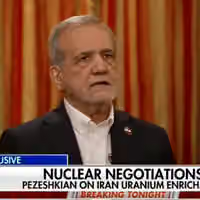
Pakistan’s Interior Minister Mohsin Naqvi met President Masoud Pezeshkian and Foreign Minister Abbas Araghchi in Tehran as Islamabad continued its mediation efforts.
Pakistan’s Defense Minister Khawaja Asif separately said signals from recent days suggested the US and Iran were close to “some sort of an arrangement,” while Qatar said Iran-Oman negotiations had reached an advanced stage.
The diplomatic push came as Washington escalated enforcement of its naval blockade. US Central Command said a Navy helicopter fired two Hellfire missiles at the Panama-flagged Vela Nova after its crew ignored repeated warnings and continued toward an Iranian port, disabling the vessel’s steering gear.
CENTCOM said the blockade remained “in full effect,” adding that US forces had redirected 55 commercial vessels, disabled three and boarded two as of Tuesday.
A deck cargo ship was also attacked by Yemen’s Iran-backed Houthis in the Bab el-Mandeb Strait on Tuesday, killing three crew members, Reuters reported, citing Yemeni coast guard sources and government military officials.
Asharq Al-Awsat reported the same day, citing Yemeni security sources, that IRGC officers were overseeing the Houthis’ escalating military operations in Yemen. Iran’s envoy to the group, Ali Mohammad Rezaei, was personally supervising an operations room managing military and security affairs in Houthi-controlled areas, according to the report.
Tehran, meanwhile, maintained that progress on shipping arrangements with Oman would not by itself reopen the strait. Supreme National Security Council Secretary Mohsen Rezaei said Hormuz would remain closed unless Washington changed its behavior and accepted Iran’s conditions, and that any agreement with Oman on a transit route would be separate from the broader closure.
Mohammad Mokhber, an adviser to Supreme Leader Mojtaba Khamenei, reinforced that position, saying the strait “will not be reopened until Iran’s conditions are met.”
Pressure on shipping also persisted. The Joint Maritime Information Center said IRGC attacks, attempted attacks and harassment continued in the strait, including UAV overflights, hailing and targeted surveillance of merchant vessels.
IRGC spokesperson Hossein Mohebi also warned that energy networks, power plants and global internet-linked infrastructure could be at risk if Iran were threatened again. He said the US had “30 to 40 warships in the region” before the recent 40-day war but that “not even one US warship” remained in the Persian Gulf.
Despite the continuing confrontation, oil flows showed signs of recovery. US Energy Secretary Chris Wright said the seven-day average for oil leaving the Strait of Hormuz had risen to nearly 9 million barrels per day, with total regional flows averaging about 15 million barrels per day when pipeline and export-facility shipments were included.
The Tuesday front page of state-run newspaper Hamshahri features Mojtaba Khamenei at the center and his latest appointments, along with the headline: The new lineup of power
Iran's latest military appointments are consolidating its command structure after the recent war, with hardliners portraying the reshuffle as a shift toward a more unified and offensive posture.
Six veteran military and security figures have been given key positions across the General Staff of the Armed Forces, the Islamic Revolutionary Guard Corps (IRGC), the IRGC Navy and the Basij, in changes that Iranian media and political figures have described as a reorganization of the country's security architecture.
Mehr News Agency said the appointments did not represent the emergence of an entirely new generation at the top of the armed forces, but argued that the changes in commanders' roles and positions were significant.
Their central message, it said, was the "reorganization of the command structure in line with the country's new security environment," combining the experience of veteran commanders with Iran's new defense requirements.
Ibrahim Rezaei, a member of parliament's National Security and Foreign Policy Committee, said the appointments would make the armed forces more offensive and increase "synergy between the armed forces and other state and governmental structures."
Hardliners see message to Washington
Hardline media and political activists have largely interpreted the appointments through the language used in the new commanders' mandates. In particular, the instruction to newly appointed IRGC commander-in-chief Ahmad Vahidi to prepare for "powerful offensive operations against the enemy" has been presented as a message of defiance to the United States.
Ehsan Salehi, a political analyst writing in the hardline Hamshahri newspaper, said the appointments would make Iran "harder for Trump, more difficult to resolve and more unpredictable."
He also linked the appointment of Mohsen Rezaei as secretary of the Supreme National Security Council to a broader message to Washington, arguing that escalation or continued threats and violations of agreements would make Iran's foreign policy and defense posture more aggressive and its influential decision-makers more hardline.
Hardline politician Mohammad-Mehdi Esmaili said the appointments had "consolidated the resistance camp against compromise."
Journalist Nizameddin Mousavi similarly described the reshuffle as a "firm response" to Donald Trump's claim that Iran's senior military commanders had been eliminated. Most of the newly appointed military and security officials, he said, were experienced commanders dating back to the Iran-Iraq war, demonstrating Khamenei's ability to rebuild and reorganize Iran's military leadership.
Reshuffle may strengthen negotiating position
The appointments, however, do not necessarily signal outright opposition to negotiations with Washington.
The emergence of senior military figures in key command and security positions could instead shift the balance toward officials willing to negotiate from what they regard as a position of greater military strength, rather than toward those opposed to negotiations altogether.
Vahidi, who represented the IRGC on the Supreme National Security Council at the time, supported the Islamabad agreement, as did nearly all the other members of the council.
Some Iranian commentators have therefore argued that the reshuffle could ultimately strengthen the case for an understanding with Washington rather than close the door to diplomacy.
Political science professor Morteza Nemati-Zargaran wrote on X that "the appointment of the military commanders appears to be tipping the balance in favor of an understanding with the United States."
Military command structure consolidated
One of the most consequential changes is the further integration of the General Staff of the Armed Forces and the Central Headquarters of Khatam al-Anbiya, a process that appears to have entered a new stage with the appointment of Ali Abdollahi as chief of the General Staff.
Khamenei's decree appointing Abdollahi specifically called for completing the integration process. The Khatam al-Anbiya headquarters has traditionally directed joint military operations, while the General Staff has been responsible for strategic planning.
According to Iranian media and government-aligned analysts, the restructuring, reportedly under consideration since last year on Khamenei's orders, is intended to streamline the chain of command, reduce duplication and bring strategic planning and battlefield operations closer together.
The Student News Network (SNN) said closer integration of the two functions would "shorten the chain of command and minimize the distance between strategic decision-making and operational implementation."
Rouydad24 described the appointments and restructuring as the beginning of "a profound review of the country's defense structure and doctrine" following the recent military confrontations.
The changes, it added, could allow Tehran to increase the resilience of its military structures, reduce parallel functions and rely on more unified command to maximize its defensive and offensive capabilities while preserving Iran's bargaining power and strategic deterrence.
Taeb appointment puts focus on internal security
The appointment of Hossein Taeb as head of the Basij has raised a different concern: the possibility that Iran will increasingly treat domestic unrest as part of a broader security threat linked to foreign adversaries.
Khamenei's decree emphasized "people-based defense," expanding the public intelligence network, using new technologies and organizing neighborhoods.
The language has prompted speculation that future domestic protests could be viewed more explicitly through the lens of threats posed by external enemies.
Conservative politician Abdolreza Davari said the appointment showed that the Basij would no longer serve merely as the IRGC's reserve force, but could become a nationwide social network for the country's security apparatus, extending into neighborhoods and villages.
According to Davari, Khamenei had sent someone close to him to lead an organization whose mission was to "turn people's capabilities into a security network."
Hardline journalist Hossein Kazerouni wrote on Telegram that the emphasis showed that "the domestic front is also considered part of the battlefield of the future."
Pro-Islamic Republic commentator Mohammad-Sadegh Alizadeh said the Basij's new mandate suggested the organization would become more military and intelligence-oriented, with an expanded information-gathering network and greater use of new technologies.
"We should expect new developments in the expansion of the intelligence network and new equipment," he wrote on X.
An Islamic Republic supporter holds a photo of Supreme Leader Mojtaba Khamenei during a state-run rally. / Photo by IRNA
Iran's unseen supreme leader has issued his first military decrees, raising a central question about the emerging order under Mojtaba Khamenei: is he tightening his grip on power, or relying on the old security establishment to shore up his authority?
The six decrees named Ali Abdollahi chief of staff of the armed forces, with Kioumars Heydari as his deputy; Ahmad Vahidi commander-in-chief of the Revolutionary Guards, with Mostafa Izadi as his deputy; Ali Azmaei commander of the Guards' navy; and Hossein Taeb, the feared former intelligence chief of the Guards, head of the Basij.
Separately, Mohsen Rezaei, the former Guards commander named Khamenei's military adviser in March, became secretary of the Supreme National Security Council and the leader's representative on the body.
The appointments put veterans of the Guards, intelligence services and Iran-Iraq war generation across the upper reaches of the security establishment. But rather than marking a wholesale changing of the guard, they draw heavily on figures who built their careers under Ali Khamenei — leaving open whether the new supreme leader is imposing his authority on the system or assembling an experienced security bloc whose support he needs to exercise it.
Khamenei's directives suggest the changes are not simply about personnel. In his appointment decree for Vahidi, he called for strengthening the force's capabilities for “maximum deterrence” and maintaining readiness to carry out “powerful offensive operations against the enemy.”
Lawmaker Ebrahim Rezaei described the appointments as “basically an indication of the fact that the Islamic Republic is moving toward a more offensive military structure.”
War commanders move to the top
The clearest sign that Khamenei may be changing how the military is run, rather than merely replacing its commanders, lies in the elevation of Abdollahi and Heydari from the Khatam al-Anbiya Central Headquarters to the two highest positions in the Armed Forces General Staff.
The General Staff is Iran's highest military coordinating body, while Khatam Central Headquarters has a more operational wartime role, coordinating military activity across different branches.
There has been no confirmed announcement that the two bodies have formally merged, but pro-establishment commentator Mohammad-Sadegh Alizadeh said the appointments confirmed a process of centralizing Iran's military command.
“The merger of Khatam al-Anbiya Central Headquarters and the Armed Forces General Staff means concentrating the country's wartime, military and offensive activities,” he wrote on X, adding that Abdollahi's decree explicitly tasked him with completing the process.
Abdollahi previously served as coordination deputy of the General Staff and deputy commander of Iran's police. Heydari commanded the regular Army Ground Forces for more than seven years before moving into Khatam's command structure in late 2025.
Heydari's appointment also preserves a senior regular Army presence near the top of a leadership heavily populated by Revolutionary Guards veterans, suggesting that greater centralization does not necessarily amount to straightforward IRGC domination of the command structure.
Taeb’s return puts domestic security in focus
If the Abdollahi and Heydari appointments point to tighter wartime command, Taeb's return to the Basij reveals the domestic-security side of Khamenei's emerging structure.
Taeb commanded the Basij during the unrest following Iran's disputed 2009 presidential election and later spent more than a decade heading the IRGC Intelligence Organization before his removal in 2022.
Khamenei's decree calls for strengthening what it describes as the Basij's “popular intelligence network,” drawing attention to the surveillance and internal-security component of Taeb's mandate.
New York-based journalist and Middle East writer Séamus Malekafzali said Taeb's return was particularly significant given his intelligence background.
“Taeb spent 13 years after leaving the Basij as the head of IRGC intelligence,” he wrote on X on August 10. Referring to Khamenei's directive for a “grassroots confrontation with enemy threats,” he added that it “certainly sounds like making sure the January protests never happen again.”
Taeb has also long been identified with Mojtaba Khamenei's security network. When he was removed as IRGC intelligence chief in 2022, Jason Brodsky, policy director at United Against Nuclear Iran, described the move as “an earthquake in Iran's intelligence community,” noting his close relationship with both Ali Khamenei and his son.
His return therefore restores a longtime Khamenei confidant to command of an organization embedded across universities, workplaces, neighborhoods and state institutions, and which has played a central role in surveillance, political mobilization and the suppression of protests.
Journalist Morteza Kazemian linked the appointment to worsening economic conditions and public discontent, arguing that Taeb had become one of Khamenei's trusted instruments of security and governance and that the Basij under his command was intended to embody the leadership's “iron fist.”
Rezaei comeback underscores reliance on old guard
If Taeb's return highlights Khamenei's reliance on trusted security figures, Rezaei's comeback makes the generational continuity harder to miss.
Rezaei commanded the Revolutionary Guards from 1981 to 1997, including through most of the Iran-Iraq war, before moving into politics and holding a succession of senior state positions.
He later served at the Expediency Council, repeatedly ran for president and became vice president for economic affairs under Ebrahim Raisi. Khamenei appointed him military adviser in March before naming him secretary of the Supreme National Security Council and his representative on the body less than five months later.
Journalist Ahmad Zeidabadi questioned why Mohammad Bagher Zolghadr had been replaced by Rezaei and what substantive change the appointment was intended to bring.
“What does the appointment of Mohsen Rezaei in place of Mohammad Bagher Zolghadr as secretary of the Supreme National Security Council mean, and what change is it supposed to bring to the way this position operates?” he wrote on X.
Some Iranian social-media users responded with mockery, reviving jokes surrounding Rezaei's repeated presidential campaigns and decades-long circulation through senior state positions.
The criticism reflected one of the broader themes surrounding the reshuffle: that Khamenei's first major appointments have elevated not a new generation of officials, but men who have occupied the Islamic Republic's military and political establishment for decades.
Vahidi promotion highlights hardline continuity
Vahidi's promotion adds another dimension to that continuity: the elevation of a commander whose record spans Iran's external military operations and domestic repression.
Vahidi had served as acting Guards commander following Mohammad Pakpour's death during the war with the United States and Israel. Khamenei formally installed him as commander and promoted him to major general.
He previously held senior roles in the Quds Force and served as defense minister under Mahmoud Ahmadinejad and interior minister under Ebrahim Raisi.
Argentine prosecutors have sought Vahidi in connection with the 1994 bombing of the AMIA Jewish community center in Buenos Aires, which killed 85 people. Iran denies involvement.
Israel's foreign ministry focused its response to the reshuffle on Vahidi and Rezaei, linking both men to allegations surrounding the AMIA case and accusing Tehran of elevating figures associated with attacks abroad.
“The Iranian regime worships terror, rewards its architects and promotes them to the highest levels of power,” the ministry said on X.
The United States has also sanctioned Vahidi over his role as interior minister during the suppression of protests following Mahsa Amini's death in custody in 2022.
But the wartime record of Vahidi, Abdollahi and Taeb also complicates the idea that their elevation simply represents Khamenei extending his personal control over the security apparatus.
President Masoud Pezeshkian accused Vahidi and Abdollahi of taking unilateral military actions that undermined efforts to secure a ceasefire, Iran International reported in April. The report also described a heated confrontation involving Taeb.
All three men now occupy senior positions in the military-security structure under Khamenei, raising the possibility that the new leader has elevated figures whose institutional power was already considerable before he formally appointed them.
Khamenei’s first imprint on security establishment
Several major international outlets interpreted the reshuffle as an early indication of how Khamenei intends to shape the security establishment after succeeding his father.
The Wall Street Journal portrayed the appointments as Khamenei putting his stamp on the national-security system and signaling a tougher approach toward Washington.
“Iran's mysterious ruler signals a hard line on Trump with new leadership,” the newspaper wrote.
The Financial Times focused on the promotion of loyalists and the possibility that Rezaei's return could point toward a harder line on the United States, while Reuters described Rezaei as a close ally of Khamenei and highlighted his recent opposition to extending a ceasefire and his skepticism toward negotiations with Washington.
Those readings emphasize Khamenei's role in choosing the new hierarchy. But the identities of the men he chose point just as strongly to continuity with the security establishment inherited from his father.
Iran International analysts had raised that tension even before the latest decrees.
The deaths of Ali Khamenei and other senior officials created a leadership gap in which his successor was still working to consolidate his position, Kazemian said in May.
After the appointments were announced, journalist Kamyar Behrang argued that the death of Ali Khamenei, who had served as the system's final arbiter, had given the Revolutionary Guards greater room to shape the political order that followed him.
The appointments can therefore be read in both directions. Khamenei is placing his own stamp on the military and security hierarchy, centralizing command and restoring trusted figures to key posts.
But he is doing so largely through men formed under his father's rule — veteran commanders and intelligence officials whose institutional weight may be as important to his authority as their loyalty to him.
The first map of power under Mojtaba Khamenei is taking shape. What remains unclear is whether these men are primarily instruments of his control, or the establishment on which that control depends.
Iran's president speaks at an even in Tehran, Iran, August 9, 2026
Masoud Pezeshkian may have a claim to being Iran’s unluckiest president, with his two years in office dominated by wars that have battered an already ailing economy to the point that keeping households above subsistence would count as an achievement.
Pezeshkian inherited years of accumulated economic problems, many created or left unresolved by previous administrations, before war deepened those structural weaknesses.
Two recent assessments of his record suggest the result is something larger than the difficulties of one presidency: the ambitions of government itself are contracting from development toward survival.
“Pezeshkian thinks the nation should thank him only because there is no famine in Iran yet,” said Nasrallah Pejmanfar, an ultraconservative cleric and lawmaker from Shiraz.
Pejmanfar intended the remark as an attack. But it echoed a more substantive criticism offered by sociologist Hamzeh Nozari in the moderate daily Shargh: that merely preventing extreme deprivation is increasingly becoming a measure of government success.
From development to survival
Nozari focused on the government’s emphasis on protecting “people’s livelihood” through subsidies, electronic coupons and efforts to secure basic goods.
Such policies may prevent extreme poverty, he argued, but they also reveal how far the ambitions of government have narrowed.
“Providing a minimal living and securing a hand-to-mouth existence is the ruling paradigm of the government, while concepts like welfare, progress and development are sidelined,” Nozari wrote.
He contrasted the current approach with previous periods when Iranian governments, however successfully, pursued broader ambitions: economic expansion in the late 1980s, greater political openness in the 1990s and redistribution in the following decade.
The question, he argued, is whether this “livelihood paradigm” is a temporary response to war and economic emergency or a more permanent retreat from development.
The economics of scarcity
Economist Teymour Rahmani, writing in Donya-ye Eghtesad, approached the same crisis from a different direction.
For Rahmani, the central problem is inflation, driven above all by a severe fiscal imbalance as government revenues decline while large and inefficient expenditures continue.
He rejected the common explanation that the falling rial is itself responsible for accelerating inflation. Currency depreciation and rising prices, he argued, are symptoms of the same underlying fiscal problem.
“The fact that inflationary force manifests first through the exchange-rate channel and that exchange-rate increases precede inflation spikes does not mean currency depreciation is the root cause,” he wrote.
The consequences are increasingly visible across the country. Rahmani pointed to point-to-point inflation of 112.4 percent in the western province of Ilam, with other poorer provinces including Lorestan, Kurdistan and Hormozgan also experiencing triple-digit inflation.
He argued that Iran has entered an inflationary environment unlike any in its modern history, while crediting experienced civil servants and residual public confidence in the monetary system with helping prevent a slide into full hyperinflation.
“We must understand that inflation is the primary issue of the Iranian economy,” Rahmani wrote, warning that the underlying fiscal imbalance must be addressed.
Administering scarcity
The two analyses approach Pezeshkian’s predicament from different directions but arrive at closely related conclusions.
Nozari describes the consequence: a government whose conception of success increasingly revolves around maintaining minimum living standards. Rahmani describes the economic machinery pushing it there: fiscal imbalance, declining revenues and inflation severe enough to overwhelm household purchasing power.
Neither problem began with Pezeshkian. He inherited years of accumulated economic weakness, while war and sanctions have sharply worsened the conditions under which his government operates.
But two years into his presidency, the distinction between emergency measures and a longer-term transformation is becoming harder to make.
A government occupied with keeping food affordable, financing subsidies and preventing inflation from becoming still more destructive has increasingly little room to pursue the growth, welfare and development promised in its economic plans.