New Zealand condemns executions and killings of protesters in Iran
New Zealand condemned Iran's execution of protesters and the broader crackdown on demonstrators, saying it was "appalled" by the escalating violence and repression.
"We condemn the brutal crackdown being carried out by Iran's security forces, including the killing of protesters," a spokesperson for New Zealand's Ministry of Foreign Affairs and Trade told Iran International.
The spokesperson said New Zealand was also deeply concerned by Iran's execution of protesters following trials that have drawn international criticism.
"Iranians have the right to peaceful protest, freedom of expression, and access to information - and that right is currently being brutally repressed," the spokesperson said.
The comments came after Iranian authorities executed protesters Amirhossein Safari and Abolfazl Sepahi on Tuesday in Isfahan, bringing to four the number of people executed in the Alikhani Square case. Eight others remain under sentence of death.
The spokesperson said New Zealand had "expressed our serious concerns directly to the Iranian Embassy in Wellington" and would continue to do so.
"We continue to urge all New Zealanders in Iran to leave now if it is safe for them to do so," the spokesperson added.
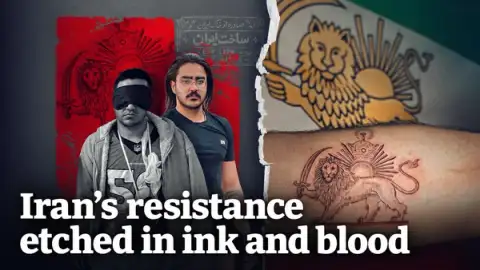
Iranian security agents allegedly cut away skin bearing tattoos of Reza Shah and an imperial crown before killing a 21-year-old protester before later shooting him dead, according to sources close to his family.
The sources told Iran International that Amirhossein Nobakht Pardasti was wounded by pellet fire and detained during the January protests at around 10 p.m. on January 8 near 30-Metri Street in Bagher Shahr, south of Tehran.
They said he was taken to hospital, where agents used blades and box cutters to remove skin and flesh bearing the tattoos before shooting him dead in what they described as an execution-style killing.
Nobakht Pardasti had previously been arrested during the 2022 Woman, Life, Freedom uprising, when he was 16.
‘Signs of torture’
His family said they received no information about his whereabouts after his detention.
When they eventually recovered his body from Kahrizak, they found extensive signs of torture, according to the sources, including severe bruising across his face and body and apparent fractures to his jaw, nose and shoulders.
The section of his arm bearing the tattoos of Reza Shah and an imperial crown had been cut away, with skin and flesh removed, the sources said.
They added that Nobakht Pardasti also had the word "Iran" tattooed on his throat and that pressure marks consistent with strangulation or restraint were visible around his neck.
Against nationalist symbols
Nobakht Pardasti's case is not the first in which Iranian authorities have been accused of targeting tattoos carrying nationalist or royalist symbolism.
One of the best-known cases was Majidreza Rahnavard, a protester executed in Mashhad on Dec. 12, 2022.
Rahnavard had a Lion and Sun emblem tattooed on his left forearm. Images published after his arrest showed the tattooed arm badly injured and immobilised in a cast and bandages.
A person close to Rahnavard told Iran International that agents repeatedly struck the arm with batons and stun guns because of the tattoo, eventually breaking it.
While the accounts cannot independently establish an official policy, the similarities between Nobakht Pardasti's case and earlier reports suggest security forces may have deliberately targeted tattoos depicting pre-revolutionary Iranian symbols as a form of punishment, humiliation and torture.
A US Army AH-64 Apache attack helicopter takes off at an undisclosed location in the Middle East in this image posted by US Central Command on X on July 25, 2026.
US President Donald Trump's most likely response to the conflict with Iran will be to intensify air strikes against a broader range of targets rather than withdraw or launch a ground invasion, former senior Pentagon official David Des Roches told Iran International TV.
Speaking on Iran International's Titre Aval (The Lead) program on Wednesday, Des Roches said the United States had limited military options after adopting an air campaign and argued Trump was unlikely to accept the political cost of ending the operation without achieving his objectives.
Three options
"The United States went in with an air power-only strategy," said Des Roches, now an associate professor at the Near East South Asia Center for Security Studies.
"That usually is flawed because once you do that, and if you look historically at how we've used an air power-led strategy in Korea, Vietnam, even World War II, but I think the illustrative point is Kosovo."
"If you don't achieve your strategic goals initially against a small target set, your options are to either introduce another element of warfare, and we don't have time to do that. To have a credible ground invasion force would take a year to build up, or you bomb more intensively."
"You widen the target list to include dual-use infrastructure, like bridges, the power grid, the national communications, television, and radio. This is what the US did against Serbia to stop the massacre of Muslims in Kosovo, or you leave."
"Those are really your three options, and I think that President Trump does not relish the prospect of leaving. That's too close to Joe Biden."
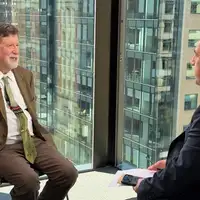
David Des Roches (left), associate professor at the Near East South Asia Center for Security Studies, speaks with Iran International TV presenter Niusha Saremi during the network's Titre Aval program on July 29, 2026.
More strikes likely
Des Roches said he believed the White House was most likely to increase military pressure rather than expand into ground operations.
"So I think, you know, he doesn't really have the ability to introduce another domain of warfare," he said.
"But really, I think his main option is to try to increase pain on the regime, and I think that that will mean an expansion into the targets towards dual-use targets and an expansion of intensive bombing to include not just areas adjacent to the Persian Gulf, but also areas inland, and especially the capital Tehran."
Asked about reports that Trump had been advised against escalating the conflict because of concerns about US weapons stockpiles, Des Roches said he believed political and economic factors were more important than military constraints.
"Some, but I think it's not really driven by military action or missile inventories," he said.
"I think it's political and economic. So we have midterm elections coming up. The Islamic Republic knows this. The leaders within the Islamic Republic know it, and they have calculated that if they can draw the war out, keep gasoline prices high, that President Trump will be in a worse position, or may even be impeached and removed."
"I think that they're kind of overplaying their hand."
Des Roches said recent Iranian actions might not reflect a unified government position.
"I'm not sure if the actions we're seeing reflect a unitary position of the Iranian government, but rather the actions of different factions of the Iranian government, probably the Revolutionary Guard, who are vying for supremacy and are trying to wreck any possibility for negotiations."
He argued that an end to the conflict would shift public attention inside Iran toward domestic issues.
"Obviously, if peace breaks out, then the focus within Iran goes from a national rally around the flag, oppose the Zionist entity and the Great Satan, towards looking at things like where has all the money gone over the year? Why is Tehran running out of water when the Revolutionary Guard controls the major construction companies in the country, and why are their children driving Lamborghinis in Spain and ours are having a hard time getting water in Tehran?"
"So it's a challenging period, but I think the hardliners, particularly in the Revolutionary Guard, are at risk of severely overplaying their hand."
Asked whether regime change had become part of US strategy, Des Roches said he believed Trump was pursuing a different approach from previous US interventions.
"My view is President Trump's theory of victory is not that the US will impose a new regime the way we did, for example, in Iraq, because that didn't work out well."
"I think he feels that economic pressure will lead the Iranians to have their own regime change."
Des Roches said Trump appeared to believe the anti-government protests in late 2019 had brought Iran close to internal political change.
"I think he feels that in December that was about to happen. It was only the violence of the Revolutionary Guard and the Basij, the massacres of between 1,300 and 4,000 Iranians - we don't know the exact number - that would have done it."
"I think that's why we're here now. It's not because Netanyahu led it. It's because, in the face of what he saw as a vindication of his policy, I think he believes that had he remained president after 2020, regime change would have been accomplished from within by about 2022."
An image released by citizen journalist Vahid Online purports to show missiles launched from central Iran toward Jordan early Wednesday, July 29, local time
Iran's ballistic missile strike on US forces in Jordan and its seizure of three oil tankers in the Strait of Hormuz have dealt a fresh blow to efforts to preserve last month's Iran-US understanding.
After Iran fired several ballistic missiles toward a US military base in Jordan early Wednesday Tehran time, US President Donald Trump vowed to hit back hard.
Hours later, the naval arm of Iran's Islamic Revolutionary Guard Corps (IRGC) announced it had struck and detained three "offending" oil tankers in the Strait of Hormuz.
Several analysts said the combination of the Jordan strike and Tehran's actions in the Strait of Hormuz suggested Iran was no longer content to react to US pressure but was instead trying to seize the initiative and reshape the course of the confrontation.
Political analyst Ruhollah Rahimpour told Iran International the overnight missile launches and the Hormuz operation reflected a deliberate strategy of escalation.
"I think last night's missile operations in Jordan and the Strait of Hormuz are part of the Islamic Republic's strategy of escalating tensions and trying to accelerate a full-scale war with the United States and Israel, forcing them into conflict before they are fully prepared," he said.
‘Ready for broader conflict’
Despite the latest escalation, Trump insisted talks with Tehran would continue. A day earlier, he told Fox News negotiations were progressing well but warned that if no agreement was reached, Washington could strike Iran's underground facilities, bridges and power plants.
The strike also marked the first time Iran had targeted a US military installation without first coming under direct US attack, although Tehran has repeatedly argued that the continuing US maritime blockade itself constitutes an act of war.
Political analyst Shahir Shahid Saless argued Tehran appears to have concluded that maintaining the current status quo is no longer strategically sustainable while Iran remains under severe economic pressure and a maritime blockade.
According to Shahid Saless, Iranian leaders believe that if Washington's strategy is to prolong a "no war, no peace" situation indefinitely, Iran will gradually be worn down while the United States enjoys the benefits of an undeclared ceasefire.
"From Tehran's perspective, this situation must be disrupted, even if the cost is a broader conflict," he wrote.
He added that renewed attacks carry only a limited risk of triggering all-out war while serving a more important strategic objective: demonstrating to Washington that it cannot unilaterally determine when conflict begins or ends.
Hormuz complicates diplomacy
The military escalation has unfolded alongside increasingly difficult negotiations over navigation through the Strait of Hormuz.
Deputy Foreign Minister Kazem Gharibabadi said Tuesday that Oman had proposed dividing responsibility for a new shipping lane equally between the two countries, but insisted the arrangement failed to address Iran's concerns.
Former Israeli intelligence official Danny Citrinowicz argued the latest attacks reflected what he described as a post-Khamenei doctrinal shift, with Tehran now prepared to initiate offensive operations rather than relying primarily on deterrence.
"Today Iran is also prepared to initiate offensive moves and to rely deeply on its missile array, drones and regional proxies,” Citrinowicz wrote on X.
"The leadership in Tehran is prepared to take significant risks because it sees the current confrontation as a decisive battle over its regional status and its ability to shape the security reality in the Middle East."
Former Iranian diplomat Kourosh Ahmadi argued Oman has little room to accommodate Tehran because of its obligations under the UN Convention on the Law of the Sea and pressure from Washington and regional states.
"The problem now is that the Strait of Hormuz has become an issue of prestige for both Iran and the United States, making it unlikely that either side will easily accept the other's conditions."
Regional conflict widens
Saudi Arabia announced Tuesday that it had intercepted several drones launched from Iraq towards Saudi oil facilities, blaming Iran-backed groups.
In response, Saudi and US forces jointly bombed positions held by the Iran-aligned Popular Mobilization Forces (PMF) in Iraq for the first time, reportedly killing numerous fighters..
The US Central Command and Saudi officials described the operation as retaliation for more than 30 drone attacks over three days targeting US forces and Saudi energy infrastructure, allegedly carried out by Iraqi groups aligned with Iran under IRGC direction.
Iran's state broadcaster IRIB quoted an unnamed military official as denying any Iranian involvement in projectiles launched from other countries towards Saudi Arabia and calling claims linking Tehran to such attacks "a major miscalculation."
Commenting on the broader trajectory of the crisis, social media commentator Tohid Javadi warned that a much larger confrontation could lie ahead.
"A major—perhaps very major—conflict may be approaching. Under the current circumstances, neither the Islamic Republic can surrender nor does Washington appear willing to reach an understanding without extensive bombing and breaking a few of Iran's bones."
US President Donald Trump and Israeli Prime Minister Benjamin Netanyahu meet at the White House on Tuesday.
Israel wants to intensify economic pressure on Iran while preserving the threat of military action, a senior Israeli official said after Prime Minister Benjamin Netanyahu's meeting with US President Donald Trump.
Speaking at a briefing attended by Iran International, the official said Trump and Netanyahu discussed three possible paths: reaching an agreement with Tehran, maintaining sanctions alongside intermittent military strikes, or launching a broader military campaign.
While stressing that the final decision rested with Trump, the official said the two leaders were aligned on the objective of preventing Iran from rebuilding its military and nuclear capabilities.
The official said Israel favoured maximising economic pressure while maintaining a credible military threat, arguing the combination would place Tehran under increasing strain without immediately requiring another full-scale war.
Trump, however, remained concerned about the impact of renewed conflict on energy markets and the global economy, according to the official.
Netanyahu acknowledged those concerns but argued they could be addressed by further squeezing Iran's already fragile economy. He also warned that Tehran was trying to use the Strait of Hormuz to extract concessions from Washington.
Tuesday's meeting—the first between the two leaders since the outbreak of the 40-day war on Feb. 28—came as Trump continued to pursue negotiations with Tehran while weighing the possibility of renewed military action.
Several hours later, Iran launched missiles at a US base in Jordan, its first direct attack on American forces since Washington paused strikes on Iran last Friday.
The official also addressed the condition of Mojtaba Khamenei, saying Iran's current leader was believed to be alive, although no one could confirm having seen him publicly.
According to the official, it remained unclear whether recent decisions attributed to Khamenei had in fact come directly from him. The official added that Khamenei had instructed those around him not to act without his approval and had become angry when that instruction was ignored.
The official dismissed reports that Netanyahu had presented Trump with a specific intelligence dossier on the underground Pickaxe Mountain nuclear facility during the meeting.
Israel believes thousands of centrifuges are concealed at the site but assesses that uranium enrichment is not currently taking place there, the official said, adding that intelligence sharing between the two countries occurs through established security channels rather than during leaders' meetings.
The official also said Tehran remained concerned about the possibility of a US ground operation targeting underground nuclear facilities and assessed that Iran's operational missile arsenal had been significantly depleted, with production capacity close to a halt.
The official described the Islamic Republic as being in its weakest economic and political position in years, citing soaring inflation, a deepening fuel crisis and a wave of executions.
The official said Israel viewed the continuing repression as evidence that Iran's leadership feared its own population.
A man gestures toward a giant anti-Trump billboard during a nightly state-backed rally in Tehran, July, 25, 2026
Amid threats of war and mounting fears of economic collapse, Iran's government is seeking to reinforce its case for moderation in a fractured and deeply polarized political landscape.
On July 29, the administration's official daily, Iran, published four opinion pieces by representatives of four moderate and conservative parties, presenting the collection as evidence of a new political accord.
The paper argued that "the traditional pattern of political competition between Iran's two major blocs has fundamentally shifted," concluding that "what seems to have 'ended' is not reformism or principlism as political identities, but the confrontational style of rivalry that had turned these blocs into near-enemies."
The optimism sits uneasily with political reality.
Hardliners routinely accuse President Masoud Pezeshkian and Parliament Speaker Mohammad Bagher Ghalibaf of betraying the country because of their relatively pragmatic approach to negotiations and the confrontation with the United States, while state television, dominated by ultraconservatives, has repeatedly censored key remarks by both men.
Nor did the initiative reflect the country's current balance of political power. The contributors came from four parties that have largely been sidelined since at least 2020 and no longer reflect the real distribution of influence in presidential or parliamentary politics.
The ultraconservative Paydari Party, arguably the most influential ideological force in today's parliament, and the centrist Executives of Reconstruction Party were both absent, whether by exclusion or choice.
The paper nonetheless argued that "the pressures of war and national security crises pushed both sides toward cooperation, reducing polarization and enabling decisions that required broad consensus."
Yet it also acknowledged that Paydari—described as "a small but loud minority" enjoying disproportionate influence through state broadcasting—stood outside the initiative.
Rather than demonstrating broad political consensus, the exercise illustrated its limits. Three of the four essays were written not by party leaders but by deputies or senior members of organisations that have played only marginal roles in Iranian politics for nearly two decades.
The four contributors differed in emphasis but converged on a common message.
Mahmoud Vaezi argued that, amid hybrid warfare and economic pressure, Iran needed rationality, restraint and an end to factional competition. Alireza Khojastehpour called for what he described as "revolutionary rationality." Mohammad Sadegh Javadi-Hessar framed moderation as a religious imperative, while Mohammad Ali Amani argued that resilience depended less on military power than on social cohesion.
Collectively, the essays portrayed moderation as a strategic necessity rooted in political experience, revolutionary reasoning and religious ethics. Extremism was presented as corrosive, narrowing political choices, deepening polarization and eroding public trust.
Yet the initiative may reveal less about the emergence of a new political consensus than about the administration's effort to reinforce its case for a more moderate course.
Facing the prospect of war, worsening economic pressures and relentless attacks from powerful hardline factions, Pezeshkian appears to be seeking validation for a strategy that many of the country's most influential political actors remain unwilling to embrace.
The country's most influential ultraconservative factions, their media allies and an IRGC that increasingly acts as a political institution in its own right were absent from the discussion.
They are also the actors least likely to look to the government's flagship newspaper for lessons in moderation.