• العربية
  • فارسی
Brand
  • Iran Insight
  • Politics
  • Economy
  • Analysis
  • Special Report
  • Opinion
  • Podcast
  • Iran Insight
  • Politics
  • Economy
  • Analysis
  • Special Report
  • Opinion
  • Podcast
  • Theme
  • Language
    • العربية
    • فارسی
  • Iran Insight
  • Politics
  • Economy
  • Analysis
  • Special Report
  • Opinion
  • Podcast
All rights reserved for Volant Media UK Limited
volant media logo

US sanctions Iran's Hormuz scheme amid shipping standoff

Jul 29, 2026, 17:39 GMT+1
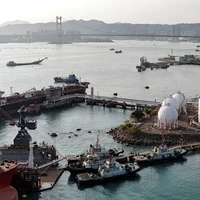
Early morning light shines on the Strait of Hormuz and vessels, as seen from Iran's Persian Gulf port city of Bandar Abbas, July 27, 2026

The United States on Wednesday imposed sanctions on ten companies and eight tankers linked to Iran's oil trade as Tehran said it had stopped three commercial vessels in the Strait of Hormuz, underscoring the ongoing battle over the strategic waterway.

The Treasury Department said the measures target two Iranian firms it accused of helping the Islamic Revolutionary Guard Corps (IRGC) extort commercial vessels by requiring them to purchase maritime insurance to transit the strait, alongside eight shipping companies operating tankers that transported Iranian crude oil and petroleum products.

The sanctions also block eight vessels that Washington said carried millions of barrels of Iranian oil, mostly to China, as part of what it describes as Tehran's "shadow fleet" used to circumvent international sanctions.

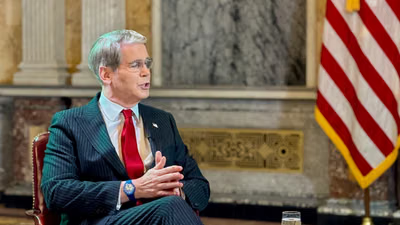
"With its economy in freefall and inflation in the triple digits, the regime is desperate for cash," Treasury Secretary Scott Bessent said.

"The United States will not allow Iran to hold global commerce hostage or use international shipping to finance the IRGC's terrorism, aggression, and repression."

According to the Treasury, the Persian Gulf Marine Insurance Company and HormuzSafe Marine Services Authority broker IRGC-approved insurance policies for commercial vessels transiting the Strait of Hormuz, including payments in digital assets such as Bitcoin designed to evade sanctions.

The department said the scheme allows Tehran to generate revenue while tightening its control over shipping through the waterway.

On Wednesday, the IRGC Navy said it had "targeted and stopped" three oil tankers after they ignored warnings and used what it described as an unsafe route through the Strait of Hormuz.

It did not identify the vessels or disclose their ownership or destination, but warned that what it called "illegal interventions and orders" by the United States would not go unanswered.

Treasury also sanctioned eight shipping companies linked to tankers transporting Iranian crude oil and petroleum products.

It said it has now sanctioned more than 100 vessels tied to Iran's shadow fleet since the beginning of the year, describing the network as a key source of revenue for Tehran despite existing sanctions.

The Strait of Hormuz has become one of the central flashpoints in the conflict in recent weeks.

Iran has sought to tighten control over commercial shipping by introducing mandatory insurance requirements, challenging alternative transit routes and stopping vessels it says violate its navigation rules, while US-led naval forces have stepped up operations to keep the waterway open.

Roughly a fifth of global oil consumption normally passes through the strait.

The latest measures were imposed under Executive Order 13902, which targets Iran's petroleum and petrochemical sectors as part of the Trump administration's renewed "maximum pressure" campaign.

•
•
•

More Stories

War widens as US, Saudi strike Iran allies in Iraq

Jul 29, 2026, 16:50 GMT+1
100%
Damage at a Popular Mobilization Forces site in Bartella after US-Saudi strikes on Iran-backed groups in Iraq.

US-Saudi strikes on Iran-backed forces in Iraq hours after the Revolutionary Guards launched missiles at a US base in Jordan signaled a sharp widening of the conflict, despite continuing indirect contacts between Washington and Tehran.

Iraq's Iran-backed Popular Mobilization Forces said at least 20 of its members were killed and 32 wounded in the strikes, which US Central Command said targeted sites used by groups it accused of carrying out more than 30 drone attacks on US forces and Saudi oil infrastructure over the previous 72 hours.

Iran's consulate general in Karbala denied reports that four IRGC members were killed in the strikes, saying they hit an unoccupied building and caused no casualties.

The operation also marked the first time Saudi Arabia publicly acknowledged taking part in US military action against Iran-backed groups, raising the prospect of a broader regional confrontation.

Iraq's presidency condemned the strikes on the paramilitaries as "an unacceptable attack" on the country's sovereignty, while the prime minister's office urged all sides to avoid escalation and convened an emergency security meeting.

Iraqi Prime Minister Ali al-Zaidi cancelled a planned meeting with Saudi Crown Prince Mohammed bin Salman following the strikes, Reuters reported, citing three people familiar with the matter.

Trump said Washington had coordinated the operation with the Iraqi government. Baghdad did not directly address that claim but reiterated that only its own government had the authority to respond to attacks on Iraqi territory.

Iran's Foreign Ministry condemned the strikes as an attempt by the United States and Israel to widen the regional conflict. Harakat Hezbollah al-Nujaba, one of the Iran-backed groups in Iraq, warned that US and Saudi forces would pay a "heavy price."

Iran resumes military action

The IRGC said it launched ballistic missiles at a US air base and Central Command facility in Jordan on Tuesday. CENTCOM said all the missiles were intercepted, while Jordan's military said it downed five missiles launched from Iran early Wednesday.

Trump vowed a forceful response.

"We'll be hitting them hard. They're going to get a beating," he told Fox News, while adding that indirect talks with Tehran were continuing.

At the same time, the IRGC Navy said it stopped three oil tankers after they ignored warnings and used what it described as an unsafe route through the Strait of Hormuz. It did not identify the vessels or report whether anyone was injured.

Oil prices rose more than 7%, pushing Brent crude above $90 a barrel as renewed fighting deepened concerns over already restricted shipping through Hormuz and the Red Sea.

The latest exchanges underscored the increasingly regional character of the war.

Even as Washington and Tehran kept indirect diplomatic channels open, fighting spread across Jordan, Iraq and the Strait of Hormuz, raising fresh doubts about whether diplomacy can keep pace with the military escalation.

Did China quietly defuse Iran's oil weapon? Pro-Ghalibaf paper asks out loud

Jul 29, 2026, 12:24 GMT+1
•
Behrouz Turani
100%
A worker walks past oil pipes at a refinery in Wuhan, Hubei province March 23, 2012.

A newspaper close to Mohammad Bagher Ghalibaf, Iran's chief negotiator with Washington, is asking whether China quietly neutralized Tehran's most feared economic weapon: the oil shock through the Strait of Hormuz that never came.

Khorasan Daily, published in Tehran and Mashhad for nearly a century, asked this week whether China's sharp cut in crude purchases "ruined Iran's Strait of Hormuz strategy" or was simply a commercial response to a war zone.

The question would be unremarkable in a Western think tank. In a paper aligned with the man running Iran's negotiations, it reads as something else: the talks camp auditing, in public, the war camp's central weapon.

The shock that never came

For decades, Iranian crisis planning has rested on one assumption: disrupt the Strait of Hormuz, through which a fifth of the world's oil normally flows, and crude rockets past $200 a barrel, forcing the world to restrain Washington. During the current war, the strait has indeed been closed to Iranian exports and contested for weeks. The spike never arrived.

Khorasan's explanation is the buyer, not the seller. China purchases heavily discounted Iranian crude in calm periods, then pivots to Strategic Petroleum Reserve (SPR) drawdowns and Russian pipeline oil the moment escalation begins, draining the drama out of the market. Western and regional reporting describes the same pattern as a deliberate "shock absorber" policy designed to neutralize Persian Gulf risk.

The paper offered two readings of Beijing's behavior. In the darker one, "real market power shifted from the producer to the largest consumer, and Iran's game was effectively neutralized by its biggest customer."

In the gentler one, China simply stepped back from a market where war-risk premiums would have bankrupted its refiners, "rather than entering intense price bidding with other global buyers."

A question from the talks camp

Where the analysis comes from matters as much as what it says. Khorasan sits in the orbit of Ghalibaf, who is not only Tehran's lead negotiator with the United States but also officially holds the China portfolio in Iran's foreign relations.

A paper in his camp questioning whether the Hormuz card still works is, in effect, an argument for his own project: if the economic weapon no longer detonates, negotiation is not weakness but arithmetic.

That may also explain the analysis's careful landing. Khorasan concluded that Beijing's buffers, reserve drawdowns and reduced refinery runs, are temporary and unsustainable without causing domestic inflation and fuel shortages.

"China did not necessarily act within a framework of ruining Iran's game," the paper wrote. Beijing's retreat "changed the traditional formula from a rapid oil shock to a gradual attrition, but it did not eliminate the core impact of the conflict on the market." The conclusion spares the partner its patron cannot afford to alienate.

Reformist and centrist outlets took the argument further. Shargh noted that while China and Russia provide diplomatic protection and veto cover at the UN Security Council, neither has any intention of entering a military or financial confrontation with Washington on Iran's behalf.

Khabar Online asked whether the two powers are helping Iran withstand Western pressure or using the confrontation as leverage in their own dealings with Washington.

Etemad and Donya-ye Eqtesad went at the doctrine itself: an energy-shock strategy assumes the customer has no alternatives, a premise they argue no longer holds.

The war camp pushes back

The other side of Iran's establishment read the same data and refused the conclusion. Tasnim, Javan and Kayhan, the outlets closest to the camp that favors fighting on, rejected the notion that Beijing "ruined Iran's strategy," reframing the story around Western supply strain and the slow grind of market friction, the "gradual attrition" that Khorasan itself conceded is still working on the world economy.

The dispute is not really about China. It is about which lever Iran has left. The war camp needs the Hormuz card to be live, because it is the argument for endurance. The talks camp needs it to be spent, because that is the argument for a deal.

What Khorasan put in print is that Iran's biggest customer may have already settled the question, and that the answer favors the men at the table.

Iran rejects Oman’s 50-50 Hormuz shipping plan, proposes new route

Jul 28, 2026, 22:07 GMT+1
100%
An Iranian patrol boat sails near a commercial tanker in the Strait of Hormuz

Iran says it is negotiating with Oman over an interim shipping arrangement for the Strait of Hormuz but insists it must exercise effective oversight over key parts of both shipping lanes, even if lasting peace is restored.

Deputy Foreign Minister Kazem Gharibabadi told Iranian state television Tuesday Oman had proposed a 50-50 arrangement under which the inbound route would be on one country’s side and the outbound route on the other’s.

Tehran rejected that formula, he said, because it would not adequately address Iran’s national security concerns.

Instead, Gharibabadi said Tehran proposed placing one shipping lane entirely within Iranian territorial waters and part of the other within Iranian waters, citing national security concerns.

“Our proposal is for one route to lie entirely within the territorial waters of the Islamic Republic of Iran, with part of the other route also passing through Iranian territorial waters, so that Iran can effectively exercise oversight over both inbound and outbound traffic.”

Reuters reported Tuesday that Oman had proposed a joint regional mechanism to manage shipping through the strategic waterway and collect voluntary fees.

The proposal has regional backing and would prevent Iran from exercising sole control over the strait, the report said citing a source from a Persian Gulf country.

The future of shipping through Hormuz was also part of Iran’s wider regional discussions. Iranian Foreign Minister Abbas Araghchi said Tuesday that he had held separate phone calls with his Omani and Saudi counterparts the previous evening.

He said the conversations covered regional developments, diplomatic efforts to restore stability and insecurity in the Strait of Hormuz.

Parallel US-Iran contacts

The negotiations over Hormuz were unfolding alongside contacts between Tehran and Washington over the broader conflict.

Gharibabadi said Iran had not requested negotiations with Washington over the past 15 days, adding that it was the United States that sought talks and conveyed through Oman that it would not carry out military action against Iran.

Trump, however, said Tuesday that Washington was holding “good talks” with Iran and had a chance of reaching an agreement. He added that the United States held a “very strong position” with Tehran and that he would prefer to avoid attacks on Iranian power plants and bridges.

Trump later hosted Israeli Prime Minister Benjamin Netanyahu at the White House, where the two leaders agreed that Iran must not obtain a nuclear weapon, an Israeli source familiar with the talks told Iran International.

The source described the meeting as a “major moment of coordination,” saying Washington and Jerusalem agreed on their objective but could differ over how to achieve it.

The diplomatic activity unfolded as more than 20 US Navy warships operated across the Middle East in support of military missions, including enforcement of what the US military called a “steel wall blockade” against Iran.

CENTCOM said Tuesday in a post on X that, as of July 28, it had redirected 18 commercial vessels, disabled two and boarded two while enforcing the blockade.

Trump faces growing Capitol backlash over Iran war

Jul 27, 2026, 04:16 GMT+1
100%
U.S. President Donald Trump delivers remarks at the White House Correspondents' Association (WHCA) Dinner, July 24, 2026

Voices against the United States' military campaign against Iran grew louder over the weekend as Republican and Democratic lawmakers argued it was leaving Americans to bear mounting military, economic and human costs.

Leading the Republican criticism was Representative Thomas Massie of Kentucky, one of the few Republicans to openly challenge President Donald Trump's handling of the conflict.

"The U.S. has been significantly weakened by the war with Iran," Massie wrote on X.

"This administration depleted our missile defenses, drained our oil reserves, sacrificed our men & women, inflated the price of consumer goods, increased our debt, and neglected our domestic needs... all for Israel."

The Wall Street Journal and CBS News reported this week that senior military officials had warned the White House about declining inventories of air defence interceptors and precision-guided munitions, raising fresh questions about the campaign's longer-term cost.

Trump rejected those reports.

"We have far more munitions than anyone in the world, and far more than we need," he told The Wall Street Journal on Sunday.

Democrats, meanwhile, sharpened their own attacks, portraying the campaign as both illegal and increasingly costly for American taxpayers.

Representative Becca Balint of Vermont criticised House Republicans' latest budget bill, saying it allocated more than $70 billion for what she described as Trump's "illegal war of choice in Iran."

"Does it do anything to lower your costs? Nope!" she wrote.

Representative Nanette Barragán of California argued that Americans should not have to "foot the bill for Trump's war on Iran or billionaires' tax cuts."

The United States and Iran have now gone three consecutive nights without direct strikes against one another, while diplomatic efforts involving regional mediators have gathered momentum.

Few officials, however, appear convinced the lull will prove durable. Trump has repeatedly said the United States remains prepared to resume military operations if negotiations fail, while Tehran has continued to warn of retaliation should attacks restart.

Representative Frank Pallone of New Jersey linked the conflict to rising fuel prices and growing pressure on US military resources.

"Gas is at $4 a gallon, our military resources are depleted, and none of Trump's stated goals have been achieved," Pallone wrote after voting in favour of a War Powers Resolution seeking to end the conflict.

"Our vote sent Trump a clear message: the American people are FED UP with this illegal war."

Ukraine moves to aid US in Iran war after striking Tehran-Moscow supply link

Jul 25, 2026, 22:25 GMT+1
100%
Ukrainian President Zelenskyy and US President Donald Trump

Ukraine is moving more directly into the Iran war, offering to share intelligence about Russian assistance to Tehran while striking vessels that Kyiv says form part of the military supply network connecting Iran and Moscow.

President Volodymyr Zelenskyy said Saturday that he would order Ukrainian intelligence to provide partner countries with information showing that Russia had helped Iran prepare strikes against US military facilities and regional states.

“I will instruct our intelligence to share with our partners the information we have regarding Russia’s new assistance to the Iranian regime,” Zelenskyy said in a post on X.

Zelenskyy said Ukraine had recorded active Russian satellite surveillance of Persian Gulf states and US military facilities there since the beginning of July.

He alleged that the resulting images were transferred to Iran and that Russian satellite activity closely corresponded with Iranian attacks—both before strikes, to assist preparations, and afterward, to assess the damage.

“On July 19 and 20 alone, four air bases fell within the area of interest of Russian satellites—two in Bahrain, one in Jordan, and one in Kuwait,” he said.

Zelenskyy did not publish evidence supporting the allegation. But his pledge to share Ukraine’s intelligence with its partners represents a potentially significant role for Kyiv in the US-led war against Iran, particularly given Ukraine’s experience tracking Russian surveillance systems and countering Iranian-designed drones.

CBS News reported that Zelenskyy planned to share evidence with the United States showing that Russia was assisting Iran in targeting US bases in the Middle East.

His allegation also directly challenges President Donald Trump’s recent assertion that he believed assurances from Russian President Vladimir Putin that Moscow was not assisting Tehran.

Rare Ukrainian attack on Iran vessel

Earlier Saturday, Zelenskyy said Ukrainian forces had achieved “very strong results” with long-range attacks in the Caspian Sea.

He said the targets included a Russian warship and vessels used to transport military cargo involving Iran, but did not identify the ships, describe the weapons used or disclose the extent of the damage.

Iran later confirmed that an Iranian commercial vessel had been hit in the Caspian Sea.

The Iranian Foreign Ministry said the attack caused an explosion that killed one sailor and injured another. It condemned the strike as an act of aggression, said Iran would defend its national interests and accused Kyiv of attempting to expand the Russia-Ukraine war.

Tehran also summoned Ukraine’s chargé d’affaires to protest what it described as a “hostile and criminal” attack, according to the Reuters report.

It was not immediately clear whether the Iranian vessel was one of the ships Zelenskyy said had been transporting military cargo.

Taken together, the Caspian strikes and the intelligence offer suggest Ukraine is treating the Russia-Iran partnership as a single military network operating across two wars.

Iranian-designed Shahed drones have played a major role in Russia’s attacks on Ukrainian cities and infrastructure. Kyiv is now alleging that assistance also flows in the opposite direction, with Moscow using its satellite capabilities to support Iranian attacks on US and regional military facilities.

Reuters reported on July 22 that Iranian drone attacks on CIA facilities in the Persian Gulf have prompted US intelligence analysts to investigate whether Russia assisted by providing targeting information or ​advanced drone technology.

The report, citing informed sources, said US intelligence officials have ‌not yet reached firm conclusions about the possible Russian involvement in the attacks on CIA facilities. But they cited the strikes' effectiveness and apparent precision, as well as Russia's broader technical support for Iran, as possible evidence.

Ukraine has previously offered its drone-interception expertise to Middle Eastern countries facing Iranian attacks, drawing on years of experience defending against Shahed-type drones used by Russia.

Kyiv has also increasingly targeted the Caspian Sea as a military logistics corridor, despite its distance from the principal battlefields in Ukraine.

In August 2025, Ukraine said it struck the Russian-flagged cargo vessel Port Olya-4 at the port of Olya in Russia’s Astrakhan region. Kyiv alleged that it was carrying Iranian ammunition and components for Shahed-type drones.

Four months later, Ukrainian special forces said they attacked the Kompozitor Rakhmaninov and Askar-Sarydzha off Russia’s Kalmykia region. Ukraine said the sanctioned vessels had transported weapons and military equipment between Iran and Russia.

Iran has denied supplying weapons for use in Ukraine, while acknowledging that it provided Russia with a limited number of drones before Moscow’s 2022 invasion.

Saturday’s developments, however, point to a broader confrontation. Ukraine is not only seeking to disrupt Iranian assistance to Russia but is offering to help Washington and its regional partners expose—and potentially counter—Russian support for Tehran’s war effort.

Most Viewed

Ukraine strike on Iranian ship divides Tehran over risks of retaliation
1
INSIGHT

Ukraine strike on Iranian ship divides Tehran over risks of retaliation

2

Iran rejects Oman’s 50-50 Hormuz shipping plan, proposes new route

3

Iran executes two protesters amid heavy security in Isfahan

4

New scaffold in Isfahan fuels fears of imminent protester executions

5

Iranian protesters’ executions stir grief and harden resolve across Iran

Banner
Banner
Banner

Spotlight

  • What does Trump mean by 'finish the job' in Iran?
    ANALYSIS

    What does Trump mean by 'finish the job' in Iran?

  • A teenage girl’s last act of defiance against Iran’s regime

    A teenage girl’s last act of defiance against Iran’s regime

  • Ukraine strike on Iranian ship divides Tehran over risks of retaliation
    INSIGHT

    Ukraine strike on Iranian ship divides Tehran over risks of retaliation

  • I stayed awake for them
    TEHRAN INSIDER

    I stayed awake for them

  • Iran factions vie to shape narrative of military lull
    INSIGHT

    Iran factions vie to shape narrative of military lull

  • US strikes pause. What comes next for Iran?
    PODCAST

    US strikes pause. What comes next for Iran?