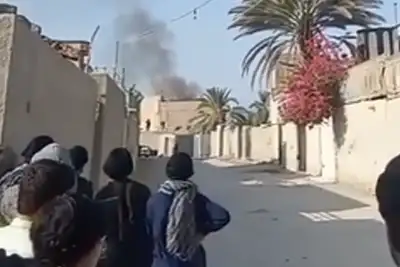
After Iran fired several ballistic missiles toward a US military base in Jordan early Wednesday Tehran time, US President Donald Trump vowed to hit back hard.
Hours later, the naval arm of Iran's Islamic Revolutionary Guard Corps (IRGC) announced it had struck and detained three "offending" oil tankers in the Strait of Hormuz.
Several analysts said the combination of the Jordan strike and Tehran's actions in the Strait of Hormuz suggested Iran was no longer content to react to US pressure but was instead trying to seize the initiative and reshape the course of the confrontation.
Political analyst Ruhollah Rahimpour told Iran International the overnight missile launches and the Hormuz operation reflected a deliberate strategy of escalation.
"I think last night's missile operations in Jordan and the Strait of Hormuz are part of the Islamic Republic's strategy of escalating tensions and trying to accelerate a full-scale war with the United States and Israel, forcing them into conflict before they are fully prepared," he said.
‘Ready for broader conflict’
Despite the latest escalation, Trump insisted talks with Tehran would continue. A day earlier, he told Fox News negotiations were progressing well but warned that if no agreement was reached, Washington could strike Iran's underground facilities, bridges and power plants.
The strike also marked the first time Iran had targeted a US military installation without first coming under direct US attack, although Tehran has repeatedly argued that the continuing US maritime blockade itself constitutes an act of war.
Political analyst Shahir Shahid Saless argued Tehran appears to have concluded that maintaining the current status quo is no longer strategically sustainable while Iran remains under severe economic pressure and a maritime blockade.
According to Shahid Saless, Iranian leaders believe that if Washington's strategy is to prolong a "no war, no peace" situation indefinitely, Iran will gradually be worn down while the United States enjoys the benefits of an undeclared ceasefire.
"From Tehran's perspective, this situation must be disrupted, even if the cost is a broader conflict," he wrote.
He added that renewed attacks carry only a limited risk of triggering all-out war while serving a more important strategic objective: demonstrating to Washington that it cannot unilaterally determine when conflict begins or ends.
Hormuz complicates diplomacy
The military escalation has unfolded alongside increasingly difficult negotiations over navigation through the Strait of Hormuz.
Deputy Foreign Minister Kazem Gharibabadi said Tuesday that Oman had proposed dividing responsibility for a new shipping lane equally between the two countries, but insisted the arrangement failed to address Iran's concerns.
Former Israeli intelligence official Danny Citrinowicz argued the latest attacks reflected what he described as a post-Khamenei doctrinal shift, with Tehran now prepared to initiate offensive operations rather than relying primarily on deterrence.
"Today Iran is also prepared to initiate offensive moves and to rely deeply on its missile array, drones and regional proxies,” Citrinowicz wrote on X.
"The leadership in Tehran is prepared to take significant risks because it sees the current confrontation as a decisive battle over its regional status and its ability to shape the security reality in the Middle East."
Former Iranian diplomat Kourosh Ahmadi argued Oman has little room to accommodate Tehran because of its obligations under the UN Convention on the Law of the Sea and pressure from Washington and regional states.
"The problem now is that the Strait of Hormuz has become an issue of prestige for both Iran and the United States, making it unlikely that either side will easily accept the other's conditions."
Regional conflict widens
Saudi Arabia announced Tuesday that it had intercepted several drones launched from Iraq towards Saudi oil facilities, blaming Iran-backed groups.
In response, Saudi and US forces jointly bombed positions held by the Iran-aligned Popular Mobilization Forces (PMF) in Iraq for the first time, reportedly killing numerous fighters..
The US Central Command and Saudi officials described the operation as retaliation for more than 30 drone attacks over three days targeting US forces and Saudi energy infrastructure, allegedly carried out by Iraqi groups aligned with Iran under IRGC direction.
Iran's state broadcaster IRIB quoted an unnamed military official as denying any Iranian involvement in projectiles launched from other countries towards Saudi Arabia and calling claims linking Tehran to such attacks "a major miscalculation."
Commenting on the broader trajectory of the crisis, social media commentator Tohid Javadi warned that a much larger confrontation could lie ahead.
"A major—perhaps very major—conflict may be approaching. Under the current circumstances, neither the Islamic Republic can surrender nor does Washington appear willing to reach an understanding without extensive bombing and breaking a few of Iran's bones."