Iran government pushes talks line, but power lies elsewhere

Amid threats of war and mounting fears of economic collapse, Iran's government is seeking to reinforce its case for moderation in a fractured and deeply polarized political landscape.
Iran International

Amid threats of war and mounting fears of economic collapse, Iran's government is seeking to reinforce its case for moderation in a fractured and deeply polarized political landscape.
On July 29, the administration's official daily, Iran, published four opinion pieces by representatives of four moderate and conservative parties, presenting the collection as evidence of a new political accord.
The paper argued that "the traditional pattern of political competition between Iran's two major blocs has fundamentally shifted," concluding that "what seems to have 'ended' is not reformism or principlism as political identities, but the confrontational style of rivalry that had turned these blocs into near-enemies."
The optimism sits uneasily with political reality.
Hardliners routinely accuse President Masoud Pezeshkian and Parliament Speaker Mohammad Bagher Ghalibaf of betraying the country because of their relatively pragmatic approach to negotiations and the confrontation with the United States, while state television, dominated by ultraconservatives, has repeatedly censored key remarks by both men.
Nor did the initiative reflect the country's current balance of political power. The contributors came from four parties that have largely been sidelined since at least 2020 and no longer reflect the real distribution of influence in presidential or parliamentary politics.
The ultraconservative Paydari Party, arguably the most influential ideological force in today's parliament, and the centrist Executives of Reconstruction Party were both absent, whether by exclusion or choice.
The paper nonetheless argued that "the pressures of war and national security crises pushed both sides toward cooperation, reducing polarization and enabling decisions that required broad consensus."
Yet it also acknowledged that Paydari—described as "a small but loud minority" enjoying disproportionate influence through state broadcasting—stood outside the initiative.
Rather than demonstrating broad political consensus, the exercise illustrated its limits. Three of the four essays were written not by party leaders but by deputies or senior members of organisations that have played only marginal roles in Iranian politics for nearly two decades.
The four contributors differed in emphasis but converged on a common message.
Mahmoud Vaezi argued that, amid hybrid warfare and economic pressure, Iran needed rationality, restraint and an end to factional competition. Alireza Khojastehpour called for what he described as "revolutionary rationality." Mohammad Sadegh Javadi-Hessar framed moderation as a religious imperative, while Mohammad Ali Amani argued that resilience depended less on military power than on social cohesion.
Collectively, the essays portrayed moderation as a strategic necessity rooted in political experience, revolutionary reasoning and religious ethics. Extremism was presented as corrosive, narrowing political choices, deepening polarization and eroding public trust.
Yet the initiative may reveal less about the emergence of a new political consensus than about the administration's effort to reinforce its case for a more moderate course.
Facing the prospect of war, worsening economic pressures and relentless attacks from powerful hardline factions, Pezeshkian appears to be seeking validation for a strategy that many of the country's most influential political actors remain unwilling to embrace.
The country's most influential ultraconservative factions, their media allies and an IRGC that increasingly acts as a political institution in its own right were absent from the discussion.
They are also the actors least likely to look to the government's flagship newspaper for lessons in moderation.


A newspaper close to Mohammad Bagher Ghalibaf, Iran's chief negotiator with Washington, is asking whether China quietly neutralized Tehran's most feared economic weapon: the oil shock through the Strait of Hormuz that never came.
Khorasan Daily, published in Tehran and Mashhad for nearly a century, asked this week whether China's sharp cut in crude purchases "ruined Iran's Strait of Hormuz strategy" or was simply a commercial response to a war zone.
The question would be unremarkable in a Western think tank. In a paper aligned with the man running Iran's negotiations, it reads as something else: the talks camp auditing, in public, the war camp's central weapon.
The shock that never came
For decades, Iranian crisis planning has rested on one assumption: disrupt the Strait of Hormuz, through which a fifth of the world's oil normally flows, and crude rockets past $200 a barrel, forcing the world to restrain Washington. During the current war, the strait has indeed been closed to Iranian exports and contested for weeks. The spike never arrived.
Khorasan's explanation is the buyer, not the seller. China purchases heavily discounted Iranian crude in calm periods, then pivots to Strategic Petroleum Reserve (SPR) drawdowns and Russian pipeline oil the moment escalation begins, draining the drama out of the market. Western and regional reporting describes the same pattern as a deliberate "shock absorber" policy designed to neutralize Persian Gulf risk.
The paper offered two readings of Beijing's behavior. In the darker one, "real market power shifted from the producer to the largest consumer, and Iran's game was effectively neutralized by its biggest customer."
In the gentler one, China simply stepped back from a market where war-risk premiums would have bankrupted its refiners, "rather than entering intense price bidding with other global buyers."
A question from the talks camp
Where the analysis comes from matters as much as what it says. Khorasan sits in the orbit of Ghalibaf, who is not only Tehran's lead negotiator with the United States but also officially holds the China portfolio in Iran's foreign relations.
A paper in his camp questioning whether the Hormuz card still works is, in effect, an argument for his own project: if the economic weapon no longer detonates, negotiation is not weakness but arithmetic.
That may also explain the analysis's careful landing. Khorasan concluded that Beijing's buffers, reserve drawdowns and reduced refinery runs, are temporary and unsustainable without causing domestic inflation and fuel shortages.
"China did not necessarily act within a framework of ruining Iran's game," the paper wrote. Beijing's retreat "changed the traditional formula from a rapid oil shock to a gradual attrition, but it did not eliminate the core impact of the conflict on the market." The conclusion spares the partner its patron cannot afford to alienate.
Reformist and centrist outlets took the argument further. Shargh noted that while China and Russia provide diplomatic protection and veto cover at the UN Security Council, neither has any intention of entering a military or financial confrontation with Washington on Iran's behalf.
Khabar Online asked whether the two powers are helping Iran withstand Western pressure or using the confrontation as leverage in their own dealings with Washington.
Etemad and Donya-ye Eqtesad went at the doctrine itself: an energy-shock strategy assumes the customer has no alternatives, a premise they argue no longer holds.
The war camp pushes back
The other side of Iran's establishment read the same data and refused the conclusion. Tasnim, Javan and Kayhan, the outlets closest to the camp that favors fighting on, rejected the notion that Beijing "ruined Iran's strategy," reframing the story around Western supply strain and the slow grind of market friction, the "gradual attrition" that Khorasan itself conceded is still working on the world economy.
The dispute is not really about China. It is about which lever Iran has left. The war camp needs the Hormuz card to be live, because it is the argument for endurance. The talks camp needs it to be spent, because that is the argument for a deal.
What Khorasan put in print is that Iran's biggest customer may have already settled the question, and that the answer favors the men at the table.
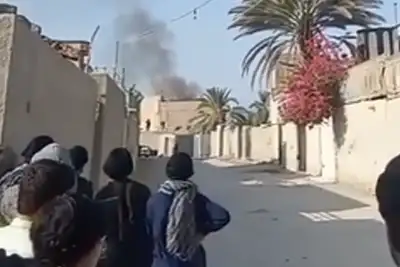
Ukraine's attack on an Iranian merchant ship has sparked a debate in Tehran over whether retaliation would restore deterrence or draw Iran into a broader confrontation involving Europe and NATO.
One sailor was killed and three others wounded when the vessel was struck on Saturday near Russia’s Astrakhan port in the Volga Delta.
While Iranian officials condemned the strike as an act of aggression and vowed it “will not go unanswered,” commentators remain divided over how Tehran should respond and whether opening a new front would strengthen or further strain Iran’s position.
Conservative newspapers portrayed the attack as part of a coordinated Western and Israeli effort to widen the conflict and divert Iran’s attention from the Strait of Hormuz.
The hardline daily Kayhan described the strike as a “strategic warning,” arguing that its purpose was to draw Iran into a new northern front.
“It is not impossible that Ukraine’s serious entry into this arena could ignite another world war, because all the signs of a global war are visible,” the newspaper warned.
Farhikhtegan argued that Zelensky would not have authorized the operation without European backing.
“Tehran knows Kyiv is not the principal actor but Europe’s and NATO’s proxy for testing the battlefield,” the conservative newspaper wrote, adding that the attack could not have taken place without Washington’s knowledge.
Military analyst Nima Akbarkhani went further, arguing that Tehran should retaliate against Ukraine’s European supporters rather than Kyiv itself.
“The strategic and precise response is to target European interests, not an emotional action,” he told state broadcaster IRIB. “The only people who can restrain Zelensky are those financing his war.”
Tehran-based journalist Afifeh Abedi also called for a “proportionate response,” describing the strike as an attempt to expand both the geography and nature of the Russia-Ukraine war.
She suggested Ukraine may be acting under Israeli pressure to bring European and US positions closer together and “merge the two wars” against Iran and Russia.
“Ukraine’s action against Iran was entirely deliberate and intended to raise tensions,” she told ISNA.
Warnings against a new northern front
Other Iranian commentators warned that retaliation could bring far greater risks than benefits.
Conservative political activist Ali Gholhaki, who is close to Parliament Speaker Mohammad-Bagher Ghalibaf, cautioned that direct action against Ukraine could mobilize European governments alongside the United States.
“Iran must ensure that any response to Ukraine does not mobilize all of Europe alongside America against Iran,” he said.
Former diplomat Kourosh Ahmadi warned that the emergence of a northern front could force Iran to redeploy military assets toward the Caspian region, creating new vulnerabilities elsewhere.
He also questioned how the United States, Europe, Turkey and Russia would react if Iran attacked targets in the Black Sea region or inside Ukraine.
Military analyst Mohsen Reyhani highlighted the practical obstacles facing Tehran. In a post on X, he said drone strikes on Odesa from the Caspian would require Russian cooperation, while missiles launched from northwestern Iran could have to cross Turkish airspace, risking NATO involvement.
He said strikes on cities such as Kyiv would require missiles with ranges of about 1,700 to 2,500 kilometers.
Political analyst Maziar Aghazadeh argued that missile or drone attacks on Ukraine would offer little deterrent value while exposing Iran to a prolonged conflict.
Such retaliation, he wrote in Asr-e Iran, could open “a futile and exhausting new front” in which Iran would bear far greater costs than Ukraine.
Diplomats try to de-escalate
The Iranian and Ukrainian foreign ministers spoke on Tuesday in an effort to contain tensions. Abbas Araghchi said Andrii Sybiha had assured him the strike was unintentional and that Kyiv did not seek escalation.
Araghchi said Iran also sought to avoid escalation but demanded restitution for the loss of life and damage.
Sybiha said in a post on X that Ukraine had not intended to target civilians or civilian vessels and urged Tehran to refrain from escalating and end its support for Russia’s war.
Hostile ties shaped by the Russia war
Relations between Tehran and Kyiv were already deeply strained before the ship attack.
The Revolutionary Guards’ downing of a Ukrainian passenger jet over Tehran in 2020 caused a lasting rupture. Tensions later deepened over Iran’s transfer of Shahed drones and production technology to Russia.
Kyiv considers Tehran a direct contributor to Moscow’s war effort. Zelensky has argued that Iran effectively entered the conflict by supplying drones, transferring technology and enabling their production inside Russia.
Tehran denies being a formal military ally of Moscow, although Iranian officials have acknowledged earlier drone transfers and technology cooperation. The two countries’ comprehensive strategic partnership, signed in January 2025, does not include a mutual defense clause.
The relationship deteriorated further after Ukraine offered to help counter Iranian drones during Iran’s confrontation with Israel and the United States, reinforcing Tehran’s perception that Kyiv had aligned itself with Iran’s regional adversaries.
Russia, meanwhile, strongly backed Tehran after the ship strike.
Foreign Ministry spokeswoman Maria Zakharova said the incident demonstrated “the clear threat Ukraine poses to the regional security of Caspian littoral states,” while Kremlin spokesman Dmitry Peskov said an attack on the Iranian vessel was “like an attack on Iran itself.”
The debate in Tehran now centers less on whether the attack requires a response than on what form that response could take without pulling Iran into an expanding conflict stretching from the Persian Gulf to the Black Sea.
The pause in US airstrikes has opened a new debate in Tehran over whether the military lull should be used to revive diplomacy or intensify pressure on Washington before another round of fighting begins.
Hardline commentators argue the United States paused its campaign because military pressure and disruptions to regional energy supplies have exposed American vulnerabilities.
Moderate and pragmatist voices, meanwhile, see a narrow window to pursue indirect diplomacy before renewed fighting further weakens Iran's economy.
The debate comes as indirect diplomacy appears to be regaining momentum after three nights without direct US or Iranian attacks.
President Donald Trump told supporters in Michigan on Monday that "very friendly negotiations" with Tehran were underway, while warning that "you got to beat them, and we'll beat the hell out of them" if diplomacy failed.
Tehran, however, has continued to portray the lull as temporary. Iran's joint military command said the US naval blockade amounted to an expansion of the conflict, accusing Washington of threatening Iranian commercial vessels and oil tankers in Iran's territorial waters over the past three days.
Outside political circles, public reactions have been more cautious than optimistic. Many Iranians reportedly interpret the sudden quiet as evidence of behind-the-scenes diplomacy rather than a genuine breakthrough, with some saying they remained unable to sleep despite the absence of airstrikes.
Official statements have also avoided describing the lull as a "ceasefire," instead referring to it as a "pause" or "hold," reflecting Tehran's continued distrust of US intentions.
For hardliners, that makes negotiations even more dangerous.
The conservative newspaper Kayhan urged the Foreign Ministry to "formally declare the end of all indirect diplomatic communications and backchannel negotiations," arguing that nearly three weeks of fighting had shown Washington only moderates its military pressure when global energy supplies come under threat.
The paper argued the pause reflected dwindling US precision-guided munitions rather than any diplomatic opening.
"The brief pause in nighttime airstrikes is not a signal of American goodwill or diplomatic flexibility—it is a tactical breathing space meant to allow the enemy to replenish depleted precision munitions and distract Tehran from exercising its strategic leverage."
The IRGC-linked newspaper Javan advanced a similar argument, saying US offensive capabilities were showing signs of "structural fatigue" and warning that any hesitation would allow Washington to rebuild regional air-defence networks and supply lines.
It also called for a forceful response to what it described as attempts to expand pressure into the Caspian Sea through recent attacks on Iranian shipping.
Moderate outlets drew almost the opposite conclusion.
Government-aligned Etemad argued that every night without airstrikes represented a crucial opportunity to prevent further deterioration in municipal services, inflation and currency markets, urging officials to make full use of regional mediation efforts, particularly those led by Oman.
Economic daily Donya-ye-Eghtesad likewise described the lull as an opportunity for indirect de-escalation that could help stabilise foreign exchange and gold markets.
Moderate Shargh, meanwhile, warned against opening a new maritime front following the reported attack on Iranian shipping in the Caspian Sea, arguing that escalating the confrontation northwards would only deepen Iran's economic isolation and threaten critical trade corridors.
Perhaps the mood was best captured by Etemad, whose front-page headline distilled both the opportunity and the uncertainty confronting Iran's leadership: "Diplomacy in the enclosure of distrust."
The suspension of US and Iranian attacks has revived hopes for diplomacy, but in Tehran the military lull has exposed a widening divide over whether the Islamic Republic should negotiate with Washington or press what hardliners see as a battlefield advantage.
Deputy Parliament Speaker Hamidreza Haji Babai made that resistance explicit on Monday, telling lawmakers that Iran would "never reach an understanding with the United States."
"We should not allow America to wage war whenever it wants and declare a ceasefire whenever it wants," he said during a virtual parliamentary session.
Former vice president Mohsen Mansouri, who served under the late President Ebrahim Raisi, voiced similar opposition in a social media post, arguing that Iran was discussing negotiations precisely when its military position had strengthened.
"We struck several ships, closed the strait and fought even harder than before. An arrow set Aramco ablaze, oil prices rose, and Iran's power became more evident than ever," he wrote.
"Why is it that just when our position is stronger and the enemy is more desperate, some immediately begin talking about negotiations, a ceasefire and reopening the strait?"
He added: "Do not restart this flawed cycle. The path to peace does not pass through negotiations and agreements. Struggle, jihad, vengeance and resistance are the road to peace."
The hardline pushback comes despite mounting signs that indirect diplomacy has resumed.
President Donald Trump said Monday that Washington was engaged in "very serious negotiations" with Iran while warning the United States would resume "very powerful military action" if diplomacy failed.
According to Turkey's Anadolu Agency, citing Pakistani sources, Pakistan and Qatar have intensified exchanges between Washington and Tehran.
The report said the mediators had proposed restoring the status quo that existed before July 9 through a two-week ceasefire, reopening maritime routes and resuming negotiations.
Iranian Foreign Ministry spokesman Esmaeil Baghaei confirmed in an interview with Austria's ORF television that Iran and the United States were exchanging messages through intermediaries.
At his weekly press briefing on Monday, however, he denied that Tehran had requested negotiations, insisting Iran had only been discussing shipping arrangements in the Strait of Hormuz with Oman.
Baghaei also rejected reports of a proposed ceasefire, saying Iran "has never allowed, and will never allow, the United States to determine the timing of war and peace."
Not everyone inside Iran shares the hardliners' view.
The reformist newspaper Etemad argued Monday that recent developments marked a turning point, with military confrontation giving way to deterrence and renewed diplomacy.
Former diplomat Abdolreza Faraji Rad wrote in Arman Emrooz that several developments—including the suspension of US attacks and Trump's latest remarks—suggested behind-the-scenes negotiations had either already produced results or were close to doing so.
He argued both sides still appeared to regard their earlier memorandum of understanding as valid.
Others dismissed that assessment.
Fada-Hossein Maleki, a member of parliament's National Security and Foreign Policy Committee, told the Iranian Labour News Agency (ILNA) that the reduction in US military operations reflected the impact of Iranian attacks on American logistical and operational infrastructure rather than diplomatic contacts.
"Iran has entered the offensive phase," he said. "In the offensive phase, there is certainly no discussion of negotiations."
The United States halted its nightly strikes on Friday after nearly two weeks of attacks, while Iran has not launched further strikes on US bases in the region since shortly after Washington's final operation.
Whether the lull develops into renewed diplomacy or merely precedes another round of fighting remains uncertain.
What has become increasingly clear, however, is that the military pause has opened a new political battle inside Tehran over whether Iran should negotiate from what some see as a position of strength or continue pressing its advantage on the battlefield.
A widening scandal over the secret network used to move Iran's oil revenues around international sanctions has triggered growing criticism after senior officials acknowledged that intermediaries misappropriated at least $1.6 billion, with some fleeing the country.
The controversy has exposed the unofficial network of so-called trusties: companies and intermediaries entrusted with receiving and transferring oil revenues outside the international banking system.
Speaking on state television on Sunday, the head of Iran's State Inspection Organization, Zabihollah Khodaeian, said one intermediary alone had failed to return $200 million in state funds before leaving the country.
Khodaeian added that judicial authorities had opened 59 criminal cases against managers of trustee companies. Some suspects have been arrested, while others have fled abroad.
Iranian media also reported that prosecutors had sought Interpol Red Notices for 15 fugitives linked to the network.
The disclosures prompted unusually blunt criticism from Majid Reza Hariri, head of the Iran-China Chamber of Commerce.
In a public message addressed to Tehran's prosecutor, Hariri said the Interpol requests meant at least 15 trusted intermediaries had escaped with "billions of dollars" in national wealth.
"Who introduced these trusties? Who guaranteed them? And why is no action being taken against those who backed them?" he asked.
Although Hariri's estimate has not been independently verified, his comments echoed questions increasingly being raised in Iranian media over how individuals entrusted with handling billions of dollars in oil revenues could allegedly abscond without serious failures in oversight.
A product of sanctions
The trustee system emerged as international sanctions largely cut Iranian banks off from the global financial system.
Unable to receive oil payments through conventional banking channels, Tehran increasingly relied on trusted intermediaries with access to foreign companies and bank accounts to collect, hold and transfer export revenues.
Many of these intermediaries operate through countries including the United Arab Emirates, Turkey and Oman.
The arrangement became indispensable to sustaining Iranian oil exports under sanctions. But it also created a largely opaque financial architecture operating outside many of the transparency, auditing and compliance mechanisms that govern formal banking systems.
Trusties have never been clearly defined under Iranian law. Little is publicly known about how they are selected, what commissions they receive, what guarantees they provide or how their activities are supervised.
Critics say the structure also creates an inherent conflict of interest. Oil revenues can remain in intermediary accounts for days or even weeks before reaching Iran, allowing trusties to profit from holding large balances while the state bears the financial risk.
Questions over oversight
The growing scandal has also drawn attention to who ultimately oversees the network.
Oil Minister Mohsen Paknejad has previously said the Oil Ministry's responsibility ends with marketing and selling crude, while the Central Bank determines where export revenues are deposited and supervises their transfer.
The issue is especially sensitive because trusties are not ordinary commercial intermediaries. They are selected precisely because they are considered sufficiently reliable to handle some of the state's most strategically important financial transactions.
Officials maintain that such intermediaries remain indispensable as long as sanctions keep Iran largely excluded from the international banking system.
The expanding investigation, however, has transformed what was once a largely hidden mechanism of sanctions evasion into yet another damaging scandal for the Islamic Republic, raising difficult questions about both the alleged abuse and the system that allowed it to occur.