Iranian state media and the IRGC said cruise missiles attributed to US forces struck the Aq Tekeh Khan railway bridge near Aqqala in Golestan province early Wednesday, damaging the Gorgan–Incheh Borun railway line.
Washington has not confirmed the strike, and the claim has not been independently verified.
The bridge is part of Iran’s northern rail connectivity with Turkmenistan and wider Central Asian networks, making it relevant to military logistics, civilian trade, sanctions resilience and alternative transit routes.
Its targeting, if confirmed, would suggest that transport nodes are becoming strategic assets in the widening conflict, where pressure on dual-use infrastructure can disrupt connectivity without focusing only on conventional military sites.
Why the bridge matters
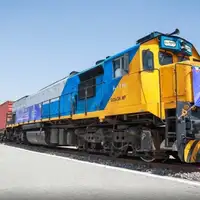
The Aq Tekeh Khan Bridge lies on the Gorgan–Incheh Borun railway, a key segment linking Iran’s interior to its northeastern border with Turkmenistan.
Incheh Borun serves as an important rail crossing and dry port in Golestan province, connecting southward into Iran’s national railway network and northward into the Kazakhstan–Turkmenistan–Iran corridor inaugurated in 2014.
The corridor, stretching from Kazakhstan through Turkmenistan into Iran, provides an overland connection between Iran and Central Asia, with links to Russia, China and wider Eurasian markets.
It also complements the International North-South Transport Corridor (INSTC) and overlaps with China’s Belt and Road Initiative ambitions by offering alternatives to vulnerable maritime routes.
For Iran, this northern railway artery is strategically valuable because it expands access to resource-rich Central Asian states and supports transit flows less exposed to Gulf chokepoints.
Freight trains from China have also moved along related corridors, underscoring the route’s place in broader East-West Eurasian trade.
Battle of transport networks
If confirmed, targeting railway infrastructure would suggest a broadening of strike objectives beyond traditional military facilities.
Railway bridges such as Aq Tekeh Khan are dual-use assets: they support civilian commerce, military mobility, sanctions-evading trade and rapid wartime logistics.
In modern conflicts, from Ukraine to the Middle East, infrastructure warfare has become increasingly central. Railways, ports, pipelines, bridges and power grids serve as chokepoints where military pressure and economic disruption intersect.
A damaged bridge can force rerouting, increase transport costs, delay supply chains and create bottlenecks whose effects exceed the physical scale of the strike itself.
For Iran, already facing pressure on southern ports, energy infrastructure and Gulf-facing trade routes, disruption to northern rail connectivity would test the resilience of its overland alternatives.
Targeting sanctions lifelines?
Damage to the Aq Tekeh Khan Bridge and associated rail services could limit Iran’s ability to move goods, fuel, equipment and strategic materials along its northern corridor.
Iranian authorities said the damage was repaired within a day and rail traffic had resumed, a claim that could not be independently verified. Even if temporary, the disruption highlights the importance of repair speed and infrastructure resilience in a conflict increasingly focused on transport networks.
Northern rail connectivity becomes especially important when southern ports or the Strait of Hormuz face military or political pressure. In such conditions, Iran’s ability to maintain alternative land routes through Central Asia, the Caspian region and Russia becomes part of its wider strategic depth.
Iran has spent years developing land corridors with Central Asia, Russia, China and the Caspian region to reduce dependence on maritime routes exposed to sanctions, surveillance and possible interdiction.
The Kazakhstan–Turkmenistan–Iran railway and INSTC-linked routes are central to that strategy, enabling transit revenues, regional trade and access to markets where sanctions enforcement may be less direct.
Strikes on such infrastructure could therefore be intended to erode Iran’s sanctions resilience by raising operational risks for partners and discouraging use of Iranian corridors during periods of conflict.
Regional consequences
The reported strike also carries potential implications for Turkmenistan, Kazakhstan and other Central Asian states.
These countries have invested in diversified transit routes through Iran to reach Gulf ports and global markets while reducing dependence on Russian or Chinese-controlled corridors.
If Iranian routes are viewed as vulnerable during conflict, governments and commercial operators may reassess their reliability.
For China, disruption to Iranian-linked corridors adds uncertainty to longer supply chains connecting East Asia, Central Asia and the Middle East.
For Russia, which has deepened logistical ties with Tehran, damage to Iranian transport infrastructure could complicate southern access routes.
The reported strike highlights how infrastructure has become part of modern strategic competition.
For Iran, the incident reinforces the challenge of protecting trade networks built to withstand sanctions and pressure on maritime access. It also shows that corridor politics, from the BRI to the INSTC, are increasingly shaped not only by commerce but by military risks.
Whether this leads to hardened infrastructure, shifts in regional trade planning or renewed pressure for de-escalation remains uncertain, but the bridge’s symbolic and practical importance now extends well beyond Golestan province.