• العربية
  • فارسی
Brand
  • Iran Insight
  • Politics
  • Economy
  • Analysis
  • Special Report
  • Opinion
  • Podcast
  • Iran Insight
  • Politics
  • Economy
  • Analysis
  • Special Report
  • Opinion
  • Podcast
  • Theme
  • Language
    • العربية
    • فارسی
  • Iran Insight
  • Politics
  • Economy
  • Analysis
  • Special Report
  • Opinion
  • Podcast
All rights reserved for Volant Media UK Limited
volant media logo

Tanker struck by unidentified projectile in Strait of Hormuz - UKMTO

Jun 27, 2026, 10:44 GMT+1Updated: 13:47 GMT+1

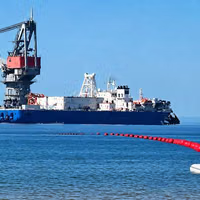
A tanker was struck by an unidentified projectile while transiting the Strait of Hormuz, the UK Maritime Trade Operations (UKMTO) said on Saturday, in the latest security incident in the strategic waterway.

UKMTO said the vessel sustained damage to its bridge but all crew members were safe and no pollution had been reported.

Authorities were investigating the incident, UKMTO said, advising vessels transiting the strait to exercise caution and report any suspicious activity.

Most Viewed

Iran held by Egypt, waits on results in bid for first World Cup knockout place
1

Iran held by Egypt, waits on results in bid for first World Cup knockout place

2

Khamenei posters expose struggle over who owns Lebanon’s ceasefire

3
OPINION

Iran's Pride Match is about visibility, not politics

4
PODCAST

US policy on Iran: can money achieve what sanctions couldn't?

5
INSIGHT

Rival visions of Iran take to the streets during Ashura

Banner
Banner
Banner

Spotlight

  • How a US-Iran deal can reshape the Middle East
    ANALYSIS

    How a US-Iran deal can reshape the Middle East

  • Iran's Pride Match is about visibility, not politics
    OPINION

    Iran's Pride Match is about visibility, not politics

  • Iranians recast Ashura mourning to remember January protest victims
    VOICES FROM IRAN

    Iranians recast Ashura mourning to remember January protest victims

  • Investigation traces January protest deaths to Gharazi Hospital in Isfahan
    SPECIAL REPORT

    Investigation traces January protest deaths to Gharazi Hospital in Isfahan

  • US-Iran MoU pauses conflict but leaves nuclear dispute unresolved

    US-Iran MoU pauses conflict but leaves nuclear dispute unresolved

  • Rival visions of Iran take to the streets during Ashura
    INSIGHT

    Rival visions of Iran take to the streets during Ashura

  • Iran’s negotiators have 60 days; its factories may not
    ANALYSIS

    Iran’s negotiators have 60 days; its factories may not

•
•
•

More Stories

Hardline daily urges Iran to suspend MoU, close Strait of Hormuz

Jun 27, 2026, 10:34 GMT+1

Iran's hardline Kayhan newspaper on Saturday called on Tehran to suspend the US-Iran memorandum of understanding and close the Strait of Hormuz, arguing Washington had repeatedly violated the agreement with its latest strikes on Iranian military sites.

In an editorial, Kayhan criticized President Masoud Pezeshkian, Parliament Speaker Mohammad Bagher Ghalibaf and Foreign Minister Abbas Araghchi for not responding publicly to what it described as a US "terrorist attack" on radar and military facilities near the Strait of Hormuz.

"The Strait of Hormuz, in Iran's territorial waters, is our lever of power against criminal America," the newspaper wrote.

It said Iran's negotiating team had "retreated too quickly" on closing the strait in what it called an "invalid memorandum," even though "most of America's commitments in the memorandum have been violated."

"The strait could have been the guarantee for implementing those commitments," it said.

Kayhan said the Strait of Hormuz "should not have been reopened before the fate of the war criminals was determined, compensation was obtained and credible guarantees secured that the threats would not be repeated."

It called on the Supreme National Security Council to declare that "implementation of the memorandum is suspended and the Strait of Hormuz is closed until the enemy's threats stop on all fronts, from the Persian Gulf to Lebanon."

The newspaper also urged Iranian leaders to "break the enemy's mistaken calculations" that Iran would remain committed to the agreement "at any price" despite what it described as repeated violations.

Direct-to-cell offers Iranians future hope, not a fix today

Jun 27, 2026, 10:24 GMT+1
•
Mahdi Saremifar, Ahmad Ahmadian
Direct-to-cell offers Iranians future hope, not a fix today
100%

Direct-to-cell satellite technology could one day help Iranians bypass part of the Islamic Republic’s digital blockade, but it is not yet a practical solution to the country’s internet shutdown despite widespread hopes.

Internet access in Iran was cut off for months, first amid the January protests and then during the March war, before being partially restored after an 88-day nationwide blackout.

International connectivity has returned for many fixed-line and home broadband users, but the network remains degraded, unstable and heavily censored.

  • Iran's internet is back, but still broken

    Iran's internet is back, but still broken

  • Iran restores internet after 88-day blackout, keeps social media blocked

    Iran restores internet after 88-day blackout, keeps social media blocked

More than 100 days after the broader shutdown began, the pattern of restoration has been limited, selective and tightly controlled.

From conditional access tied to identity verification and the migration of businesses to domestic platforms to the creation of internet-access whitelists, the Islamic Republic appears intent on preserving its multi-layered system of censorship, surveillance and communications control.

The National Information Network, centralized gateways to the global internet, controlled mobile-network settings, identity-verification systems and device-registration mechanisms are all tools that allow the state to restrict or cut off public access to the global internet while keeping stable communication channels open for selected groups.

That is why direct-to-cell, or D2C, has attracted growing attention among Iranians. Many see the promise of direct phone-to-satellite connectivity — without a dish, terminal, domestic operator or government gateway — as a possible way out of the Islamic Republic’s digital prison.

  • Iran is turning the internet into a privilege

    Iran is turning the internet into a privilege

  • Iran’s partial internet return exposes rift inside ruling system

    Iran’s partial internet return exposes rift inside ruling system

  • Iran’s internet kill switch project in final stages - sources

    Iran’s internet kill switch project in final stages - sources

The idea has gained enough attention that the Pentagon held talks with SpaceX about activating direct-to-cell service for Iranian citizens. According to Reuters, SpaceX requested up to $500 million to launch the service and $100 million per month to operate it.

The central question, however, is whether current versions of direct-to-cell technology can meet such expectations on the scale of Iran. For now, the answer is no: today’s systems remain limited in capacity, vulnerable to radio interference and risky for users who could be identified through Iran’s device-registration and mobile-network systems.

The central questions, however, remain: Can current versions of Direct-to-Cell technology truly meet such expectations on the scale of Iran? Is the technology still only an emergency and limited communication channel, or can it become a scalable escape route for millions of Iranian users? And if future generations of the technology operate without relying on domestic towers and operators, will Iran’s digital wall be broken?

Dependency on mobile operators and the foreign eSIM scenario

In ordinary Starlink service, the satellite connects to a dedicated ground terminal — the same dish that users must obtain, install, maintain and hide from the Islamic Republic. The phone connects to the Starlink modem through Wi-Fi.

But Direct-to-Cell is based on a different idea: an ordinary phone itself becomes the receiver and transmitter for satellite communication.

Current versions of Direct-to-Cell are mostly not independent satellite internet systems. Rather, they complement the existing coverage of mobile operators in each area, effectively turning the satellite into a space-based cell tower whose real function is to cover mobile-network dead zones.

The use of independent S-Band frequencies and the deployment of satellites in very low Earth orbit, or VLEO, closer to the Earth’s surface, are among the paths that could make D2C more relevant to Iran’s problem.

Under this scenario, foreign Starlink partner operators such as T-Mobile, Kyivstar or One NZ in New Zealand would declare Iranian territory a zone without terrestrial coverage and include it under their own service.

Politically and technically, this model comes closer to what Iranian citizens expect from the technology. In that case, a phone using a SIM card or eSIM from one of these operators could establish a D2C connection from inside Iran to SpaceX’s new-generation satellites. Reports say about 700 satellites of this type are already in orbit.

But making this scenario a reality is not limited to SpaceX’s will or decision. It requires an entire chain: frequency spectrum, regulatory licenses, compatible phones, modems, antennas, transmission power and chipsets that support new satellite bands.

Companies such as Qualcomm, MediaTek, Apple, Samsung and Google play a decisive role in this process. If phone hardware is not ready, even an advanced satellite constellation will not become a practical connection for users inside Iran.

Even under this optimistic scenario for Iran, three major obstacles remain: limited capacity, the possibility of radio interference, and the risk of users being identified through device registration and the Hamta system.

1. Capacity limits in densely populated areas

The first serious obstacle to widespread D2C deployment in Iran is capacity. This connection is not designed to replace urban internet. It is designed to deliver minimal connectivity to areas with no terrestrial coverage or weak coverage. But in Iran, the issue is not simply connecting a few users on a road or in a mountain area.

The issue is a communications blackout in cities where hundreds of thousands of people may simultaneously need messaging apps, voice and video calls, news, maps, email, financial services, and the ability to send photos and videos.

In some early tests, recorded bandwidth for a single connection reached about 14 Mbps. But this number should not be confused with the experience of urban internet speeds. In the real world, that limited bandwidth must be shared among all users across the wide area covered by each satellite.

To better understand the scale, in a city such as Tehran, if only 1% of residents simultaneously wanted a very basic 1 Mbps connection, the network would need capacity equivalent to 99 Gbps. Compared with the current capacity of each active D2C beam, which ranges from 4 to 17 Mbps, and even compared with an optimistic 150 Mbps outlook for future generations, this reveals a gap hundreds of times larger than current capabilities.

2. Radio interference from ground signals

Even if D2C can reduce the problems of capacity and dependence on domestic operators, it still faces an obstacle rooted in the physics of radio waves. To connect, a phone must receive a very weak signal from a satellite moving hundreds of kilometers above the Earth, while operating in an environment filled with nearby mobile towers, ground transmitters and local signals that are far stronger.

In this context, the ratio between the desired signal and surrounding interference determines whether the receiver can detect the satellite signal at all amid noise and terrestrial interference.

A nearby ground tower operated by MCI or Irancell could emit a signal so much stronger than the satellite signal that the phone’s receiver effectively fails to see the weaker signal or cannot build a stable connection on it.

In such a situation, the government does not need to target the satellite. It only needs to use towers, transmitters and control over mobile-network power levels to make the radio environment around the user unfavorable for satellite connectivity.

For the Islamic Republic, this type of interference could be fast, local and low-cost. So even if the satellite is beyond the government’s reach, the user’s phone remains on the ground, inside a radio environment that can be manipulated. Future versions with dedicated spectrum, better modems and more resilient protocols may reduce part of this vulnerability, but they will not eliminate it entirely.

3. Device registration and user identification

The more serious security question is how identifiable a user inside Iran would be when using D2C. In Iran, a phone is not merely a communication device. The SIM card, subscriber identity, device identity and the user’s real identity are linked together across several layers.

Every phone has a unique hardware identifier, or IMEI, which serves as the device’s identity on mobile networks. The Hamta system can link this identifier to the SIM card, activation history, ownership and, in many cases, the user’s real identity.

In such an environment, using a foreign SIM card or eSIM for satellite connectivity does not necessarily make the user anonymous. If a phone with a known IMEI suddenly tries to connect through an unauthorized satellite route using a foreign operator identifier, that behavior could become an unusual and flaggable pattern.

The combination of device registration, operator data, SIM-card databases and local monitoring tools could turn such a connection into a security risk. The key question, therefore, is how this can be done without exposing the user’s identity, location and behavioral pattern.

A strategic opportunity, not an immediate solution

Direct-to-Cell should be taken seriously, but it should not be exaggerated. For Iran, the appeal of this technology is clear: if one day an ordinary phone can connect to a satellite without a dish, separate terminal, domestic operator or Islamic Republic gateway, one of the foundations of Iran’s internet-control architecture will be challenged. But that day has not yet arrived. Current versions under development are mainly designed to cover dead zones, not to replace urban internet for tens of millions of users.

Limited capacity, the possibility of interference, and the risk of exposing and identifying users mean this technology is not currently a public and scalable escape route from Iran’s internet shutdown. Its present value is mostly as an emergency tool: sending messages, sharing locations, issuing alerts or maintaining brief communication during a crisis.

The future could be different if the next generation of satellites brings together higher capacity, independent spectrum, compatible phones, user security and global protective rules. Until then, Direct-to-Cell remains an important opening for the future — not today’s solution to the digital prison.

Bahrain condemns Iranian drone attack it says breached ceasefire

Jun 27, 2026, 09:57 GMT+1

Bahrain condemned an Iranian drone attack targeting its territory early on Saturday, accusing Tehran of violating its sovereignty and breaching the US-Iran memorandum of understanding reached this month.

The statement came hours after the United States said it had struck Iranian missile, drone and radar sites in southern Iran in response to what it described as an Iranian drone attack on the Singapore-flagged container ship Ever Lovely in the Strait of Hormuz. Iran, in turn, said it had retaliated by striking US-linked targets and accused Washington of violating the memorandum of understanding.

In a statement, Bahrain's foreign ministry said "a number of Iranian drones" had targeted the kingdom in a "flagrant violation" of its sovereignty, threatening the security of citizens and residents.

It said Iran alone bore responsibility for "undermining peace efforts" and accused Tehran of pursuing a policy of destabilizing regional security.

Bahrain said the attack violated the June Islamabad memorandum of understanding, under which Iran had committed to a permanent halt to military operations and to respect the sovereignty of regional states.

It said it reserved its full right under international law to defend its sovereignty, security and stability, and called on the UN Security Council to ensure implementation of its resolution and hold "the aggressor" accountable.

Iranian lawmaker rejects Trump proposal on use of unfrozen funds

Jun 27, 2026, 09:54 GMT+1

Iranian lawmaker Alaeddin Boroujerdi rejected President Donald Trump's proposal that Iranian funds unfrozen under the US-Iran memorandum of understanding be used to buy American agricultural products, calling the idea "baseless" and saying Tehran should not accept food imports from the United States.

Boroujerdi, a member of parliament's National Security Committee, said Trump's remarks that Iranian funds would be earmarked for purchases from US farmers were "unrealistic" and reflected what he described as the US president's "illusions" about international affairs and Iran.

"Iran's sources for buying grain are completely clear, and we have no need to import from America," Boroujerdi said.

He said food security and public safety must come first and argued Iran could not rely on US food products because "there is no trust" in them.

"Any import of food products from America, even if they meet standards, is unacceptable," Boroujerdi said, adding that the government "should not go along with it."

Swedish court upholds dismissal of migration official over Iran security concerns

Jun 27, 2026, 09:41 GMT+1
Swedish court upholds dismissal of migration official over Iran security concerns
100%

A Swedish court upheld the dismissal of a Migration Agency case officer after finding the agency had lawful grounds to fire him based on security concerns linked to contacts with Iranian intelligence operatives and people connected to organized crime.

In a ruling published on Friday, Solna District Court said the employee had, over several years, maintained extensive contacts with "an Iranian intelligence officer, an agent linked to refugee espionage and individuals connected to a motorcycle gang environment," according to Swedish media.

The court said the contacts posed "a concrete risk" that sensitive information held by the Migration Agency could be passed on and amounted to a serious breach of the employee's duty of loyalty.

National security concerns

The Migration Agency argued it was particularly vulnerable to foreign intelligence activity because it holds information on asylum seekers, Iranian government critics and others who could be of interest to foreign states.

  • Iran secretly buries executed Swedish citizen at site linked to mass graves

    Iran secretly buries executed Swedish citizen at site linked to mass graves

The court agreed that the employee's contacts were incompatible with his position, saying they undermined confidence in both the individual and the agency.

Court rejects appeal

The former official, who had worked at the agency since 2016 and was dismissed in February 2025, sought reinstatement and damages, arguing the agency lacked sufficient grounds to dismiss him.

The court rejected the claims, found testimony from Sweden's Security Service (Säpo) to be credible and detailed, and ruled the agency had acted within the legal time limit for the dismissal.

The former employee was also ordered to pay the state 168,000 Swedish kronor ($17,600) in legal costs.