• العربية
  • فارسی
Brand
  • Iran Insight
  • Politics
  • Economy
  • Analysis
  • Special Report
  • Opinion
  • Podcast
  • Iran Insight
  • Politics
  • Economy
  • Analysis
  • Special Report
  • Opinion
  • Podcast
  • Theme
  • Language
    • العربية
    • فارسی
  • Iran Insight
  • Politics
  • Economy
  • Analysis
  • Special Report
  • Opinion
  • Podcast
All rights reserved for Volant Media UK Limited
volant media logo
PODCAST

US policy on Iran: can money achieve what sanctions couldn't?

Negar Mojtahedi
Negar Mojtahedi

Iran International

Jun 26, 2026, 18:24 GMT+1
People gather at the base of the Washington Monument ahead of a flyover during a rally kicking off the Great American State Fair marking the 250th anniversary of U.S. independence, in Washington, D.C., U.S., June 24, 2026

The new US-Iran memorandum of understanding marks a fundamental shift in Washington's approach to Tehran, replacing years of "maximum pressure" with an effort to use economic incentives to secure nuclear concessions, experts told Iran International.

The agreement could eventually unlock tens of billions of dollars in oil revenue and frozen assets while paving the way for a proposed $300 billion reconstruction program.

Much of that money would depend on further negotiations during a 60-day window, but analysts say the direction of US policy has already changed.


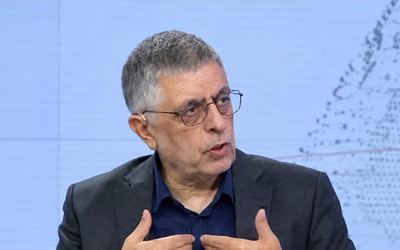
"If the MOU is acted upon based on what we've seen in the text... I fear that we are at risk of moving from maximum pressure to maximum appeasement," he told Eye for Iran.

Economist Mohamad Machine-Chian sees the same policy shift, though he describes it differently.

"To my understanding, it seems like the US administration has concluded it is moving toward a different paradigm," he said.

"Before that they were relying on sanctions and maximum pressure. Now they're trying to provide incentives and basically direct and control using incentives."

Where could the money come from?

The economic package outlined in the MOU has three main components: expanded oil revenue, access to frozen Iranian assets and a proposed reconstruction and economic development plan worth at least $300 billion. Each would operate differently.

According to Meizlish, the biggest immediate change is Treasury's General License X.

The significance of the license, he says, goes far beyond allowing Iran to export oil. It authorizes much of the commercial activity surrounding those exports, including associated financial transactions.

That means Iran is not simply allowed to sell oil. It is allowed to receive and use the proceeds.

"We're talking about potentially tens of billions of dollars in a relatively short period of time," Meizlish said. "It's unconditioned, unrestricted sanctions relief that's going to provide billions of dollars to the regime."

According to Meizlish, the license appears to contain no escrow mechanism or reporting requirements, distinguishing it from previous arrangements in which unfrozen Iranian assets were held in restricted accounts and designated for humanitarian purposes.

Frozen assets

Separate from oil revenue are Iran's frozen assets.

The MOU states that those funds would be made available under procedures to be negotiated during the 60-day talks.

The Trump administration has suggested released assets could be used to purchase humanitarian goods, including American agricultural products.

But Machine-Chian says there is no practical way to guarantee those goods ultimately benefit ordinary Iranians.

"I don't think there's any way to make sure it actually reaches ordinary Iranians," he said.

Even if wheat, medicine or other humanitarian supplies are purchased, he said, Washington has little control over how they are distributed once inside Iran.

The reconstruction fund

The agreement also proposes developing a reconstruction and economic development plan worth at least $300 billion with regional partners.

Exactly how the fund would operate remains unclear. President Donald Trump has repeatedly said US taxpayers would not finance reconstruction, while administration officials have suggested Persian Gulf partners and private investment could provide much of the funding if a final agreement is reached.

Unlike oil revenue, however, the reconstruction plan remains largely conceptual and would require further agreements before any large-scale investment materializes.

Have sanctions really disappeared?

Not entirely.

Machine-Chian cautioned that sanctions relief alone would not fully reconnect Iran to the global economy.

Iranian banks remain largely cut off from the international financial system, and restoring normal banking ties would likely require Tehran to comply with standards set by the Financial Action Task Force (FATF), a politically contentious step that hardline factions have long resisted.

As a result, sanctions relief alone is unlikely to normalize Iran's banking sector.

Who benefits?

The central debate surrounding the agreement is not simply how much money Iran could receive but who ultimately controls it.

Machine-Chian argues Iran's Central Bank is under severe pressure from inflation, a weakening rial and dwindling foreign exchange reserves. Fresh access to foreign currency, he says, could help stabilize the economy and prevent a deeper financial crisis.

"In that regard, these funds are going to help the Islamic Republic immensely," he said.

Whether that ultimately improves life for ordinary Iranians, however, remains uncertain.

Meizlish warns that fresh revenue could help rebuild military infrastructure damaged during the war while flowing into sectors such as oil, construction and petrochemicals, which he argues are deeply connected to the Islamic Revolutionary Guard Corps (IRGC).

"So what has Iran actually done?" Meizlish asked, arguing that reopening the Strait of Hormuz and agreeing to continue negotiations fall well short of the scale of economic relief now being offered.

Whether the strategy succeeds will depend less on the size of the promised economic package than on whether Washington can convert financial incentives into lasting nuclear concessions.

For now, the agreement represents a clear break from the sanctions-first approach that has defined US policy toward Iran for much of the past decade.

You can watch Eye for Iran on YouTube or listen on any podcast platform of your choosing.

Most Viewed

Inside the strike on a Shiraz lodging complex: why was a civilian site hit?
1
EXCLUSIVE

Inside the strike on a Shiraz lodging complex: why was a civilian site hit?

2
EXCLUSIVE

Sources detail Ali Khamenei bunker with blast-resistant room

3
INSIGHT

President's economic reality check fuels Iran's US deal debate

4

North Korea received $25 million for Iran tunnel technology, ex-diplomat says

5

World Cup déjà vu: Iran’s ominous Brazil-Scotland quake memory haunts Venezuela

Banner
Banner
Banner

Spotlight

  • Iran's Pride Match is about visibility, not politics
    OPINION

    Iran's Pride Match is about visibility, not politics

  • Investigation traces January protest deaths to Gharazi Hospital in Isfahan
    SPECIAL REPORT

    Investigation traces January protest deaths to Gharazi Hospital in Isfahan

  • US-Iran MoU pauses conflict but leaves nuclear dispute unresolved

    US-Iran MoU pauses conflict but leaves nuclear dispute unresolved

  • Iran economists warn recovery needs reform not just relief
    INSIGHT

    Iran economists warn recovery needs reform not just relief

  • Rival visions of Iran take to the streets during Ashura
    INSIGHT

    Rival visions of Iran take to the streets during Ashura

  • Iran’s negotiators have 60 days; its factories may not
    ANALYSIS

    Iran’s negotiators have 60 days; its factories may not

  • Will the Islamic Republic trade with the 'Great Satan'?

    Will the Islamic Republic trade with the 'Great Satan'?

•
•
•

More Stories

Iranian wanted in US over IRGC-linked hacking case arrested in Montenegro

Jun 26, 2026, 07:36 GMT+1
Iranian wanted in US over IRGC-linked hacking case arrested in Montenegro
100%

Montenegrin police and the FBI have arrested an Iranian national wanted by the United States over a major hacking campaign that allegedly targeted US universities and benefited Iran’s Revolutionary Guards, Reuters reported.

The 39-year-old man, who holds Iranian and Turkish citizenship, was identified by Montenegrin media as Amir Barati and was arrested in the Adriatic resort town of Kotor, Montenegro’s police directorate said Thursday.

He is wanted by the US District Court for the Southern District of New York on charges including conspiracy to commit computer fraud, hacking and identity theft. The case will now go before a High Court judge in Podgorica for extradition proceedings.

Montenegrin police said the suspect had carried out large-scale cyberattacks from 2013 onward, targeting more than 150 universities in the United States and causing damage estimated at more than $3.4 billion.

Police said the stolen data and access to compromised university accounts were used for the benefit of the Islamic Revolutionary Guard Corps and other Iranian entities, including universities.

Barati’s name does not appear on the FBI’s public list of nine Iranian hackers charged in 2018 over the Mabna Institute campaign, but the allegations described by Montenegrin police closely match that case, including the 2013 start date, the university targets, the IRGC connection and the $3.4 billion damage estimate.

The overlap leaves open the possibility that Barati was tied to the same broader operation or to a related US case, though neither US nor Montenegrin authorities have publicly linked him to the 2018 indictment.

100%

The FBI said in 2018 that the Mabna Institute, an Iran-based company created in 2013, was used to steal access to non-Iranian academic and scientific resources through computer intrusions. US authorities said members of the institute were contracted by the IRGC and other Iranian government clients.

According to the FBI, the campaign compromised about 144 US-based universities and 176 foreign universities in 21 countries. It also targeted private companies, US government entities, the states of Hawaii and Indiana, and the United Nations.

US authorities said the hackers targeted more than 100,000 professor accounts worldwide and successfully compromised about 8,000 of them. They stole more than 30 terabytes of academic data and intellectual property, including journal access, research papers, electronic books and other proprietary academic material.

The campaign relied heavily on spearphishing emails that appeared to come from other academics. Victims were directed to fake university login pages, where their credentials were captured and later used to access library databases and research platforms.

The FBI said the stolen material covered a wide range of fields, including science, technology, engineering, medicine, social sciences and other academic disciplines.

US investigators also said the hackers used password-spraying attacks against companies and government targets, gaining access to email accounts and sensitive data. Victims included academic publishers, media and entertainment companies, technology firms and investment firms.

When the 2018 charges were announced, then-FBI Deputy Director David Bowdich said apprehending the suspects would be difficult but “not impossible,” adding that the defendants could be arrested if they traveled outside Iran.

“Where we can’t apprehend these individuals quickly, we will resort to different methods – naming and shaming, sanctions, and a lot of publicity,” Bowdich said at the time. “We will keep at it, because the FBI and our partners at the Department of Justice have a very long memory.”

The arrest in Montenegro suggests that warning may now be playing out years later, as one suspect allegedly linked to the campaign faces possible extradition to the United States.

The case comes amid renewed US warnings about Iranian cyber operations. In April, US cybersecurity, law enforcement and intelligence agencies warned of escalating Iranian hacking campaigns targeting equipment across critical infrastructure.

Iran economists warn recovery needs reform not just relief

Jun 26, 2026, 06:57 GMT+1
•
Behrouz Turani
Iran economists warn recovery needs reform not just relief
100%
A woman and child look at clothes displayed outside a shop in Tehran, June 11, 2026

Economists and business analysts in Iran say the country's biggest challenges may come after any agreement with the United States, arguing that structural reforms will be as crucial as sanctions relief to achieving a durable economic recovery.

They say Tehran must use the post-war period to impose budgetary discipline, avoid past currency-stabilization mistakes and overhaul its bureaucracy to attract foreign investment, rather than treating the current pause as a short-lived tactical opportunity.

Business strategy consultant Ali Nazemzadeh argued that historical experience—from post-World War II Germany and Japan to Iran's reconstruction after the Iran-Iraq War and the 2008 global financial crisis—suggests economies rarely collapse permanently after major shocks.

Instead, they undergo periods of restructuring and renewal.

Writing in Jahan-e Sanat earlier this week, Nazemzadeh urged business leaders to abandon a passive "waiting mode" and prepare for a post-crisis economy that could unleash pent-up demand and redistribute market share toward the most resilient firms.

Although the 12-day and 40-day wars constrained business decision-making through currency volatility, internet disruptions, the triggering of the UN snapback mechanism, domestic unrest and military tensions, he argued that economic recovery remains historically inevitable.

With its natural resources, strategic location and population of 90 million, "Iran cannot fail to develop after a wartime era," he wrote, describing crises as an "economic sieve" that allows businesses with liquidity, disciplined management and clear strategy to emerge stronger.

Economist Pouya Jabal Ameli echoed that view, arguing that while the interim agreement may not permanently end the cycle of war and ceasefire, it creates a crucial window ahead of the 60-day deadline for negotiating a comprehensive settlement.

He urged policymakers to treat the period not as a tactical pause but as a launchpad for deep structural reforms.

By taking advantage of falling inflation expectations, enforcing budgetary discipline, avoiding historical currency-stabilization traps such as Dutch disease, and preparing a bureaucratic overhaul capable of attracting foreign investment, Iran could shift its global image from conflict toward economic renewal.

Jabal Ameli concluded that Iranian officials should view the memorandum—and any subsequent agreement with the United States—as an opportunity for structural reform rather than a short-term tactical maneuver.

Offering a more optimistic political assessment, pro-reform daily Sharq described the memorandum as "the first direct official agreement between the presidents of Iran and the U.S. in over four decades."

Columnist Abdolrahman Fathollahi argued the agreement could pave the way for a durable ceasefire, economic recovery and the gradual lifting of sanctions while noting that Supreme Leader Mojtaba Khamenei had approved the talks only conditionally and continued to stress distrust of Washington.

He also pointed to repeated warnings from the IRGC and the Supreme National Security Council that Iran had prepared retaliatory measures should the United States fail to honour its commitments.

Despite criticism from a handful of hardline lawmakers, Parliament Speaker Mohammad Bagher Ghalibaf, who also serves as Iran's chief negotiator, declared parliament's backing for the process.

"With the finalization of the memorandum, the difficult path of fulfilling commitments and reclaiming the rights of the Iranian nation has only just begun," he said.

Fathollahi cautioned against excessive optimism, arguing that the agreement's ultimate success "will be determined not in its text, but in the degree of adherence to commitments, the management of regional crises, and the tests ahead."

Canada sends mixed signals on Tehran embassy reopening

Jun 25, 2026, 22:00 GMT+1
Canada sends mixed signals on Tehran embassy reopening
100%
Canadian Prime Minister Mark Carney

Canadian Prime Minister Mark Carney on Thursday called for broader diplomatic engagement with Iran, saying embassies do not amount to endorsement, one day after his Foreign Ministry told Iran International it was not considering reopening its embassy in Tehran.

Speaking to reporters in Ottawa after deadly earthquakes in Venezuela, Carney said diplomatic presence does not amount to political approval.

“Engagement is not endorsement,” he said, adding that embassies and consular services help governments respond faster in emergencies.

Carney said Canada had faced similar challenges during the war in Iran. “We’ve had to rely on allies and countries that also aren’t our natural allies to help us, particularly in Iran, to help get Canadians out."

“In my opinion, we must change the way we’re doing things,” Carney added, while cautioning that he was making a general point and that no decision had been made on restoring ties.

His remarks come despite earlier comments by Canada’s Foreign Ministry to Iran International that Ottawa’s policy toward Tehran had not changed.

The ministry said Canada maintains a Controlled Engagement Policy with Iran, limiting bilateral contacts to consular affairs, including issues related to the downing of Flight PS752, as well as human rights and nuclear non-proliferation.

“While we continually monitor opportunities in which diplomatic representation may be in the interests of Canadians, and noting that engagement is not endorsement, we are not currently considering re-opening an embassy in Iran,” the ministry told Iran International.

Canada closed its embassy in Tehran in 2012 and expelled Iranian diplomats from Ottawa after designating the Islamic Republic a state sponsor of terrorism. The absence of diplomatic ties has complicated consular support for Canadians in Iran, including members of Canada’s large Iranian diaspora.

Ottawa has since maintained what it calls a Controlled Engagement Policy with Tehran, limiting bilateral contacts to consular issues, the 2020 downing of Flight PS752, human rights and nuclear non-proliferation.

The absence of Iranian diplomatic representation in Canada has in turn forced more than 280,000 members of the country’s Iranian diaspora to handle consular affairs through the Islamic Republic’s Interests Section in Washington, DC.

Power, water outages disrupt daily life across Iran

Jun 25, 2026, 13:40 GMT+1
Power, water outages disrupt daily life across Iran
100%
File photo shows residents queue with containers to collect water from a public distribution point in the central Iranian city of Yazd amid water cuts.

Daily electricity and water outages disrupted life across Iran as summer began, with residents blaming years of underinvestment and deteriorating infrastructure despite officials citing rising demand and shrinking water supplies.

Messages sent to Iran International from residents in Khuzestan, Ilam, Lorestan, East Azarbaijan, Alborz, Tehran and other provinces described hours-long daily power cuts and recurring water shortages that began with the onset of summer.

The reports come as much of Iran experiences extreme heat, placing additional strain on the country's aging electricity and water networks.

A resident of Khuzestan, one of Iran's main electricity-producing provinces, said scheduled power cuts had resumed despite the province generating far more electricity than it consumes.

"On the first day of summer, with temperatures above 50 degrees Celsius, they started cutting electricity again in a province that produces twice its own needs."

Residents in Ilam province also reported electricity outages lasting up to four hours as temperatures reached 46 degrees Celsius. One warned that if the blackouts continue, authorities would face "angry and protesting people."

  • Iran runs dry as Islamic Republic funds ideology and foreign proxies

    Iran runs dry as Islamic Republic funds ideology and foreign proxies

In Pardis, east of Tehran, a resident of a 14-story apartment building said electricity was cut for four hours during the day, leaving elevators out of service.

"How are we supposed to climb all these stairs?"

Others said the loss of elevator access posed particular difficulties for elderly residents and families with young children.

Water shortages deepen disruption

Citizens also reported prolonged water outages, which they said often coincided with electricity cuts because pumping stations stopped operating.

Mehdi Masaeli, secretary of Iran's Electricity Industry Syndicate, said last year that water supplies are interrupted when electricity fails because pumps stop working.

Residents in Boumehen near Tehran said they had access to running water on only two days during the previous week, and then only for a few hours.

"We have a sick person at home. We no longer know who to turn to."

People from Shahriar and Qods, west of Tehran, also described prolonged water cuts, with some saying supplies were unavailable from mid-afternoon until early the following morning. Several said repeated calls to the local water utility produced only tracking numbers and recorded messages.

"Water is a basic necessity, not a luxury service."

Officials have cited falling reservoir levels, declining rainfall and rising consumption as the main causes of the shortages. Many people, however, said authorities were blaming consumers instead of addressing years of underinvestment and poor management.

File photo shows residents lining up with containers to collect water from a tanker truck during water shortages in Iran.
100%
File photo shows residents lining up with containers to collect water from a tanker truck during water shortages in Iran.

One message from Ilam province said the city of Shabab had gone without running water for three consecutive days.

Some also compared the shortages with recent warnings about attacks on infrastructure.

"There was no need for anyone to attack the energy infrastructure," one citizen wrote. "Government inefficiency has taken our water away and pushed us back to the Stone Age. We carry water home in containers."

Higher bills, aging infrastructure

People also complained that utility bills had increased even as services deteriorated.

A resident in Zanjan said electricity and water tariffs had quietly risen just as power cuts resumed. In Ahvaz, people reported sharply higher water bills, with one saying many families could no longer afford to pay them and that local authorities were unwilling to offer installment plans.

  • Rampant electricity outages take toll on frustrated Iranians

    Rampant electricity outages take toll on frustrated Iranians

Energy experts have long warned that Iran's electricity and water systems suffer from years of inadequate investment in power generation, transmission networks and water infrastructure.

They say authorities have repeatedly relied on rotating blackouts and water restrictions to manage seasonal shortages rather than addressing the underlying causes, leaving households increasingly vulnerable during periods of extreme heat.

Iran’s negotiators have 60 days; its factories may not

Jun 25, 2026, 13:21 GMT+1
•
Mohamad Machine-Chian
Iran’s negotiators have 60 days; its factories may not
100%

Iran’s negotiators have opened a renewable 60-day clock. Its factories may not have that long. The Chamber of Commerce’s own PMI survey shows warehouses emptying, orders drying up and production lines at risk of stoppage within months.

Every serious economy watcher knows the ritual. At the start of each month, the purchasing managers’ indexes land, and markets move.

A PMI is the closest thing economics has to a pulse reading. Surveyors ask the people who run companies a simple set of questions about the month just ended: did production rise or fall, did new orders come in, are you hiring?

The answers are compressed into a number from 0 to 100. The 50 line separates growth from contraction. A few points below 50 signals trouble.

Readings under 40 usually belong to crises. When the index for US manufacturing fell to 41.5 in April 2020, with the country in lockdown, it made headlines for weeks.

A pulse reading below crisis level

Iran has a PMI too. Few outside the country have heard of it.

Since 2018, the research center of Iran’s Chamber of Commerce has surveyed managers of Iranian firms every month, following standard PMI methodology, and published the result under the Persian acronym Shamekh. The acronym is formed from Shakhes-e Modiran-e Kharid, literally “the index of purchasing managers.”

It is the instrument Iran’s own business establishment built to take the economy’s pulse. Official inflation statistics can be delayed, reweighted and narrated. A factory’s order book is harder to argue with.

That is what makes the latest readings so remarkable.

In March, the month war hit business conditions, Iran’s manufacturing Shamekh registered 26.2.

Some calibration is necessary, because the scale matters.

In April 2020, the cruelest month of the pandemic for many economies, Spain’s manufacturing PMI fell to 30.8. Britain’s fell to 32.6, its worst reading in roughly three decades. India, which confined 1.4 billion people to their homes, recorded 27.4, the lowest in that survey’s history.

Iran’s manufacturing sector in March came in below every one of them.

And the comparison flatters the situation, because those pandemic readings measured economies in a medically induced coma. Governments had deliberately and temporarily shut commerce down. Within months, every one of those indexes was back above 50.

No one switched Iran’s economy off to save lives.

Epic Fury may have concluded, but the economic fury continues. Judging by the latest figures, it is working. Iran’s industry is being suffocated by war, sanctions and the lingering effects of a naval blockade whose dismantling has now been promised but not yet proved in economic life.

The difference is the difference between a pause and a stroke.

Empty warehouses, falling orders

The 26.2 reading was never announced in a standalone report.

The chamber skipped its March publication. The figure surfaced quietly in a chart accompanying the April edition.

April itself brought no relief worth the name. Manufacturing stood at 37.4, while the whole-economy index was 38.5. Apart from March, these were the lowest readings in the survey’s history.

Iranian industry has now spent five consecutive months below the 50 line, meaning five straight months of contraction.

  • US sanctions waiver could bring Iran's oil trade out of the shadows

    US sanctions waiver could bring Iran's oil trade out of the shadows

The Iranian New Year holidays, known as Nowruz, always slow business activity around late March and early April. Factories close, workers travel and early-spring readings often weaken. But the survey has eight Nowruz seasons on record, and none came anywhere near these levels.

Ten of the survey’s eleven components are below 50.

New orders, at 37.4, show demand drying up at home and in export markets alike. Delivery times, at 39.6, carry some of the report’s most telling explanations: internet shutdowns, broken payment channels and import restrictions.

Raw-material inventories stand at 32.6. That is not just a weak number; it is a warning about the physical ability to keep producing.

  • President's economic reality check fuels Iran's US deal debate

    President's economic reality check fuels Iran's US deal debate

Here the chamber’s own language turns blunt. If conditions persist, it warns, production lines face partial or complete stoppage in the months ahead.

Employment, at 36.8, is the lowest in the survey’s history, even lower than during the war month itself. The layoffs did not end with the ceasefire. They are deepening.

One component points the other way, and it completes the picture.

The price of raw materials stands at 77.4, deep in inflationary territory. Iranian firms are producing less, selling less and paying more for what they buy.

  • Tehran bread prices jump up to 100% in latest increase

    Tehran bread prices jump up to 100% in latest increase

Demonstrating stagflation usually requires setting two datasets side by side. Here, both halves sit on a single page of a single report, published by a single institution.

The costs are already passing through to households. Consumer prices rose nearly 9 percent in May. Not at an annual rate. In one month.

That is roughly what American consumers endured across the whole of 2022.

  • Iran may get a lifeline, but major obstacles remain

    Iran may get a lifeline, but major obstacles remain

A 60-day clock factories may not have

What turns a bad snapshot into a worse forecast is the composition underneath.

For years, two sectors helped hold the index up: steel and petrochemicals. They are among Iran’s principal earners of hard currency, and they reliably scored above 50, pulling the average with them.

By the chamber’s own account, both were directly struck in the war.

Their weakness closes a loop. Fewer exports mean less foreign exchange. Less foreign exchange means scarcer and costlier imported inputs. Scarcer inputs mean still less production.

  • Relief or resistance? Tehran dailies offer diverging readings of talks

    Relief or resistance? Tehran dailies offer diverging readings of talks

Set that loop beside the emptying warehouses, and beside a blockade that, by available estimates, has cost the economy on the order of $430 million a day. Even if the new memorandum begins to unwind it, the damage already done will not disappear on the day diplomats announce progress.

The component worth watching now is the quietest one: expectations of production for the month ahead.

It stands at 32.2, among the lowest readings the survey has ever produced. That question is about the future, answered by the people with the most direct knowledge of it and the least incentive for theater.

A memorandum now promises to change that future. A promise of the same kind preceded last year’s 12-day war in June 2025. Whether this one holds, or goes the way of that one, is the open question.

The agreement commits Washington to begin dismantling the blockade at once. But a signed page is not a furnace relit.

The talks in a Swiss resort started last week, and the 60 days the memorandum allots to reach a deal are, in the American president’s own telling, extendable by mutual consent.

  • A thaw with the US won't fill Iranian tables overnight

    A thaw with the US won't fill Iranian tables overnight

Tehran has run this clock before. It is reportedly running it now over Lebanon.

At current inventories, the chamber’s surveyors warn, production lines face stoppage in the months ahead.

A government that spends its factories’ last quarter on a war beyond its borders has ranked its priorities. The managers who answered at 26 sit far down the list.