• العربية
  • فارسی
Brand
  • Iran Insight
  • Politics
  • Economy
  • Analysis
  • Special Report
  • Opinion
  • Podcast
  • Iran Insight
  • Politics
  • Economy
  • Analysis
  • Special Report
  • Opinion
  • Podcast
  • Theme
  • Language
    • العربية
    • فارسی
  • Iran Insight
  • Politics
  • Economy
  • Analysis
  • Special Report
  • Opinion
  • Podcast
All rights reserved for Volant Media UK Limited
volant media logo

Khamenei posters expose struggle over who owns Lebanon’s ceasefire

Jun 26, 2026, 12:26 GMT+1
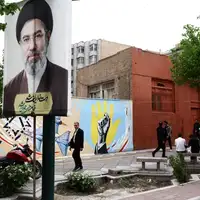
Billboards showing Iran’s new Supreme Leader Mojtaba Khamenei and his late father, Ali Khamenei, on the road to Beirut’s airport (June 2026)

Lebanon has ordered the removal of billboards showing Iran’s new Supreme Leader Mojtaba Khamenei and his late father from the road to Beirut’s airport, turning a dispute over public posters into a test of who gets to define the country’s fragile post-ceasefire moment.

The billboards, installed this week along the route to Beirut-Rafic Hariri International Airport, carried the slogan “Thank you to loyal Iran.” They appeared days after a ceasefire was announced between Israel and Hezbollah as part of wider US-Iran negotiations, and as Lebanese and Israeli officials continued direct US-mediated talks over southern Lebanon.

Interior Minister Ahmad Hajjar said Thursday he had ordered the banners and posters removed within two days. Speaking on the sidelines of a Cabinet meeting, he said the decision was part of efforts to regulate public spaces and enforce existing laws.

But the timing gave the order wider political weight. Hezbollah and its allies have portrayed the ceasefire as proof of Iran-backed “resistance” leverage, while Lebanon’s government is trying to show that decisions over the country’s territory, security and public space still belong to the Lebanese state.

The airport road is one of Lebanon’s most visible political corridors. For years, posters and banners linked to Hezbollah, Amal and Iran-aligned figures have lined parts of the route into Beirut.

Shiite mourners walk past a banner depicting Iran's late Supreme leader Ali Khamenei as they mark Ashura, the holiest day on the Shiite Muslim calendar, in the southern suburbs of Beirut, Lebanon, June 26, 2026.
100%
Shiite mourners walk past a banner depicting Iran's late Supreme leader Ali Khamenei as they mark Ashura, the holiest day on the Shiite Muslim calendar, in the southern suburbs of Beirut, Lebanon, June 26, 2026.

In 2022, Lebanon’s Tourism Ministry asked Hezbollah and Amal to remove billboards showing religious and political figures from the same road and replace them with signs promoting tourism.

The latest posters carried a sharper message. By thanking Iran days after the ceasefire, they presented Tehran not as an outside power in Lebanon’s war but as the loyal patron whose support helped shape the outcome.

That message comes as the ceasefire itself remains unsettled. Lebanese and Israeli officials have been engaged in US-mediated talks over southern Lebanon, including proposals for Israeli forces to hand some areas to the Lebanese army and for Hezbollah to be kept out of those zones.

Israel, however, has signaled it does not intend to leave southern Lebanon quickly. Prime Minister Benjamin Netanyahu has said Israel will remain in a southern security zone as long as required, while Defense Minister Israel Katz has said Israeli troops will not withdraw even under US pressure.

The ceasefire has also been strained by continued violence. Local and international reports have described Israeli strikes and gunfire in southern Lebanon since the truce was announced, while Hezbollah has accused Israel of violating the agreement.

Hezbollah, for its part, has rejected any settlement that resembles normalization with Israel. In a televised Ashura address on Friday, Hezbollah leader Naim Qassem said Israel must leave Lebanon “unconditionally” and said the group would accept no normalization, no end to hostility with Israel, no gains for Israel and no partial Israeli presence on Lebanese soil.

His remarks placed Hezbollah on a collision course with the logic of the US-mediated talks, which depend on a negotiated security arrangement in the south. They also reinforced the message carried by the airport road billboards: that Iran and Hezbollah see the ceasefire as part of a wider regional struggle, not merely a Lebanese border arrangement.

For Lebanon’s government, the posters created an immediate sovereignty problem. Leaving them in place would allow an Iran-Hezbollah victory message to dominate the country’s main international gateway at the very moment Beirut is trying to negotiate under its own authority.

Removing them, however, exposes the limits of that authority. The Lebanese state can clear a road, but it cannot easily resolve the deeper conflict behind the posters: Hezbollah’s weapons, Israel’s presence in the south, Iran’s role in the ceasefire and Washington’s attempt to keep Lebanon’s track separate from its broader deal with Tehran.

Most Viewed

IRGC personnel sheltered in Shiraz lodging complex were target of deadly strike
1
EXCLUSIVE

IRGC personnel sheltered in Shiraz lodging complex were target of deadly strike

2
EXCLUSIVE

Sources detail Ali Khamenei bunker with blast-resistant room

3
INSIGHT

President's economic reality check fuels Iran's US deal debate

4

North Korea received $25 million for Iran tunnel technology, ex-diplomat says

5

FIFA lets fans take rainbow flags to Iran-Egypt match, but bars Lion and Sun

Banner
Banner
Banner

Spotlight

  • Investigation traces January protest deaths to Gharazi Hospital in Isfahan
    SPECIAL REPORT

    Investigation traces January protest deaths to Gharazi Hospital in Isfahan

  • US-Iran MoU pauses conflict but leaves nuclear dispute unresolved

    US-Iran MoU pauses conflict but leaves nuclear dispute unresolved

  • Iran economists warn recovery needs reform not just relief
    INSIGHT

    Iran economists warn recovery needs reform not just relief

  • Rival visions of Iran take to the streets during Ashura
    INSIGHT

    Rival visions of Iran take to the streets during Ashura

  • Iran’s negotiators have 60 days; its factories may not
    ANALYSIS

    Iran’s negotiators have 60 days; its factories may not

  • Sources detail Ali Khamenei bunker with blast-resistant room
    EXCLUSIVE

    Sources detail Ali Khamenei bunker with blast-resistant room

  • US sanctions waiver could bring Iran's oil trade out of the shadows
    ANALYSIS

    US sanctions waiver could bring Iran's oil trade out of the shadows

  • IRGC personnel sheltered in Shiraz lodging complex were target of deadly strike
    EXCLUSIVE

    IRGC personnel sheltered in Shiraz lodging complex were target of deadly strike

•
•
•

More Stories

US-Iran MoU pauses conflict but leaves nuclear dispute unresolved

Jun 26, 2026, 09:30 GMT+1
•
Kambiz Tavana
US-Iran MoU pauses conflict but leaves nuclear dispute unresolved
100%
Greg Priddy - Analyst, Center for the National Interest

The US-Iran understanding appears more likely to freeze the conflict than resolve it, leaving the future of Iran's nuclear program as the central unresolved issue, according to Washington-based analyst Greg Priddy.

The arrangement follows months of confrontation and is designed to reduce the risk of renewed escalation. But it does not settle the core dispute between Washington and Tehran: how much uranium enrichment Iran will be allowed to retain, and under what conditions.

That question has long been the hardest part of any agreement. The latest understanding may ease immediate tensions, but it leaves unanswered what comes next and whether follow-on talks can produce a more durable settlement.

"The question is, do the follow-on talks yield a final deal that everyone can live with, do we go back to conflict, or do we just keep kicking the can down the road," Priddy said. "I think the most probable outcome is that they keep extending it."

Iran is unlikely to give up enrichment permanently, while the Trump administration has shown little interest in returning to a JCPOA-style framework that would allow limited enrichment under international safeguards.

Priddy said any long-term arrangement would probably need to include monitored enrichment, even if that remains politically difficult for Washington to accept.

"Iran is not going to concede to giving up enrichment forever," he said. "If we got to the point where the US could say yes, you could have limited enrichment under safeguards, a lot of other things start to become negotiable."

Priddy also said hardliners in Tehran may believe they have gained leverage after threatening the Strait of Hormuz, particularly after demonstrating they could use energy pressure to shape Washington's response.

"What I'm worried about at this point is I think there's a lot of hubris in Tehran right now among hardliners that they won the war," he said. "They can ask for everything now and get away with conceding very, very little."

Fears of higher gasoline prices and broader economic disruption helped push Washington toward restraint, while Persian Gulf energy infrastructure remained exposed.

Priddy described the situation as "mutually assured vulnerability," saying both sides now know they can target each other's energy infrastructure even if neither can eliminate the threat.

The regional fallout is likely to shape the next phase as much as the nuclear talks themselves. Persian Gulf states are likely to diversify their defence partnerships, while the United States may maintain a military presence in the region but with a smaller, more cautious footprint.

Israel remains the biggest wildcard in the next phase of negotiations. Washington appears intent on limiting further escalation, particularly in Lebanon, but Prime Minister Benjamin Netanyahu may still favour a more confrontational approach.

Priddy said he does not expect the current understanding to produce a grand bargain or a warmer relationship between Washington and Tehran. Instead, he said, the most likely outcome is a hostile but transactional relationship that is repeatedly extended rather than fundamentally resolved.

Global index says torture is embedded in Iran’s laws, courts and prisons

Jun 26, 2026, 03:37 GMT+1
Global index says torture is embedded in Iran’s laws, courts and prisons
100%
Students hold up blood-red handprint paintings as an act of protest at a girls’ school in Iran.

Iran was listed among the world’s highest-risk countries for torture, impunity and state violence in the 2026 Global Torture Index, released Thursday by the World Organization Against Torture (OMCT) and partner groups.

The index, produced for Iran in collaboration with Impact Iran, said torture remained deeply embedded in the country’s law, policy and practice, and warned that US and Israeli strikes on Iran during the June 2025 military escalation had further increased the risk of torture, ill-treatment and arbitrary detention.

The report said Iran scored at the most severe level on six of the index’s seven pillars: political commitment, police and institutional violence, impunity, victims’ rights, the right to defend human rights, and protection for all. It rated Iran as high-risk on conditions in detention.

It said Iran had not ratified the UN Convention against Torture, did not criminalize torture as a distinct offense, and continued to allow punishments such as flogging and amputation.

The report also cited the use of confessions in convictions, saying this created incentives for torture and ill-treatment to extract statements, including confessions later broadcast by state media.

It said at least 1,639 executions were recorded in Iran in 2025, including executions of people who were under 18 at the time of their alleged offenses.

The index also pointed to what it called near-total impunity, saying no independent body investigates torture allegations or deaths in custody, while overcrowded detention facilities operate with little or no outside oversight.

Women and girls, ethnic minorities, LGBTQIA+ people, human rights defenders, journalists and lawyers face heightened risks of torture, arbitrary detention and other abuse, the report said.

“In Iran, torture is not a failure of the system – it is the system: written into law, rewarded by the courts, and concealed behind prison walls,” said Rose Richter, Impact Iran’s executive director.

Richter said security forces fired on civilians even inside hospitals during the crackdown of December 2025 and January 2026, when more than 50,000 people were arrested and more than 7,000 killed.

Other rights groups and monitoring organizations have previously reported higher figures for the crackdown, pointing out the difficulty of verifying casualties and arrests amid restrictions on access, intimidation of families and limited independent reporting inside Iran.

  • Over 36,500 killed in Iran's deadliest massacre, documents reveal

    Over 36,500 killed in Iran's deadliest massacre, documents reveal

“Behind each of those numbers is a person whose suffering was deliberate, and a family still waiting for the truth,” Richter said.

Gerald Staberock, secretary general of OMCT, said the index was intended to turn “scattered warnings into evidence that cannot be ignored.”

“The Global Torture Index should be read by development agencies, but also by security actors and businesses seeking to engage or invest in the countries covered,” Staberock said.

OMCT urged Iran to halt executions and judicial corporal punishment, ratify the UN Convention against Torture, criminalize torture, end the use of coerced confessions and give the UN Fact-Finding Mission unhindered access.

Ship attack in Hormuz tests fragile US-Iran understanding

Jun 26, 2026, 01:05 GMT+1
Ship attack in Hormuz tests fragile US-Iran understanding
100%
IRGC personnel patrol in Persian Gulf waters in a speed boat in this undated file photo

A cargo ship was struck by a projectile off the coast of Oman on Thursday, underscoring the fragility of the US-Iran understanding as tensions over navigation through the Strait of Hormuz resurfaced.

The latest incident highlighted the central place of the strategic waterway in the de-escalation agreement, with Iran tightening its warnings to shipping while the United States and Perisan Gulf Arab states insisted any lasting arrangement must guarantee freedom of navigation.

The UK Maritime Trade Operations said the vessel was hit on its starboard side at 2:10 p.m. UTC about 7.5 nautical miles southeast of Dahit, Oman, damaging its bridge. The ship's master reported that all crew were safe and there was no environmental damage.

The Wall Street Journal, citing two senior US officials, reported that Iran's Revolutionary Guards attacked the Singapore-flagged cargo ship in the Strait of Hormuz.

The incident was followed by a warning by Iran's Persian Gulf Strait Authority that vessels using routes outside its designated framework would not be covered by safe-passage guarantees, insurance protections or related liability arrangements.

"Any consequences arising from unauthorized routing shall be the sole responsibility of the vessel owner, charterer, and master," the authority said on X.

IRGC-affiliated outlets also reported that three tankers attempting to pass through a US-declared corridor in Omani waters turned back after receiving warnings from the Revolutionary Guards.

The vessels were identified as the UAE-owned Blue Star I, Japan's Azumasan and the Japan-managed Omega Trader.

The attack prompted the International Maritime Organization to temporarily suspend its evacuation operation for ships in the Persian Gulf, saying it needed to reassess safety guarantees before continuing.

IMO Secretary-General Arsenio Dominguez said the pause was intended "to reconfirm that the necessary safety guarantees continue to be in place for the ships on our evacuation list and all those in the region."

The developments came as US Secretary of State Marco Rubio and GCC foreign ministers met in Manama and reaffirmed that reopening the Strait of Hormuz to free and unrestricted navigation was essential to regional and global security.

Rubio and GCC foreign ministers said in a joint statement on Thursday that "lasting regional peace and security requires addressing the full spectrum of Iran’s threats, including its ballistic missiles, drones, and support of proxies in the region."

The ministers said any US-Iran de-escalation agreement must guarantee Persian Gulf security and freedom of navigation through the strait. They also rejected any tolls, fees or attempts to assert control over Hormuz, saying transit passage must remain protected under international law.

The GCC added that any regional understanding must take into account the security interests of Persian Gulf states while safeguarding the region's economic and developmental gains.

Oil prices rose on Thursday as the latest maritime incident renewed concerns over shipping through one of the world's most important energy corridors.

Brent futures rose just over 2 percent to $75.26 a barrel, according to Reuters, while US West Texas Intermediate rose 2.3 percent to $71.92.

Iran’s negotiators have 60 days; its factories may not

Jun 25, 2026, 13:21 GMT+1
•
Mohamad Machine-Chian
Iran’s negotiators have 60 days; its factories may not
100%

Iran’s negotiators have opened a renewable 60-day clock. Its factories may not have that long. The Chamber of Commerce’s own PMI survey shows warehouses emptying, orders drying up and production lines at risk of stoppage within months.

Every serious economy watcher knows the ritual. At the start of each month, the purchasing managers’ indexes land, and markets move.

A PMI is the closest thing economics has to a pulse reading. Surveyors ask the people who run companies a simple set of questions about the month just ended: did production rise or fall, did new orders come in, are you hiring?

The answers are compressed into a number from 0 to 100. The 50 line separates growth from contraction. A few points below 50 signals trouble.

Readings under 40 usually belong to crises. When the index for US manufacturing fell to 41.5 in April 2020, with the country in lockdown, it made headlines for weeks.

A pulse reading below crisis level

Iran has a PMI too. Few outside the country have heard of it.

Since 2018, the research center of Iran’s Chamber of Commerce has surveyed managers of Iranian firms every month, following standard PMI methodology, and published the result under the Persian acronym Shamekh. The acronym is formed from Shakhes-e Modiran-e Kharid, literally “the index of purchasing managers.”

It is the instrument Iran’s own business establishment built to take the economy’s pulse. Official inflation statistics can be delayed, reweighted and narrated. A factory’s order book is harder to argue with.

That is what makes the latest readings so remarkable.

In March, the month war hit business conditions, Iran’s manufacturing Shamekh registered 26.2.

Some calibration is necessary, because the scale matters.

In April 2020, the cruelest month of the pandemic for many economies, Spain’s manufacturing PMI fell to 30.8. Britain’s fell to 32.6, its worst reading in roughly three decades. India, which confined 1.4 billion people to their homes, recorded 27.4, the lowest in that survey’s history.

Iran’s manufacturing sector in March came in below every one of them.

And the comparison flatters the situation, because those pandemic readings measured economies in a medically induced coma. Governments had deliberately and temporarily shut commerce down. Within months, every one of those indexes was back above 50.

No one switched Iran’s economy off to save lives.

Epic Fury may have concluded, but the economic fury continues. Judging by the latest figures, it is working. Iran’s industry is being suffocated by war, sanctions and the lingering effects of a naval blockade whose dismantling has now been promised but not yet proved in economic life.

The difference is the difference between a pause and a stroke.

Empty warehouses, falling orders

The 26.2 reading was never announced in a standalone report.

The chamber skipped its March publication. The figure surfaced quietly in a chart accompanying the April edition.

April itself brought no relief worth the name. Manufacturing stood at 37.4, while the whole-economy index was 38.5. Apart from March, these were the lowest readings in the survey’s history.

Iranian industry has now spent five consecutive months below the 50 line, meaning five straight months of contraction.

  • US sanctions waiver could bring Iran's oil trade out of the shadows

    US sanctions waiver could bring Iran's oil trade out of the shadows

The Iranian New Year holidays, known as Nowruz, always slow business activity around late March and early April. Factories close, workers travel and early-spring readings often weaken. But the survey has eight Nowruz seasons on record, and none came anywhere near these levels.

Ten of the survey’s eleven components are below 50.

New orders, at 37.4, show demand drying up at home and in export markets alike. Delivery times, at 39.6, carry some of the report’s most telling explanations: internet shutdowns, broken payment channels and import restrictions.

Raw-material inventories stand at 32.6. That is not just a weak number; it is a warning about the physical ability to keep producing.

  • President's economic reality check fuels Iran's US deal debate

    President's economic reality check fuels Iran's US deal debate

Here the chamber’s own language turns blunt. If conditions persist, it warns, production lines face partial or complete stoppage in the months ahead.

Employment, at 36.8, is the lowest in the survey’s history, even lower than during the war month itself. The layoffs did not end with the ceasefire. They are deepening.

One component points the other way, and it completes the picture.

The price of raw materials stands at 77.4, deep in inflationary territory. Iranian firms are producing less, selling less and paying more for what they buy.

  • Tehran bread prices jump up to 100% in latest increase

    Tehran bread prices jump up to 100% in latest increase

Demonstrating stagflation usually requires setting two datasets side by side. Here, both halves sit on a single page of a single report, published by a single institution.

The costs are already passing through to households. Consumer prices rose nearly 9 percent in May. Not at an annual rate. In one month.

That is roughly what American consumers endured across the whole of 2022.

  • Iran may get a lifeline, but major obstacles remain

    Iran may get a lifeline, but major obstacles remain

A 60-day clock factories may not have

What turns a bad snapshot into a worse forecast is the composition underneath.

For years, two sectors helped hold the index up: steel and petrochemicals. They are among Iran’s principal earners of hard currency, and they reliably scored above 50, pulling the average with them.

By the chamber’s own account, both were directly struck in the war.

Their weakness closes a loop. Fewer exports mean less foreign exchange. Less foreign exchange means scarcer and costlier imported inputs. Scarcer inputs mean still less production.

  • Relief or resistance? Tehran dailies offer diverging readings of talks

    Relief or resistance? Tehran dailies offer diverging readings of talks

Set that loop beside the emptying warehouses, and beside a blockade that, by available estimates, has cost the economy on the order of $430 million a day. Even if the new memorandum begins to unwind it, the damage already done will not disappear on the day diplomats announce progress.

The component worth watching now is the quietest one: expectations of production for the month ahead.

It stands at 32.2, among the lowest readings the survey has ever produced. That question is about the future, answered by the people with the most direct knowledge of it and the least incentive for theater.

A memorandum now promises to change that future. A promise of the same kind preceded last year’s 12-day war in June 2025. Whether this one holds, or goes the way of that one, is the open question.

The agreement commits Washington to begin dismantling the blockade at once. But a signed page is not a furnace relit.

The talks in a Swiss resort started last week, and the 60 days the memorandum allots to reach a deal are, in the American president’s own telling, extendable by mutual consent.

  • A thaw with the US won't fill Iranian tables overnight

    A thaw with the US won't fill Iranian tables overnight

Tehran has run this clock before. It is reportedly running it now over Lebanon.

At current inventories, the chamber’s surveyors warn, production lines face stoppage in the months ahead.

A government that spends its factories’ last quarter on a war beyond its borders has ranked its priorities. The managers who answered at 26 sit far down the list.

Omani shipping corridor rattles Iran hardliners over Hormuz control

Jun 25, 2026, 12:39 GMT+1
Omani shipping corridor rattles Iran hardliners over Hormuz control
100%
Ships are seen in the Strait of Hormuz from southern Iran on June 18, 2026.

An ultraconservative Iranian outlet warned on Wednesday that a temporary shipping corridor announced by Oman in coordination with the International Maritime Organization could become a “direct challenge” to Iran’s position in the Strait of Hormuz.

Raja News argued that the Omani route, which it said runs south of the traditional Traffic Separation Scheme and through Omani coastal waters, could create a parallel system for shipping in Hormuz outside Iranian oversight.

The report came after Oman announced on June 23 that it was providing vessels with the option of using a temporary maritime corridor in the Strait of Hormuz, coordinated with the IMO and based on coordinates announced by the UN shipping agency and Omani authorities.

Oman said the corridor was in line with efforts by the United States and Iran and was intended to guarantee freedom of navigation “without imposing any tolls.” It said ships seeking to transit should coordinate with the IMO.

The IMO said the corridor was part of a wider evacuation plan for more than 11,000 seafarers stranded in the region after months of disruption to civilian shipping.

“We have secured the necessary safety guarantees and have thoroughly verified the conditions for safe navigation to support these operations,” IMO Secretary-General Arsenio Dominguez said in a June 23 statement.

Raja News said Oman’s reference to free passage with no tolls was the key point, arguing that it could undercut any Iranian effort to shape future transit terms in Hormuz.

Raja News described the Omani corridor as a “dangerous” step, saying it could divert ships from a northern passage announced by Iran after the usual shipping lane through Hormuz was disrupted during the recent conflict.

It also argued that the route could preserve a US security role in the strait while presenting it as voluntary support for safe transit rather than a coercive military presence.

Raja News said the issue required a rapid response from Iran’s negotiating team and, if necessary, from military institutions, to prevent what it called an apparently temporary arrangement from becoming entrenched.

“Oman’s decision, made just one day after talks with Iranian officials in Muscat, requires a swift response from Iran’s negotiating team and, if necessary, the country’s military institutions to prevent this apparently temporary precedent from being implemented and entrenched in the Strait of Hormuz,” the report said.

Oman’s statement, however, framed the measure as a temporary maritime option tied to freedom of navigation, international law and the law of the sea.

On Thursday, US Secretary of State Marco Rubio framed the dispute as a test of Iran’s conduct rather than its rhetoric, effectively placing Washington behind the Omani-IMO route as an operational benchmark for safe passage through Hormuz.

He said Iranian officials and media could continue making “maximalist” public statements, but warned that if such rhetoric translated into threats against vessels or disruption of shipping, Washington would treat it as a violation of the agreement.