Iran denies ban on 'death to America' chants, flag burning at rallies
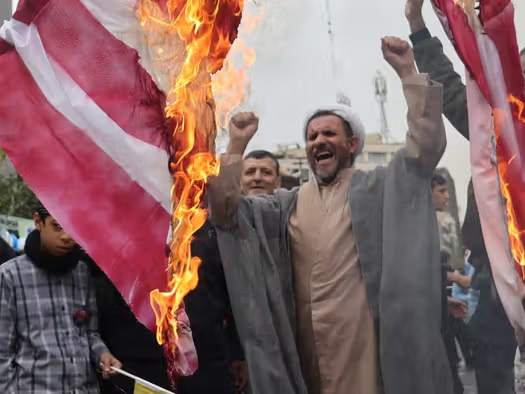
The Islamic Republic’s judiciary denied reports that chanting slogans against the United States or burning the US flag at gatherings had been banned, calling the claim “fake” and “false.”
The judiciary’s media center said no law or criminal provision exists banning such acts. It described the report as part of a media “psychological operation,” without giving further details.
The denial came after claims circulated that authorities had prohibited anti-US slogans and the burning of the American flag at public gatherings following the memorandum of understanding signed between Tehran and Washington.






Messages sent to Iran International from residents in Khuzestan, Ilam, Lorestan, East Azarbaijan, Alborz, Tehran and other provinces described hours-long daily power cuts and recurring water shortages that began with the onset of summer.
The reports come as much of Iran experiences extreme heat, placing additional strain on the country's aging electricity and water networks.
A resident of Khuzestan, one of Iran's main electricity-producing provinces, said scheduled power cuts had resumed despite the province generating far more electricity than it consumes.
"On the first day of summer, with temperatures above 50 degrees Celsius, they started cutting electricity again in a province that produces twice its own needs."
Residents in Ilam province also reported electricity outages lasting up to four hours as temperatures reached 46 degrees Celsius. One warned that if the blackouts continue, authorities would face "angry and protesting people."
In Pardis, east of Tehran, a resident of a 14-story apartment building said electricity was cut for four hours during the day, leaving elevators out of service.
"How are we supposed to climb all these stairs?"
Others said the loss of elevator access posed particular difficulties for elderly residents and families with young children.
Water shortages deepen disruption
Citizens also reported prolonged water outages, which they said often coincided with electricity cuts because pumping stations stopped operating.
Mehdi Masaeli, secretary of Iran's Electricity Industry Syndicate, said last year that water supplies are interrupted when electricity fails because pumps stop working.
Residents in Boumehen near Tehran said they had access to running water on only two days during the previous week, and then only for a few hours.
"We have a sick person at home. We no longer know who to turn to."
People from Shahriar and Qods, west of Tehran, also described prolonged water cuts, with some saying supplies were unavailable from mid-afternoon until early the following morning. Several said repeated calls to the local water utility produced only tracking numbers and recorded messages.
"Water is a basic necessity, not a luxury service."
Officials have cited falling reservoir levels, declining rainfall and rising consumption as the main causes of the shortages. Many people, however, said authorities were blaming consumers instead of addressing years of underinvestment and poor management.
One message from Ilam province said the city of Shabab had gone without running water for three consecutive days.
Some also compared the shortages with recent warnings about attacks on infrastructure.
"There was no need for anyone to attack the energy infrastructure," one citizen wrote. "Government inefficiency has taken our water away and pushed us back to the Stone Age. We carry water home in containers."
Higher bills, aging infrastructure
People also complained that utility bills had increased even as services deteriorated.
A resident in Zanjan said electricity and water tariffs had quietly risen just as power cuts resumed. In Ahvaz, people reported sharply higher water bills, with one saying many families could no longer afford to pay them and that local authorities were unwilling to offer installment plans.
Energy experts have long warned that Iran's electricity and water systems suffer from years of inadequate investment in power generation, transmission networks and water infrastructure.
They say authorities have repeatedly relied on rotating blackouts and water restrictions to manage seasonal shortages rather than addressing the underlying causes, leaving households increasingly vulnerable during periods of extreme heat.
Every serious economy watcher knows the ritual. At the start of each month, the purchasing managers’ indexes land, and markets move.
A PMI is the closest thing economics has to a pulse reading. Surveyors ask the people who run companies a simple set of questions about the month just ended: did production rise or fall, did new orders come in, are you hiring?
The answers are compressed into a number from 0 to 100. The 50 line separates growth from contraction. A few points below 50 signals trouble.
Readings under 40 usually belong to crises. When the index for US manufacturing fell to 41.5 in April 2020, with the country in lockdown, it made headlines for weeks.
A pulse reading below crisis level
Iran has a PMI too. Few outside the country have heard of it.
Since 2018, the research center of Iran’s Chamber of Commerce has surveyed managers of Iranian firms every month, following standard PMI methodology, and published the result under the Persian acronym Shamekh. The acronym is formed from Shakhes-e Modiran-e Kharid, literally “the index of purchasing managers.”
It is the instrument Iran’s own business establishment built to take the economy’s pulse. Official inflation statistics can be delayed, reweighted and narrated. A factory’s order book is harder to argue with.
That is what makes the latest readings so remarkable.
In March, the month war hit business conditions, Iran’s manufacturing Shamekh registered 26.2.
Some calibration is necessary, because the scale matters.
In April 2020, the cruelest month of the pandemic for many economies, Spain’s manufacturing PMI fell to 30.8. Britain’s fell to 32.6, its worst reading in roughly three decades. India, which confined 1.4 billion people to their homes, recorded 27.4, the lowest in that survey’s history.
Iran’s manufacturing sector in March came in below every one of them.
And the comparison flatters the situation, because those pandemic readings measured economies in a medically induced coma. Governments had deliberately and temporarily shut commerce down. Within months, every one of those indexes was back above 50.
No one switched Iran’s economy off to save lives.
Epic Fury may have concluded, but the economic fury continues. Judging by the latest figures, it is working. Iran’s industry is being suffocated by war, sanctions and the lingering effects of a naval blockade whose dismantling has now been promised but not yet proved in economic life.
The difference is the difference between a pause and a stroke.
Empty warehouses, falling orders
The 26.2 reading was never announced in a standalone report.
The chamber skipped its March publication. The figure surfaced quietly in a chart accompanying the April edition.
April itself brought no relief worth the name. Manufacturing stood at 37.4, while the whole-economy index was 38.5. Apart from March, these were the lowest readings in the survey’s history.
Iranian industry has now spent five consecutive months below the 50 line, meaning five straight months of contraction.
The Iranian New Year holidays, known as Nowruz, always slow business activity around late March and early April. Factories close, workers travel and early-spring readings often weaken. But the survey has eight Nowruz seasons on record, and none came anywhere near these levels.
Ten of the survey’s eleven components are below 50.
New orders, at 37.4, show demand drying up at home and in export markets alike. Delivery times, at 39.6, carry some of the report’s most telling explanations: internet shutdowns, broken payment channels and import restrictions.
Raw-material inventories stand at 32.6. That is not just a weak number; it is a warning about the physical ability to keep producing.
Here the chamber’s own language turns blunt. If conditions persist, it warns, production lines face partial or complete stoppage in the months ahead.
Employment, at 36.8, is the lowest in the survey’s history, even lower than during the war month itself. The layoffs did not end with the ceasefire. They are deepening.
One component points the other way, and it completes the picture.
The price of raw materials stands at 77.4, deep in inflationary territory. Iranian firms are producing less, selling less and paying more for what they buy.
Demonstrating stagflation usually requires setting two datasets side by side. Here, both halves sit on a single page of a single report, published by a single institution.
The costs are already passing through to households. Consumer prices rose nearly 9 percent in May. Not at an annual rate. In one month.
That is roughly what American consumers endured across the whole of 2022.
A 60-day clock factories may not have
What turns a bad snapshot into a worse forecast is the composition underneath.
For years, two sectors helped hold the index up: steel and petrochemicals. They are among Iran’s principal earners of hard currency, and they reliably scored above 50, pulling the average with them.
By the chamber’s own account, both were directly struck in the war.
Their weakness closes a loop. Fewer exports mean less foreign exchange. Less foreign exchange means scarcer and costlier imported inputs. Scarcer inputs mean still less production.
Set that loop beside the emptying warehouses, and beside a blockade that, by available estimates, has cost the economy on the order of $430 million a day. Even if the new memorandum begins to unwind it, the damage already done will not disappear on the day diplomats announce progress.
The component worth watching now is the quietest one: expectations of production for the month ahead.
It stands at 32.2, among the lowest readings the survey has ever produced. That question is about the future, answered by the people with the most direct knowledge of it and the least incentive for theater.
A memorandum now promises to change that future. A promise of the same kind preceded last year’s 12-day war in June 2025. Whether this one holds, or goes the way of that one, is the open question.
The agreement commits Washington to begin dismantling the blockade at once. But a signed page is not a furnace relit.
The talks in a Swiss resort started last week, and the 60 days the memorandum allots to reach a deal are, in the American president’s own telling, extendable by mutual consent.
Tehran has run this clock before. It is reportedly running it now over Lebanon.
At current inventories, the chamber’s surveyors warn, production lines face stoppage in the months ahead.
A government that spends its factories’ last quarter on a war beyond its borders has ranked its priorities. The managers who answered at 26 sit far down the list.


