• العربية
  • فارسی
Brand
  • Iran Insight
  • Politics
  • Economy
  • Analysis
  • Special Report
  • Opinion
  • Podcast
  • Iran Insight
  • Politics
  • Economy
  • Analysis
  • Special Report
  • Opinion
  • Podcast
  • Theme
  • Language
    • العربية
    • فارسی
  • Iran Insight
  • Politics
  • Economy
  • Analysis
  • Special Report
  • Opinion
  • Podcast
All rights reserved for Volant Media UK Limited
volant media logo
EXCLUSIVE

Opium for survival: Inside a shift in Iran’s Zagros villages

Saman Rahmatian
Saman Rahmatian

Iran International

Jun 23, 2026, 22:00 GMT+1

Opium poppy cultivation in some villages of the Zagros mountains in western Iran has evolved from a hidden, scattered practice into an essential part of the rural subsistence economy, an Iran International investigation found.

On the rugged slopes of the Zagros, amid rocky plots and felled oak trees, opium poppy is no longer merely an illegal crop. It has become a sign of the economic deadlock facing villages where wheat, chickpeas and lentils no longer cover the costs of farming and daily life.

A few kilometers from the road, deep in the Zagros mountains, a small plot of land emerges from among cut-down oaks. Access to it is difficult, and it is barely visible from the village. Its owner prefers to watch over it from a distance.

He told Iran International that if authorities find the plot, it would be difficult for them to prove who owns the land.

Opium poppy plants have grown quietly in the Zagros, a crop now seen more often than before in some villages across the region.

Lancing season on the Zagros slopes

It is now the season for lancing poppy capsules in the Zagros range. Before the sun grows harsh over the plains, farmers make cuts in the poppy bulbs.

Hours later, a white sap seeps from the wounds, a substance that turns into opium once dried.

Farmers say poppy is usually planted in the region in two seasons. Some fields are cultivated in the first month of autumn, around September and October, and others in the second month of winter, around January and February. Harvesting continues from mid- to late-spring, roughly from April to late May.

'Poppy is our only hope'

Iran International’s investigations show that poppy cultivation in the Zagros has been expanding for more than 10 years.

Most poppy growers prefer to plant the crop on mountain slopes and in hard-to-reach areas, where the risk of detection is lower.

One farmer said poppy is suited to the region’s climate and can be grown even on rain-fed and rocky land.

“Planting in the heart of the mountain is hard, but we have no other choice,” he said. “Poppy is our only hope.”

Wheat no longer covers the costs

For years, wheat, chickpeas and lentils formed the backbone of village economies in the Zagros. But farmers tell Iran International rising production costs, consecutive droughts, declining land productivity and delays in government payments have changed the farming equation.

“Wheat no longer covers the cost of the land,” one farmer said. “Costs have risen so much that in the end, nothing is left for us — and that is if the government pays for the wheat on time.”

Academic research and international studies in poppy-producing regions confirm that drought, falling agricultural income and the lack of alternative economic options are among the main factors pushing farmers toward poppy cultivation.

The United Nations Development Program has also stressed that combating poppy cultivation will be difficult without creating sustainable economic alternatives.

The opium economy: A more profitable crop

The value of the opium market has risen in recent years. Some Iranian media outlets reported in April that the retail price of each gram of opium was about 250,000 tomans, roughly $1.6.

According to data from the United Nations Office on Drugs and Crime, poppy fields in climates similar to Iran’s typically produce between 20 and 30 kilograms of pure opium per hectare. In some regions, the figure exceeds 50 kilograms.

A comparison between income from poppy and wheat, one of the main agricultural products of western Iran, helps explain why some farmers have turned to the crop.

With wheat priced at about 49,500 tomans per kilogram and average production of 3.5 tons per hectare, the value of wheat from 1 hectare is estimated at around 173 million tomans (almost $1,081).

By contrast, a hectare of poppy producing 20 to 30 kilograms of opium could generate an estimated 5 billion to 7.5 billion tomans, or roughly $31,000 to $47,000, based on the reported retail price.

In higher-yield areas, where output can exceed 50 kilograms per hectare, the value could rise to about 12.5 billion tomans, or roughly $78,000. That means the estimated value of opium from 1 hectare could be about 29 to 72 times higher than wheat grown on the same area.

Cultivated area grows more than threefold

Signs of the spread of poppy cultivation can even be seen in remarks by some officials.

According to Mohammad Jamalian, a member of parliament’s Health and Medical Commission, the area under poppy cultivation in Iran has reached about 32,000 hectares — a figure he said is more than 3 times higher than in previous years.

Accurately estimating the total area under cultivation is difficult, because many poppy fields are set up in remote lands and places outside public view.

However, a review of reports published in recent years shows that the names of Zagros provinces appear more often than other regions in news about the discovery and destruction of poppy fields. These are provinces that are simultaneously grappling with drought, unemployment and livelihood crises.

Afghanistan’s shadow over the regional market

The story of poppy does not end in the Zagros fields. Hundreds of kilometers away, in Afghanistan, an unprecedented decline in poppy cultivation following the Taliban’s return to power has altered the dynamics of the market across the region.

Iran’s Drug Control Headquarters has said the sharp fall in poppy cultivation in Afghanistan has led to a noticeable decline in the entry and seizures of opium in Iran, and has even created problems in supplying raw materials for some medicines.

The recent war has added to these pressures and worsened Iran’s medicine supply crisis, with health officials reporting shortages of nearly 1,000 types of medication across the country.

Meanwhile, Iran remains one of the world’s largest opium consumer markets.

According to Health Ministry officials, in addition to the hidden number of drug users, about 3 million people in Iran are officially registered as addicts, and opium remains their main drug of use.

Western Iran is also located near one of the region’s key routes for the trafficking of opiates, a route that passes through Iraq and the Kurdistan Region and continues toward Turkey and Europe.

Although there is no evidence that the crop produced by poppy farmers in the Zagros is exported, the existence of a consumer market and the region’s sensitive geography are among the factors that could create fertile ground for the phenomenon to expand.

The blade drawn today across poppy capsules on the slopes of the Zagros reveals the trace of a crisis that began with drought and rising costs — and has now changed the path of livelihood in some of Iran’s villages.

Most Viewed

Will the Islamic Republic trade with the 'Great Satan'?
1
INSIGHT

Will the Islamic Republic trade with the 'Great Satan'?

2
INSIGHT

Iran's postwar rallies become flashpoint in diplomacy debate

3

Lebanon 'deconfliction cell' emerges after intense Switzerland talks

4

Cyber campaign posing as Iran International staff continues

5

Caspian seals face extinction threat as deaths continue

Banner
Banner
Banner

Spotlight

  • Tehran bread prices jump up to 100% in latest increase

    Tehran bread prices jump up to 100% in latest increase

  • Rising gym fees push fitness beyond reach for many Iranians
    VOICES FROM IRAN

    Rising gym fees push fitness beyond reach for many Iranians

  • Relief or resistance? Tehran dailies offer diverging readings of talks
    INSIGHT

    Relief or resistance? Tehran dailies offer diverging readings of talks

  • Will the Islamic Republic trade with the 'Great Satan'?
    INSIGHT

    Will the Islamic Republic trade with the 'Great Satan'?

  • Iran's postwar rallies become flashpoint in diplomacy debate
    INSIGHT

    Iran's postwar rallies become flashpoint in diplomacy debate

  • MoU's forgotten casualty is the Iranian people
    OPINION

    MoU's forgotten casualty is the Iranian people

•
•
•

More Stories

Banking disruption hits services at eight Iranian banks

Jun 23, 2026, 14:20 GMT+1
Banking disruption hits services at eight Iranian banks
100%
File photo of people queue at an ATM in an Iranian city as customers seek access to banking services.

At least eight Iranian banks suffered widespread service disruptions on Tuesday, leaving customers unable to access many electronic and card-based services days after a separate outage affected four major banks.

Customers told Iran International that services at Pasargad, Melli, Mellat, Sepah, Tejarat, Saderat, Tose’e Ta’avon and Resalat banks were severely disrupted on Tuesday with reports indicating that almost all services had become unavailable.

Some domestic media outlets also confirmed the disruptions. ILNA news agency reported that parts of Iran's banking systems had experienced outages and slowdowns since Tuesday morning.

The Informatics Services Corporation later pointed to cyberattacks as the cause of the latest problems.

“The Informatics Services Corporation has temporarily taken card-based services offline to prevent any unauthorized access and safeguard customers’ data and assets,” the company said in a statement.

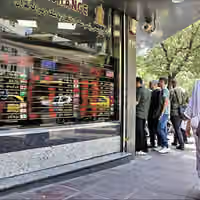
Customers wait at a bank branch in Iran as staff process transactions at service counters. (undated)
100%
Customers wait at a bank branch in Iran as staff process transactions at service counters.

Outages follow earlier attack

The disruption comes after electronic services at Melli, Tejarat, Saderat and Tose’e Saderat banks were hit by major outages on June 13.

Those problems affected mobile banking, internet banking, automated teller machines, point-of-sale terminals and other card services.

A day later, the Coordination Council of Banks said the outage resulted from a “limited cyberattack” targeting communications infrastructure shared by the four lenders. The council said no unauthorized access to customer data had occurred and no information had been deleted.

Meysam Zohourian, a member of parliament’s Economic Committee, later warned that a full restoration of services could take up to two weeks.

“Despite investigations by various bodies, the origin and cause of the main attack have not yet been identified, and even replacing hardware has not solved the problem,” Zohourian wrote on X.

A customer speaks with a bank teller at a branch in Iran. (undated)
100%
A customer speaks with a bank teller at a branch in Iran.

Infrastructure under scrutiny

Zohourian also criticized the role of the Informatics Services Corporation, which provides key banking and payment infrastructure and is partly owned by the Central Bank and several commercial lenders.

Iran’s banking sector has faced repeated service outages in recent years, many of them linked to cyberattacks. Such disruptions have become more common during periods of conflict and heightened security concerns, raising questions about the resilience of the country’s financial infrastructure.

Tehran bread prices jump up to 100% in latest increase

Jun 23, 2026, 13:13 GMT+1
•
Hooman Abedi
Tehran bread prices jump up to 100% in latest increase
100%
A baker prepares traditional flatbread Barbari at a bakery in Iran.

Bread prices across Tehran province have risen by as much as 100%, pushing the cost of one of the most important staple foods sharply higher and raising fresh concerns over government plans to overhaul the country's subsidy system.

Residents arriving at bakeries on Tuesday found new official prices in effect following an order issued by Tehran provincial authorities and announced by the Iran Chamber of Guilds' flour and bread working group. Under the new rates, lavash flatbread now costs 27,000 rials (2 cents), yeast-leavened barbari 100,000 rials (6 cents) and sangak 155,000 rials (10 cents).

The average monthly wage in Iran is estimated at around $150. A family relying solely on bread for its food consumption would spend roughly $8-$17 per month, depending on the type of bread purchased.

  • Bread shortages, soaring prices strain households in Iran, residents say

    Bread shortages, soaring prices strain households in Iran, residents say

The increase came only two days after Agriculture Minister Gholamreza Nouri Ghezeljeh said bread price rises were not under consideration and that the government was pursuing plans to transfer subsidies from bakeries to households through an expanded electronic voucher system.

The latest hike continues a trend that began during the presidency of the late Ebrahim Raisi and has accelerated under President Masoud Pezeshkian. Compared with less than a year ago, official price schedules show sangak prices have risen by 104%, barbari by 85% and lavash by 93%.

Freshly baked Sangak bread is displayed at a bakery in Iran (undated)
100%
Freshly baked Sangak bread is displayed at a bakery in Iran

Before September 2024, when the US dollar traded at around 600,000 rials on the free market, Lavash cost 5,000 rials ($0.008), while Barbari sold for 18,000 rials (3 cents) and Sangak for 30,000 rials (5 cents).

The increase follows similar price rises elsewhere in the country. Bread prices in West Azarbaijan province rose by 70% to 100% last month, while prices in Mashhad increased by an average of 49% in mid-June. Reports from other provinces have also pointed to either higher bread prices or reductions in dough weights, a practice some consumers and analysts describe as hidden inflation.

Card-based bread system

The latest increase comes as authorities continue to rely on the Nanino digital monitoring platform, introduced in 2022 to distribute subsidized flour based on bakery sales.

  • Rampant inflation may ignite bread riots in Iran, economist warns

    Rampant inflation may ignite bread riots in Iran, economist warns

Many bakers say technical problems and disputed calculations have reduced their flour allocations. Although authorities insist there are no limits on bread purchases, consumers in many areas report restrictions as bakeries attempt to stretch subsidized flour supplies.

Subsidy cuts spark concern

The Pezeshkian administration has steadily reduced support for wheat and flour subsidies since taking office and is examining plans to integrate bread subsidies into the electronic voucher program, a move that could effectively end the current subsidy structure.

The proposal has generated concern even among media outlets generally supportive of state policies. News website Khabar Online warned that public tolerance for rising prices was wearing thin and that additional pressure linked to a staple as widely consumed as bread could provoke a strong public reaction.

"Public tolerance for price increases has reached its limit, and society may face severe tension and shock from any new pressure, particularly over a product such as bread that is consumed extensively across cities, villages and lower-income households," the outlet wrote.

Freshly baked lavash bread is displayed at a bakery in Iran. (undated)
100%
Freshly baked lavash bread is displayed at a bakery in Iran.

Bakery owners say they face growing costs for labor, utilities and raw materials while operating under regulated prices and delayed subsidy payments. Economists and labor activists warn that repeated increases in bread prices disproportionately affect low-income families because bread remains a key component of household consumption.

The price rise comes as inflation remains elevated. According to Iran's Statistical Center, consumer prices in May were 83.9% higher than a year earlier, while annual inflation reached 57.7%.

As the government moves ahead with subsidy reforms, the price of bread is increasingly becoming a measure of the economic strain facing millions of families across the country.

Rising gym fees push fitness beyond reach for many Iranians

Jun 23, 2026, 10:38 GMT+1
•
Saba Heidarkhani
Rising gym fees push fitness beyond reach for many Iranians
100%
A man adjusts a treadmill at a gym in Iran.

Soaring gym fees and shrinking household budgets are forcing many Iranians to abandon sports and fitness activities, turning what was once a routine part of daily life into an unaffordable luxury, according to messages sent to Iran International.

Monthly gym memberships that were once within reach for many families now cost at least 20 million rials ($12.5) in smaller cities. In some gyms in Tehran and other major urban centers, 12 training sessions can cost as much as 200 million rials ($125). The average wage in Iran is $150.

Gym owners say inflation, rising rents, higher energy bills and the growing cost of imported equipment have left them little choice but to raise fees. For many households, however, food, housing and transportation now take priority over exercise.

Teen athletes forced to quit

Many of the messages received by Iran International on the issue came from teenagers who said financial pressures were disrupting their athletic ambitions.

A 15-year-old taekwondo athlete said she had spent months trying to save enough money to buy a punching bag. A 13-year-old basketball player said he had been forced to stop training indoors because of rising fees.

A university student in Mashhad said gym membership remained out of reach despite a strong interest in fitness.

“Registering at a gym and working out is something I still want to do, but my salary is so low that I cannot afford it,” the student said.

100%

The decline in participation is also hitting gym owners and coaches.

A gym manager in eastern Tehran said the number of clients at his facility had fallen to roughly one-third of previous levels, despite keeping membership fees unchanged.

Coaches in several cities said they had lost most of their students in recent months and lacked both fixed salaries and insurance coverage. Many warned that smaller sports businesses could face closure if the trend continues.

Rising costs beyond membership fees

The financial pressure extends beyond gym subscriptions. Coaches and athletes say the price of protein-rich foods and sports supplements has climbed sharply, making it harder to maintain training programs.

Citizens reported that whey protein now costs around 200 million rials ($125), while a 300-gram container of creatine sells for about 40 million rials ($25).

Football players also pointed to soaring equipment costs, saying cleats priced below 50 million rials ($31) have become difficult to find. One player said football field rental fees can also reach 50 million rials ($31).

Health experts have long warned that lower levels of physical activity can contribute to higher healthcare costs over time. For many Iranians, however, regular exercise is increasingly becoming a financial burden rather than a basic part of a healthy lifestyle.

Students protest exam schedule, demand postponement of final tests

Jun 22, 2026, 13:06 GMT+1
•
Baharan Azadi
Students protest exam schedule, demand postponement of final tests
100%
Students gather outside an education office on June 22, 2026 to protest Iran's final examination schedule. Placards held by demonstrators read, “We demand a review” and “Postpone the exams".

High school students in several Iranian cities gathered outside education offices on Monday, demanding that final exams be postponed after a compressed testing schedule left them with too little time to prepare.

Videos and reports received by Iran International showed 11th- and 12th-grade students protesting in multiple cities on Monday, calling on authorities to revise the timetable for final examinations.

The students say the short gaps between exams, combined with the proximity of final tests to the national university entrance exam, have increased pressure and reduced opportunities for study.

"We do not have enough time to prepare for both the final exams and the university entrance exam," one protesting student told Iran International.

The final exams were originally scheduled to begin in late May but were postponed following disruptions linked to recent events and the aftermath of the conflict between the Islamic Republic and the United States.

The dispute comes after education officials said the exam calendar had been arranged to conclude before Arbaeen, the annual Shiite pilgrimage marking 40 days after the killing of the third Shiite Imam.

On June 6, Hossein Sadeghi, head of the Education Ministry's information center and public relations office, said final exams were scheduled to end before the event so students could benefit from what he described as Arbaeen's "spiritual and educational opportunity."

The controversy touches on a longstanding debate in Iran over the role of religious ideology in education. Critics of the Islamic Republic's policies argue that authorities frequently align academic and civic programs with religious events as part of broader efforts to promote the state's ideological and religious narrative.

Some students, however, have objected to the timetable and are calling for exams to be postponed until after Arbaeen, arguing that the compressed schedule has reduced the time available for preparation.

Students seek timetable revision

Students had circulated calls in recent days urging classmates to join demonstrations and press officials to change the exam schedule.

In some provinces, including Lorestan, parents joined the gatherings and discussed the students' demands with education officials.

Several students also criticized what they described as efforts to prevent the protests from gaining visibility.

A student in Mashhad told Iran International that officials warned participants that city surveillance cameras would record their presence and that they could later be questioned about attending the gathering.

Another student said demonstrations outside education offices in Tehran and Karaj were quickly dispersed and participants were not allowed to continue protesting. Some students later gathered outside the Supreme Council of the Cultural Revolution building, according to the same account.

Education policies draw repeated criticism

The latest protests follow earlier demonstrations over education policies, including the weighting of 11th-grade final exam scores in university admissions and the format of final examinations.

  • Student protests over university entrance exam rules continue across Iran

    Student protests over university entrance exam rules continue across Iran

On June 2, groups of 11th- and 12th-grade students gathered outside the Education Ministry in Tehran, calling for the cancellation of a policy that gives 11th-grade scores a decisive role in university entrance results, or at least changing it to a positive weighting system.

Students have repeatedly complained about changes to exam schedules, testing procedures and university admission regulations, warning that frequent policy shifts have disrupted educational planning and increased psychological pressure.

The issue has also spread beyond secondary education. On Sunday, graduate and doctoral students at Tehran's Islamic Azad University protested outside the university's central offices against the decision to hold exams in person while the whole term courses were held online.

Iran media told to frame Hormuz closure as support for diplomacy

Jun 20, 2026, 17:07 GMT+1
Iran media told to frame Hormuz closure as support for diplomacy
100%

Iranian media have been instructed to avoid portraying the renewed closure of the Strait of Hormuz and Iran’s participation in US talks as a divide between the armed forces and negotiators, according to a Supreme National Security Council directive seen by Iran International.

The directive, addressed to media managers and editors, said the renewed closure of Hormuz came in response to what it called continued ceasefire violations and Israeli actions in southern Lebanon, while Iran’s negotiating team was heading to Switzerland.

It said the Islamic Republic was pursuing a “single strategy” that combines deterrence and military leverage with diplomacy to force the other side to implement its commitments and protect Iran’s national interests.

The directive urged media outlets to frame military actions not as a replacement for diplomacy but as its support, and to avoid presenting negotiations as a sign of retreat.

It also called on outlets to emphasize the “synergy” between military power and diplomacy in securing national interests.