• العربية
  • فارسی
Brand
  • Iran Insight
  • Politics
  • Economy
  • Analysis
  • Special Report
  • Opinion
  • Podcast
  • Iran Insight
  • Politics
  • Economy
  • Analysis
  • Special Report
  • Opinion
  • Podcast
  • Theme
  • Language
    • العربية
    • فارسی
  • Iran Insight
  • Politics
  • Economy
  • Analysis
  • Special Report
  • Opinion
  • Podcast
All rights reserved for Volant Media UK Limited
volant media logo

Omani shipping corridor rattles Iran hardliners over Hormuz control

Jun 25, 2026, 12:39 GMT+1Updated: 14:37 GMT+1
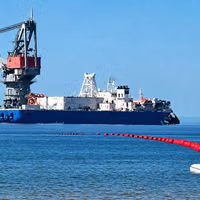
Ships are seen in the Strait of Hormuz from southern Iran on June 18, 2026.

An ultraconservative Iranian outlet warned on Wednesday that a temporary shipping corridor announced by Oman in coordination with the International Maritime Organization could become a “direct challenge” to Iran’s position in the Strait of Hormuz.
Raja News argued that the Omani route, which it said runs south of the traditional Traffic Separation Scheme and through Omani coastal waters, could create a parallel system for shipping in Hormuz outside Iranian oversight.

The report came after Oman announced on June 23 that it was providing vessels with the option of using a temporary maritime corridor in the Strait of Hormuz, coordinated with the IMO and based on coordinates announced by the UN shipping agency and Omani authorities.

Oman said the corridor was in line with efforts by the United States and Iran and was intended to guarantee freedom of navigation “without imposing any tolls.” It said ships seeking to transit should coordinate with the IMO.

The IMO said the corridor was part of a wider evacuation plan for more than 11,000 seafarers stranded in the region after months of disruption to civilian shipping.

“We have secured the necessary safety guarantees and have thoroughly verified the conditions for safe navigation to support these operations,” IMO Secretary-General Arsenio Dominguez said in a June 23 statement.

Raja News said Oman’s reference to free passage with no tolls was the key point, arguing that it could undercut any Iranian effort to shape future transit terms in Hormuz.

Raja News described the Omani corridor as a “dangerous” step, saying it could divert ships from a northern passage announced by Iran after the usual shipping lane through Hormuz was disrupted during the recent conflict.

It also argued that the route could preserve a US security role in the strait while presenting it as voluntary support for safe transit rather than a coercive military presence.

Raja News said the issue required a rapid response from Iran’s negotiating team and, if necessary, from military institutions, to prevent what it called an apparently temporary arrangement from becoming entrenched.

“Oman’s decision, made just one day after talks with Iranian officials in Muscat, requires a swift response from Iran’s negotiating team and, if necessary, the country’s military institutions to prevent this apparently temporary precedent from being implemented and entrenched in the Strait of Hormuz,” the report said.

Oman’s statement, however, framed the measure as a temporary maritime option tied to freedom of navigation, international law and the law of the sea.

On Thursday, US Secretary of State Marco Rubio framed the dispute as a test of Iran’s conduct rather than its rhetoric, effectively placing Washington behind the Omani-IMO route as an operational benchmark for safe passage through Hormuz.

He said Iranian officials and media could continue making “maximalist” public statements, but warned that if such rhetoric translated into threats against vessels or disruption of shipping, Washington would treat it as a violation of the agreement.

Most Viewed

Don’t feed us, free us: Iranians hit back at Vance over 'hunger' remarks
1
VOICES FROM IRAN

Don’t feed us, free us: Iranians hit back at Vance over 'hunger' remarks

2
EXCLUSIVE

IRGC personnel sheltered in Shiraz lodging complex were target of deadly strike

3
EXCLUSIVE

Opium for survival: Inside a shift in Iran’s Zagros villages

4

IAEA chief says inspectors will visit Iran enrichment sites under US-Iran MoU

5
INSIGHT

President's economic reality check fuels Iran's US deal debate

Banner
Banner
Banner

Spotlight

  • Sources detail Ali Khamenei bunker with blast-resistant room
    EXCLUSIVE

    Sources detail Ali Khamenei bunker with blast-resistant room

  • Unveiled in wartime, targeted in peacetime?
    INSIGHT

    Unveiled in wartime, targeted in peacetime?

  • US sanctions waiver could bring Iran's oil trade out of the shadows
    ANALYSIS

    US sanctions waiver could bring Iran's oil trade out of the shadows

  • Hardline revolt targets Ghalibaf over US agreement
    INSIGHT

    Hardline revolt targets Ghalibaf over US agreement

  • IRGC personnel sheltered in Shiraz lodging complex were target of deadly strike
    EXCLUSIVE

    IRGC personnel sheltered in Shiraz lodging complex were target of deadly strike

  • Don’t feed us, free us: Iranians hit back at Vance over 'hunger' remarks
    VOICES FROM IRAN

    Don’t feed us, free us: Iranians hit back at Vance over 'hunger' remarks

  • Opium for survival: Inside a shift in Iran’s Zagros villages
    EXCLUSIVE

    Opium for survival: Inside a shift in Iran’s Zagros villages

•
•
•

More Stories

Canada says Iranian doctoral student’s research could aid Tehran weapons programs

Jun 25, 2026, 10:34 GMT+1
Canada says Iranian doctoral student’s research could aid Tehran weapons programs
100%
Canadian flag flies in front of the Peace Tower on Parliament Hill in Ottawa

Canadian security agencies flagged an Iranian doctoral student at Carleton University as a threat to national security, saying his aerospace research could help advance Iran’s weapons programs, Global News reported on Wednesday.

The report said Mohammadreza Pakatchian, 41, was pursuing a PhD in aerospace engineering at the Ottawa university after beginning studies online in 2023.

The Canadian Security Intelligence Service said Pakatchian worked for MAPNA, an Iranian company sanctioned by Canada over weapons of mass destruction concerns, and planned to return to the company after completing his studies, according to Global News.

“[He] represents a danger to the security of Canada,” the report quoted Canadian security records as saying.

Concerns over research and technology transfer

The Canada Border Services Agency said knowledge gained through his studies “could be used to contribute to advancing Iran’s military and weapons systems,” Global News reported.

Mohammadreza Pakatchian
100%
Mohammadreza Pakatchian

Pakatchian worked as a designer of axial compressors, which can power jet engines and have civilian and military uses, the report said.

Canadian agencies also cited his association with Mahmoud Mani, an academic at Tehran’s Amirkabir University whose work focused on missile aerodynamics, rocket engines and ballistic missiles.

Pakatchian did not respond to requests for comment. His lawyer declined to comment, saying he did not have permission from his client, while CSIS, the border agency and Carleton University did not comment, Global News reported.

Pakatchian arrived in Canada in 2023, according to immigration records cited by Global News. In May, he asked the Federal Court to order the government to decide on his student visa and sought C$10,000 in compensation over delays.

The court dismissed his application on June 9, the report said.

North Korea received $25 million for Iran tunnel technology, ex-diplomat says

Jun 25, 2026, 10:30 GMT+1
North Korea received $25 million for Iran tunnel technology, ex-diplomat says
100%
A satellite image shows ongoing efforts to harden and strengthen a facility's two tunnel entrances at a complex near Nantanz, Iran, February 10, 2026.

A former North Korean diplomat said Pyongyang received about $25 million for providing Iran with tunnel technology that he understood was used extensively at underground nuclear facilities near Natanz and Isfahan.

Ryu Hyun-woo, a former acting ambassador at North Korea’s embassy in Kuwait, made the remarks in an interview published this month by the Korea Development Institute, a prominent South Korean think tank.

“North Korea provided Iran with tunnel design and technology in the early 2000s, receiving about $25 million,” Ryu said.

“I understand that North Korean tunnel technology was applied to a considerable extent at underground nuclear facilities in areas such as Natanz and Isfahan,” he added.

  • Atlas of Iran missile cities: The hidden network behind Tehran’s missile power

    Atlas of Iran missile cities: The hidden network behind Tehran’s missile power

Possible transfer to Hezbollah and Hamas

Ryu said reports of direct North Korean links to Hezbollah and Hamas were inaccurate.

“Many media outlets talk about North Korea-Hezbollah and North Korea-Hamas links, but that is not true,” he said.

He said North Korea was unlikely to have directly transferred tunnel expertise to either group, but added: “It cannot be ruled out that Iran transferred tunnel-related technology it received from North Korea to Hezbollah or Hamas.”

Earlier reporting

The comments follow a March report by The Washington Times, which said North Korean entities had supplied Iran with underground construction expertise and missile technology.

The newspaper cited Bruce Bechtol, a former US Marine and political science professor at Angelo State University, as saying North Koreans helped build underground facilities in Iran, including at Isfahan, in the early 2000s.

“Most of Iran’s underground facilities – including Isfahan – were built in the early 2000s by North Koreans,” Bechtol told the newspaper.

Bechtol said North Korea’s support also included missile systems, help with arms-factory construction, specialized components and technical personnel. Iran and North Korea have not publicly confirmed the reported transfers.

Sources detail Ali Khamenei bunker with blast-resistant room

Jun 25, 2026, 10:15 GMT+1
•
Mojtaba Pourmohsen
Sources detail Ali Khamenei bunker with blast-resistant room
100%
حسن اکبری و علی خامنه‌ای

An underground complex built by the Islamic Revolutionary Guards Corps (IRGC) to protect former Supreme Leader Ali Khamenei included a blast-resistant room and escape tunnels beneath central Tehran, according to information received by Iran International.

Iran International obtained architectural plans for the facility from an informed source, and a security source confirmed the documents’ authenticity.

The plans show that the IRGC spent about a decade building the underground compound, known as Habib Ebrahimi, next to Khamenei’s official residence.

The complex, named after Khamenei's former driver Habib Ebrahimi, who died before construction began, was built between 2009 and the late 2010s, according to the information.

Underground network

According to the plans, the main vehicle entrance allowed cars to descend about 30 meters underground into the complex.

Architectural plans obtained by Iran International show the layout of the IRGC-built underground bunker beneath the former supreme leader's compound in Tehran.
100%
Architectural plans obtained by Iran International show the layout of the IRGC-built underground bunker beneath the former supreme leader's compound in Tehran.

A 27-meter tunnel linked the bunker to multiple escape routes, including exits toward streets around. Another tunnel reportedly connected the facility to a parking garage near the Enghelab square in central Tehran.

Iran International reviewed construction images showing one tunnel exit during excavation, as well as separate images depicting a five-level underground office complex for senior officials attached to the Office of the Supreme Leader.

Sources familiar with the project, who spoke on condition of anonymity, said the site was concealed beneath what appeared to be a sports center. Below ground, the facility included a three-level parking garage, target ranges and two shelters located approximately 30 and 35 meters beneath the surface.

Plans show one of those shelters contained a blast-resistant room intended to protect Khamenei during missile attacks.

Construction and oversight

The documents showed construction began in 2009 with Khamenei's approval and was financed by the IRGC's Khatam al-Anbiya Construction Headquarters.

The project was overseen by the IRGC's engineering division, then headed by Brigadier General Ali Masjedian, while execution was assigned to the Shahid Rajaei Institute, a subsidiary of Khatam al-Anbiya.

The institute was headed by Brigadier General Hossein Akbari. His brother, Brigadier General Hassan Akbari, supervised construction while serving both as one of Khamenei's closest bodyguards and as an official in the IRGC unit responsible for protecting the Supreme Leader.

Brigadier General Hossein Akbari, the former head of the IRGC's Shahid Rajaei Institute, which oversaw construction of the underground bunker complex for Ali Khamenei.
100%
Brigadier General Hossein Akbari, the former head of the IRGC's Shahid Rajaei Institute, which oversaw construction of the underground bunker complex for Ali Khamenei.

The IRGC-linked Fars News Agency previously reported that Hassan Akbari was accidentally killed on April 29, 2016, after a weapon malfunction during a training mission.

A security source, however, told Iran International that his death was tied to an internal power struggle inside the Office of the Supreme Leader.

Contradictory public statements

The Habib Ebrahimi complex was among the Israeli military’s targets during a March 2026 strike on the Supreme Leader’s compound.

Satellite imagery reviewed by Iran International, however, did not show clear evidence that the underground facility had been destroyed.

Satellite image highlighting the underground bunker complex beneath the former supreme leader's compound in central Tehran.
100%
Satellite image highlighting the underground bunker complex beneath the former supreme leader's compound in central Tehran.

The discovery contrasts with public remarks by former Iranian officials. Former Interior Minister Mostafa Pourmohammadi had said Khamenei had no underground shelter, while Ezzatollah Zarghami, a former broadcasting chief and tourism minister, said Khamenei had opposed building one for himself.

Khamenei was killed in a targeted Israeli strike on his residence on February 28, 2026, during a meeting of Iran's Defense Council. The Financial Times later reported that Israel had used hacked traffic cameras and telecommunications infrastructure around the area to identify the gathering before the attack.

IRGC personnel sheltered in Shiraz lodging complex were target of deadly strike

Jun 24, 2026, 21:14 GMT+1
•
Shahed Alavi
IRGC personnel sheltered in Shiraz lodging complex were target of deadly strike
100%

IRGC personnel sheltering in a civilian lodging complex in Shiraz were the likely target of a strike that also killed nine civilians at a neighboring emergency center in the early days of the 2026 war, an Iran International investigation found.

The March 5 strike hit several buildings inside the Zibashahr emergency lodging complex, where members of the Islamic Revolutionary Guard Corps and affiliated forces had taken shelter during the war, according to images from the site, open-source data, Iranian media reports, witness accounts and an expert assessment reviewed by Iran International.

The evidence suggests the strike was not a simple miss aimed at a nearby IRGC facility, but an attack on the lodging complex itself.

The site sat inside a civilian area, beside a local ambulance station that is part of Iran’s 115 emergency medical service, as well as service buildings and residential homes.

No party has claimed responsibility for the strike.

Fars provincial authorities later said 20 people had been killed and 30 wounded. At an official memorial ceremony in Zibashahr, however, only 16 names and photographs were released: seven IRGC and Basij members and nine civilians.

The civilians included two emergency technicians, a health worker, municipal employees and contractors, and a local shopkeeper.

The strike destroyed the ambulance station, a neighboring building and a larger structure to the east that formed part of the municipal emergency lodging complex. Nearby residential buildings were also damaged.

Aftermath of the March 2026 strike on the Zibashahr complex in Shiraz
100%
Aftermath of the March 2026 strike on the Zibashahr complex in Shiraz

Why the lodging complex was hit

The large destroyed building inside the Zibashahr complex was not an empty passenger facility or an unidentified structure.

The Student News Agency, linked to the Student Basij, published a video report from the site after the attack and said missiles had hit “dormitory and administrative buildings” in the complex. It also reported that military personnel had been killed and wounded.

The agency said the personnel were there for “training courses for border protection.”

But public mapping services, including Google Maps and the Iranian app Neshan, identify the site as an emergency lodging complex, not a military training facility.

The entrance of the Zibashahr complex
100%
The entrance of the Zibashahr complex

Verified images and videos from the area also show the lodging complex sign at the entrance. Iran International found no publicly available evidence that the site had previously functioned as a military training center.

Less than 200 meters away, across the highway, sits a large IRGC Ground Forces training and military complex. Open-source mapping also links the area to the IRGC’s 19th Fajr Division and an IRGC Aerospace Force unit in Shiraz. One officer killed in the Zibashahr strike was linked to the 19th Fajr Division.

Yet post-strike imagery showed no sign that the nearby IRGC complex itself had been destroyed.

That pattern is central to the investigation. If the intended target had been the formal IRGC facility, a miss of about 200 meters across the highway would have to explain several impacts on separate buildings inside the civilian lodging complex.

Wes Bryant, a former head of a US Air Force special targeting team and former Pentagon civilian-casualty assessment official, reviewed visual evidence from the site.

He assessed that the strike involved about 1,350 kilograms of munitions, including a weapon comparable to a 900-kilogram bomb against the larger eastern building and smaller munitions, comparable to 220-kilogram bombs, against two western structures, including the ambulance station.

With modern precision-guided munitions, Bryant said, a 200-meter error across a highway would be highly unlikely, particularly in several separate impacts.

His assessment supports the conclusion drawn from the other evidence: the lodging complex itself, or specific buildings inside it, was the likely target.

Aftermath of the March 2026 strike on the Zibashahr complex in Shiraz
100%
Aftermath of the March 2026 strike on the Zibashahr complex in Shiraz

A target among civilians

The evidence reviewed by Iran International points to a strike on a civilian lodging complex after IRGC personnel moved into it during the war.

That may explain why the Zibashahr complex, rather than the nearby formal IRGC facility, was hit. But the same evidence also shows that the targeted buildings stood inside a civilian setting, beside an ambulance station and near residential homes.

That leaves responsibility on the Iranian side.

By moving or allowing military personnel to shelter in a civilian lodging complex, next to an emergency medical site and homes, Iranian authorities placed civilians and medical workers in the path of a foreseeable strike.

It is not necessary to prove that civilians were intentionally used as shields to establish the consequence: the risk of war was shifted from a military facility into a place used by civilians.

That responsibility does not remove the attacker’s obligations.

Even if the presence of IRGC personnel made part of the lodging complex a military target, it did not automatically strip the neighboring ambulance station, surrounding buildings or nearby homes of protection.

A medical site loses its special protection only if it is itself used for acts harmful to the enemy; Iran International found no evidence in the material reviewed that the ambulance station was used in that way.

The strike therefore leaves two central facts in tension.

IRGC personnel appear to have taken shelter among civilians, turning part of the complex into a target. But the attack also destroyed an ambulance station and killed civilians in an area whose medical and residential character was visible in public maps and imagery.

In Zibashahr, the war moved from a military complex into a lodging site, an ambulance station and people’s homes.

Lufthansa rebuts Iran report suggesting return of flights

Jun 24, 2026, 18:11 GMT+1
Lufthansa rebuts Iran report suggesting return of flights
100%

Lufthansa Group pushed back against Iranian media claims that its airlines are preparing to return to Iran, saying flights to and from Tehran remain suspended until October 24 and any resumption depends on a security review.

Earlier on Wednesday, Mehr News Agency reported under the headline “Lufthansa returns to Iran” that a Lufthansa Group representative met Ramin Kashef-Azar, chairman and chief executive of Imam Khomeini Airport City, to discuss restoring flights and developing new routes.

The Iranian report said the representative had expressed interest by Lufthansa Group airlines, including Eurowings, Austrian Airlines and ITA Airways, in resuming flights to Iran. It also said Austrian Airlines would likely restart earlier than others and that Lufthansa was reviewing Iran flights for its winter schedule.

But in a written response to Iran International’s Germany correspondent Ahmad Samadi, Lufthansa described the meeting as a customary exchange and made clear that no return decision had been announced.

“The airlines of the Lufthansa Group have suspended all flights to and from Tehran up to and including October 24th, 2026,” the company said.

“We can confirm that a meeting with local representatives recently took place. Such exchanges are customary and form part of our ongoing assessment of operational and regulatory conditions,” Lufthansa added.

The company said any return to Iran would depend on a wider security review.

“Any decision regarding a resumption of services to Iran will be subject to a comprehensive security assessment and ongoing evaluation of the operational environment,” Lufthansa said. “The safety and security of our passengers and crews remain our highest priority.”

Lufthansa’s response did not confirm any restart date, winter schedule plan or specific return by any of its group airlines, sharply contrasting with the Iranian framing of the meeting as a sign of imminent normalization.

The exchange shows Tehran’s attempt to present routine aviation contacts as evidence that foreign carriers are returning after the war, while major airlines remain publicly cautious about security and operating conditions in Iran.