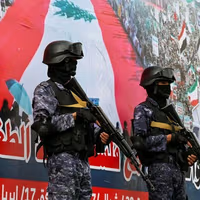
US continues to enforce blockade against Iran, CENTCOM says
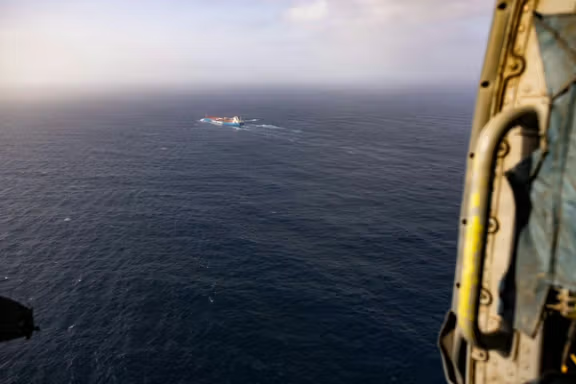

US Central Command said US Navy warships and air assets continue to patrol regional waters to enforce the blockade against Iran, adding that American forces have redirected 136 commercial vessels and disabled nine others.
"As of today, US forces have redirected 136 commercial vessels and disabled 9 to ensure compliance," CENTCOM said in a post on X accompanying images of the operations.
The latest figures indicate an expansion of US maritime enforcement measures targeting traffic linked to Iran.





Semi-oficial Mehr News Agency denied reports that $3 billion had been transferred from the United Arab Emirates to Iran, saying none of the Islamic Republic's frozen financial assets have been released.
The response came after reports alleged that Tehran's announcement of a ceasefire followed the delivery of a US message through a Qatari delegation on June 8 and coincided with the transfer of $3 billion from Abu Dhabi to Tehran aboard an Emirati Boeing 737 aircraft.
Mehr said that, to date, none of Iran's blocked funds had been unfrozen.
Israeli Prime Minister Benjamin Netanyahu said Iran would not acquire nuclear weapons as long as he remains in office, adding that he and US President Donald Trump are "in full agreement" on the issue.
"For over 30 years, I have been at the forefront of the international struggle against Iran's nuclear program," Netanyahu said in a post on X.
"Were it not for this struggle, Iran would have long ago possessed atomic bombs to destroy Israel."
Netanyahu added that Iran is seeking to destroy the Jewish state and said he has dedicated his life to preventing that outcome.
"As long as I am the Prime Minister of Israel, this will not happen," he said.
Hossein Hosseini, the head of Kurdistan province's judiciary, said judicial cases had been opened against 19 people in connection with war-related investigations and that authorities had ordered the monitoring, identification and seizure of their assets.
The measures, he said, were taken under legislation imposing tougher penalties for "espionage and cooperation with Israel and hostile countries" against national security and interests.
Hosseini also said special handling of the cases would continue, adding that those accused would be dealt with "in accordance with the law and without leniency."
Iran's state broadcaster reported that transit through the Strait of Hormuz has been suspended until further notice, citing the Revolutionary Guards' navy as saying it would not authorize vessels to pass through the strategic waterway.
Around 50 ships are waiting near the Strait of Hormuz for clearance to transit, according to the report. The decision was attributed to what the broadcaster described as "the terrorist acts of US forces" and security considerations involving the vessels.
State television also said the number of ships halted at the second and third anchorage areas is about 20 times greater than those gathered at the entrance to the strait and that they too are awaiting further developments.
Mahmoud Nabavian, a member of Iran's parliament, criticized the reported draft agreement between Washington and Tehran, describing it as similar to the 2015 nuclear deal and a "pure loss."
"Talking about victory with this vague and damaging text is completely wrong," Nabavian said.
Criticizing provisions he said were included in the draft, Nabavian said the Islamic Republic would not have the right to produce nuclear weapons under the agreement. The fate of Iran's enriched material, he said, would depend on US approval and that all issues related to the nuclear program would be subject to negotiations.
"This agreement, like the JCPOA, is a pure loss and stems from a change in the calculations of officials," he said.