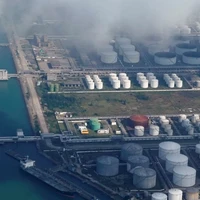
Vessels are anchored in the Strait of Hormuz, as seen from Musandam, Oman, June 11, 2026.
Hours after threatening to hit Iran “very hard,” President Donald Trump said a deal with Tehran was close, leaving Iranian officials to balance threats of retaliation with signals that talks over Hormuz, sanctions relief and a fragile ceasefire are still alive.
The sudden shift followed a volatile day in which US forces were reportedly hours away from launching new strikes inside Iran before Trump called off the operation and said the two sides had reached what he described as a “great deal.”
Reports by Axios, Politico and other outlets said the emerging memorandum of understanding would immediately reopen the Strait of Hormuz without tolls, lift the US blockade, extend the ceasefire for 60 days, including in Lebanon, and leave detailed nuclear negotiations for a second stage.
The agreement has not been formally signed. Axios reported that it still needed final approval, while Iran’s Foreign Ministry said Tehran had not reached a final decision. Al Arabiya reported that Iran had conveyed approval of a draft through Qatari mediators.
The latest diplomatic push came after a sharp escalation in rhetoric. Trump had earlier threatened new strikes against Iran and suggested the United States could eventually take control of Kharg Island and other parts of Iran’s oil infrastructure.
For Tehran, the public response has mixed defiance with pressure tactics.
Ali Abdollahi, commander of Iran’s Khatam al-Anbiya Central Headquarters, warned that attacks on Iran’s energy infrastructure could threaten exports across the region.
“Either oil and gas exports will remain available for everyone, or they will be possible for no one,” he said, adding that Iran would respond more forcefully if US attacks continued and that “the fire of war could spread further.”
Parliament Speaker Mohammad-Bagher Ghalibaf also warned that US actions could destabilize the region and energy markets.
“Wrong strategies and impulsive decisions will reset the entire board for the worse, explode energy infrastructure and markets, and create an endless quagmire that you will be stuck in for years,” he wrote on X. “You will see a different Iran.”
Mohsen Rezaei, a military adviser to Supreme Leader Mojtaba Khamenei, mocked Trump’s strategy and said military pressure would deepen Washington’s problems.
“The unhinged US president imagines that bombs can get him out of the quagmire he himself created,” Rezaei wrote. “But Iranian missiles will sink him even deeper into it.”
He added that Washington must choose between accepting Iran’s terms and losing what he called the last remains of its credibility.
Lawmaker Mojtaba Zarei said Iran had effectively moved beyond the ceasefire, saying Tehran was using its military power in three arenas: the Strait of Hormuz, the blockade front, and Lebanon and Bab al-Mandab. He said Iran would not relinquish control over Hormuz.
Iranian state media have also sought to portray the US strikes as ineffective and Trump’s threats as exaggerated. Outlets including Fars, IRNA and state broadcaster IRIB have described the attacks as aggression and a repeated violation of the ceasefire, while emphasizing reported damage to civilian infrastructure, including drinking-water reservoirs in southern Iran.
They have largely ridiculed Trump’s remarks about taking Kharg Island and Iranian oil infrastructure, describing them as delusion, adventurism or hollow threats.
Still, Iranian-linked actions and claims have continued around the edges of the ceasefire. Fox News reported that US forces shot down two Iranian one-way attack drones after an attempted strike on commercial ships transiting the Strait of Hormuz.
Iranian state media also reported that the IRGC Navy had confronted what it described as a “violating” vessel near Sirik and forced an oil tanker to comply with a traffic prohibition order.
The mixed signals have left analysts divided over whether the latest exchange marks a return to war or another stage of coercive bargaining.
Hassan Hanizadeh, a foreign policy analyst, told Fararu that the US strikes appeared aimed less at launching a full-scale campaign than at restoring Washington’s initiative.
“The United States is trying to shift the psychological balance in its favor through limited military actions,” he said.
Hanizadeh argued that the likelihood of a full-scale war in the short term remains low, and that Washington is instead pursuing a war of attrition combining military pressure with economic tools.
Others in Tehran have described the strikes as part of the negotiating process itself. Ebrahim Azizi, chairman of parliament’s National Security Committee, called the military operations “the military annex to the negotiating table.”
Political analyst Hossein Ghatib argued that Washington is trying to turn the Strait of Hormuz from a geopolitical asset for Iran into a source of military, economic and diplomatic vulnerability.
He said recent attacks on coastal radars, air-defense systems, naval command centers, drone bases and missile facilities appeared designed to weaken Iran’s ability to monitor and control the waterway.
But Shahin Shahid-Saless, an international affairs analyst, argued that military pressure is unlikely to soften Tehran’s position.
“Under military pressure, no matter how powerful, the Islamic Republic will not change its position,” he wrote on X. “I would even go further and say that heavy bombing will not soften its stance; it will make it harder and less reconcilable.”
That tension now defines the moment: Washington is using military threats and a blockade to push Tehran toward a preliminary deal, while Iranian officials are threatening Hormuz, US interests and regional energy flows to raise the cost of further pressure.
Whether the emerging agreement holds may depend less on Trump’s claim that the deal is nearly done than on whether Tehran treats the current pressure as a reason to sign – or as another reason to harden its terms.
From right to left: Negar Mojtahedi, Alex Vatanka, Robert Satloff, and Ambassador David Hale attend Iran International's townhall in Washington DC on June 10, 2026.
The Middle East may be entering a period in which ceasefires no longer end wars but manage them, as the warring sides trade limited strikes below the threshold of an all-out war, experts told Iran International’s townhall held in Washington DC.
The discussion, hosted by Iran International’s Negar Mojtahedi, centered on whether the latest ceasefire in Lebanon marks the end of a war or the beginning of a more dangerous phase: a regional conflict in which Iran increasingly treats attacks on its proxies as attacks on itself.
A ceasefire that does not end the war
Alex Vatanka, a senior fellow at the Middle East Institute, said Iran’s latest posture toward Lebanon should be viewed against the long arc of the Islamic Republic’s presence there.
He noted that it has been more than four decades since the first official officers of the Islamic Revolutionary Guard Corps arrived in Lebanon, making the country a central pillar of Tehran’s regional project.
Alex Vatanka
For years, Vatanka said, Iran used Lebanon and Hezbollah to project power, particularly against Israel. But recent events suggest Tehran may now be entering “a new chapter,” one in which the distinction between Iran and its proxy network becomes more blurred.
“An attack on Hezbollah, an attack on the Houthis, an attack on the Hashd al-Shaabi is going to, from now onward, be considered an attack on Iran,” Vatanka said, describing what Iranian officials have presented as a new defense doctrine.
He cautioned that if taken literally, such a doctrine could mean an open-ended regional confrontation. Any strike on Hezbollah in Lebanon, the Houthis in Yemen, or Iran-backed militias in Iraq could invite a direct Iranian response, turning local battlefields into triggers for wider escalation.
Vatanka said Tehran appears to be defending its proxy strategy at a moment when many analysts had expected the opposite. After October 7 and the heavy blows inflicted on Iran-backed groups, some believed the Islamic Republic might conclude that its “forward defense” strategy had failed. Instead, he said, influential voices in Tehran appear to be arguing that this is precisely the moment to double down.
Iran’s umbrella over Lebanon
Robert Satloff, executive director of the Washington Institute, said Lebanon is now caught between two competing visions of its future.
“There are two competing realities in Lebanon,” Satloff said. “One reality is Iran asserting its umbrella to control Lebanon... The other reality is Lebanon and Israel negotiating a security agreement, potentially a peace agreement.”
That contrast may define the next phase of the conflict. In one scenario, Iran tries to reassert control through Hezbollah and make clear that Lebanon remains part of its regional security architecture. In the other, Lebanon’s government attempts to reclaim sovereignty and pursue security arrangements with Israel, with US backing.
Robert Satloff
Satloff said Iran’s attempt to claim Lebanon under its umbrella has not succeeded, but neither has the effort to fully disarm Hezbollah. He described the challenge as a contest between Iran’s regional power projection and a fragile Lebanese state trying to implement commitments it has made before but repeatedly failed to fulfill.
He also argued that Iran’s latest direct attack on Israel showed weakness rather than strength. Compared with previous barrages involving hundreds of missiles, he said, the latest attack was limited and intercepted, exposing the degradation of Iran’s capabilities rather than demonstrating strategic confidence.
Hezbollah down, but not out
Ambassador David Hale, a distinguished diplomatic fellow at the Middle East Institute and former US ambassador to Lebanon, Jordan and Pakistan, said one of the most striking changes is Hezbollah’s current vulnerability.
“Hezbollah is so degraded, it's down but not out, but it's so degraded that it can't defend itself,” Hale said. “Iran is coming in to defend its proxy. It's always the other way around.”
For Hale, that reversal is significant. Hezbollah was long understood as one of Iran’s most powerful deterrent tools, a force capable of threatening Israel and shaping Lebanese politics on Tehran’s behalf. Now, he said, Iran’s direct intervention suggests Hezbollah can no longer perform its traditional role with the same effectiveness.
Ambassador David Hale
Still, Hale warned against assuming that Lebanon can resolve the Hezbollah question through military action alone. He said sovereignty is not “a light switch,” and disarming Hezbollah will require a political process as well as military pressure.
Lebanon’s state institutions, he said, remain weak by design, reflecting the country’s sectarian balance. Although President Joseph Aoun and Prime Minister Nawaf Salam have shown willingness to engage in a new direction, Hale said the Lebanese Armed Forces are unlikely to simply move into Hezbollah-controlled areas “guns blazing.” A durable solution would require humanitarian support, political alternatives for Lebanon’s Shiite community, and a credible state presence in the south.
The US as the decisive variable
The panelists agreed that whether this becomes the region’s new normal depends heavily on Washington.
Satloff said Iran’s attacks across the region, including against Kuwait, Bahrain and a US base in Jordan, should remind Arab states “who the real aggressor is” and create an opportunity for President Donald Trump to rally regional partners against Tehran. But he warned that the moment could be lost if Washington quickly returns to seeking any deal it can get.
Hale said the United States should rely less on public rhetoric and more on sustained pressure. He argued that Tehran understands violence and intimidation, and that Washington must be prepared to respond with persistent military, economic and political pressure.
But the panel also raised doubts about the coherence of US strategy. Vatanka said he was struck by how much planning appeared to have gone into the military side of the confrontation, and how little into the political endgame. The stated US goal, he noted, has shifted from encouraging Iranians to challenge the regime to narrower objectives such as the nuclear file, trade and the Strait of Hormuz.
That uncertainty may be what makes the current moment so dangerous. A ceasefire may reduce the intensity of the fighting, but if Iran continues to defend its proxies as extensions of itself, Israel continues to strike perceived threats, Arab states are drawn into the line of fire, and Washington alternates between pressure and dealmaking, the region could remain trapped in a cycle of calibrated escalation.
Audience questions turn to Washington’s endgame
The audience Q&A shifted the discussion from battlefield dynamics to whether Washington has a political strategy to match its military pressure on Tehran.
Asked about regime change, Hale warned against raising expectations among Iranians without being prepared to follow through.
Satloff said Washington should instead invest in tools that prepare the ground for change, including stronger broadcasting to Iranians, internet access, and visa or asylum pathways for dissidents.
Vatanka said the deeper problem remains the lack of a coherent US strategy toward Iran.
The exchange underscored a central point of the townhall: without a political endgame, military pressure alone may leave the region trapped in a cycle of ceasefires, strikes and retaliation.
For now, the experts suggested, the Middle East is not clearly moving from war to peace. It may instead be settling into a volatile gray zone: a ceasefire era in which the guns never fully fall silent.
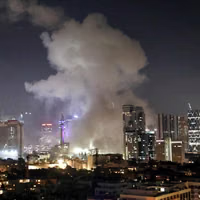
US strikes on targets in southern Iran and Tehran's retaliatory attacks on American bases in the region have raised tensions between the two countries, even as negotiators continue indirect talks aimed at reaching a temporary agreement.
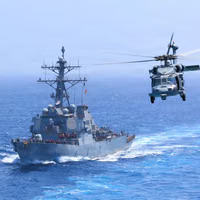
The latest escalation followed the crash of a US military helicopter near the Strait of Hormuz on Monday, an incident for which Iran has denied responsibility.
Washington responded by launching attacks on what it described as military infrastructure in southern Iran. The Pentagon described the operation as “limited and proportionate,” and U.S. Central Command announced that the mission had concluded around 4 a.m. Tehran time.
Iran subsequently declared that it had struck US bases in Jordan, Kuwait, and Bahrain. The Revolutionary Guards (IRGC) also claimed in a statement that Iranian forces had shot down an MQ-9 drone in southern Iran.
Washington has not publicly confirmed the Iranian claims regarding the extent of damage inflicted on US facilities in the region.
Diplomacy and conflict side by side
Despite the exchange of military strikes, officials on both sides have continued to signal an interest in diplomacy.
While President Donald Trump has warned that further US attacks on Iran and its infrastructure remain possible, other senior officials, including Vice President J.D. Vance, have said that indirect negotiations with Tehran are continuing.
Iranian officials have also insisted that diplomatic contacts remain active. However, Foreign Ministry spokesman Esmaeil Baghaei accused Washington and Israel of undermining diplomatic efforts through contradictory messages, repeated changes in positions and demands, and repeated ceasefire violations in Lebanon.
Iranian Parliament Speaker Mohammad Bagher Ghalibaf, who also heads Iran’s negotiating team, and Foreign Minister Abbas Araghchi both said Tuesday night that Iran “prefers the language of diplomacy” but retains the capability to respond militarily if necessary.
Reformist-leaning news website Rouydad24 interpreted those statements as evidence that Tehran is seeking to avoid a wider confrontation.
“Regardless of the political content of these remarks, their message was clear: Tehran does not want to climb the ladder of escalation under current circumstances,” the website wrote. “Officially accepting responsibility for an attack on a US helicopter carrying two servicemen would have run directly counter to such a strategy.”
The website also criticized Ebrahim Rezaei, spokesman for parliament’s National Security Committee and a figure associated with the hardline Paydari (Steadfastness) Party, for appearing to suggest in a post on X that Iranian forces had been responsible for the helicopter incident.
“I kiss the hand of the fighter who struck another blow against Satan by bringing down the American helicopter in the Strait of Hormuz. We will honor him as a hero,” Rezaei wrote.
Trump, meanwhile, said on Wednesday that Iran had spent too much time negotiating over what he described as an agreement that would have been highly favorable to Tehran and must now pay the price for that delay. In an interview with Fox News, he also said he was close to authorizing new strikes against Iranian power plants and bridges.
Amid the tensions, a Qatari delegation arrived in Tehran on Wednesday. Reuters, citing a source familiar with the matter, reported that Qatari negotiators had traveled to the Iranian capital after consultations with the United States to finalize a possible agreement.
Political analyst Rahman Ghahremanpour argued in a post on X that the confrontation is unlikely to spiral into a broader conflict.
“Reports about a temporary agreement are increasing and appear serious, while the clashes continue,” he wrote on X. “For now, it may be concluded that both sides are trying to demonstrate determination ahead of a possible agreement to gain more leverage at the negotiating table and to tell domestic radical groups that they are reaching a deal from a position of strength.”
Ali Khezriyan, a member of the Iranian parliament’s National Security Committee, offered a different interpretation, claiming that Trump is seeking to “exit the war with dignity” and may either launch a larger attack or attempt to weaken Iran’s position before negotiations.
Threats and counter-threats
Trump has repeatedly warned that the killing of American troops would constitute a red line. He said the two crew members aboard the downed helicopter had survived.
In a post on Truth Social on Wednesday morning, he reiterated his warning: “If an American is killed, the US response will not be proportionate; complete catastrophe is coming.”
Nour News, a media outlet close to Iran’s Supreme National Security Council, dismissed the threat.
“Trump’s threat of ‘complete catastrophe’ in the event of an American death is a display of power, but it has no effect on Iran’s determination to defend itself,” the outlet wrote. “Tehran showed today that it will respond decisively to any aggression. Responsibility for any further bloodshed lies with the one who ignites the fire.”
The outlet also linked the latest developments to Israel’s military actions in Lebanon, arguing that the region’s various fronts cannot be separated.
“No ceasefire has credibility unless it encompasses all arenas of conflict, and no agreement has practical value unless the principal party assumes responsibility,” it wrote.
Khezriyan further claimed in an interview with the state-run television that Iran had destroyed 16 US regional bases during the recent conflict and was now planning attacks on American facilities beyond the Middle East.
Reactions online
The latest confrontation also generated debate among pro-government users on social media.
Davoud Modaresian, a commentator, argued that Iran should take a more proactive military approach.
“Even if there is no intention of giving a worthy response to the naval blockade imposed during the ceasefire period, Iran should at least be the initiator of these scattered and continuous strikes,” he wrote on X. “We must keep the Americans in the region engaged and exhausted through constant blows until they abandon the blockade, not wait for them to strike first and then respond.”
Hardline journalist Parisa Nasr warned that the attacks could be a precursor to a larger campaign.
“Do not doubt that these attacks are part of preparations for a large-scale operation in southern Iran,” she wrote, adding that the failure to break the naval blockade or strike targets in Israel made the situation “truly worrying.”
Cleric Abdolrahim Soleimani Ardestani (right) during a youtube debate show with cleric Hamed Kashani (center)
Iran’s Special Clerical Court has sentenced dissident cleric Abdolrahim Soleimani Ardestani to six years in prison, a fine and removal from the clergy, months after his public challenge to state-backed Shiite narratives drew threats and political pressure.
Soleimani Ardestani, a religious scholar, former Mofid University professor and member of a reformist association of Qom seminary teachers and researchers, is being held in Qom’s prison.
According to Mojtaba Lotfi, an official from the office of the late dissident cleric Hossein Ali Montazeri, the court convicted him on all eight charges brought against him.
Lotfi said Soleimani Ardestani does not plan to appeal unless the court agrees to hold a public hearing.
In a letter from prison, Soleimani Ardestani said the charges against him included disturbing public opinion, insulting sacred values, insulting the leadership in relation to Ali Khamenei and his son Mojtaba, taking part in a gathering over the house arrest of Mir-Hossein Mousavi, and assembly and collusion against domestic security.
Mousavi, a former prime minister, has been under house arrest since 2011 after rejecting the official result of Iran’s disputed 2009 presidential election and becoming one of the symbols of the Green Movement protests.
Soleimani Ardestani also listed accusations such as propaganda against the system, spreading falsehoods online, insulting senior religious authorities, damaging the dignity of the clergy and “mind control and psychological suggestion” – a striking charge even by the standards of Iran’s broad political indictments.
He has called the indictment weak and baseless, criticized his arrest and solitary confinement, and said he wrote his defense not to seek acquittal but to leave a record for history.
The case began with remarks in a debate with pro-government cleric Hamed Kashani. Soleimani Ardestani questioned long-promoted Shiite accounts about the death of Fatemeh Zahra, the daughter of the Prophet Muhammed and wife of Ali, the first Shiite Imam.
In Iran, the story of Fatemeh’s martyrdom is not only a religious narrative but part of a vast state-backed culture of mourning, ritual and political identity.
Soleimani Ardestani argued that if Ali had merely watched his wife being attacked and had not intervened, then the traditional account would raise questions about his justice. He later said he had not insulted Fatemeh and was challenging what he called the “stories told by religious singers or eulogists (maddahs).”
He also questioned mourning ceremonies for Muhammad Taqi, the ninth Shiite Imam, saying his death was linked to jealousy by his wife after he remarried and that mourning the event 1,300 years later was meaningless.
The backlash was immediate. Pro-government eulogists, who play an influential role in mobilizing religious crowds, attacked him with vulgar and sexist language. Reports also emerged of a group attack on his home.
Hardline figures called for prosecution and defrocking, while some religious voices went further, suggesting that denial of Fatemeh’s martyrdom could amount to leaving Shiite doctrine.
The controversy also split parts of the political middle ground. Reformist figures criticized Soleimani Ardestani’s tone and timing, while others warned that violent threats, home attacks and denunciations violated freedom of belief.
The sentence is significant because it shows how quickly the Islamic Republic can convert a dispute over religious history into a security case.
Soleimani Ardestani was not an outside critic of clerical rule. He was a cleric from inside the seminary world, which makes his challenge more sensitive.
By sentencing him to prison and stripping him of clerical status, the system is not only punishing one man. It is policing the boundaries of who is allowed to interpret religion, how far internal debate can go, and what happens when religious scholarship collides with the political theology of the state.
An Israeli ultra-Orthodox Jewish man reacts near a part of a missile protruding from the ground, following strikes from Iran, in the central Israeli-occupied West Bank, June 8, 2026.
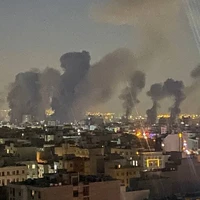
Iranian officials and media outlets say Tehran's missile strike on Israel in response to attacks on Beirut has established a new red line: future attacks on Hezbollah and Lebanon could trigger direct Iranian retaliation.
The debate emerged after Iran launched missiles at Israel following Israeli strikes in Beirut's southern suburbs, at a time when negotiations between Tehran and Washington were widely described as nearing an agreement.
Although Iran's Khatam al-Anbiya Central Headquarters announced on Monday that it was halting further strikes, it warned that attacks would resume if Israel targeted either Iran or Lebanon again.
US President Donald Trump called on both sides to halt retaliatory attacks, while Foreign Ministry spokesman Esmail Baghaei said Washington bore "direct responsibility" for any action taken by Israel against Iran.
Speaking to the Revolutionary Guards (IRGC)-linked Tasnim News Agency, an unnamed military source dismissed Washington's lack of public endorsement for Israeli attacks as a "purely propagandistic and deceptive act."
"If the Israelis and Americans believe they can, through 'controlled escalation,' make Iran and the Resistance Front predictable or limit the nature of Iran's response, they are making a foolish mistake," he said.
A new strategic doctrine?
Among the most notable reactions came from Sadegh Larijani, chairman of Iran's Expediency Council.
In a post on X, Larijani described the strike carried out in defense of Lebanon as "the official declaration of a strategic doctrine" and the opening of "a new chapter in defense policy," in which Iran would pursue its regional power through initiative and offensive capability.
Parliament Speaker Mohammad Bagher Ghalibaf, who also heads Iran's negotiating team in talks with Washington, argued that Iran had "overturned the equation of a ceasefire on paper and its repeated violation on the battlefield."
"As long as there is no genuine will for confidence-building, Iran's response will remain the same," he wrote on X.
President Masoud Pezeshkian struck a more measured tone, arguing that diplomacy and deterrence remained complementary rather than contradictory.
"We will firmly defend the rights of the nation and retreat before no threat," he wrote. "Diplomacy and defense are the two wings of national power; we have abandoned neither the battlefield nor the negotiating table."
Media echo the new strategy
Iranian media quickly expanded on that interpretation, arguing that the strike reflected a broader shift in Tehran's deterrence strategy.
Farda News, a website close to Ghalibaf, argued that attacks on Lebanon would no longer be cost-free and that Israeli actions on one front could trigger responses on another. The outlet also interpreted the reported targeting of the Haifa refinery—described by the IRGC as retaliation for attacks on Iran's petrochemical industry—as an example of "strategic symmetry."
"The era of cost-free attacks on the Resistance Front has ended," it wrote.
Other conservative outlets advanced similar arguments. Tabnak, which is considered close to Mohsen Rezaei, an adviser to Iran's supreme leader, argued that Tehran had for the first time retaliated militarily for an Israeli attack on a country other than Iran itself.
Khabar Online described the strike as a redefinition of deterrence equations in the Middle East, while Rouydad24 argued that Tehran was signalling a willingness to expand both the geography and scope of future confrontations.
Several commentators framed the issue not simply as support for Hezbollah but as a test of Iran's credibility with its regional allies. Allowing Hezbollah to be weakened or destroyed without a response, they argued, would undermine decades of Iranian regional strategy and raise questions about the reliability of Tehran's support for its partners.
Mixed reactions online
Public reactions on social media were more divided.
Some users criticized Iran's involvement on behalf of Hezbollah. One commenter wrote that Iran had effectively become "the proxy force of a foreign group called Hezbollah," arguing that resources intended to strengthen Iran's own security were instead being spent defending an ally.
Others focused on the domestic costs of escalation.
"If they hit our water, electricity, refineries and power plants tomorrow, remember that your Revolutionary Guard brothers dragged Iran into war because of Lebanon," one user wrote.
Several users expressed concern that prolonged conflict could make Iran resemble Lebanon, a country long marked by instability and recurring wars.
"I fear the Beirutization of Tehran," one commenter wrote. "I am terrified of the Beirutization of Iran."
Together, the reactions highlighted a widening debate over the costs and benefits of Tehran's regional strategy. While officials and conservative media presented the strike as the emergence of a new deterrence doctrine, many ordinary Iranians appeared more concerned about the risks that such a doctrine could bring at home.
The appearance of Iranian pop singer Gheysar, who has spent nearly four decades living in Los Angeles, at a state-backed religious celebration in Tehran has sparked widespread debate over politics, culture, and the possible return of exiled artists.
The performance took place on Thursday during Eid al-Ghadir celebrations at Imam Hossein Square in central Tehran. The event, which received extensive coverage from official and semi-official media outlets, featured Binesh Bolour, known professionally as Gheysar, who has lived outside Iran for nearly four decades.
In recent years, the Islamic Republic has sought to transform Eid al-Ghadir into a broader national celebration through large-scale public events held in city streets and squares.
The festival included speeches by clerics, performances by government-approved pop singers and religious vocalists closely associated with hardline political groups. Gheysar took the stage as some members of the crowd chanted “Long Live Iran” and “Death to America.”
Official and semi-official media outlets, including state broadcaster IRIB, widely circulated videos of his appearance. In a caption accompanying one of the videos, IRIB wrote that Gheysar had “shouted out his patriotism and returned to Iran” after the outbreak of the recent war involving Iran, the United States, and Israel.
The newspaper Haft-e Sobh described Gheysar’s participation in an official event as both “surprising” and “taboo-breaking,” noting that it was unprecedented since the 1979 Islamic Revolution.
The newspaper wrote: “Gheysar’s presence in Tehran and his performance should be regarded as an important development with dimensions beyond an artistic event. This form of participation in an official ceremony could symbolize the breaking of one of the cultural boundaries of the past four decades.”
Anti-western statements during the war
During the recent conflict involving Iran, the United States and Israel, Gheysar repeatedly criticized US President Donald Trump and Israeli Prime Minister Benjamin Netanyahu on social media. He also strongly attacked Crown Prince Reza Pahlavi and opposition groups that advocated foreign support for the overthrow of the Islamic Republic.
In one video, he said the Iranian nation had broken the “hegemony of the West” and that he was proud of being Iranian. Following the military confrontation, he published additional videos praising Iran’s military capabilities and said: “We shattered the West’s grandeur, and I am proud of that.”
Mixed reactions online
The singer’s appearance has generated sharply divided reactions on social media. Some users described the government’s decision to allow him to perform as hypocrisy, arguing that the authorities embrace nationalism only when they need public support.
One user, Mehrdad Raha, wrote: “Whenever you see a veteran Iranian singer abroad becoming softer in tone toward the Islamic Republic, know that the government has probably been in contact with them for some time, using intermediaries, with promises of money, sponsorship, travel opportunities to Iran, or other incentives to win them over.”
Gheysar rejected such accusations in a video circulated online. He said this was not his first visit to Iran and insisted that he had not returned for money or to obtain a permanent license to work in the country.
He said he had participated in the ceremony because, like many Shiites, he holds a deep respect for Imam Ali, whom Shiites believe was designated by the Prophet Muhammad as his successor at Ghadir.
The legacy of the “Los Angeles singer”
The controversy also revived discussion about the long-standing phenomenon of the so-called “Los Angeles singer.”
Following the 1979 revolution, many Iranian pop stars and actors left the country, particularly female performers whose singing careers were effectively prohibited under the new political order. Many settled in the United States, especially in Southern California.
For years, recordings by exiled singers circulated inside Iran through cassette tapes and videotapes that were copied and distributed despite official restrictions. Possession or distribution of such material could expose people to legal penalties.
The style of dance-oriented Persian pop music associated with Los Angeles was often portrayed in official discourse as morally corrupt, and the term “Los Angeles singer” frequently carried a derogatory connotation in state media.
Several Iranian outlets referred to Gheysar, who has also performed in Israel, a destination Iranian citizens are generally prohibited from visiting, in exactly those terms while reporting on his recent appearance.
Yet the two songs he performed in Tehran differed markedly from the repertoire that made him famous.
One song was dedicated to his hometown, Tehran. The second, titled “The Children of Minab,” was inspired by damage to a school in the southern city of Minab during the first day of the recent conflict. Iranian media reported that 120 schoolchildren and nearly 40 teachers, staff members and parents were killed in the attack.
Could other exile artists return?
Gheysar’s official appearance has renewed speculation about whether other prominent exile artists might be allowed to return.
Haft-e Sobh asked: “Now we must wait and see whether Gheysar’s return is an exception or whether this path will be opened for other artists as well. Will this remain limited to one person, or could it become a model for the future?”
In recent months, several well-known Los Angeles-based Iranian singers have publicly expressed a desire to spend their final years in Iran.
Among those expressing a desire to return is veteran singer Shahram Shabpareh, who has said he would like to spend the final years of his life and career in Iran.
The possibility of a return by singer Moein has also been the subject of recurring speculation, although reports about potential concerts in Iran have repeatedly been denied by him or those close to him.
For supporters, Gheysar’s appearance may signal a gradual easing of long-standing cultural restrictions surrounding exiled performers.
Skeptics, however, point to the experience of singer Habib, who returned to Iran in 2009 but was repeatedly denied permits to perform, arguing that official approval can be fleeting and does not necessarily translate into lasting artistic freedom.