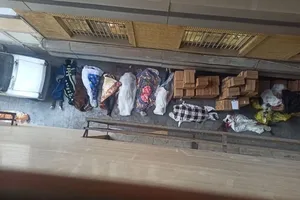
Witnesses in Rasht say protesters were driven into narrow market passages, trapped as fire spread and fired upon by security forces during January’s unrest, according to accounts gathered by Iran International.
The accounts are part of an Iran International public documentation campaign seeking to establish how many people were killed in Rasht, how the market fire unfolded and what happened to victims’ bodies and families in the days that followed.
The campaign is collecting and verifying accounts, images and videos from witnesses and families of those killed in Rasht, one of several cities where the January protests were met with severe force.
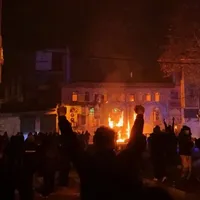
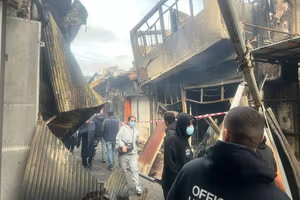
Parts of Rasht’s old market, including the booksellers’ market, the arched bazaar and the coppersmiths’ market, caught fire during the protests.
One eyewitness said security forces drove protesters toward areas with limited entry and exit points. After those areas were surrounded, fires broke out in the same sections.
The aftermath of the fire in Rasht bazaar
Trapped as fire spread
A witness described the smell of smoke, fire and burning as so strong that parts of Rasht remained hazy until near dawn.
The protests in Rasht began on Wednesday, January 7, when people gathered in the market and called on shopkeepers to close their stores. The crowd later moved toward Municipality Square. After Basij forces arrived, protesters dispersed for a time, but gatherings formed again around sunset in Sabzeh Meydan and near Bistoon Street.
One eyewitness said the crowd in Sabzeh Meydan initially numbered between 1,000 and 2,000 people, but grew over time.
Basij forces at first appeared confused, the witness said, because protesters were gathering in scattered groups across the city. When security forces moved toward one location, another gathering formed elsewhere.
The aftermath of the fire in Rasht bazaar
Crowds across the city
Protests on January 8 formed simultaneously in several parts of Rasht and later connected in central streets.
One witness described large crowds filling the streets from the Toutounkaran intersection to Municipality Square.
The witness said tens of thousands of people were on Imam Street and around Municipality Square, and that the protests were not limited to main roads but had spread into neighborhoods and side streets.
As the crowd grew and protesters gained control of parts of the city, security forces responded with tear gas and live ammunition, witnesses said.
Security forces blocked retreat routes from several directions, entered through nearby alleys and fired at protesters, according to the accounts.
Shooting at protesters was reported in Falakeh Gaz, Moallem Street, Municipality Square, Sabzeh Meydan, Shariati Street and routes around the market.
The aftermath of the fire in Rasht bazaar
'They came to hunt'
Witnesses said the crackdown intensified after about 10:30 p.m., when Revolutionary Guards forces entered the streets and direct fire with military weapons began.
One person who attended the January 8 protest in Rasht described the scene this way: “In the early hours, the crackdown was mostly carried out by the Basij. But from around 10:30 p.m., the IRGC came in. They came with AK-47s. The first person drove the motorbike and the person behind aimed and fired. It was as if they had come to hunt. Most of Rasht’s deaths began from that hour.”
The witness said security forces especially targeted teenage boys and young men. In some cases, they fired at car windows to force drivers to cross street barriers and clear the way for security forces.
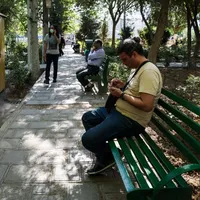
People walking at Rasht bazaar the day after the fire in January
When fire reached the market
The fire in Rasht’s market began while security forces were suppressing protesters in different parts of the city.
The fire started near Shariati Street and the Haj Mojtahed Mosque area, witnesses said. Because of the market’s dense layout, it spread quickly to other sections.
Some people trying to escape gunfire and security attacks were pushed toward Rasht’s market, a maze of narrow passages with limited exits.
Witnesses said security forces blocked the market’s exits from both sides. After that, parts of the market caught fire.
Protesters and other people trapped inside the market faced two deadly choices: remain amid smoke and flames, or try to leave and risk being shot by armed forces.
Some of those who died around the market were shot while trying to escape, witnesses said, while others were trapped by smoke and fire.
Some of the dead in the market area were shopkeepers who had gone inside to remove goods and save their property but were caught in the fire and blocked passageways.
One eyewitness said that around 2:30 a.m., after phone lines were reconnected, word spread that the market was burning.
“I and a few others went toward the market and saw several old caravanserais burning,” the witness said. “People were trying to pull goods out of shops that the fire was approaching.”
Describing the scene, the witness added: “Everyone was either helping or crying. One shopkeeper whose store and all his goods had burned was shouting, ‘My whole life is gone.’ Right there, several people began chanting against Khamenei.”
People walking at Rasht bazaar the day after the fire in January
Delayed firefighting
Fire engines were initially unable to fully enter the market area, and the first vehicles arrived after several hours of delay, according to accounts gathered by Iran International.
One witness said people were banging on the side of a fire truck and pleading with the driver to move farther into the market to control the fire. The driver, who had stopped near the shops, said: “I have orders only to come this far. They won’t let me go any farther. My mission ends here.”
Iran International also received accounts saying security bodies, including the Intelligence Ministry and the IRGC Intelligence Organization, had instructed firefighters not to begin full firefighting operations at that stage.
Some protesters were shot while fleeing the market area, witnesses said, while others were trapped in smoke and flames.
By early Friday morning, security forces had closed off part of Municipality Square near the start of Sa’di Street.
The bodies of several protesters were gathered there and then taken away in Nissan pickup trucks, according to accounts received by Iran International.
Direct fire in the streets
On the evening of Friday, January 9, the violence by security forces grew more intense. Fewer people were in the streets, witnesses said, and security forces fired without warning at even small gatherings.
Motahari Street, Moallem Street and nearby alleys were among the areas where witnesses reported blood on the asphalt and direct gunfire.
One witness said: “There was no warning anymore, no tear gas, no batons. Just direct fire with military weapons. Even inside the alleys, the asphalt was bloody.”
After the crackdown, Rasht was filled with reports of killed and wounded protesters.
In the following days, people shared news of deaths with one another in shops and on the streets.
One witness said that on Sunday, January 11, large crowds had gathered around the Bagh-e Rezvan cemetery in Rasht, with roads packed with cars for several kilometers.
The witness said an acquaintance who had gone to Bagh-e Rezvan for a relative’s burial reported that hundreds of bodies had been transferred there that day for identification.
Pressure on families
Families said the bodies of some of those killed were handed over only after relatives were forced to sign written undertakings.
Some families were pressured to accept the official narrative that their loved ones had been killed by “Israeli and American agents,” according to accounts received by Iran International.
The accounts from Rasht suggest that January’s events in the city went beyond a street crackdown.
The full scale remains unclear, including the number of people killed, who ordered the response and why families say they were pressured afterward.
Iran International’s public campaign aims to document the names, stories and evidence of those killed in Rasht, before their deaths are buried in silence or overwritten by official denial.
Ahead of the 2026 World Cup, a possible ban on Iran’s lion-and-sun flag has opened a dispute between FIFA and Iranian opponents of the Islamic Republic over identity, representation and politics in sport.
For many Iranians abroad, the World Cup is not only a sporting event. It is also a rare global stage where they can be seen, express identity and say things that can carry serious costs inside Iran.
Now, ahead of the 2026 tournament, that stage has become the center of a new argument. On the surface, it is about a flag. In practice, it is about who gets to define Iran, which symbols are allowed to represent it and where FIFA draws the line between sport and politics.
FIFA says flags, banners and symbols of a political nature are not allowed inside World Cup stadiums. Football’s global governing body says such rules are intended to preserve the neutrality of sport and prevent stadiums from becoming arenas for political conflict.
But in Iran’s case, many Iranians say that boundary is neither clear nor neutral.
Two flags, two visions of Iran
Opponents of the Islamic Republic say FIFA’s rules effectively privilege Tehran’s post-1979 official flag while treating the historic lion-and-sun banner as political.
The lion-and-sun emblem was used in Iran before the 1979 revolution and is still embraced by many Iranians as a national symbol outside the framework of the Islamic Republic.
The lion-and-sun emblem has deep roots in Iranian history and was used in different forms for centuries. After the 1979 revolution, the Islamic Republic replaced it with a new flag bearing religious and revolutionary symbols. For many opponents of the current system, the older flag has become a symbol of national identity separate from the Islamic Republic.
For them, a ban is not simply the enforcement of a stadium regulation. It is a choice between two competing narratives of Iran.
“If the Iranian government has registered its own symbol as the official flag, why should a symbol that was part of Iran’s history for centuries be considered political?” one Iranian opponent of the Islamic Republic in Los Angeles told Iran International. “Who gets to decide that definition?”
The debate is not new.
During the 2022 World Cup in Qatar, there were reports that some Iranian fans faced restrictions when trying to enter stadiums with the lion-and-sun flag or symbols associated with anti-government protests.
The same question was raised then: whether sports bodies’ definition of a political symbol is truly neutral, or whether it can itself become a political decision.
A changed relationship with Team Melli
The issue is no longer only about the flag.
Since the Woman, Life, Freedom movement, the relationship between parts of Iranian society and the national football team has changed significantly.
For decades, even as the Islamic Republic tried to fold public institutions into its official narrative, the national football team remained for many Iranians something larger than the government – a source of national pride, shared memory and collective identity.
After nationwide protests and intensified repression inside Iran, however, part of the public no longer views the team only through a sporting lens. The players’ conduct, silence or public positions, and their relationship with the state have all become politically charged.
Some opponents of the Islamic Republic now say the distance has grown deeper than ever, following the killing of large numbers of Iranians during the January protests and the rise in security pressure after the recent war.
In conversations with Iran International, several Iranian opponents of the Islamic Republic in Los Angeles and Seattle repeated the same argument: for part of the public, this team no longer represents the Iranian people.
“We love football. We love Iran’s national team. We were happy when it won and sad when it lost,” one of them said. “But today, many people feel this is no longer the national team in which they can see themselves.”
For this group, the issue is not hostility toward football or rejection of a national sport. On the contrary, they see themselves as part of a society for which football has long been tied to everyday life and national identity.
Their argument is that when the ruling system tries to use every national symbol – from sport to the flag – for political legitimacy, separating sport from politics becomes difficult.
A symbol of reclaiming identity
In that atmosphere, the lion-and-sun flag is not merely a historical symbol for some opponents of the Islamic Republic. It is an attempt to reclaim a version of Iran they feel has been taken from them.
“If a team that the Islamic Republic considers its representative is going onto the pitch, we also want to show our Iran in the stands,” one protester said.
This is where the dispute becomes more complicated.
If some Iranians no longer see the official team as reflecting their national identity, then barring the symbol they identify with is not viewed as a simple stadium rule, but as another exclusion of their voice from the world stage.
At the same time, some Iranian legal and civil groups are pursuing legal avenues to challenge such restrictions. They argue that banning these symbols conflicts with principles of free expression, particularly in a country such as the United States, where free speech has strong legal protection.
The legal issue is complicated. World Cup stadiums under FIFA management operate under specific tournament rules and are not necessarily governed in the same way as ordinary public spaces.
Still, the anger among opponents of the Islamic Republic is real. Some openly say that even if the flag is banned inside stadiums, they will find other ways to display it.
For them, the question is no longer only whether one flag can enter a stadium. It is who has the authority to decide what Iran is, which symbol represents it and which voices are allowed to be visible on the world stage.
FIFA says politics should not enter sport. But when identity itself has become political for part of a nation, the deeper question is whether people can be asked to leave that identity outside the stadium gates.
Shayan Kabiri came to Canada with his family seven years ago. Today, he sees many friends who arrived from Iran alone, hoping to build a more stable future, trapped in a crisis that threatens not only their education but also their mental health and immigration status.
As an advocacy officer with the Iranian Students’ Association at Toronto Metropolitan University, he says many of his peers have no family in Canada and have been living under severe financial and emotional pressure for months.
“Over 99 percent of Iranian students are suffering from this issue – not just emotionally, but financially. Many no longer have access to the money their families send,” he said.
Crisis reaches Canada
According to the latest figures from Immigration, Refugees and Citizenship Canada, around 30,000 Iranian students live in Canada – young people who moved thousands of kilometers from their families in search of safety and stability.
But for many, the crisis is no longer confined to Iran. It has reached their classrooms, dormitories and daily lives in Canada.
Internet restrictions and blackouts in Iran, difficulties transferring money and growing economic pressure on families have left many Iranian students in Canada facing severe financial and psychological strain. Students say they have lost not only reliable access to family support, but in many cases regular contact with parents and loved ones for weeks or even months.
Kabiri says the problem now goes beyond emotional distress. Many international students are struggling to pay tuition and cover basic living expenses.
“Ontario’s laws are such that if you cannot pay your tuition, the university is allowed to expel you. Then there is the risk of having to return to Iran,” he said.
Fear of return
For some students, returning to Iran would not simply mean the end of their education. Many have taken part in anti-government rallies and protests in Toronto and fear they could face serious security consequences if forced back.
Shervin Akhlaghi, captain of the jiu-jitsu team at Toronto Metropolitan University, a member of the university’s Board of Governors and a member of the Iranian Students’ Association, says this has become one of the most urgent concerns among students in recent months.
“Many were active in the rallies. Their pictures have been published. If, for any reason, they cannot continue their education and are forced to return to Iran, God knows what will happen to them,” he said.
He says financial pressure has become so severe that some students are turning to university food banks to meet basic needs.
“Many students are now using emergency food services. The cost of living in Canada is very high, and many are not allowed to work more than a limited number of hours per week,” he said.
Mental health toll
Alongside the financial pressure, family separation, disrupted communication and uncertainty about the future are weighing heavily on students.
Sara Rahimi, a psychotherapist and author, says many Iranian students are experiencing severe anxiety, depression and helplessness.
“These kids feel like they are caught in the middle of a storm. They have no control over their future, nor are they sure they can finish their studies,” she said.
For many, Rahimi says, losing contact with family is not just a communication problem but a deep emotional rupture.
“It’s like the severing of an emotional umbilical cord for many of these students. They still need their family’s emotional support, and now that connection has suddenly been cut,” she said.
Rahimi also warns that prolonged stress, grief and anger could expose some students to risky behavior or social conflict, potentially jeopardizing their academic or professional future.
Limited support
Some Canadian universities have introduced limited measures, including tuition deferrals, flexible exam schedules, free counseling and emergency relief funds. But students say the support is inconsistent, limited in scope and unavailable at some institutions.
The Ontario government has also recently gained broader authority to intervene in university affairs under Bill 33, the Supporting Children and Students Act, 2025. That authority could potentially be used to mandate special financial or academic accommodations for students from crisis-affected countries.
So far, however, no specific plan or official policy has been announced for Iranian students.
Akhlaghi says student associations from several Ontario universities, including the University of Toronto, York University, Queen’s University and Toronto Metropolitan University, have tried to raise the issue with the provincial government, but the response has been disappointing.
Generic response
According to Akhlaghi, the response from Ontario’s Ministry of Colleges and Universities felt generic and impersonal.
“Our feeling was as if this answer was written by artificial intelligence, because they sent the exact same repetitive response to student associations and even the media,” he said.
In response to questions from Iran International, the ministry did not directly mention Iranian students, saying only that universities and colleges have introduced “measures and supports” for students affected by global crises and advising students to contact their institutions directly.
Student activists say the situation requires more than generic guidance. They say Iranian students are facing overlapping financial distress, mental health challenges, immigration anxiety and fear of return, and need urgent, targeted policies.
Those measures, they say, should include flexibility on tuition payments, emergency financial aid, specialized mental health support and immigration assurances for students who may face danger if returned to Iran.
Beyond the blackout
Although internet access has improved in some parts of Iran in recent days, many students say their difficulties will not disappear quickly.
The sharp decline in families’ financial capacity, continued disruption in money transfers and months of instability have left many students under sustained financial and psychological strain.
For many, this was never only about internet blackouts. It has become a crisis that calls into question their academic future, mental well-being and ability to remain in Canada.
Iran largely restored internet access on Tuesday after 88 days of near-total isolation, NetBlocks said, while major social media platforms remained blocked and a court challenge cast uncertainty over the government's restoration order.
"Welcome back Iran! Metrics show a further rise in connectivity as mobile networks and other segments are reconnected to the global internet," the internet observatory Netblocks said in a Tuesday post on X.
"Filternet remains in place but can be worked around. WhatsApp now restricted, requiring circumvention. Some users still offline," it added, as it put the connectivity rate at 86 percent.
The restoration followed a Monday vote by a special cyberspace body created by President Masoud Pezeshkian to return international internet access to its pre-January 2026 status.
However, state media reported Tuesday that an administrative court had temporarily suspended implementation of the order that established the body, raising questions over the legal future of the reopening process.
ICT Minister Sattar Hashemi said the restoration decision was approved by nine votes to two at the body’s first official meeting, while his deputy said the reopening of fixed-line internet had begun nationwide.
On Monday, the IRGC-affiliated Fars News agency first questioned whether the administration had the authority to issue such an order, arguing that because the restrictions were imposed by the Supreme National Security Council, only the same body could formally reverse them.
Hours later, however, Fars appeared to soften its position in an editorial describing the reopening as a necessary “technical and security” decision that would have happened “sooner or later” as cyber conditions improved.
The outlet said the restrictions had originally been imposed to prevent cyber espionage and protect critical infrastructure during wartime conditions and an unprecedented wave of cyberattacks.
While acknowledging criticism over the legal process behind the decision, Fars dismissed efforts to turn the issue into a political dispute and accused some reformist media outlets of exploiting the shutdown to deepen internal divisions during what it described as a “full-scale war.”
The meeting of the Special Task Force on Cyberspace Management ended with nine votes in favor and three against reconnecting Iran to the global internet, according to reports.
Peyman Jebelli, head of Iran’s state broadcaster, and Mohammad-Amin Aghamiri, secretary of the Supreme Council of Cyberspace, were among the strongest opponents of restoring international internet access, Faraz reported citing informed sources.
According to Faraz, both men remained firmly opposed to reconnecting the country to the global internet until the end of the meeting.
The report said Aghamiri’s position was particularly notable because the secretary of the Supreme Council of Cyberspace is appointed by the president. Although Aghamiri was first appointed under the previous administration, Pezeshkian later retained him in the post.
Faraz said Aghamiri’s opposition had placed him at odds with the government at a time when Pezeshkian has publicly identified restoring internet access as one of his priorities.
Iran may be moving beyond temporary internet blackouts toward something more durable: a Chinese-style system of digital control.
Concerns intensified after a former head of Iran’s state broadcaster said Tehran had imported Chinese equipment for a “permanent internet shutdown,” while millions of Iranians endure what monitoring group NetBlocks says is now the world’s longest ongoing nationwide blackout.
Experts warn the Islamic Republic may not be trying to shut the internet off forever but instead attempting to build a controlled and heavily surveilled online ecosystem designed to filter information, monitor communications and isolate Iranians from the outside world while still keeping parts of the economy online.
Mohammad Sarafraz, the former head of Islamic Republic of Iran Broadcasting and a current member of the Supreme Council of Cyberspace, said in an interview with the online newspaper Faraz that factions in Tehran are seeking to restrict global internet access for the general public while preserving it for a limited and controlled group.
He said the Islamic Republic had imported Chinese equipment for “permanently cutting off the internet.”
Spectre of digital control
Laura Edelson, assistant professor of computer science at Northeastern University, said the closest comparison may be China’s internet crackdown in Xinjiang after unrest there in 2009, when authorities isolated the Uyghur-majority region from the outside internet for 10 months.
“Functionally, for the vast majority of the population, they were effectively cut off entirely from the outside world,” Edelson said.
She said China’s model is far more sophisticated than simply blocking websites, relying on centralized state control to filter content, surveil users and selectively determine what information people can access.
“This centralized model is one that a lot of other countries, including and almost especially Iran, has been moving toward,” she told Iran International.
She added that turning off the internet forever “is not useful,” meaning authoritarian governments increasingly favor adaptable systems that can tighten restrictions during politically sensitive moments and loosen them when economic activity is needed.
“Iran’s government doesn’t trust its own people,” Edelson said. “The vast majority of people don't support the government.”
“If you can have an internet that you can adaptively not just turn on and off, but control what people can reach and what they can’t reach — that’s a set of internet censorship and surveillance systems that I would be more afraid of personally,” she said.
Can Tehran pull it off?
Max Meizlish, Senior Research Analyst at the Foundation for Defense of Democracies and a former US Treasury official focused on sanctions enforcement, said China has long exported censorship technologies and surveillance capabilities to authoritarian partners.
“We know that China has been a significant partner to several malign actors, including Iran, but also Russia and North Korea, with respect to cyber technology censorship capabilities,” Meizlish told Iran International.
He said China’s own internet system gives Tehran both a blueprint and a commercial partner.
According to Meizlish, Iran’s centralized control over internet infrastructure already gives authorities the ability to regulate what information enters or leaves the country.
“What we could actually see is Iran building out its own internet,” he said, “so that the people of Iran are only able to view what the government wants them to view.”
He said technology transfers between Beijing and Tehran should increasingly be viewed through the lens of human rights abuses and digital repression.
“There’s an argument to be made that this form of censorship constitutes a wide-scale human rights abuse,” Meizlish said.
But Amin Sabeti, founder of cybersecurity research group CERTFA, cautioned that Iran still lacks many of the domestic technological capabilities that made China’s censorship system possible.
“The Iranian regime imports the technology; it doesn't own the technology,” Sabeti said.
Unlike China, he said, Iran lacks strong domestic alternatives to many global services and remains heavily dependent on foreign infrastructure and technology.
“In China, there isn't a need for Gmail because they have good services in terms of email,” Sabeti said. “In Iran, there isn't any proper email service.”
Sabeti said Iran has repeatedly shown it can temporarily shut down the internet during protests and unrest, but questioned whether the regime could sustain a truly permanent nationwide blackout over the long term.
“I don't think it will happen,” he said.
Iran’s rulers may not want to permanently disconnect Iranians from the global internet, but they appear to be moving toward a more sustainable architecture of digital control that allows the state to keep commerce functioning while isolating citizens from independent information, encrypted communications and even family members abroad.
For many Iranians, the question is no longer whether the internet will fully return, but what kind of internet the state intends to allow back.
Rauf Derakhshani-Mehr, a 19-year-old university student killed during January protests in the southern city of Dezful, was buried at night under pressure from security forces after his family located his body in a morgue, according to information obtained by Iran International.
Derakhshani-Mehr, a law student at Islamic Azad University, was shot dead during protests on January 9, a source familiar with the case said.
He was struck by a live bullet in the side and had also suffered metal pellet wounds to the left side of his body before the fatal shooting, the source said.
After he was transferred to Ganjavian hospital, his body was left alongside those of several other young protesters in the hospital grounds, according to witnesses and hospital staff cited by the source.
Witnesses said wounded protesters were denied treatment and that several people died because they did not receive medical care. Blood covered parts of the hospital grounds because of the severity of the injuries, they added.
Family searched hospitals and morgues
Derakhshani-Mehr’s family spent hours searching for him and went to the hospital, where officials initially denied he was there despite the family checking different wards.
Emergency personnel later told the family his body was being held in the hospital morgue, but security forces sealed the facility and prevented relatives from seeing him, the source added.
Family members were also given conflicting information by different authorities and were at one point told that he was still alive.
His body was eventually identified at the forensic medicine office in Ahvaz after being transferred there as an unidentified person, according to the account received by Iran International.
Before handing over the body, authorities forced the family to agree that the burial would take place at night and attended only by a small number of people. Derakhshani-Mehr was buried in Shahidabad cemetery in Dezful.
Night burials reported in earlier crackdowns
Security forces in Iran have previously buried slain protesters at night or without notifying their families.
In one case previously reported by Iran International, a 16-year-old boy named Reza who was killed during protests in Karaj was secretly buried by members of the Islamic Revolutionary Guards Corps without his family’s knowledge.
Witnesses said Reza was shot by a sniper around 9 p.m. on January 8 in the Shahin Vila neighborhood of Karaj. He later died after being moved to a residential parking area and then taken to a clinic.
People familiar with the case said the teenager’s family was informed the following day that members of the Revolutionary Guards had buried him overnight and disclosed the location of the grave afterward.