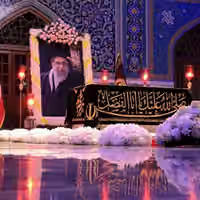
Four prominent moderates sit on both sides of senior cleric and supreme leader appointee Mohsen Qomi in an event to honour two former foreign ministers killed in a crash and by US-Israeli attacks, in Tehran, Iran, May 20, 2026. (Left to right: former nuclear chief Ali Akbar Salehi, former foreign minister Mohammad Javad Zarif, Mohsen Qomi, foreign minister Abbas Araghchi, and president Pezeshkian's chief of staff Mohsen Haji-Mirzaei)
A growing range of political voices in Tehran are calling for realism abroad and reconciliation at home rather than deeper confrontation as Washington signals both openness to talks and readiness for further military action.
US President Donald Trump talked up negotiations with Iran on Wednesday before quickly adding that hitting harder was still on the table.
In Tehran, a widening group of moderate, centrist and pragmatic conservative figures are warning the leadership that wartime solidarity cannot be taken for granted and that failure to change course could deepen Iran’s political and economic crisis.
Former MP and prominent moderate Mohsen Mirdamadi said in a May 20 interview with Etemad newspaper that “Iran’s most important assets are its people,” warning the government against overlooking that reality.
“Failing to recognize and appreciate this key asset is more dangerous than the destruction of any infrastructure,” he said.
Mirdamadi asserted that the war had strengthened many Iranians’ sense of patriotism. This public empathy, he argued, creates a responsibility for the government to enact meaningful changes in its policies in order to restore hope in the future.
“Give-and-take and balance are essential for reaching the optimal point,” he said, warning that those “beating the drums of war” could eventually force Iran’s leadership to “drink the chalice of poison” — a reference to accepting painful compromises too late rather than pursuing a timely agreement.
Similar warnings have increasingly appeared even in parts of the conservative camp.
On Wednesday, the conservative daily Jomhouri Eslami urged officials “not to provoke non-belligerent countries against Iran” and warned that threatening friendly states or discussing attacks on undersea communication cables in the Persian Gulf would only deepen hostility toward Tehran.
The paper also called on opponents of negotiations with the United States to reconsider their stance, arguing that constructive engagement with non-hostile countries could benefit Iran.
Other outlets focused on the domestic implications of the war atmosphere.
Rouydad24 warned authorities against using the conflict as a pretext to further restrict civil liberties, including internet access.
“Sustainable security is a product of justice, welfare, and trust in government, not restrictions and pressure on the people,” the outlet wrote, adding that “citizenship rights are not a luxury.”
Conservative commentator Mohammad Mohajeri similarly warned that wartime unity could prove fragile if the government fails to recognize growing public dissatisfaction.
“The government must understand that no war lasts forever,” Mohajeri told Etemad. “Eventually, there will have to be a ceasefire, an agreement or a mechanism to manage the crisis.”
Ali Rabiei, an adviser to President Masoud Pezeshkian, echoed the same concern in comments published by Etemad.
“We have no asset other than the people,” Rabiei wrote. “Please do not allow them to become polarized or fragmented as this is exactly what our enemies want.”
Yet the growing chorus of calls for pragmatism is unfolding alongside signs that Iran’s hardline camp is becoming more radicalized and more tightly aligned around confrontation.
While moderate and pragmatic voices may be broadening across parts of the political spectrum, it is the security establishment and its allies who still appear to hold the upper hand.
Calls for pragmatism are visibly rising. Whether anyone with real hard power is listening is far less clear.
An illustration showing an ancient Iranian soldier and a Revolutionary Guard member holding a weapon together, displayed during a November 7 ceremony in Tehran where a statue of pre-Islamic Persian King Shapur I was unveiled.
Tehran’s unveiling of a towering statue depicting the Roman Emperor Valerian kneeling before pre-Islamic Persian King Shapur I has renewed criticism of the Islamic Republic’s appeal to nationalist sentiment following the June war with Israel.
For over forty years, the theocracy purged ancient Persian history from schoolbooks, replacing it with post-Islamic narratives. But after the 12-day conflict with Israel, officials have turned to the distant pre-Islamic past to rally a divided society.
From murals of ancient kings and soldiers to patriotic songs added to Shi’ite mourning ceremonies performed before Supreme Leader Ali Khamenei, Tehran now embraces imagery once deemed heretical by its own revolutionary ethos.
The statue unveiled in Tehran's Revolution Square
'Kneel before Iran' campaign
Tehran’s Revolution (Enghelab) Square was the scene of an unusual spectacle on Friday as officials unveiled a massive bronze statue depicting Roman Emperor Valerian kneeling in submission before Sassanid King Shapur I, commemorating Iran’s victory at the Battle of Edessa (260 AD).
The event was held under the slogan “Kneel before Iran,” part of what authorities describe as a campaign to project “national unity and historical pride” following the June war with Israel.
Tehran Mayor Alireza Zakani, a staunch ultraconservative, said on X: “Enmity with Great Iran can only end in kneeling before this historic nation.”
Municipal official Davood Goodarzi said the installation would be accompanied by visual displays depicting “other victories of Iranians over foreign aggressors,” including the defeat of British forces by local commander Rais-Ali Delvari, Mirza Kuchak Khan’s resistance against Russian troops, and Surena’s triumph over Rome at the Battle of Carrhae in 53 BCE.
The goal, Goodarzi said, is “strengthening concepts such as national dignity, social unity, and Iranian identity.”
The statue, he said, would remain temporarily at Revolution Square before being moved to a city gateway “where it will stand as the first emblem of Iran before diplomats and foreign visitors.”
Unveiled women were allowed to attend the unveiling ceremony—an uncommon scene at events organized by Tehran’s ultra-hardline municipality.
The turn to the pre-Islamic past
The sharp reversal also recalls remarks once made by Khamenei. In a 2011 speech, he asserted that “all the great military victories of this nation came after Islam,” dismissing pre-Islamic accounts as “things that are not documented.”
In 1987, he had said that prophets triumphed over kings such as Cyrus and that “nothing remains of these monarchs in history but names remembered with derision.”
Nevertheless, pro-government social media accounts have now gone so far as to circulate posters equating Khamenei himself with Shapur, showing him standing with a staff as Benjamin Netanyahu and Donald Trump kneel before him. The caption reads: “You will kneel before Iran.”
Image circulating by hardliners on social media
'Hypocrisy'
Pro-government figures have hailed the move as a patriotic success. Conservative political reporter Hossein Saremi posted: “Today’s grand Iranian gathering showed that people and the state share one essence: Iran itself. Nothing can take our homeland away.”
Others, however, called the spectacle “hypocrisy.” Journalist Gholamhossein Pashaei wrote on X: “Every year you close Pasargadae to stop people from celebrating Cyrus Day, yet you unveil Shapur’s statue in Enghelab Square with drums and fireworks during Fatimiyya (mourning period)!”
Dissident commentator Hamid Asafi called the ceremony “a perfect snapshot of the Islamic Republic’s contradictions.”
On Telegram he wrote: “A week ago they closed Cyrus’s tomb out of fear of the crowds, and now they glorify Shapur in the same breath. The Islamic Republic fears living history but poses for selfies with its corpse.”
He added: “They know people no longer respond to rosaries and sermons. That’s why they’ve brought history back to the stage—in a controlled costume. If they can’t erase the past, they’ll try to own it.”
The irony deepened as UNESCO formally recognized Cyrus’s Charter as one of the earliest human-rights documents.
President Masoud Pezeshkian wrote on X: “Iran, the cradle of dialogue, justice, and coexistence, can still inspire peace today.”
Users swiftly replied, questioning how such pride could coexist with a government that blocks access to Cyrus’s tomb each year to those wishing to visit it on his birthday.