Iran keeps loyal voices online as public faces record internet blackout | Iran International
Iran keeps loyal voices online as public faces record internet blackout
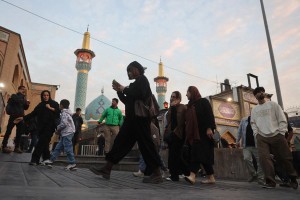
A telecommunications tower stands in the background as a woman in Tehran uses her phone on January 24, 2026.
Iran’s government said on Tuesday that it is providing special internet access to select users capable of promoting its messaging online, even as the country remains under what monitoring groups call one of the most severe nationwide internet shutdowns ever recorded.
Much of that privileged access is believed to operate through so-called “white SIM cards” – mobile lines exempt from Iran’s filtering system that allow direct access to blocked platforms such as X, Telegram and Instagram.
Spokeswoman Fatemeh Mohajerani did not directly refer to those SIM cards but spoke about the government-imposed national internet blackout, saying Tehran is instead offering connectivity to “those who can better deliver the message.”
According to internet monitoring group NetBlocks, the Iranian government has been promoting its agenda through whitelisted online services while the public remains in a digital blackout
“The regime continues to promote its agenda through whitelisted networks, cultivating media assets at home and abroad,” NetBlocks said on Friday, six days into the latest round of nationwide internet shutdown.
This is while President Masoud Pezeshkian vowed in early December to deactivate the so-called “white SIM cards” that grant unfiltered access to a circle of state-linked users.
“We have instructed that these white internet lines be turned black as well, to show what will happen to people if this blackness continues,” he said.
Pezeshkian has repeatedly promised to lift filtering, a key pledge of his 2024 presidential campaign.
Meanwhile, Iran’s nationwide internet shutdown has continued for more than 240 hours, marking one of the most severe government-imposed nationwide blackouts ever recorded globally and the second longest in the country’s history after the January protests, according to NetBlocks.
The group said on Tuesday that Iran has now spent roughly a third of the year 2026 offline.
Tehran may have assumed that a US–Israeli attack would activate the loose alignment it has cultivated with Moscow, Beijing and other non-Western powers. So far, it has instead exposed its limits.
What Iranian officials often presented as an emerging geopolitical counterweight to Western power appears, for now, far from a wartime coalition.
Russia and China have condemned the attacks and called for restraint, but neither has shown willingness to intervene militarily on Iran’s behalf.
Reports suggest Moscow may have shared limited intelligence that could assist Iranian targeting of US assets in the region. Even if so, such cooperation remains indirect and far short of what a wartime alliance would entail.
For Moscow, deeper involvement carries obvious risks. Russia remains heavily engaged in Ukraine and under sustained military and economic pressure from the West. Opening another confrontation with the United States in the Middle East would pose significant strategic dangers.
Yet instability in the region could still bring Moscow indirect gains. As a major oil exporter, Russia benefits from higher global energy prices, which help cushion the impact of Western sanctions.
A wider conflict could also divert Western political attention from Ukraine, easing pressure on its primary theater.
China’s calculus points in the same direction: distance. Beijing’s interests in the Middle East are largely economic—stable energy supplies, secure shipping routes and predictable markets. A major regional war threatens all three.
At the same time, a prolonged conflict that absorbs American attention and resources could indirectly ease pressure on China in its broader rivalry with Washington.
North Korea, often cited as part of an emerging anti-Western axis, has remained largely silent. Pyongyang lacks the logistical capacity to project meaningful military power into the Middle East and has little incentive to risk confrontation with the United States in a distant conflict.
For decades, Tehran invested heavily in expanding its regional influence through a network of non-state actors stretching from Lebanon to Yemen. Groups such as Hezbollah, Hamas and the Houthis were meant to provide strategic depth, allowing Iran to pressure adversaries indirectly while avoiding direct confrontation.
That network now faces growing strain.
Hamas has been significantly weakened by prolonged conflict with Israel. Hezbollah remains Iran’s most capable partner, but its structure also reveals a deeper limitation in Tehran’s approach: the system often depends on personal relationships between commanders rather than durable institutional frameworks, making coordination more fragile when individuals are removed.
The Houthis retain the capacity to disrupt shipping routes and launch missile or drone attacks across the region. But their strength lies primarily in asymmetric disruption; in a high-intensity campaign driven by air power and long-range strikes, such actions cannot quickly alter the strategic balance inside Iran itself.
Elsewhere, several militia groups cultivated by Tehran in Iraq appear reluctant to escalate dramatically, underscoring the limits of Iran’s ability to mobilize partners during a major confrontation.
In recent years, Iran has sought to present itself as part of a broader alignment against Israel while simultaneously pursuing pragmatic openings with Arab states. The China-brokered rapprochement with Saudi Arabia in 2023 suggested the possibility of a more stable Gulf balance.
But that détente depends heavily on regional stability. If Iranian actions—or those of allied militias—threaten shipping lanes or energy infrastructure, Arab governments may prove far less inclined to view Tehran as a reliable long-term partner.
If the conflict continues while its partners remain cautious, Iran risks growing isolation. Its ties with Russia and China are shaped primarily by overlapping interests rather than formal alliance commitments.
Strategic priorities diverge, and even governments opposed to Western dominance remain wary of dependence or rivalry.
A deeper alignment might have emerged under different geopolitical conditions, much as sustained confrontation during the Cold War pushed Western states toward institutional alliances such as NATO.
But that moment has not arrived. The war suggests it may not—at least not on terms Iran had imagined.
Israeli military images of an underground tunnel complex attributed to Ali Khamenei appear to confirm long-circulating rumors of a network stretching several kilometers beneath central Tehran, under medical centers, schools, and residential neighborhoods.
On March 5, shortly after heavy strikes targeted areas near the Pasteur government complex in central Tehran – a district that houses the Iranian presidency and several key government offices – the Israeli military published a video depicting what it described as Khamenei’s underground bunker system.
The complex resembles a subterranean city. According to the video and accompanying imagery, the facility appears to have been used as a secure shelter for Iran’s leadership and may still be used by remaining officials following Khamenei’s death.
A tunnel network stretching nearly five kilometers
Analysis of the imagery released by the Israeli military, using publicly available online mapping tools, suggests the tunnel network extends close to five kilometers in length.
To understand the scale of the project, it helps to compare it with ordinary infrastructure construction in Tehran.
According to statements by Tehran mayor Alireza Zakani and members of the Tehran City Council, building one kilometer of metro tunnel in Tehran currently costs between 5,000 and 6,000 billion tomans – roughly $30-36 million at an exchange rate of about 166,000 tomans per dollar.
This estimate covers only the excavation and structural work. It does not include interior finishing, equipment, ventilation systems, or other underground facilities.
Based on those figures, building five kilometers of underground tunnel would cost about 25,000 to 30,000 billion tomans, or roughly $150-180 million.
Given the secrecy and security requirements surrounding such a project, the actual cost was likely significantly higher than that of a standard transportation tunnel.
Under normal conditions, tunneling contractors in Tehran can excavate around 10 meters per day. At that pace, building a five-kilometer tunnel system would take at least 500 days – roughly 17 months.
Considering the classified nature of the project and the additional infrastructure involved, the construction timeline may have been considerably longer.
The core of the complex: beneath a medical facility
The video appears to place the central section of the bunker complex southwest of the presidential compound in the Pasteur district.
The site sits directly beneath the Shahid Shourideh Medical Center, a clinic affiliated with Iran’s Ministry of Agriculture. The facility has operated since 1985 and effectively functions as part of the broader Pasteur government complex.
Based on the height of vehicle ramps and the dimensions of vehicles visible in the imagery, the central installation appears to be located 40 to 50 meters underground.
From there, the tunnel system extends northwest toward another entrance near the end of Rajabi Street, roughly 200 meters from the Shourideh hospital complex.
Shahid Shourideh Medical Center, which is affiliated with Iran’s Ministry of Agriculture, sits above what appears to be the main core of Khamenei’s bunker complex, estimated to be 40 to 50 meters underground.
Easternmost entrance: next to an elementary school
The easternmost known entrance to the tunnel network appears to be located in the Sheikh Hadi neighborhood, along Valiasr Street, beneath the Jami multi-story parking garage.
This parking structure stands directly beside Hejrat Girls’ Elementary School, while Saheb a-Zaman Boys’ Elementary School lies about 100 meters away.
At the northern edge of the network sits another multi-story garage known as the 12 Farvardin Parking Complex, located near the intersection of Jomhouri Eslami Street and Danesh Street.
Both parking structures were inaugurated on December 4, 2017, as part of a paired urban development project attended by Tehran’s then-mayor Mohammad Najafi.
One entrance to the tunnel network appears to lie beneath a building opposite the Karimeh Ahl-e Beit clinic near Hor Square in central Tehran.
An entrance beneath a mosque, beside a school
Another entrance appears west of Pasteur Square, between Hor Metro Station and the square itself.
This access point lies beneath Tohid Mosque. Adjacent to the mosque is a building, and behind it stands Shahid Kadkhodaei Boys’ Elementary School.
Roughly 200 meters away, another possible entrance is located on the southwestern side of Pasteur Square, along a street that houses the AJA University of Command and Staff – the staff college of the Islamic Republic of Iran Army.
Nearby are the Karimeh Ahl-e Beit dental clinic and medical clinic, as well as the 29 Farvardin Pharmacy, which is affiliated with Iran’s army.
The easternmost entrance to the tunnel complex appears to lie beneath the Jami multi-story parking garage, directly next to Hejrat Girls’ Elementary School.
Western entrance beside a football school
The westernmost identified entrance to the tunnel network appears to lie beneath a small building near an office responsible for issuing hunting weapon permits.
Immediately next to the building, sharing a wall, is a football training school, while dense residential complexes surround the area.
This location sits near the intersection of Sepah and Kamali streets, along Kashan Street, at the end of Fourth Street.
The tunnels also lie close to the Yas and Namjou residential complexes, which are affiliated with the Iranian army.
One of the entrances to the tunnel network appears to lie beneath a mosque next to Shahid Kadkhodaei Boys’ Elementary School.
Iran said on Monday there was no room to discuss a ceasefire while military attacks by the United States and Israel continue.
Foreign Ministry spokesperson Esmaeil Baghaei said Iran did not start the war and that it had been in negotiations when the conflict began.
“We are in the eleventh day of military aggression by the United States and the Zionist regime. We did not start this war,” he said at a news conference.
“Military aggression is ongoing and therefore in this situation there is little place to talk about anything other than defense and a crushing response to the enemy,” he added, saying all of Iran’s focus is currently on defending the country.
Iran denies drone attacks on Azerbaijan, Turkey and Cyprus
Baghaei also denied on Monday that Iranian armed forces launched drones or missiles toward Azerbaijan, Turkey or Cyprus, as regional tensions spill beyond its borders.
Debris of a NATO air defence system that intercepted a missile launched from Iran is seen in Dortyol, in southern Hatay province, Turkey, March 4, 2026.
He said Iran’s defense actions “should in no way be interpreted as hostility toward any of the countries in the region,” adding that the armed forces’ general staff had “explicitly and officially announced that such launches were not carried out from inside Iran or by our military forces.”
His remarks follow accusations by Azerbaijan that four drones crossed into its Nakhchivan exclave, striking the airport terminal and exploding near a school, injuring civilians.
President Ilham Aliyev called the incident an “act of terror,” demanded an explanation and apology from Tehran, and ordered the withdrawal of Azerbaijani diplomatic staff from Iran.
Earlier, Iran’s Foreign Minister Abbas Araghchi denied that Tehran launched drones toward Nakhchivan and told his Azerbaijani counterpart that Iran “denies any drone launch toward that republic,” according to state media.
He said Iran’s armed forces were investigating the reported explosions and accused Israel of seeking to disrupt relations between Muslim countries to harm Iran’s ties with its neighbors.
Turkey has said NATO air defenses intercepted an Iranian ballistic missile that entered Turkish airspace last week. Ankara protested to Tehran and has deployed F-16 fighter jets to Northern Cyprus as a precautionary security measure.
Cyprus has also reported a drone strike on a British base on the island, which it said was likely launched by Iran-backed Hezbollah rather than directly from Iran.
Iran’s judiciary said on Monday that Iranians living abroad could face the seizure of their assets if they cooperate with countries Tehran considers hostile, in a warning that appeared aimed at deterring support for the United States and Israel during the war.
The threat was issued in a statement by the Office of the Prosecutor General, which said such cooperation, if deemed harmful to national security, could bring confiscation of all assets and other legal penalties.
The statement cited Article 1 of a law passed in October that increased penalties for espionage and cooperation with Israel and other countries deemed hostile to Iran’s national security and interests.
Under that law, operational or intelligence activities carried out on behalf of Israel, the United States or other “hostile” governments or groups can lead to the confiscation of all assets and the death penalty, the statement said.
The warning came after some members of the Iranian diaspora seeking change in Tehran gathered in cities across Europe and the United States to celebrate the killing of Supreme Leader Ali Khamenei in the US-Israeli war against Iran.
At the same time, newly created Telegram channels have published details about prominent Iranians abroad who criticized Iran’s clerical establishment and backed the US-Israeli airstrikes that began on February 28.
Between 5 million and 10 million Iranians are estimated to live abroad, mostly in the United States and Western Europe, according to Iranian official data and domestic media reports.
Iran International has launched a new interactive news map on its website aimed at making it easier for audiences to access stories and better understand the geographic spread of events in Iran and around the world.
The feature allows users to explore news not only by time or topic but also by geographic location, offering a visual way to track developments across cities, provinces and countries.
Each news event appears as a marker on the map showing where it occurred. By clicking on a marker, users can open a list of related stories published about that location and read further details.
The tool enables audiences to quickly see what has happened in a particular city, province or region of the world at a glance.
The interactive map is now available from the top-right section of the Iran International website and through a dedicated link, allowing users to follow developments in Iran and globally in an interactive format.
Search news by location
On the Iran International interactive map, news events are marked with icons that correspond to a specific city, province or location worldwide.
Selecting any marker displays a list of news items connected to that geographic location.
This feature is particularly useful for tracking developments concentrated in a specific region, ranging from protests and political developments to major international events.
Filter news by time
The map also includes a time filter that allows users to display stories from a selected period.
With this tool, audiences can review how events have unfolded over time and see what developments occurred across different parts of the world during a specific timeframe.
Available time filters include today, the past seven days, the past 14 days, the past month, the past three months and the past year.
Browse news by topic
In addition to location and time, users can filter news by subject.
The interactive map allows audiences to select from a range of news categories, including liveblog, the Middles East crisis, Iran’s protests, world news, and economy and environment.
The feature helps users quickly navigate large volumes of news and find stories related to their specific interests.
The launch of the interactive map is part of Iran International’s broader effort to provide new digital tools and make access to information easier for its audience.