Iranian drones fuel Sudan war as conflict enters fourth year - Fox News
Iran is facing accusations of supplying attack drones to Sudan’s army as the country’s civil war enters its fourth year, with US officials and analysts warning that drone strikes are increasingly hitting civilians, hospitals, schools and aid operations, Fox News reported.

The war between the Sudanese Armed Forces and the paramilitary Rapid Support Forces began in April 2023. Some estimates put the death toll as high as 400,000, while more than 11 million people have been displaced, making it the world’s largest displacement crisis.
A research analyst at the Foundation for Defense of Democracies, Mariam Wahba, told Fox News Digital that Iran has supplied the Sudanese Armed Forces with Mohajer-6 drones, produced by Qods Aviation Industries, a US-sanctioned Iranian entity.
Wahba described the Mohajer-6 as Iran’s “workhorse drone,” saying it is used for surveillance and precision strikes and has also been used in attacks involving Iran-backed groups such as Hezbollah and the Houthis.
She said at least seven cargo flights traveled between Iran and Sudan between December 2023 and July 2024, likely carrying drones and components.
The report also cited the arrest of Iranian-born US resident Shamim Mafi at Los Angeles International Airport earlier this month. US prosecutors accused her of brokering a $70 million deal to supply Sudan’s Ministry of Defense with Mohajer-6 systems and other Iranian-made weapons, including bombs, fuses and ammunition.
A spokesperson for the US Attorney’s Office for the Central District of California told Fox News Digital that Mafi remains in federal custody and is scheduled to be arraigned on May 8 in Los Angeles.
A State Department spokesperson told Fox that Washington is “greatly concerned” about the spread of drone warfare in Sudan and its impact on civilians and civilian infrastructure, saying both sides in the war have used drones to destroy hospitals and schools.
The spokesperson also said Islamist groups aligned with Sudan’s army have built ties with Iran and received support from the Islamic Republic, including training and assistance from the Revolutionary Guards.
UN officials have condemned recent drone attacks in Sudan. UN spokesperson Stéphane Dujarric said a UNHCR aid truck carrying emergency shelter supplies was hit by a drone in North Darfur on April 24, destroying all supplies. He said another drone attack the next day in El Obeid, in North Kordofan, killed seven people and wounded more than 20, citing a local medical group.
UNICEF’s Ricardo Pires told Fox that for Sudanese children, the sound of a drone has become “another dreadful signal to hide and hope they are not harmed next,” warning that streets, hospitals and schools are being turned into places of danger and death.
The most important question in Tehran may also be the one least possible to answer with confidence: who is making decisions?
Months before Ali Khamenei was killed, Masoud Pezeshkian warned of the danger that would follow if anything happened to the supreme leader. “Then we would fight among ourselves,” he said. “Israel would not even need to come.” That warning now reads less like a passing warning than a map of the crisis facing Tehran.
Since the killing of Ali Khamenei and the wartime rise of his son Mojtaba, Iran’s system has not collapsed. Nor has it become transparent. What appears to have emerged is a less centralized, more militarized and more opaque order: its old arbiter is gone, its new leader is unseen, and rival camps are testing how far they can move without breaking the Islamic Republic they all want to preserve.
No one outside Iran’s innermost circle can know exactly who is making decisions. But the visible signs point to a system divided more over tactics than survival. The familiar split between “hardliners” and “moderates” may capture some real tensions, but it can also serve as a useful false dichotomy – for Tehran, for foreign governments and, most dangerously, against the Iranian public.
For ordinary Iranians, the question is not whether one faction speaks more softly than another. The deeper point is that the same system still controls war, repression, public life and the limits of political choice. The names may shift; the method endures.
On paper, Mojtaba Khamenei is Iran’s Supreme Leader. In practice, he has not yet performed the role his father played for decades: appearing publicly, speaking directly, ending factional arguments and signaling the final line of the state.
That absence matters, but it should not be overstated. Mojtaba may still be consulted or asked to formally approve decisions. The more important point is that power appears to have moved into a harder-to-see structure: a security-led order shaped by overlapping circles that compete, cooperate and distrust one another.
The Guards blocked presidential appointments, including Pezeshkian’s effort to name a new intelligence minister, while Ahmad Vahidi, the IRGC commander and a central figure in the current security order, insisted that sensitive posts be selected and managed directly by the Guards under wartime conditions.
Sources also said Pezeshkian repeatedly sought an urgent meeting with Mojtaba but received no response, while a “military council” of senior IRGC officers enforced a security cordon around the new Supreme Leader and prevented government reports from reaching him.
But the IRGC should not be treated as one simple faction. Almost every major actor in the current crisis has some link to the Guards, the war generation, the security apparatus or the Supreme Leader’s office. The useful distinction is not “IRGC versus civilians,” but the different circles now competing over how the system survives.
One circle is the older intelligence-security network around Mojtaba. It includes figures such as Hossein Taeb, the former head of the IRGC Intelligence Organization, and Mohammad Ali Jafari, the former IRGC commander. Mojtaba’s old ties to the Habib Battalion from the Iran-Iraq War matter because they helped create personal links with men who later rose through intelligence, security and repression structures. This is less a formal faction than a network of trust built over decades.
Another circle is closer to the negotiation-facing track. It includes Pezeshkian, Parliament Speaker Bagher Ghalibaf, Foreign Minister Abbas Araghchi and Ali Bagheri Kani, a former nuclear negotiator.
Their relative openness to talks may make them more flexible tactically, but not “moderates” in any democratic sense. They operate inside the Islamic Republic’s security logic. But they have been more visibly tied to keeping a diplomatic channel open with Washington and trying to turn pressure into some form of agreement.
A third circle appears closer to direct military and security decision-making. Vahidi is the key figure here, followed by Mohammad Bagher Zolghadr, a former senior IRGC commander now heading the Supreme National Security Council.
Other security-state figures – including former police chief Esmail Ahmadi Moghaddam, former defense minister Amir Hatami, police chief Ahmadreza Radan and judiciary chief Gholam-Hossein Mohseni-Ejei – are often seen as closer to this coercive order than to the negotiation-facing track.
A fourth circle is the ideological pressure camp around Saeed Jalili, the former nuclear negotiator and ultrahardline security figure; Hamid Rasaei, Amirhossein Sabeti and Mohammad Nabavian, hardline lawmakers; and Sadegh Mahsouli, a key patron of the Paydari current. This camp is especially hostile to talks with Washington. Its role in the current crisis is to define compromise as betrayal, attack negotiators and claim to defend the Supreme Leader’s red lines.
These are not clean factions. Their members overlap, and their positions can shift. All appear invested in the survival of the Islamic Republic. What differs is their method: tactical negotiation, coercive escalation, ideological discipline, or some combination of the three.
The best reading is not a name, but a map of relationships.
The dispute over talks with the United States has made those networks visible.
Iran International reported on April 10 that senior officials were divided over the authority of the delegation set to negotiate with Washington in Islamabad.
Sources said Vahidi wanted to curb the authority of Ghalibaf, the parliament speaker and former IRGC commander who had led the negotiating team, and Araghchi, the foreign minister. Vahidi also wanted Zolghadr included in the team and sought to prevent any negotiation over Iran’s missile program.
The dispute widened as the talks faltered. Sources told Iran International on April 23 that a delegation was ready to leave for further talks when a message from Mojtaba’s inner circle ruled out discussion of nuclear issues and reprimanded the foreign ministry team over earlier negotiations. Araghchi warned that attending under such constraints would serve no purpose.
A day later, sources said Ghalibaf stepped down as head of the negotiating team after being reprimanded for trying to include the nuclear issue in talks. Araghchi then traveled to Islamabad alone to deliver Tehran’s proposal, which was later rejected by Trump, according to media reports.
The latest signs point to an even messier picture. Two sources familiar with the matter told Iran International that Pezeshkian and Ghalibaf are now seeking Araghchi’s removal, accusing him of acting less like a cabinet minister and more like an aide to Vahidi. The sources said Araghchi had coordinated with the IRGC commander over the past two weeks without properly informing the president.
That is an important turn. It suggests the rift is not simply between “negotiators” and “hardliners.” Even figures associated with the diplomatic track are accusing one another of serving the security command.
The public signs have been just as revealing. Ghalibaf defended indirect talks after hardline critics accused him of betrayal and even hinted at a coup. He framed diplomacy not as retreat, but as another front in the conflict – a way to turn military gains into political outcomes.
Iran International later learned that Ghalibaf went further in a private meeting, describing figures including Jalili and Sabeti as extremist militia-like actors who would destroy Iran. He accused them of using state television and mobilized hardline supporters to intensify opposition to negotiations.
Tasnim, a news agency linked to the IRGC, republished an editorial mocking maximalist demands for a deal, including full sanctions removal and a comprehensive ceasefire with Iran’s regional allies, as a fantasy akin to expecting a “magic beanstalk.” Raja News, close to Jalili’s camp, accused Tasnim of weakening the Supreme Leader’s red lines and repeating the path that led to the nuclear deal it calls “pure damage.”
Tasnim removed the article but hit back sharply, accusing Raja News of sowing division and helping complete Trump’s project in Iran. It also referred to arrests over “suspicious movements to undermine sacred unity.”
That language is not routine factional criticism. It shows a fight inside the revolutionary camp over who gets to define loyalty, who can speak for the leader, and who will be blamed if talks fail or concessions become unavoidable.
The rift is real, but it should not be mistaken for an opening.
It is not a contest between democrats and authoritarians. It is not proof that Iran has a liberal faction waiting to be empowered. It is not even a simple split between the IRGC and the civilian state, because the so-called civilian figures operate inside a system shaped by the Guards, the Supreme Leader’s office and the security state.
The split is between factions of the Islamic Republic arguing over how best to preserve the system.
From Washington, Marco Rubio made a similar point. “They’re all hardliners in Iran,” the US secretary of state told Fox News. But he drew a distinction between hardliners who understand they still have to run a country and an economy, and those “completely motivated by theology.”
Rubio described the president, foreign minister, parliament speaker and other political officials as hardliners too, but said they also know that “people have to eat” and that the government has to pay salaries. The harder core, he said, includes the IRGC, the Supreme Leader and the council around him. “Unfortunately,” Rubio added, “the hardliners, with an apocalyptic vision of the future, have the ultimate power in that country.”
Trump has used harsher language, saying Iran’s government is “seriously fractured” and that its leaders are struggling to figure out who is in charge. Those remarks should be read both as Washington’s assessment and as part of its pressure campaign.
Tehran answered with a unity slogan that unintentionally made the same point. “There are no hardliners or moderates in Iran; we are all ‘Iranian’ and ‘revolutionary,’” Pezeshkian wrote on X. He added that with “full obedience to the Supreme Leader,” Iran would make the “criminal aggressor” regret its actions.
The same line was then posted by Ghalibaf, Araghchi, Mohseni-Ejei and other senior officials. It was meant to deny division. But for many Iranians, the phrase “Iranian and revolutionary” says something else too: inside the Islamic Republic, political difference still ends where loyalty to the revolution begins.
The better reading is that the Islamic Republic is divided over tactics, not survival; and more militarized, not more moderate. That is where the trap begins: a real rift can still serve a false choice.
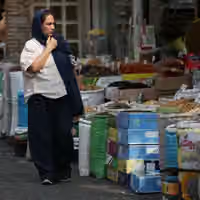
A woman wears a badge with a picture of Iran’s new Supreme Leader, Mojtaba Khamenei, during a rally in Tehran, Iran, April 29, 2026.
The false choice: bad, worse and the politics of leverage
The “hardliner versus moderate” frame has always served more than one audience.
For foreign diplomats, it offers a familiar temptation: make a deal with the less bad side before the worse side takes over. For the Islamic Republic, it offers a warning: give us concessions, because the alternative is chaos or escalation. For Iranians, it narrows politics to a suffocating choice: accept this faction, or suffer that one.
Iran’s internal divisions may be real, but the Islamic Republic has long benefited from presenting politics as a choice between bad and worse – a choice that narrows the imagination of both Iranian society and foreign diplomats.
That is the false dichotomy at the center of the current crisis.
The rift is real: there are disputes over talks, nuclear red lines, the negotiating team and how much to concede. But the rift is also distorted: Pezeshkian, Araghchi and Ghalibaf may be more negotiation-facing than Jalili or Nabavian, but they are not outside the system.
And the rift can be useful. A negotiator can point to hardliners to seek concessions. A hardliner can accuse a negotiator of betrayal to raise the cost of compromise. The state can deny division in public while allowing enough ambiguity to make foreign governments wonder who can deliver a deal.
When no one clearly owns the decision, no one clearly owns the consequences. Talks can be authorized, denied, resumed and scrapped. A delegation can be sent, restrained, reprimanded and replaced. The people are then told not to ask who is responsible, because the country is at war and unity is sacred.
Whether spontaneous, managed, or both, the Islamic Republic has repeatedly turned internal factionalism into a political instrument. The public is asked to choose between bad and worse; foreign governments are asked to negotiate with bad to avoid worse.
What the rift does – and does not – change
The immediate consequence is both diplomatic and domestic. Talks become harder to arrange, harder to interpret and harder to trust, while Iranians remain exposed to decisions made by a system they cannot hold accountable.
This does not mean Iran cannot negotiate. It means any deal must survive several internal tests: the security core’s calculation, Mojtaba Khamenei’s formal blessing or silence, ideological backlash, state media narratives and the regime’s fear of looking weak to its own base.
The challenge may not be that Tehran cannot send a negotiator, but that no envoy can easily bind the system behind him.
For Iranians, however, the debate over who rules Tehran is not an abstract puzzle. It is lived through decisions made behind walls: war, economic pressure, repression, the threat of crackdowns on any renewed protest movement, and the shrinking space for public life.
The rival circles now visible in Tehran may disagree over tactics, but they all operate inside a system built to preserve itself before it answers to society.
The Islamic Republic may be less centralized than before, but that does not make it more accountable. It may be more divided in public, but that does not make it more open. It may need diplomacy, but that does not make its negotiators representatives of the people.
The internal map has shifted. The old supreme leader is gone. The new one is unseen. Security networks appear stronger. The ideological camp is louder. Negotiators are more exposed. Rival circles are more willing to wound each other in public.
But for the Iranian people, the core fact has not changed enough. They are still being asked to live with the consequences of decisions they cannot see, made by men who compete for power while agreeing on the survival of a system that denies the public any real power.
Any settlement of the Iran war that leaves the Revolutionary Guards in control would preserve the Islamic Republic's core of power and risk turning a military advantage for the US and Israel into a strategic defeat.
That is the central challenge now facing Washington and its allies: how to end the conflict without giving the Islamic Republic time to absorb the blow, preserve the Revolutionary Guards’ grip on power and survive through another diplomatic compromise.
The war must conclude in a way that empowers the Iranian people, with support from outside players, namely the United States and Israel, and leaves them fully prepared to overthrow the IRGC-controlled regime. Any settlement or deal that ensures the Islamic Republic's survival would amount to a strategic defeat for the US and Israel.
In reality, the remnants of the regime still possess enough offensive capability to threaten the region and beyond. The US and Israel can use the most powerful and lethal force available against the Islamic Republic— the Iranian people — to eliminate the remaining threats once and for all.
To be sure, the people of Iran now face a fragmented leadership marked by serious rifts among political factions. The country’s economy is in ruins. The theocracy has sustained deep wounds and is effectively bleeding as a result of the elimination of top military commanders and political leaders.
The Islamic Republic is reportedly losing between $450 million and $500 million per day due to the US blockade of Hormuz. However, there is no guarantee that such economic losses will lead to its immediate collapse or overthrow. It may well resort to further violence and terrorist activity abroad.
Overall, the Islamic Republic is down, but it is not out. Sadly, more innocent people have been executed since an uneasy ceasefire took hold in mid-April.
This is simply because the core nucleus of power — the Islamic Revolutionary Guard Corps — remains functional. It has effectively engineered a silent coup under the cover of war, sidelining other contenders such as Ghalibaf, with whom Trump is reportedly seeking a possible framework to end the conflict.
The Trump administration and European powers should be mindful that no so-called reformist figure like Mikhail Gorbachev will emerge from within the Islamic Republic. From this regime, only terrorists emerge, wearing a mask of diplomatic civility.
Israel, whether one agrees with it or not, has a strong understanding of Tehran's modus operandi, largely because it has developed extensive expertise in countering terrorist networks, many of which are supported or enabled by the radicals in Tehran.
In this view, the world should recognize that the disintegration of the IRGC cannot be achieved through negotiation or a maritime blockade alone. Such an outcome requires a hybrid strategy centered on maximum economic pressure, sustained military pressure and the empowerment of the Iranian people to topple the clerical rule.
If decision-makers in Tehran conclude that the United States ultimately wants to avoid continued conflict, they may be incentivized to prolong the confrontation in a more attritional form, using stalling tactics and deception to buy time. In parallel, they could gradually escalate tensions below the threshold of an all-out war in an effort to extract concessions, particularly if they believe the US is seeking to end the conflict without committing to regime change.
The key, therefore, is to deprive the Islamic Republic of the notion that Trump seeks an off-ramp in this war and instead shift toward sustained pressure so that the IRGC faces only two options: total surrender or regime change.
I argue that the IRGC will not fully acquiesce to US conditions. Instead, it may accept certain demands while rejecting others in order to prolong the conflict and extend the diplomatic process.
The best way to neutralize the threats posed by the IRGC regime in Tehran is to take the following considerations into account:
Expand pressure on the Islamic Republic's third tier of current and former leaders, including figures such as Ghalibaf, Rouhani, Zarif and Khatami.
Seize Iran’s buried uranium stockpile before it is too late.
Maintain the maritime blockade and expand it to other areas, including the Indo-Pacific, with the aim of cutting off Tehran's financial lifeline.
Provide Israel with greater latitude for targeted operations against IRGC and Basij commanders and lower-level security forces.
Directly enable people inside Iran through intelligence assets and logistical support so they can seize the Islamic Republic’s strategic institutions themselves.
Engage with Crown Prince Reza Pahlavi in a manner reminiscent of Reagan’s outreach to Sakharov, fostering dialogue with the most consequential Iranian opposition leader, backed by a vast number of people inside Iran.
In sum, the conflict involving the US and the IRGC should be resolved in a way that fundamentally weakens the current regime and increases the agency of the Iranian population.
Any negotiated settlement that allows the Islamic Republic to remain intact would be a strategic setback for the United States and Israel. The US and Israel have the people of Iran as the most powerful force against the regime in Tehran.
The United States has asked partner countries to join its newly formed Maritime Freedom Coalition to help secure passage through the Strait of Hormuz and Persian Gulf waterways, according to a State Department cable.
The cable, sent this week to US diplomatic posts around the world, instructed diplomats to announce the coalition and “ask for partner participation” by Friday.
It also told diplomats not to discuss the initiative with “US adversaries, including Russia, China, Belarus, and Cuba.”
According to the cable, which was first reported by the Wall Street Journal, the coalition will be led by the State and Defense Departments through US Central Command.
“The MFC will take steps to ensure safe passage, including providing real-time information, safety guidance, and coordination to ensure vessels can transit these waters securely,” the cable said.
President Donald Trump has on several occasions criticized NATO allies and European countries for not doing enough to help the United States reopen and secure the Strait of Hormuz which has been effectively closed after the Iran war.
US blockade
The US initiative comes as Washington has imposed a naval blockade on Iranian ports since April 13, sharply reducing Iran’s oil exports and intensifying pressure on Tehran’s access to maritime trade routes.
Iranian crude shipments that successfully moved out of the Gulf of Oman fell to about four million barrels between April 13 and April 25, Reuters reported, citing oil analytics firm Vortexa.
That was down more than 80% from a comparable period in March, when Iran exported 23.4 million barrels, according to LSEG data cited by Reuters.
Reuters said only a handful of tankers carrying Iranian crude left the Gulf of Oman during that period.
Some Iranian vessels have turned off tracking systems, while US forces have turned back Iranian tankers, making it impossible to determine how much crude Iran is still delivering to customers, particularly China.
Taliban leaders and affiliated figures voiced support for Iran after Israeli strikes in June 2025 and later US threats, signaling a limited and conditional alignment despite longstanding disputes with Tehran.
Despite a history of sectarian and political friction, recent statements from Taliban officials point to an alignment with the Islamic Republic during a period of heightened regional confrontation.
Differences over border clashes, water rights from the Hirmand (Helmand) River and the treatment of Afghan refugees remain unresolved.
The clearest articulation came from Taliban spokesman Zabihullah Mujahid, who said the group does not favor war but supports Iran’s right to respond to attacks.
“We are not in favor of war… Iran is right; defense is Iran’s right,” Mujahid said in a February 15, 2026 interview with radio. “Whatever happens, Afghans are ready to sympathize with Iran in times of war and hardship and cooperate within their means.”
Mujahid added that any assistance would depend on Iran making a request and said that diplomacy remains preferable to escalation.
The spokesman had earlier condemned Israeli strikes on Iranian nuclear and military targets on June 13, 2025, describing them as a “violation of international law and national sovereignty.”
Foreign ministry stance
Taliban Foreign Minister Amir Khan Muttaqi also conveyed support in direct contacts with his Iranian counterpart Abbas Araghchi.
In a March 2, 2026 statement, the foreign ministry said Muttaqi condemned what he described as “US and Israeli aggression against Iran” and expressed sympathy following the reported death of Iran’s supreme leader.
Muttaqi urged a diplomatic resolution, calling “violations of national sovereignty unacceptable under international norms.”
Haqqani network figures
Figures linked to the Islamist Haqqani network reinforced this position through social media activity. Mohammad Jalal, a senior member of the Taliban’s cultural committee, circulated images of damage in Israeli cities after Iranian missile strikes, framing Tehran’s response as “legitimate self-defense.”
Jalal also shared posts by Iranian Parliament Speaker Mohammad Bagher Ghalibaf promoting a campaign encouraging volunteers to defend Iran, aligning with broader anti-Israel rhetoric within Taliban circles.
Anas Haqqani, another senior figure, published a poem referencing the Strait of Hormuz in support of Iran.
Pro-Taliban commentators
Media figures close to the Taliban have gone further, portraying Iran as a model of national unity. Abdullah Raihan, a Kabul-based commentator, praised defiance following US threats to target Iranian infrastructure.
“Afghans should learn patriotism from Iranians,” Raihan wrote earlier in April, describing scenes of civilians gathering on bridges in response to threats of bombardment.
Raihan contrasted this with Kabul’s 2021 fall, arguing that “even critics of Iran’s government did not undermine national infrastructure.” He also condemned attacks on civilian sites and adding that foreign intervention is worse than domestic political shortcomings.
Taliban-controlled national radio and television largely reflected official statements without advancing independent advocacy for Iran. Coverage focused on Mujahid’s interview and foreign ministry statements, framing developments through concerns about regional escalation and sovereignty.
Programming remained largely domestic in focus, though Iran-related coverage rose sharply during the most intense phases of the conflict.
Whether this limited convergence translates into tangible cooperation remains unclear, given enduring Iran-Taliban disputes and the Taliban’s preference for avoiding direct involvement in the conflict.
Iran ranked among the world’s worst countries for press freedom in 2026 as global conditions hit a 25-year low, with legal pressure on journalists intensifying across multiple regions, Reporters Without Borders said.
More than half of all countries now fall into “difficult” or “very serious” categories, with the global average score at its lowest since the index began, the organization said.
“Iran remains near the bottom of the ranking, held back by the regime’s own repression and the US-Israeli war on its soil,” Reporters Without Borders wrote.
Iran anchored in ‘very serious’ category
Iran ranked 177th out of 180 countries, placing it firmly in the “very serious” category on the global press freedom map, according to the index.
The map shows Iran shaded in the darkest category, alongside a group of countries where conditions for journalists are considered most restrictive.
The report links Iran’s position to longstanding constraints on media and the use of legal and security frameworks to prosecute journalists or limit reporting.
Press freedom has declined steadily worldwide, with less than 1% of the global population now living in countries classified as having a “good” environment for journalism.
Russia and China shape restrictive landscape
Russia and China remain central to the global decline, both through domestic policies and the spread of their legal models abroad.
Russia ranked 172nd, with authorities using laws tied to extremism and national security to detain journalists and restrict independent reporting.
China ranked 178th and continues to hold more journalists in prison than any other country, with its censorship and legal frameworks increasingly replicated across the Asia-Pacific region.
Across that region, 21 of 32 countries are now classified as having “difficult” or “very serious” press freedom conditions.
Syria posts rare improvement
Syria recorded the sharpest improvement in the 2026 index, climbing 36 places following political changes after the fall of Bashar al-Assad’s government in late 2025.
Despite that shift, the map visualization shows much of the Middle East and parts of Asia still dominated by darker shades, indicating persistent risks for journalists across the region.
Legal pressure drives global decline
The legal environment for journalism deteriorated in more than 60% of countries over the past year, reflecting wider use of national security laws and criminal charges against reporters.
These legal tools have become central to controlling information, often reinforced by economic pressure and political messaging against independent media.
The findings point to a global shift in how press freedom is constrained, with legal systems now playing a defining role in shaping access to information and the boundaries of public reporting.