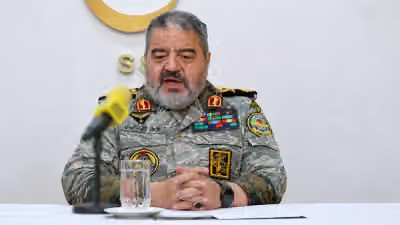
Iran’s Parliament Speaker Mohammad Bagher Ghalibaf warned in a radio message on Wednesday that the United States had entered a new phase of the war to weaken Iran from within, or even make it collapse, through economic pressure, media campaigns, and a naval blockade.
Ghalibaf’s warning reflected a broader concern among political observers inside Iran that a prolonged naval blockade could impose escalating costs and, over time, prove more damaging than a direct military conflict.
Economic dissatisfaction is increasingly visible across media and social networks. Even before the recent conflict, rising economic pressures—reflected in the sharp increase in the dollar—had already driven days of protests and an exceptionally bloody crackdown in cities across the country. Those pressures have since intensified.
International affairs analyst Ali Bigdeli described the social climate in an interview with Khabar Online: “People are in an exhausting situation. At the societal level, signs of fatigue and restlessness are completely evident.”
He warned that a US naval blockade could be more dangerous than war itself and argued that authorities should move quickly toward negotiations with Washington, showing flexibility—even if that means temporarily halting parts of Iran’s nuclear program. “Ultimately, if no concessions are given to the United States, more complex internal social and political consequences may arise,” he added.
One reader commented: “I constantly have the feeling that people might pour into the streets soon—because of rising prices, internet shutdowns, and unemployment. Send this article to Mr. Ghalibaf so they move faster on reaching a deal; otherwise, things could turn.”
Risk of losing core supporters
Among government supporters, the current ceasefire period is described as a “war of resilience.” However, some warn that worsening economic conditions could erode the loyalty of core supporters—often referred to by conservatives as “The Street”—who backed the Islamic Republic during the conflict, while undecided “gray” segments of society may shift toward opposition.
Conservative figure Ali Gholhaki wrote that the war has entered a new phase, pointing to sharp increases in car prices, surging housing costs despite security risks, and rising currency and gold prices as signs of negative developments:
“The economic phase of the war is an essential part of the war itself. A new plan must be devised before the ‘street’ is lost!”
A user on X expressed similar concerns: “These days my fear is that the patience of the gray class will run out and, God forbid, we may experience another street conflict—even with revolutionary supporters present.”
Post-war economy under pressure
The fears are being amplified by a series of post-ceasefire indicators showing pressure spreading from prices and currency markets to employment.
According to the Statistical Center of Iran, the consumer price index rose 5% in Farvardin (March–April) compared to the previous month, reaching 73.5% year-on-year—over five percentage points higher than figures reported by the Central Bank of Iran earlier this week.
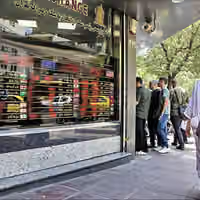
After a period of relative stability with the dollar below 1,600,000 rials, the exchange rate in the informal market rose to around 1,820,000 rials on April 30. While fears of renewed conflict played a role, rising inflation is also a key driver, analysts say.
Unemployment has surged sharply. A deputy labor minister said the 40-day war left 2 million people jobless. However, labor activist Hamid Haj Esmaeili estimates that including informal sectors and digital platforms, the real figure could be between 3 and 4 million.
The war has also disproportionately affected women’s employment. Zahra Behrouz Azar recently stated that nearly one-third of unemployment insurance claims filed over the past 40 days were submitted by women. Given their lower participation in formal employment, she described the figure as significant, noting it indicates a higher rate of women exiting the labor market—many of whom are heads of households.
According to new estimates by the International Monetary Fund, Iran’s economy is expected to contract by 6.1% due to the war, potentially leading to further unemployment and deepening poverty.
Expanding poverty and social risks
As inflation and unemployment rise, more Iranians are falling below the absolute poverty line. The head of Iran’s Welfare Organization reported in January that the population living in absolute poverty has doubled since 2018, reaching 44% (around 35 million people), with an additional 4 million experiencing extreme poverty.
Economic analyst Majid Goudarzi warned that if current trends continue, Iran could face “a combination of widespread unemployment, declining purchasing power, and rising poverty that will be very difficult to manage.”