• العربية
  • فارسی
Brand
  • Iran Insight
  • Politics
  • Economy
  • Analysis
  • Special Report
  • Opinion
  • Podcast
  • Iran Insight
  • Politics
  • Economy
  • Analysis
  • Special Report
  • Opinion
  • Podcast
  • Theme
  • Language
    • العربية
    • فارسی
  • Iran Insight
  • Politics
  • Economy
  • Analysis
  • Special Report
  • Opinion
  • Podcast
All rights reserved for Volant Media UK Limited
volant media logo

Tehran residents face eviction from hotels after war damage

May 1, 2026, 10:06 GMT+1
People inspect the site of a residential building damaged by a strike, amid the US-Israeli conflict with Iran, in Karaj, Iran, April 3, 2026.

Dozens of residents in Tehran displaced by a 40-day war with the US and Israel said municipal authorities ordered them to vacate temporary hotel housing despite unsafe homes and limited aid, according to interviews published by Etemad newspaper on Thursday.

Several of those affected said they were told to leave by the end of the week after calls from Tehran’s crisis management body, even though official inspections had deemed their homes uninhabitable.

“I was told I had to leave the hotel by the end of the week, even though my home is unsafe and I have nowhere to go,” one resident said, describing a call from a municipal official who noted reconstruction had not begun due to lack of funds.

People inspect the site of a residential building damaged by a strike, amid the US-Israeli conflict with Iran, in Karaj, Iran, April 3, 2026.
100%
People inspect the site of a residential building damaged by a strike, amid the US-Israeli conflict with Iran, in Karaj, Iran, April 3, 2026.

Unsafe homes, no rental support

A resident, who lived in a seventh-floor apartment damaged by a nearby missile strike in March, described shattered windows and debris that rendered both the unit and building access unusable. Emergency services later confirmed the structure was unsafe.

Despite this, the resident said no rental assistance or deposit support had been offered. “They told me I should find housing myself because there is no budget,” the resident added.

Other displaced residents reported receiving similar instructions. Many said they lacked the financial means to rebuild or secure new housing, leaving them at risk of homelessness.

Under earlier municipal pledges, affected households were to receive temporary accommodation, rental support, and reconstruction assistance.

Updated figures increased aid for household goods to 4 billion rials (about $2,200), rental deposits to 20 billion rials (about $11,000), and monthly rent support to 400 million rials (about $220).

However, residents said these commitments have not been consistently fulfilled.

Average income in Iran is around $150 to $200 per month, while the minimum wage is typically below $100.

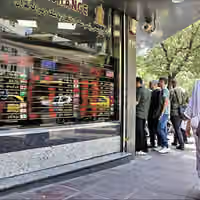
Civilians react on a street as tensions rise during the US–Israeli conflict with Iran, with one man speaking on the phone while others look on in concern. (undated)
100%
Civilians react on a street as tensions rise during the US–Israeli conflict with Iran, with one man speaking on the phone while others look on in concern.

Delays and conditions on compensation

Some families whose homes were destroyed said they were instructed to pay for basic household items upfront and submit receipts for reimbursement, which could take up to 10 months.

Others said even smaller grants had limited impact. One resident who received 2.5 billion rials (about $1,400) said it was insufficient to replace essential items such as a refrigerator, stove, and bedding.

“We lost everything in the strike and could not even recover clothes,” the resident said. “With that money, we could only buy a few basic items.”

In some cases, families forced to leave hotels reported moving into improvised spaces. One household said they had lived for months in a 30-square-meter storage room after being unable to afford rent.

Insurance payouts also stalled

Residents with damaged vehicles described similar difficulties in seeking compensation. Several said they were told by representatives of insurance that earlier claims from a previous conflict in June had not yet been settled.

“They told me there is no timeline for paying these damages,” one vehicle owner said after visiting an insurance office.

Official figures show that thousands of vehicles and tens of thousands of residential units were damaged in the 40-day conflict, adding to earlier destruction from a previous 12-day escalation in June.

A man inspects a car buried under rubble inside a damaged building following strikes during the US–Israeli conflict with Iran. (undated)
100%
A man inspects a car buried under rubble inside a damaged building following strikes during the US–Israeli conflict with Iran.

City council response highlights gaps

A spokesperson for Tehran’s city council acknowledged reports of inconsistencies and said cases of forced eviction without support should be reviewed.

“This should not happen, and if such cases exist, they must be followed up,” Alireza Nadali said, adding that municipal policy ties the end of hotel stays to securing alternative housing.

The official also pointed to the scale of damage and budget constraints, adding that assistance programs were introduced voluntarily and may face delays.

At the same time, the council emphasized that reconstruction responsibilities differ depending on the level of damage and local planning rules, which has led to varied outcomes across districts.

Oversight concerns emerge

The accounts raise questions about the oversight role of the city council and the implementation of municipal commitments. Residents interviewed said many promises remained unfulfilled months after the initial damage.

Efforts to obtain direct comment from municipal crisis officials were unsuccessful, according to the report.

Most Viewed

Even state media sounds alarm as Iran’s economy sinks
1
INSIGHT

Even state media sounds alarm as Iran’s economy sinks

2
EXCLUSIVE

Iran football chief with IRGC ties sent back by Canada after arrival

3
EXCLUSIVE

Pezeshkian, Ghalibaf seek Araghchi’s ouster over 'subservience' to Guards

4
INSIGHT

As Tehran praises Moscow, critics ask where Russia was

5
INSIGHT

How the Taliban tilted toward Iran during wartime tensions

Banner
Banner

Spotlight

  • Ottawa on defensive after Iran football chief linked to IRGC entered Canada
    EXCLUSIVE

    Ottawa on defensive after Iran football chief linked to IRGC entered Canada

  • Even state media sounds alarm as Iran’s economy sinks
    INSIGHT

    Even state media sounds alarm as Iran’s economy sinks

  • Tehran is pricing out its daughters
    TEHRAN INSIDER

    Tehran is pricing out its daughters

  • Three layers of mistrust behind US-Iran deadlock
    ANALYSIS

    Three layers of mistrust behind US-Iran deadlock

  • Iran’s water crisis: Mafia or destruction by design?
    SPECIAL REPORT

    Iran’s water crisis: Mafia or destruction by design?

  • As Tehran praises Moscow, critics ask where Russia was
    INSIGHT

    As Tehran praises Moscow, critics ask where Russia was

  • War damage amounts to $3,000 per Iranian, with blockade set to add to losses

    War damage amounts to $3,000 per Iranian, with blockade set to add to losses

  • War-hit homeowners feel abandoned as Iran’s reconstruction aid fades

    War-hit homeowners feel abandoned as Iran’s reconstruction aid fades

  • War leaves its mark on Iran's cultural heritage

    War leaves its mark on Iran's cultural heritage

•
•
•

More Stories

Economics may decide outcome of Iran-US standoff

Apr 30, 2026, 22:31 GMT+1
•
Behrouz Turani

The next phase of the Iran–US standoff may be decided not on the battlefield, but by how much economic pressure each side can withstand.

What remains unclear is how that pressure will play out. Will rising fuel prices and market instability in the United States push President Donald Trump toward compromise, or will Iran’s mounting economic strain force Tehran to accept US demands?

"Iran's economy is a disaster. So we'll see how long they hold out," Trump told reporters on Thursday.

In both Iran and the US, political messaging already points toward eventual claims of victory. For ordinary Iranians, however, the only positive outcome is one where their livelihood improves.

Ali Asghar Zargar, a political science professor in Tehran, describes the current moment as “as dangerous as the war itself.” Speaking to the reform-leaning Fararu website, he warned that “when diplomacy collapses, the likelihood of military action increases.”

Still, he noted that despite the lack of progress, “the path to dialogue has not been completely closed.”

Zargar characterized the current state of half-active diplomacy as a safety valve slowing the slide toward open conflict. But he cautioned that “an error on either side can trigger a clash at any moment,” pointing to the volatility of the situation in the Strait of Hormuz.

The two-week ceasefire between Tehran and Washington expired last week, with no clear indication that talks will resume soon.

Iranian diplomatic activity, particularly Foreign Minister Abbas Araghchi’s recent visits to Pakistan, Oman and Russia, has fueled speculation about both renewed negotiations and the possibility of further escalation.

Some Iranian analysts believe another round of US and Israeli strikes cannot be ruled out.

Israeli Defense Minister Israel Katz said on Thursday that Iran has suffered “very severe blows” over the past year and warned that further action may be needed “to ensure the achievement of our goals.”

Also on Thursday, Iran’s parliament speaker and lead negotiator Mohammad Bagher Ghalibaf said Tehran could use its position over the Strait of Hormuz to reshape regional dynamics and reduce US influence.

“Iran, by exercising control over the Strait of Hormuz, will ensure that it and its neighbors enjoy the precious blessing of a future free from the presence and interference of America,” he wrote on X.

Abbas Abdi, a reformist commentator who had largely avoided domestic political writing in recent months, returned this week with a stark assessment: “We are in an exceptional situation where everything is about survival.”

He argued that Iran needs a new framework that prioritizes ending the war above all else.

The economic cost of the standoff is already significant on both sides. Opposition to the war and its financial consequences has grown in the United States, while Trump has claimed Iran is “losing $500 million a day” under the U.S. blockade of the Strait of Hormuz.

As Tehran and Washington test each other’s resilience, distrust continues to deepen. A Fararu analysis described the situation as one of “active suspension”: relations are neither moving toward full confrontation nor showing any clear path to agreement.

For now, both sides appear to be probing how much pressure the other can endure without breaking. But the longer that calculation continues, the greater the risk that economic strain—and a single misstep—could tip the balance toward escalation rather than compromise.

How the Taliban tilted toward Iran during wartime tensions

Apr 30, 2026, 10:22 GMT+1

Taliban leaders and affiliated figures voiced support for Iran after Israeli strikes in June 2025 and later US threats, signaling a limited and conditional alignment despite longstanding disputes with Tehran.

Despite a history of sectarian and political friction, recent statements from Taliban officials point to an alignment with the Islamic Republic during a period of heightened regional confrontation.

Differences over border clashes, water rights from the Hirmand (Helmand) River and the treatment of Afghan refugees remain unresolved.

  • Taliban diverts Helmand River water again, satellite images show

    Taliban diverts Helmand River water again, satellite images show

The clearest articulation came from Taliban spokesman Zabihullah Mujahid, who said the group does not favor war but supports Iran’s right to respond to attacks.

“We are not in favor of war… Iran is right; defense is Iran’s right,” Mujahid said in a February 15, 2026 interview with radio. “Whatever happens, Afghans are ready to sympathize with Iran in times of war and hardship and cooperate within their means.”

Mujahid added that any assistance would depend on Iran making a request and said that diplomacy remains preferable to escalation.

The spokesman had earlier condemned Israeli strikes on Iranian nuclear and military targets on June 13, 2025, describing them as a “violation of international law and national sovereignty.”

Foreign ministry stance

Taliban Foreign Minister Amir Khan Muttaqi also conveyed support in direct contacts with his Iranian counterpart Abbas Araghchi.

In a March 2, 2026 statement, the foreign ministry said Muttaqi condemned what he described as “US and Israeli aggression against Iran” and expressed sympathy following the reported death of Iran’s supreme leader.

Muttaqi urged a diplomatic resolution, calling “violations of national sovereignty unacceptable under international norms.”

Haqqani network figures

Figures linked to the Islamist Haqqani network reinforced this position through social media activity. Mohammad Jalal, a senior member of the Taliban’s cultural committee, circulated images of damage in Israeli cities after Iranian missile strikes, framing Tehran’s response as “legitimate self-defense.”

Jalal also shared posts by Iranian Parliament Speaker Mohammad Bagher Ghalibaf promoting a campaign encouraging volunteers to defend Iran, aligning with broader anti-Israel rhetoric within Taliban circles.

Anas Haqqani, another senior figure, published a poem referencing the Strait of Hormuz in support of Iran.

Pro-Taliban commentators

Media figures close to the Taliban have gone further, portraying Iran as a model of national unity. Abdullah Raihan, a Kabul-based commentator, praised defiance following US threats to target Iranian infrastructure.

“Afghans should learn patriotism from Iranians,” Raihan wrote earlier in April, describing scenes of civilians gathering on bridges in response to threats of bombardment.

Raihan contrasted this with Kabul’s 2021 fall, arguing that “even critics of Iran’s government did not undermine national infrastructure.” He also condemned attacks on civilian sites and adding that foreign intervention is worse than domestic political shortcomings.

  • Afghan migrants among those killed in Iran protests

    Afghan migrants among those killed in Iran protests

State media mirrors official line

Taliban-controlled national radio and television largely reflected official statements without advancing independent advocacy for Iran. Coverage focused on Mujahid’s interview and foreign ministry statements, framing developments through concerns about regional escalation and sovereignty.

Programming remained largely domestic in focus, though Iran-related coverage rose sharply during the most intense phases of the conflict.

  • Up to 40 Afghan migrants die crossing into Iran in severe cold

    Up to 40 Afghan migrants die crossing into Iran in severe cold

Whether this limited convergence translates into tangible cooperation remains unclear, given enduring Iran-Taliban disputes and the Taliban’s preference for avoiding direct involvement in the conflict.

Iran ranks near bottom as press curbs deepen worldwide

Apr 30, 2026, 07:00 GMT+1

Iran ranked among the world’s worst countries for press freedom in 2026 as global conditions hit a 25-year low, with legal pressure on journalists intensifying across multiple regions, Reporters Without Borders said.

More than half of all countries now fall into “difficult” or “very serious” categories, with the global average score at its lowest since the index began, the organization said.

“Iran remains near the bottom of the ranking, held back by the regime’s own repression and the US-Israeli war on its soil,” Reporters Without Borders wrote.

100%

Iran anchored in ‘very serious’ category

Iran ranked 177th out of 180 countries, placing it firmly in the “very serious” category on the global press freedom map, according to the index.

The map shows Iran shaded in the darkest category, alongside a group of countries where conditions for journalists are considered most restrictive.

The report links Iran’s position to longstanding constraints on media and the use of legal and security frameworks to prosecute journalists or limit reporting.

Press freedom has declined steadily worldwide, with less than 1% of the global population now living in countries classified as having a “good” environment for journalism.

100%

Russia and China shape restrictive landscape

Russia and China remain central to the global decline, both through domestic policies and the spread of their legal models abroad.

Russia ranked 172nd, with authorities using laws tied to extremism and national security to detain journalists and restrict independent reporting.

China ranked 178th and continues to hold more journalists in prison than any other country, with its censorship and legal frameworks increasingly replicated across the Asia-Pacific region.

Across that region, 21 of 32 countries are now classified as having “difficult” or “very serious” press freedom conditions.

Syria posts rare improvement

Syria recorded the sharpest improvement in the 2026 index, climbing 36 places following political changes after the fall of Bashar al-Assad’s government in late 2025.

Despite that shift, the map visualization shows much of the Middle East and parts of Asia still dominated by darker shades, indicating persistent risks for journalists across the region.

Legal pressure drives global decline

The legal environment for journalism deteriorated in more than 60% of countries over the past year, reflecting wider use of national security laws and criminal charges against reporters.

These legal tools have become central to controlling information, often reinforced by economic pressure and political messaging against independent media.

The findings point to a global shift in how press freedom is constrained, with legal systems now playing a defining role in shaping access to information and the boundaries of public reporting.

Iran war clouds summer travel as jet fuel costs soar

Apr 29, 2026, 07:16 GMT+1

European airlines are facing their biggest test since the COVID-19 pandemic as the Iran war drives up jet fuel prices, disrupts Middle East routes and raises concerns about possible fuel shortages ahead of the summer holiday season.

Jet fuel prices have risen nearly 84% since the start of the war on February 28, according to Reuters. Airlines have so far softened the impact through hedging, which allows them to lock in fuel prices, but some of those protections are starting to run out as the conflict drags on.

“There is a risk that we’ll see rationing of fuel supply, particularly in Asia and Europe,” Willie Walsh, head of the International Air Transport Association, told Reuters, though he said supply remained robust for now.

Walsh said the crisis was still far smaller than the pandemic-era collapse in travel, because demand for flights remains strong. “I think COVID was on a completely different scale,” he said. “What we’re seeing here is, in effect, a cost issue for the airlines.”

The aviation pressure is tied directly to the Iran war and the disruption around the Strait of Hormuz, a critical route for global oil and gas flows. Repeated stops and starts in peace talks, combined with uncertainty over the reopening of Hormuz, have kept energy markets under strain.

Some carriers are already warning of weaker bookings and higher costs. EasyJet and tour operator TUI have reported drops in forward bookings and issued profit warnings, while Air France-KLM, IAG and Lufthansa are expected to report first-quarter results in the coming days after raising prices and cutting capacity in response to the war.

Persian Gulf carriers have been hit hardest. Cirium Ascend data cited by Reuters showed flights operated by Middle Eastern airlines fell 50% year-on-year in March, while bookings for the second and third quarters through major regional hubs are down 42.5%.

Still, the impact is uneven. Wizz Air said summer bookings remain strong, Ryanair’s Michael O’Leary played down the risk of supply disruption, and Finnair said the crisis had so far helped demand for its Asian flights. Global passenger capacity remains nearly 2% higher than in 2025.

Three layers of mistrust behind US-Iran deadlock

Apr 28, 2026, 15:53 GMT+1
•
Ata Mohamed Tabriz

Deep-rooted mistrust continues to stand in the way of any meaningful thaw between Iran and the United States despite renewed diplomacy after weeks of war.

After a 40-day war, Iran and the United States returned to the negotiating table in Islamabad for 21 hours of high-level talks that ended without agreement. A day later, US President Donald Trump announced a naval blockade of the Strait of Hormuz and Tehran said it would not negotiate under threat.

What the Islamabad talks made clear is that mistrust is not a single obstacle but a three-layered structure.

The first layer is structural, rooted in conflicting historical narratives and incompatible visions of the future. The second is tactical, visible in disputes over agenda, sequencing and guarantees. The third—and perhaps most acute in current circumstances—is mistrust in the negotiating teams themselves, both across the table and within each country’s political establishment.

Understanding these layers is essential to any realistic assessment of whether negotiations can succeed.

Structural mistrust

Washington often traces the hostility to the 1979 seizure of the US embassy in Tehran and the anti-American ideology that followed, from chants of “Death to America” to attacks by Iran-backed armed groups across the region.

Tehran begins its story in 1953, when the US and Britain backed the coup against Prime Minister Mohammad Mossadegh. Iranian officials portray Washington as a colonial power bent on undermining Iran’s sovereignty and independence.

Successive conflicts have deepened these narratives: the eight-year Iran-Iraq war, last year’s 12-day war, and now a 40-day conflict with the United States.

Iranian Foreign Minister Abbas Araghchi recently summed up the mood when he said hostility would endure “as long as America is America and the Islamic Republic is the Islamic Republic.”

In such an environment, diplomatic gestures are easily interpreted as tactical deception rather than genuine attempts at compromise. Compounding the problem is the absence of any shared vision for a post-war settlement.

Trump speaks of a “big deal” but has not clearly defined what that means in diplomatic or regional security terms. Tehran speaks of ending the war “with victory” without clarifying whether that means restoring the status quo or securing recognition of its regional role.

Negotiation without a shared end state is less a path to resolution than a continuation of war by other means.

This is one reason the 2015 nuclear deal, the Joint Comprehensive Plan of Action, proved fragile: both sides treated it as a temporary management tool, not a new beginning.

Tactical mistrust

Hardline Iranian lawmaker Mahmoud Nabavian, who was reportedly involved in the Islamabad talks, called the inclusion of the nuclear issue a “strategic mistake,” arguing it encouraged US demands such as removing nuclear material from Iran or suspending enrichment for decades.

Yet Washington has repeatedly framed the core issue as preventing Iran from obtaining a nuclear weapon. Trump has at times spoken of dismantling Iran’s nuclear infrastructure entirely.

Even third parties have hinted at confusion. Turkish Foreign Minister Hakan Fidan has suggested both sides have issues to discuss, but no agreed text or framework yet exists.

Tehran reportedly presented a 10-point proposal to end the war. According to Axios, Washington responded with a three-page counterproposal.

What is described publicly as negotiation often looks more like two parallel monologues.

Another unresolved question is sequencing. Iran says it will not negotiate under threat and has demanded an end to the naval blockade as a precondition. Washington expects Iran to reopen the Strait of Hormuz and present a unified proposal.

When Trump extended a ceasefire on April 21, he said it would last only until Iran’s leaders and representatives could produce “a unified proposal.” In Tehran, such language was interpreted less as an invitation to talks than as coercion.

Mistrust in negotiators

Layered on top of these disputes is growing mistrust in the negotiators themselves.

Many in Tehran doubt whether the US side has the authority to deliver. Mohammad-Amin Imanjani, editor of the hardline Iranian newspaper Farhikhtegan, dismissed Trump’s envoys as lacking sufficient understanding of Iran and failing to properly convey Tehran’s demands.

Iranian state media has echoed such doubts, particularly regarding the role and authority of US intermediaries.

For Washington, the issue is both Tehran’s authority to deliver and the belief that it is not negotiating with one voice.

The result was visible in the rhetoric after Islamabad. As he left the city, US Vice President JD Vance reportedly said Washington had presented its “best and final” offer and that walking away would hurt Iran more than America.

Iranian parliament speaker Mohammad Bagher Ghalibaf responded by accusing Washington of failing to earn Tehran’s trust. The two narratives barely intersect.

Is a deal still possible?

Negotiations built on three layers of mistrust are unlikely to produce more than temporary arrangements. To make progress, both sides would first need to restore confidence in the process itself.

But the deeper obstacle may remain unchanged: both sides appear to believe they still have more to gain through pressure than compromise.

Washington may calculate that military and economic pressure has not yet reached breaking point. Tehran may believe it has demonstrated enough resilience to extract concessions from a position of strength.

As long as both see escalation as more rewarding than accommodation, diplomacy will struggle.

The danger is that the conflict may not spiral through one dramatic rupture, but through a series of smaller decisions—each rational in isolation—that move both sides further from any durable agreement.