• العربية
  • فارسی
Brand
  • Iran Insight
  • Politics
  • Economy
  • Analysis
  • Special Report
  • Opinion
  • Podcast
  • Iran Insight
  • Politics
  • Economy
  • Analysis
  • Special Report
  • Opinion
  • Podcast
  • Theme
  • Language
    • العربية
    • فارسی
  • Iran Insight
  • Politics
  • Economy
  • Analysis
  • Special Report
  • Opinion
  • Podcast
All rights reserved for Volant Media UK Limited
volant media logo
INSIGHT

US talks trigger unprecedented rift in Iran’s hardline camp

Maryam Sinaiee
Maryam Sinaiee

Iran International

Apr 28, 2026, 21:12 GMT+1
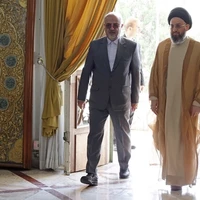
Saeed Jalili (left), a former chief negotiator and current member of Iran's Supreme National Security Council, listens to slain Supreme Leader Ali Khamenei in this file photo from 2025

A widening split over how to deal with the United States has reached the deepest layers of Iran’s hardline establishment, surfacing in state-linked media and among factions that have long presented a united front under the banner of revolutionary loyalty.

The divide became unusually public this week as several ultraconservative MPs refused to sign a letter backing Iran’s negotiating team. The dispute then spilled into hardline media, triggering an unprecedented public clash between Raja News and the Revolutionary Guards-linked Tasnim News Agency.

The confrontation largely pits supporters of former nuclear negotiator and National Security Council member Saeed Jalili against allies of his longtime rival, parliament speaker Mohammad Bagher Ghalibaf, who recently led Iran’s delegation in talks in Islamabad.

On Monday, Iranian media reported that 27 members of parliament—including seven affiliated with Jalili’s ultraconservative camp—refused to sign a letter backing the negotiating team and Ghalibaf’s leadership in the Islamabad talks.

One of them, Mahmoud Nabavian, who had traveled to Islamabad with the delegation, later claimed that Mojtaba Khamenei’s “red lines” had been violated. He alleged that negotiators had engaged with the United States on nuclear issues against those guidelines.

In recent days, hardline lawmakers and commentators have increasingly criticized the negotiating team.

Jalili himself appeared to escalate tensions when he called on Mojtaba Khamenei to clarify publicly whether ongoing actions reflected his directives. In a now-deleted post, he wrote that if no such message was issued, “there is one hundred percent a ‘sedition of officials,’ and all these statements are written by the coup plotter himself.”

The remark was widely seen as aimed at Ghalibaf.

The feud escalated further after a Tasnim editorial said demanding the United States lift all sanctions or agree to a comprehensive ceasefire with Iran’s armed allies in the region amounted to unrealistic expectations like a “magic beanstalk.”

The article also argued that negotiations with the United States should not be seen as a final solution and that “the power of the people in the streets” could serve as Iran’s main leverage.

Raja News published a harsh response.

Tasnim later removed the article, saying it had republished it from another outlet, but responded in an unusually sharp tone, accusing Raja of inciting division and acting against national security.

It said the outlet was “seeking to complete Trump’s project in Iran” and noted that some individuals had recently been arrested over “suspicious movements to undermine sacred unity.”

A Telegram post by Saberin News, a channel linked to security institutions, went further, labeling the Paydari Party as the Kharijites—a historical term for extremist dissenters who opposed and ultimately assassinated Imam Ali, the first Shia imam.

The post accused them of “sowing division on the battlefield” and “playing in favor of Israel and the United States.”

Iran’s state broadcaster (IRIB) has also come under scrutiny for alleged bias. Its deputy for cultural affairs, Vahid Jalili, is Saeed Jalili’s brother.

Moderate outlet Khabar Online reported that by its count, 8 out of 10 of pundits appearing on IRIB during the recent conflict have been conservatives, with 15 percent linked to the ultraconservative Paydari Front.

“The problem is not just the elimination of reformists; the data shows that even moderate conservatives or critical insiders have almost no presence in these programs,” the outlet wrote.

Raja News later said it would avoid prolonging the dispute in public and would instead pursue legal action. But as the stakes rise—whether through renewed talks with Washington or a return to war—it may prove difficult to put the genie back in the bottle.

Most Viewed

The hidden target in US war on Iran may be China
1
PODCAST

The hidden target in US war on Iran may be China

2

Is the US blockade working? It depends who you ask

3
EXCLUSIVE

New intelligence exposes IRGC-linked network targeting Israeli, Western sites

4
EXCLUSIVE

Iran's top security council holds meeting over fears of renewed protests

5
INSIGHT

Is Ghalibaf becoming Iran’s Khrushchev?

Banner
Banner

Spotlight

  • US talks trigger unprecedented rift in Iran’s hardline camp
    INSIGHT

    US talks trigger unprecedented rift in Iran’s hardline camp

  • Calls for secrecy in Tehran reflect divisions over US talks
    INSIGHT

    Calls for secrecy in Tehran reflect divisions over US talks

  • Three layers of mistrust behind US-Iran deadlock
    ANALYSIS

    Three layers of mistrust behind US-Iran deadlock

  • Iran’s water crisis: Mafia or destruction by design?
    SPECIAL REPORT

    Iran’s water crisis: Mafia or destruction by design?

  • Iran’s foreign trade suffers wartime collapse
    ANALYSIS

    Iran’s foreign trade suffers wartime collapse

  • Why a blockade would not halt Iran’s oil overnight
    ANALYSIS

    Why a blockade would not halt Iran’s oil overnight

•
•
•

More Stories

Calls for secrecy in Tehran reflect divisions over US talks

Apr 28, 2026, 18:36 GMT+1

As efforts continue to revive talks with the United States, Iranian lawmakers and state-linked outlets are increasingly calling for secrecy around negotiations.

The growing calls for secrecy may reflect an effort to control the narrative as divisions emerge at home over how far Iran should go in any negotiations.

Ahmad Bakhshayesh Ardestani, a member of parliament’s National Security and Foreign Policy Committee, told reporters on Monday that “not everything about the negotiations needs to be stated openly.”

He compared diplomacy to marriage negotiations, where each side conceals parts of its background until after an agreement is reached, insisting that secrecy does not contradict transparency with the public.

Continue reading

Women covering their faces attend a state-sponsored rally against Israel and the United States, Tehran, Iran, April 22, 2026
100%
Women covering their faces attend a state-sponsored rally against Israel and the United States, Tehran, Iran, April 22, 2026

Calls for secrecy in Tehran reflect divisions over US talks

Apr 28, 2026, 18:08 GMT+1
•
Behrouz Turani

As efforts continue to revive talks with the United States, Iranian lawmakers and state-linked outlets are increasingly calling for secrecy around negotiations.

The growing calls for secrecy may reflect an effort to control the narrative as divisions emerge at home over how far Iran should go in any negotiations.

Ahmad Bakhshayesh Ardestani, a member of parliament’s National Security and Foreign Policy Committee, told reporters on Monday that “not everything about the negotiations needs to be stated openly.”

He compared diplomacy to marriage negotiations, where each side conceals parts of its background until after an agreement is reached, insisting that secrecy does not contradict transparency with the public.

Iran used similar tactics at least twice in recent history: during the release of American hostages in January 1981 after 444 days in captivity, and in August 1988 when it accepted the ceasefire that ended the eight-year war with Iraq.

On Tuesday, ultraconservative lawmaker Amir Hossein Sabeti, a prominent anti-US figure, called for “nuclear ambiguity,” arguing that the United States and Israel would have used nuclear weapons against Iran had they known the exact location of Iran’s enriched uranium stockpiles.

His remarks coincided with similar statements from other lawmakers urging officials not to speak publicly about Iran’s positions on the nuclear issue or the Strait of Hormuz—two of the central obstacles in diplomatic efforts to break the deadlock in Iran-US relations.

US President Donald Trump said on Tuesday that Tehran had told Washington it wanted the Strait of Hormuz reopened “as soon as possible,” suggesting efforts to revive talks may include discussions over shipping through the strategic waterway.

In a Truth Social post, Trump said Iran was in a “state of collapse” and was trying to resolve “their leadership situation,” though Tehran has not publicly commented on the claim.

In Tehran, conflicting public statements have underscored divisions within the political establishment over the talks.

Ultraconservative MP Ali Khezrian told state broadcaster that all doors of negotiation with the United States were shut down” adding that no messages were being exchanged through intermediaries.

Yet other lawmakers have acknowledged that talks are continuing, including Ardestani, who said, “we cannot stop negotiating … we have won the war, and we need to establish our victory in negotiations.”

Khezrian and Ardestani both said hardline cleric and lawmaker Mahmoud Nabavian—who accompanied the Iranian delegation to Islamabad during the first round of talks—was there only to brief parliament afterward.

Nabavian later said it had been “a mistake” to include the nuclear issue in the discussions.

In a report published on April 27, Khabar Online cited conservative commentator Mohammad Mohajeri criticizing lawmakers and some officials for making “uncalculated” statements on foreign-policy matters, including Iran’s position on the Strait of Hormuz.

According to the report, remarks about imposing taxes on shipping, proposing a “new legal regime” for the waterway, or using the term “closure of the strait” instead of “control” have raised concerns they could harm Iran’s national interests and create legal complications.

Khabar Online also warned lawmakers not to undermine the authority of the Supreme National Security Council, which coordinates national-security and foreign-policy positions.

Three layers of mistrust behind US-Iran deadlock

Apr 28, 2026, 15:53 GMT+1
•
Ata Mohamed Tabriz

Deep-rooted mistrust continues to stand in the way of any meaningful thaw between Iran and the United States despite renewed diplomacy after weeks of war.

After a 40-day war, Iran and the United States returned to the negotiating table in Islamabad for 21 hours of high-level talks that ended without agreement. A day later, US President Donald Trump announced a naval blockade of the Strait of Hormuz and Tehran said it would not negotiate under threat.

What the Islamabad talks made clear is that mistrust is not a single obstacle but a three-layered structure.

The first layer is structural, rooted in conflicting historical narratives and incompatible visions of the future. The second is tactical, visible in disputes over agenda, sequencing and guarantees. The third—and perhaps most acute in current circumstances—is mistrust in the negotiating teams themselves, both across the table and within each country’s political establishment.

Understanding these layers is essential to any realistic assessment of whether negotiations can succeed.

Structural mistrust

Washington often traces the hostility to the 1979 seizure of the US embassy in Tehran and the anti-American ideology that followed, from chants of “Death to America” to attacks by Iran-backed armed groups across the region.

Tehran begins its story in 1953, when the US and Britain backed the coup against Prime Minister Mohammad Mossadegh. Iranian officials portray Washington as a colonial power bent on undermining Iran’s sovereignty and independence.

Successive conflicts have deepened these narratives: the eight-year Iran-Iraq war, last year’s 12-day war, and now a 40-day conflict with the United States.

Iranian Foreign Minister Abbas Araghchi recently summed up the mood when he said hostility would endure “as long as America is America and the Islamic Republic is the Islamic Republic.”

In such an environment, diplomatic gestures are easily interpreted as tactical deception rather than genuine attempts at compromise. Compounding the problem is the absence of any shared vision for a post-war settlement.

Trump speaks of a “big deal” but has not clearly defined what that means in diplomatic or regional security terms. Tehran speaks of ending the war “with victory” without clarifying whether that means restoring the status quo or securing recognition of its regional role.

Negotiation without a shared end state is less a path to resolution than a continuation of war by other means.

This is one reason the 2015 nuclear deal, the Joint Comprehensive Plan of Action, proved fragile: both sides treated it as a temporary management tool, not a new beginning.

Tactical mistrust

Hardline Iranian lawmaker Mahmoud Nabavian, who was reportedly involved in the Islamabad talks, called the inclusion of the nuclear issue a “strategic mistake,” arguing it encouraged US demands such as removing nuclear material from Iran or suspending enrichment for decades.

Yet Washington has repeatedly framed the core issue as preventing Iran from obtaining a nuclear weapon. Trump has at times spoken of dismantling Iran’s nuclear infrastructure entirely.

Even third parties have hinted at confusion. Turkish Foreign Minister Hakan Fidan has suggested both sides have issues to discuss, but no agreed text or framework yet exists.

Tehran reportedly presented a 10-point proposal to end the war. According to Axios, Washington responded with a three-page counterproposal.

What is described publicly as negotiation often looks more like two parallel monologues.

Another unresolved question is sequencing. Iran says it will not negotiate under threat and has demanded an end to the naval blockade as a precondition. Washington expects Iran to reopen the Strait of Hormuz and present a unified proposal.

When Trump extended a ceasefire on April 21, he said it would last only until Iran’s leaders and representatives could produce “a unified proposal.” In Tehran, such language was interpreted less as an invitation to talks than as coercion.

Mistrust in negotiators

Layered on top of these disputes is growing mistrust in the negotiators themselves.

Many in Tehran doubt whether the US side has the authority to deliver. Mohammad-Amin Imanjani, editor of the hardline Iranian newspaper Farhikhtegan, dismissed Trump’s envoys as lacking sufficient understanding of Iran and failing to properly convey Tehran’s demands.

Iranian state media has echoed such doubts, particularly regarding the role and authority of US intermediaries.

For Washington, the issue is both Tehran’s authority to deliver and the belief that it is not negotiating with one voice.

The result was visible in the rhetoric after Islamabad. As he left the city, US Vice President JD Vance reportedly said Washington had presented its “best and final” offer and that walking away would hurt Iran more than America.

Iranian parliament speaker Mohammad Bagher Ghalibaf responded by accusing Washington of failing to earn Tehran’s trust. The two narratives barely intersect.

Is a deal still possible?

Negotiations built on three layers of mistrust are unlikely to produce more than temporary arrangements. To make progress, both sides would first need to restore confidence in the process itself.

But the deeper obstacle may remain unchanged: both sides appear to believe they still have more to gain through pressure than compromise.

Washington may calculate that military and economic pressure has not yet reached breaking point. Tehran may believe it has demonstrated enough resilience to extract concessions from a position of strength.

As long as both see escalation as more rewarding than accommodation, diplomacy will struggle.

The danger is that the conflict may not spiral through one dramatic rupture, but through a series of smaller decisions—each rational in isolation—that move both sides further from any durable agreement.

Did Araghchi’s tour signal leverage or isolation?

Apr 28, 2026, 04:34 GMT+1

In Tehran, Abbas Araghchi’s whirlwind regional tour is being presented as evidence that Iran still has diplomatic options and regional leverage.

But behind the official narrative, even Iranian media and senior officials are beginning to acknowledge a harsher reality: talks with Washington are stalled, allies are limited and the country’s room to maneuver is narrowing.

The reformist daily Shargh wrote on Monday that the visits revealed “clear signs of a deadlock in negotiations with Washington.”

In an interview with ISNA, Araghchi himself acknowledged that “the first round of talks in Islamabad failed to reach its objectives,” blaming what he described as “the United States’ excessive demands.”

Read the full article here.

Did Araghchi’s tour signal leverage or isolation?

Apr 28, 2026, 03:01 GMT+1
•
Behrouz Turani

In Tehran, Abbas Araghchi’s whirlwind regional tour is being presented as evidence that Iran still has diplomatic options and regional leverage.

But behind the official narrative, even Iranian media and senior officials are beginning to acknowledge a harsher reality: talks with Washington are stalled, allies are limited and the country’s room to maneuver is narrowing.

The reformist daily Shargh wrote on Monday that the visits revealed “clear signs of a deadlock in negotiations with Washington.”

In an interview with ISNA, Araghchi himself acknowledged that “the first round of talks in Islamabad failed to reach its objectives,” blaming what he described as “the United States’ excessive demands.”

Media in Tehran have portrayed Araghchi’s visits to Pakistan, Oman and Russia as part of an effort to break the impasse with Washington through regional diplomacy.

But leaks in US media suggest Tehran’s message remains uncompromising: end the US blockade of the Strait of Hormuz as a precondition for immediate talks on Iran’s nuclear program.

That demand underscores the gap between Tehran’s public message of diplomacy and the harder line it may still be taking behind closed doors.

The idea that Tehran can quickly repair relations with neighboring states also appears optimistic. Regional capitals still vividly remember Iran’s recent strikes on the United Arab Emirates, Qatar, Kuwait, Bahrain and Saudi Arabia.

While Tehran insists diplomatic channels remain open, only a handful of neighbors appear willing—or able—to engage.

Oman, traditionally a trusted mediator, may have less incentive to play that role after Tehran’s recent actions and amid Washington’s hesitation. Russia, meanwhile, is increasingly viewed with suspicion inside Iran, where critics accuse Moscow of exploiting Tehran’s isolation without offering meaningful support.

Yet despite the impasse, signs of a possible diplomatic opening remain.

Pakistan’s active mediation has positioned Islamabad as an important hub for indirect US-Iran communication, suggesting both sides still see value in keeping channels open.

In Washington, President Donald Trump’s recent references to an “agreement in principle,” including possible limits on uranium enrichment in exchange for sanctions relief, suggest discussions may have moved from whether to talk toward what terms might be acceptable.

Economic pressure is also pushing both sides toward pragmatism.

In Iran, the economy is buckling under war, inflation and disruption to oil exports. In the United States, rising gasoline prices are creating domestic political pressure.

The so-called pragmatists in Tehran appear increasingly willing to pursue compromise to preserve stability. Hardliners, especially among a younger generation of officials, increasingly frame the conflict as existential and may see concessions as surrender.

If they conclude Washington’s ultimate goal is regime change rather than policy change, pressure could grow for nuclear escalation rather than restraint.

Washington’s insistence that Iran halt all uranium enrichment and remove previously enriched material remains a central sticking point. The Strait of Hormuz is another.

The United States has reportedly conditioned any pause in military action on the complete and safe reopening of the waterway. Any renewed Iranian interference with shipping could trigger immediate retaliation and collapse diplomacy.

Israeli strikes on Iranian nuclear or leadership targets—or retaliatory actions by Hezbollah or the Houthis—could drag both Tehran and Washington into a cycle neither fully controls.

For now, the immediate question is no longer whether Washington and Tehran are talking. It is whether either side is prepared to soften their demands before events overtake diplomacy.

And in Tehran, where the costs of war are rising by the day, that question is becoming harder to ignore.