The Islamic Republic that has emerged from the killing of Iran's Supreme Leader Ali Khamenei may prove more operationally aggressive than the one it replaces, analysts say.
Dominated by the Revolutionary Guards, the leadership in Tehran may be less constrained by theology and more driven by revenge.
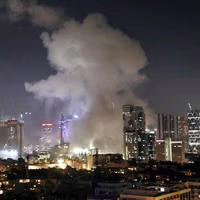
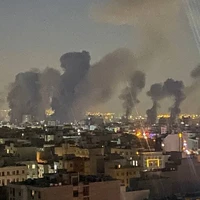
This is an assessment by analysts tracking the post-war power shift in Tehran, as a string of attacks on Jewish and Israeli targets have taken place since the Feb. 28 US-Israeli strikes.
Across Europe, an Iran-linked group calling itself Harakat Ashab al-Yamin al-Islamia has claimed several attacks, including the targeting of Jewish volunteer ambulances in London, a synagogue in Belgium and a synagogue and Jewish school in the Netherlands.
In Azerbaijan, an alleged Iranian plot targeting the Israeli embassy in Baku and Jewish community sites was foiled by authorities.
Danny Citrinowicz, a senior researcher at the Institute for National Security Studies in Tel Aviv, says the post-Ali Khamenei Islamic Republic is likely to become more operationally aggressive, with sleeper cells and lone-wolf attacks posing a growing threat to Tehran’s adversaries.
"Lone wolves are a bigger threat," Citrinowicz told Iran International, referring to the act of an individual committing a violent act alone without a direct order.
"You just need to create the atmosphere," Citrinowicz said. "It will lead to someone saying, I'm going to do something."
Citrinowicz describes the Islamic Republic in 2026 as "Iranian Revolution 3.0" — its third iteration since 1979 — in which a military junta has taken control of the founding doctrine of clerical rule, Velayat-e Faqih, with the IRGC dominating all meaningful decisions.
It is a regime that has demonstrated, through the foreign fighters it brought in to suppress its own population during the January 2026 uprising, that it harbors sizable loyal support outside its borders.
"The regime will try to present itself as a continuation of Ali Khamenei's regime," Citrinowicz said.
Yet the IRGC-dominated leadership still faces a limitation in its power, inheriting a government whose revolutionary appeal has long outlasted its domestic popularity.
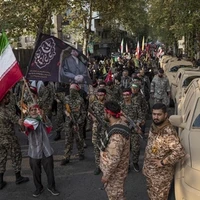
Iran International reported that around 800 members of Iraqi militia groups — including Kataib Hezbollah and Harakat al-Nujaba — entered Iran days before the January 2026 crackdown that killed tens of thousands of protesters.
The Pakistani contingent — the Zainabiyoun Brigade — is an armed wing rooted in Tehran's ideological network, drawn from South Asia's Shia communities. But one militia is only part of the picture.
Simon Wolfgang Fuchs, an associate professor at the Hebrew University of Jerusalem, describes Lahore-based cleric Jawad Naqvi as running a sprawling and sophisticated Shia seminary operation in Lahore, Pakistan.
The seminary produces Qom-trained scholars, high-quality social media content, and an explicit political model.
"He's really someone who says we have to implement the Iranian model in Pakistan," Fuchs told Iran International. Naqvi's political model draws inspiration from Hezbollah, Fuchs argues — a Shia minority that embraced Velayat-e Faqih and came to dominate Lebanon's political field.
"The vision and the boldness to simply claim that you could also dominate the state is definitely there," Fuchs said, though he cautioned the comparison has limits — Pakistan's Shia community has no history of armed resistance.
"Iran's efforts to gain a following as the legitimate leader of the Shia (community) has paid off somewhat in South Asia," said Cliff Smith, a fellow at the Middle East Forum who visited Indian-administered Kashmir and documented Iranian influence on the ground.
"The idea of Iran is stronger outside its borders than it is inside."
India, home to between 20 and 40 million Shia — the second-largest such population after Iran — has received less scrutiny than its neighbour.
Smith observed during time spent in Kashmir that New Delhi had effectively tolerated Iranian influence among the Shia community, calculating it served as a useful counterweight to Sunni radicalism from Pakistan.
The wave of protests and unrest that was seen in India following Khamenei's killing has prompted a reassessment, according to Smith.
"I had one of those people tell me, when they had seen the riots and demonstrations after Khamenei’s death, that I was right. We should have paid attention to this sooner," he said, recalling a contact at an Indian think tank.
Abhinav Pandya of India's Usanas Foundation argues the blind spot runs deeper than Kashmir, as Iran's influence among Indian Muslims is not confined to Shia communities.
India is home to around 200 million Muslims — the world's third-largest — and Pandya argues the Indian security establishment has been too focused on the Sunni threat to register how deeply the Islamic Republic's influence has taken root among the country's Shia groups.
"The biggest misunderstanding is that most of the jihadist problem comes from the Sunni Muslims, and the Shias — they don't need to bother about them, Shias are completely loyal," Pandya said.
"So far Shia Muslims have not majorly participated in any terrorist activity... But partly this understanding is problematic."
For Citrinowicz, the killing of Khamenei —a figure seen as much as a religious leader as a political one — risks transforming Iran's conflict with the US and Israel into something far harder to contain.
“The killing of him is potentially opening some sort of religious war that I think that we have to make sure it won't expand between the Shias and the state of Israel," he said.
Citrinowicz also warned of an increase in Iranian terror activity abroad. "While they have this kind of capabilities and shared communities all over the world, especially in places like India, definitely we'll see an uptick."
An illustration showing an ancient Iranian soldier and a Revolutionary Guard member holding a weapon together, displayed during a November 7 ceremony in Tehran where a statue of pre-Islamic Persian King Shapur I was unveiled.
Tehran’s unveiling of a towering statue depicting the Roman Emperor Valerian kneeling before pre-Islamic Persian King Shapur I has renewed criticism of the Islamic Republic’s appeal to nationalist sentiment following the June war with Israel.
For over forty years, the theocracy purged ancient Persian history from schoolbooks, replacing it with post-Islamic narratives. But after the 12-day conflict with Israel, officials have turned to the distant pre-Islamic past to rally a divided society.
From murals of ancient kings and soldiers to patriotic songs added to Shi’ite mourning ceremonies performed before Supreme Leader Ali Khamenei, Tehran now embraces imagery once deemed heretical by its own revolutionary ethos.
The statue unveiled in Tehran's Revolution Square
'Kneel before Iran' campaign
Tehran’s Revolution (Enghelab) Square was the scene of an unusual spectacle on Friday as officials unveiled a massive bronze statue depicting Roman Emperor Valerian kneeling in submission before Sassanid King Shapur I, commemorating Iran’s victory at the Battle of Edessa (260 AD).
The event was held under the slogan “Kneel before Iran,” part of what authorities describe as a campaign to project “national unity and historical pride” following the June war with Israel.
Tehran Mayor Alireza Zakani, a staunch ultraconservative, said on X: “Enmity with Great Iran can only end in kneeling before this historic nation.”
Municipal official Davood Goodarzi said the installation would be accompanied by visual displays depicting “other victories of Iranians over foreign aggressors,” including the defeat of British forces by local commander Rais-Ali Delvari, Mirza Kuchak Khan’s resistance against Russian troops, and Surena’s triumph over Rome at the Battle of Carrhae in 53 BCE.
The goal, Goodarzi said, is “strengthening concepts such as national dignity, social unity, and Iranian identity.”
The statue, he said, would remain temporarily at Revolution Square before being moved to a city gateway “where it will stand as the first emblem of Iran before diplomats and foreign visitors.”
Unveiled women were allowed to attend the unveiling ceremony—an uncommon scene at events organized by Tehran’s ultra-hardline municipality.
The turn to the pre-Islamic past
The sharp reversal also recalls remarks once made by Khamenei. In a 2011 speech, he asserted that “all the great military victories of this nation came after Islam,” dismissing pre-Islamic accounts as “things that are not documented.”
In 1987, he had said that prophets triumphed over kings such as Cyrus and that “nothing remains of these monarchs in history but names remembered with derision.”
Nevertheless, pro-government social media accounts have now gone so far as to circulate posters equating Khamenei himself with Shapur, showing him standing with a staff as Benjamin Netanyahu and Donald Trump kneel before him. The caption reads: “You will kneel before Iran.”
Image circulating by hardliners on social media
'Hypocrisy'
Pro-government figures have hailed the move as a patriotic success. Conservative political reporter Hossein Saremi posted: “Today’s grand Iranian gathering showed that people and the state share one essence: Iran itself. Nothing can take our homeland away.”
Others, however, called the spectacle “hypocrisy.” Journalist Gholamhossein Pashaei wrote on X: “Every year you close Pasargadae to stop people from celebrating Cyrus Day, yet you unveil Shapur’s statue in Enghelab Square with drums and fireworks during Fatimiyya (mourning period)!”
Dissident commentator Hamid Asafi called the ceremony “a perfect snapshot of the Islamic Republic’s contradictions.”
On Telegram he wrote: “A week ago they closed Cyrus’s tomb out of fear of the crowds, and now they glorify Shapur in the same breath. The Islamic Republic fears living history but poses for selfies with its corpse.”
He added: “They know people no longer respond to rosaries and sermons. That’s why they’ve brought history back to the stage—in a controlled costume. If they can’t erase the past, they’ll try to own it.”
The irony deepened as UNESCO formally recognized Cyrus’s Charter as one of the earliest human-rights documents.
President Masoud Pezeshkian wrote on X: “Iran, the cradle of dialogue, justice, and coexistence, can still inspire peace today.”
Users swiftly replied, questioning how such pride could coexist with a government that blocks access to Cyrus’s tomb each year to those wishing to visit it on his birthday.