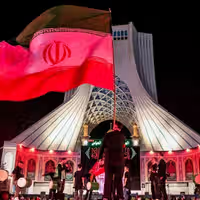
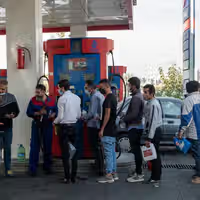
People walk in Tehran Bazaar, amid a ceasefire between US and Iran, in Tehran, Iran, April 21, 2026.
With US-Iran talks in Pakistan in doubt after Iran's foreign minister left Islamabad and President Trump canceled the planned trip by US negotiators, veteran journalist Eli Lake says Washington should use its leverage not only on the nuclear file, but to help the people of Iran.
Iranian Foreign Minister Abbas Araghchi was in Islamabad on Saturday, where he met Pakistani Prime Minister Shehbaz Sharif and army chief Asim Munir as Pakistan continued efforts to mediate between Tehran and Washington.
A Pakistani source involved in the talks told Reuters that Araghchi conveyed Tehran’s demands and concerns about US positions during the visit. Iranian state media also said he delivered Iran’s response to proposals in a meeting with Munir before leaving Islamabad for Oman and Russia.
Iranian officials had earlier said Araghchi had no plan to meet US officials in Pakistan.
Lake, a journalist at The Free Press and host of the Breaking History podcast, told Eye for Iran that the Islamic Republic is seeking negotiations as a lifeline after major military, economic and political setbacks.
“Their backs are against the wall and these negotiations they hope are going to be a lifeline,” Lake said.
But he argued that any renewed diplomatic track should begin with pressure on Tehran over the Iranian people.
“If I was Vice President Vance, I would say… the first thing I’d say is, you need to turn back on the internet if you’re going to get these financial lifelines. You need to release political prisoners,” Lake said.
He added that Washington should also demand an end to executions.
The remarks come as Iran’s internet blackout has entered its 57th day, according to NetBlocks, with international connectivity still largely severed amid worsening conditions inside the country.
Lake said the US should recognize that “our best allies are the Iranian people on the ground,” and warned against strikes on civilian infrastructure such as power plants, saying they would hurt ordinary Iranians more than the Islamic Republic.
The diplomatic maneuvering has also unfolded amid signs of deepening disagreement inside Tehran. Mohammad Bagher Ghalibaf, the parliament speaker, has stepped down as head of Iran’s negotiating team amid internal disputes, with Saeed Jalili floated as a possible replacement and Araghchi seeking greater control of the talks.
Lake said he believes the fractures inside the Islamic Republic are genuine.
“At the end of the day, with enough pressure, they’re probably going to start turning on each other,” he said.
He argued that the Islamic Republic has lost legitimacy and that Iran’s future will ultimately be decided by Iranians themselves.