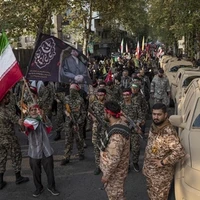
Muslim volunteers at a collection drive for Iran in Srinagar, Indian Kashmir
Fundraising drives across Indian-administered Kashmir have collected nearly $2 million for Iran following the killing of Supreme Leader Ali Khamenei, highlighting the depth of religious and ideological ties between the region’s Shia community and the Islamic Republic.
The connection runs deep enough that the region has long been nicknamed Irani Sagir (or Mini Iran.)
Across towns and villages, portraits of Khamenei appeared at donation events where residents contributed whatever they could spare: banknotes, gold jewellery and even copper utensils.
A Kashmiri Muslim girl donates a gold ring at an Imambara fund collection centre in Budgam
The collection drives, held in late March in cities including Budgam and Srinagar, allowed proceeds to be wired directly to the Iranian embassy in New Delhi. Iran’s embassy in India has also posted a QR code for donations .
In just one week, nearly ₹18 crore (about $2 million) was collected across Kashmir, excluding amounts deposited directly into the embassy’s account, according to local media reports.
One contribution seen by Iran International was ₹26 lakh (around $28,000).
A cheque written out to Iran's embassy
The fundraising came weeks after widespread protests erupted across Kashmir following the US-Israeli airstrike that killed Khamenei on Feb. 28.
Demonstrations in Srinagar turned violent in places, leaving at least 12 people injured, including five police officers. Authorities responded with tear gas and batons, shut schools, throttled mobile internet for five days and arrested at least 50 people.
Among the outpouring of grief were calls for revenge from some protesters.“Those who oppress Muslims—we will kill them,” one unnamed demonstrator in Srinagar told Reuters on March 1.
The unrest prompted authorities to investigate several political figures accused of spreading inflammatory content online. Among them was Srinagar MP Aga Syed Ruhullah Mehdi, an influential Shia cleric with a cross-sectarian following.
“Some fools in J&K Police and administration think that by withdrawing/downgrading my security detail and suspending my Facebook account will stop me from calling out their atrocities. It is laughable,” Mehdi wrote on Facebook.
Former Srinagar mayor Junaid Azim Mattu also had his security withdrawn after condemning Khamenei’s killing on X.
A Facebook page affiliated with Mattu has Ali Khamenei as the profile picture
Danny Citrinowicz, a fellow at the Institute for National Security Studies in Tel Aviv and former head of the Iran branch in Israeli military intelligence, warned that the donations were a possible indication that a post-Ali Khamenei Islamic Republic, likely dominated by the IRGC, would prove more operationally aggressive, not less.
"Those who think it will stay only at the level of donations are totally mistaken," he said.
For scholars of South Asian Islam, the reactions in Kashmir reflect a longstanding—though often misunderstood—connection between the region and Iran.
Oxford University's Associate Professor Justin Jones
Justin Jones, a specialist in modern Islam in South Asia at Oxford University, said that for most Indian Shias the Islamic Republic functions primarily as a political symbol rather than a direct religious authority.
“The actual political thought of Velayat-e Faqih doesn’t cut very deep in much of India,” he said, referencing the Islamic Republic’s central doctrine of the Guardianship of the Islamic Jurist, founded by Ruhollah Khomeini after Iran’s 1979 revolution.
“It’s simply a kind of imaginary of Shia power, which has some psychological effect, but maybe not a political one.”
Kashmir, however, is different.
“Kashmir is one of the places that has been most receptive to Iranian influence,” Jones said, citing both themes of political justice that resonate with local Shia communities and ideological currents linked to Iran’s doctrine of Velayat-e Faqih.
Javed Beigh, a human rights activist based in Budgam
“Iran is perceived as the representative of the Muslim world,” human rights activist Javed Beigh told Iran International.
“There was no other Muslim leader perceived as strongly against the United States and its allies as Seyyed Ali Khamenei,” said Beigh, who is a Shia Muslim based in Budgam.
That perception, he added, has also resonated with some Sunni Muslims across the subcontinent, particularly amid Israel’s war in Gaza.
A Kashmiri law student who asked not to be identified described two different responses among younger Shias.
One group, he said, views the Islamic Republic as a political system that must survive — and would find its collapse “almost existentially shattering”. The other sees Iran’s 1979 revolution as a historical process that may endure even if the current regime falls.
“They think of it as something in evolution,” he said. “It might fail temporarily, but they have a strong belief in the possible resurgence and resurrection of the system in the future.”
Simon Wolfgang Fuchs, an associate professor at the Hebrew University of Jerusalem who studies Shia Islam in South Asia and the Middle East, said the Islamic Republic’s influence in the region extends beyond politics.
Simon Wolfgang Fuchs, Associate Professor at Hebrew University
“For them, Iran is very much a religious landscape—an enchanted place where you have a Shia-run state,” he said.
“The symbolic capital of Iran has not weakened… for South Asian Shia, Iran has been perceived as someone who stands by them and protects them.”
That connection has deepened as Iranian-trained clerics return to South Asia and pilgrims travel through Iran to reach holy sites in Iraq, experiencing the country as part of a broader sacred geography.
The Kashmiri student said many Shias in the region view that geography, stretching from Iran to Iraq, as central to the future of Shia political movements.
“Iran and Iraq are seen to inhabit the symbols of the sacred geography of the Shiite tradition,” he said. “If such a movement is going to be reborn, it must be around that geography—not outside it.”
He estimated that roughly 60 to 70 percent of Kashmiri Shias hold that view: that any future resurgence of the ideology would belong in the Middle East rather than South Asia.
Those ties are reinforced by institutions that operate independently of Tehran.
The Imam Khomeini Memorial Trust, an Iranian-linked organisation active in Kashmir, trains local clerics and funds religious education, according to research by the Middle East Forum.
Al-Mustafa International University, headquartered in Qom and funded directly by Iran’s Supreme Leader, operates affiliated seminaries across India and Pakistan whose graduates return to run religious institutions, according to research by United Against Nuclear Iran.
“Many people, even from my village, are still in Iran — living there, doing business, studying,” Beigh said. “That’s how you actually develop a strong bond between two communities.”
For some security analysts, however, those connections raise concerns about political radicalisation.
Sajid Yousuf Shaha, a lawyer and political analyst in Jammu and Kashmir
Sajid Yousuf Shah, a political analyst in Jammu and Kashmir with India's ruling Hindu nationalist BJP party, said ideological loyalty to the Islamic Republic runs deep within the region’s Shia community.
“They don’t want modernisation. They don’t want westernisation. They don’t want any regime change in Iran,” he said, arguing that many supporters hope for the Islamic Republic’s survival rather than its replication elsewhere.
Abhinav Pandya, CEO of the Usanas Foundation, a geopolitical think tank in India, said Tehran’s ideological outreach has fostered what he described as “extraterritorial loyalties”.
Abhinav Pandya of the Usanas Foundation
“Increasingly, the Shia Muslims in India have come under the influence of the Iranian regime,” he said. “That is very problematic.”
Pandya also pointed to contacts between Iran-aligned militant groups such as Hamas and Hezbollah and anti-India militant networks in the region, citing Indian media reports linking such groups to militant activity in Kashmir.
It was a similar concern voiced by Citrinowicz, who said Iran’s student and religious networks in India could potentially serve as recruitment channels.
Danny Citrinowicz, a fellow at the Institute for National Security Studies in Tel Aviv
“The platform they are able to build—through control of religious centres, through academia, through social media—has transformed these places into fertile ground for recruitment,” he said.
Citrinowicz points to the Islamic Republic’s history of retaliating globally following the killing of its senior figures, with plots disrupted across Africa, Europe and Asia after the assassinations of Qasem Soleimani and Mohsen Fakhrizadeh in 2020.
"Nobody should be surprised if you'll see in the next couple of weeks or months (Iran) again tries to do something against India.”
Indian officials familiar with the issue, however, say such fears may be overstated.
A former official at India’s National Security Council Secretariat said the solidarity expressed after Khamenei’s killing reflected religious sentiment more than political mobilisation.
“The reverence is more on the religious side than on a struggle side,” he said, describing the protests as a form of collective mourning typical of Shia communities.
While authorities were monitoring the donation drives, he said they did not consider them significant enough to warrant intervention. The donations themselves also reveal a more complex picture.
Local media reported that some Hindu donors sympathetic to Iran’s historical ties with the subcontinent also contributed to the fundraising drive.
Fabrizio Speziale, Professor at CEIAS
Fabrizio Speziale, a Professor of Indo-Persian history at the School for Advanced Studies in the Social Sciences in Paris, said the cultural connections between Iran and South Asia have long crossed religious boundaries.
Persian culture historically served as a shared intellectual language across the region, linking Sunni, Shia, Hindu and even European scholars.
That legacy, he said, differs significantly from the modern political ideology of Velayat-e Faqih.
For Beigh, however, the bond between Kashmir’s Shia community and Iran transcends politics. “We have more than 90 percent of things we do in our daily lives similar to what you do in Iran,” he said.
Even if the Islamic Republic were to collapse, he believes the connection would endure. “They will have to embrace any change in Iran,” he said. “But the bond will remain.”
An illustration showing an ancient Iranian soldier and a Revolutionary Guard member holding a weapon together, displayed during a November 7 ceremony in Tehran where a statue of pre-Islamic Persian King Shapur I was unveiled.
Tehran’s unveiling of a towering statue depicting the Roman Emperor Valerian kneeling before pre-Islamic Persian King Shapur I has renewed criticism of the Islamic Republic’s appeal to nationalist sentiment following the June war with Israel.
For over forty years, the theocracy purged ancient Persian history from schoolbooks, replacing it with post-Islamic narratives. But after the 12-day conflict with Israel, officials have turned to the distant pre-Islamic past to rally a divided society.
From murals of ancient kings and soldiers to patriotic songs added to Shi’ite mourning ceremonies performed before Supreme Leader Ali Khamenei, Tehran now embraces imagery once deemed heretical by its own revolutionary ethos.
The statue unveiled in Tehran's Revolution Square
'Kneel before Iran' campaign
Tehran’s Revolution (Enghelab) Square was the scene of an unusual spectacle on Friday as officials unveiled a massive bronze statue depicting Roman Emperor Valerian kneeling in submission before Sassanid King Shapur I, commemorating Iran’s victory at the Battle of Edessa (260 AD).
The event was held under the slogan “Kneel before Iran,” part of what authorities describe as a campaign to project “national unity and historical pride” following the June war with Israel.
Tehran Mayor Alireza Zakani, a staunch ultraconservative, said on X: “Enmity with Great Iran can only end in kneeling before this historic nation.”
Municipal official Davood Goodarzi said the installation would be accompanied by visual displays depicting “other victories of Iranians over foreign aggressors,” including the defeat of British forces by local commander Rais-Ali Delvari, Mirza Kuchak Khan’s resistance against Russian troops, and Surena’s triumph over Rome at the Battle of Carrhae in 53 BCE.
The goal, Goodarzi said, is “strengthening concepts such as national dignity, social unity, and Iranian identity.”
The statue, he said, would remain temporarily at Revolution Square before being moved to a city gateway “where it will stand as the first emblem of Iran before diplomats and foreign visitors.”
Unveiled women were allowed to attend the unveiling ceremony—an uncommon scene at events organized by Tehran’s ultra-hardline municipality.
The turn to the pre-Islamic past
The sharp reversal also recalls remarks once made by Khamenei. In a 2011 speech, he asserted that “all the great military victories of this nation came after Islam,” dismissing pre-Islamic accounts as “things that are not documented.”
In 1987, he had said that prophets triumphed over kings such as Cyrus and that “nothing remains of these monarchs in history but names remembered with derision.”
Nevertheless, pro-government social media accounts have now gone so far as to circulate posters equating Khamenei himself with Shapur, showing him standing with a staff as Benjamin Netanyahu and Donald Trump kneel before him. The caption reads: “You will kneel before Iran.”
Image circulating by hardliners on social media
'Hypocrisy'
Pro-government figures have hailed the move as a patriotic success. Conservative political reporter Hossein Saremi posted: “Today’s grand Iranian gathering showed that people and the state share one essence: Iran itself. Nothing can take our homeland away.”
Others, however, called the spectacle “hypocrisy.” Journalist Gholamhossein Pashaei wrote on X: “Every year you close Pasargadae to stop people from celebrating Cyrus Day, yet you unveil Shapur’s statue in Enghelab Square with drums and fireworks during Fatimiyya (mourning period)!”
Dissident commentator Hamid Asafi called the ceremony “a perfect snapshot of the Islamic Republic’s contradictions.”
On Telegram he wrote: “A week ago they closed Cyrus’s tomb out of fear of the crowds, and now they glorify Shapur in the same breath. The Islamic Republic fears living history but poses for selfies with its corpse.”
He added: “They know people no longer respond to rosaries and sermons. That’s why they’ve brought history back to the stage—in a controlled costume. If they can’t erase the past, they’ll try to own it.”
The irony deepened as UNESCO formally recognized Cyrus’s Charter as one of the earliest human-rights documents.
President Masoud Pezeshkian wrote on X: “Iran, the cradle of dialogue, justice, and coexistence, can still inspire peace today.”
Users swiftly replied, questioning how such pride could coexist with a government that blocks access to Cyrus’s tomb each year to those wishing to visit it on his birthday.