• العربية
  • فارسی
Brand
  • Iran Insight
  • Politics
  • Economy
  • Analysis
  • Special Report
  • Opinion
  • Podcast
  • Iran Insight
  • Politics
  • Economy
  • Analysis
  • Special Report
  • Opinion
  • Podcast
  • Theme
  • Language
    • العربية
    • فارسی
  • Iran Insight
  • Politics
  • Economy
  • Analysis
  • Special Report
  • Opinion
  • Podcast
All rights reserved for Volant Media UK Limited
volant media logo

Iran executes protester over January uprising

Apr 25, 2026, 07:37 GMT+1
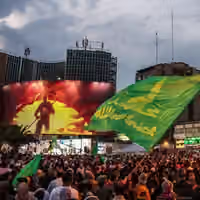
Anti-government protesters gather in the streets of Tehran during nationwide unrest in January 2026.

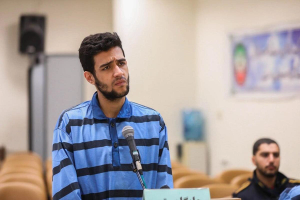
Iran executed a man on Saturday over his involvement in January anti-establishment protests, whom authorities said acted on behalf of Israel’s Mossad intelligence service.

Judiciary-affiliated media identified him as Erfan Kiani and said his death sentence had been upheld by the Supreme Court before being carried out early in the morning.

Authorities said Kiani led a group in the central city of Isfahan that carried out acts including damaging public and private property, setting fires, using Molotov cocktails, blocking roads and attacking security forces during the unrest.

State media described him as a key figure in efforts to create “fear and chaos,” framing the case as part of what officials say is a broader campaign against foreign-backed activity.

The execution comes amid an ongoing crackdown following the January protests, with several people executed in recent weeks on similar charges. Earlier this month, authorities executed two men accused of attempting to storm a military site and access weapons, while another man was put to death over allegations he set fire to a mosque during the unrest.

Rights groups, including Amnesty International, have repeatedly raised concerns over the use of capital punishment in protest-related cases, saying defendants are often convicted in unfair trials and based on confessions obtained under duress.


Most Viewed

Behind Tehran’s unity show: The secret letter to the shadow king
1
INSIGHT

Behind Tehran’s unity show: The secret letter to the shadow king

2
EXCLUSIVE

Disputes within Iran leadership blocked negotiators’ trip to Islamabad

3
INSIGHT

Power vacuum in Tehran emboldens hardliners

4
ANALYSIS

Rapid deterioration of Iran-UAE ties threatens a critical trade lifeline

5
VOICES FROM IRAN

Inflation spikes, basic goods slip out of reach for Iranians, citizens say

Banner
Banner

Spotlight

  • Iran’s economy after the March war: how bad can it get?
    ANALYSIS

    Iran’s economy after the March war: how bad can it get?

  • Behind Tehran’s unity show: The secret letter to the shadow king
    INSIGHT

    Behind Tehran’s unity show: The secret letter to the shadow king

  • Rapid deterioration of Iran-UAE ties threatens a critical trade lifeline
    ANALYSIS

    Rapid deterioration of Iran-UAE ties threatens a critical trade lifeline

  • Tehran stocks head for reopening, but it risks triggering a new crisis
    ANALYSIS

    Tehran stocks head for reopening, but it risks triggering a new crisis

  • Power vacuum in Tehran emboldens hardliners
    INSIGHT

    Power vacuum in Tehran emboldens hardliners

  • Inflation spikes, basic goods slip out of reach for Iranians, citizens say
    VOICES FROM IRAN

    Inflation spikes, basic goods slip out of reach for Iranians, citizens say

  • Iran executes two men as protest-related hangings continue

    Iran executes two men as protest-related hangings continue

  • Iran executes man as January protest crackdown continues

    Iran executes man as January protest crackdown continues

•
•
•

More Stories

Iranian national charged in US over migrant smuggling scheme

Apr 25, 2026, 05:55 GMT+1

A US federal indictment has charged an Iranian national with coordinating a large-scale migrant smuggling operation into the United States, the Justice Department said on Friday.

Jafar Tafakori, 57, was arrested in Colombia at the request of US authorities and is accused of arranging the movement of mainly Iranian nationals through South and Central America and Mexico to the US border.

According to the indictment, the alleged scheme ran from late 2022 to mid-2024 and involved providing transport, shelter and, in some cases, airline tickets for migrants, charging fees of up to $30,000 per person.

  • US deports over 100 Iranians in rare deal with Tehran - NYT

    US deports over 100 Iranians in rare deal with Tehran - NYT

  • Iran says 40 Iranians in ICE custody to be flown home

    Iran says 40 Iranians in ICE custody to be flown home

Prosecutors said migrants were directed to enter the United States illegally once they reached the border. Tafakori faces one count of conspiracy and five counts of bringing migrants into the United States for financial gain.

If convicted, he could face up to 10 years in prison per count, with a potential mandatory minimum sentence if found guilty on multiple counts.

US officials said the arrest reflects efforts to target transnational smuggling networks operating across multiple countries.

UK’s LBC finds alleged Iran-linked channel hiring Britons for sabotage

Apr 24, 2026, 12:42 GMT+1

A journalist from LBC was offered payment by an alleged Iran-linked contact to carry out a street-level act of vandalism within hours of contact, the British broadcaster reported on Friday.

The undercover reporter, engaging with a Telegram channel advertising “high-paid” work, was instructed to burn images of Donald Trump and Benjamin Netanyahu in a London street and send video proof in exchange for cryptocurrency.

“This is the first step in building trust, and I will pay for it,” the account wrote, presenting the task as an entry point to further assignments.

Matt Jukes, the deputy commissioner of the Met Police, has warned that proxies being asked to act on behalf of Iran are easily expendable and will be dropped by their handlers as soon as police get involved.

“You’re going to prison if you do that,” Jukes said. “We are going to catch you because London, this fantastic city, is on the lookout for you.”

Recruitment mirrors known playbooks

Jonathan Hall KC, the UK’s independent reviewer of state threats legislation, said the exchange reflected patterns seen in earlier foreign-directed cases.

“It looks straight from that sort of recruitment playbook,” Hall said. “The individual is being asked to do something that you might think is fairly minor and trivial… but presumably once you’ve done that and proved yourself, this is just the beginning.”

Security specialists said the model reflects a broader shift toward outsourcing operations to individuals motivated by money rather than ideology.

Officials warn of broader pattern

The outreach surfaced alongside recent arson attacks targeting Jewish-linked sites in London, increasing concern among officials about coordinated intimidation efforts.

Prime Minister Keir Starmer said he was “increasingly concerned” about foreign states using proxies for criminal acts, pledging to accelerate legislation addressing the issue.

Stephen Silverman of Campaign Against Antisemitism said the findings point to foreign-linked disruption. “By getting this to take root and getting people to act on it and spread fear and alarm, they are working to undermine our everyday lives,” Silverman said.

Authorities said the exchange has been passed to counter-terrorism police, underscoring warnings that seemingly minor tasks can serve as gateways to more serious criminal activity.

Two men accused of spying for Iran to appear in London’s Old Bailey court

Apr 24, 2026, 10:17 GMT+1

Two men accused of carrying out surveillance on Jewish and Israeli-linked sites in London on behalf of Iran are due to appear at the Central Criminal Court on Friday for a preliminary hearing.

Nematollah Shahsavani, 40, and Alireza Farasati, 22, face charges under the UK’s National Security Act of engaging in conduct likely to assist a foreign intelligence service. Prosecutors allege the activity was carried out for Iran.

The pair are accused of conducting reconnaissance of multiple locations, including a synagogue, a Jewish community centre and sites linked to Israeli interests in London. The alleged surveillance is said to have taken place over several months.

Friday’s hearing before Mrs Justice Cheema-Grubb is procedural rather than substantive, meaning the court will not rule on guilt or innocence. Instead, it is expected to address case management issues, including how the trial will proceed, disclosure of evidence and the timetable for future hearings.

The defendants previously appeared at Westminster Magistrates’ Court, where the charges were first presented. Because the offences are indictable-only due to their seriousness, the case was referred to the Crown Court. Both men remain in custody and their cases are being heard together, indicating the allegations arise from closely linked facts.

Iran to add US-Israel war to school curriculum amid ceasefire

Apr 24, 2026, 09:45 GMT+1

Iran plans to include the recent war with the United States and Israel in school textbooks, the education minister said, referring to what officials call the “third imposed war,” the latest conflict now under a ceasefire extended by US President Donald Trump.

“We will try to ensure that the memory of the martyrs and the strength of the Islamic Republic in the third imposed war are properly reflected in our textbooks,” he said.

He added that a working group has been formed to incorporate accounts of the conflict, saying: “We are carrying out special work to include narratives… from parts of the third imposed war and the martyrdom of the leader.”

“We will present this history using all available capacities and pass it on to the new generation,” he said.

The move builds on an expanding state-led effort to shape war narratives in education. Last year, authorities introduced new curriculum materials portraying a previous conflict with Israel as a national success, aiming to strengthen unity, patriotism and deterrence among students.

Those materials included lessons linking military strength with national identity and encouraging students to engage with themes of defense, science and resistance, reflecting a broader push to embed state ideology and wartime messaging in classrooms.

Tehran stocks head for reopening, but it risks triggering a new crisis

Apr 23, 2026, 22:00 GMT+1
•
Mohamad Machine-Chian

After nearly two months of closure, Tehran’s stock market is preparing a phased reopening, but deep structural flaws, lack of transparency and uncertainty over US negotiations threaten to turn the restart into a fresh crisis.

Trading has been suspended for two months. Ticker symbols remain closed, and millions of retail investors have been unable to move their assets.

The head of the Securities and Exchange Organization said the market would reopen within ten to twelve days in phases. In the first stage, only companies not directly damaged by the war will resume trading, while steel and petrochemical firms that suffered losses will remain closed.

Reopening a damaged petrochemical company whose production has halted and whose recovery costs and timeline are unclear would likely trigger a sharp price drop and create a volatile market signal. Yet the current approach of prolonged closure presents deeper structural concerns.

There are three conceivable scenarios for reopening the Tehran Stock Market.

  • War or economic collapse: can Iran withstand the pressure?

    War or economic collapse: can Iran withstand the pressure?

Scenario one: Comprehensive deal with US

The first scenario envisions a comprehensive agreement and broad sanctions relief. In an optimistic case, Iran reconnects to the global financial system, oil and petrochemical exports face fewer restrictions, and foreign investment gradually returns. Market reopening could then mark the beginning of long-delayed reforms: transition from price controls to market pricing, reduced financial repression in banking, and transparent government balance sheets.

Export-oriented sectors such as steel, petrochemicals, and copper would benefit from renewed access to global markets. Banks could reassess their balance sheets and shift toward genuine credit evaluation. Foreign investors, absent for nearly two decades, might gradually return.

However, without internal coordination and structural reform, even sanctions relief would not rescue the TEDPIX.

  • Dollar-pegged pizza in Tehran points to a different kind of regime change

    Dollar-pegged pizza in Tehran points to a different kind of regime change

Scenario two: Limited military and regional agreement

A more likely scenario involves a limited agreement focused on military and regional tensions. Hostilities ease, but sanctions remain largely intact and foreign investment prospects stay uncertain.

Under these conditions, reopening may trigger a new crisis. Major export-driven firms would initially remain untradeable. Downstream industries would face raw material shortages and price spikes. The automotive sector, already loss-making before the war, would struggle with supply chain disruptions and accumulated losses.

Meanwhile, limited foreign currency inflows could push the government toward inflationary financing to fund reconstruction and subsidies, either through money creation or borrowing from banks already dependent on regulatory forbearance. With high inflation ahead, questions arise about how listed firms can generate sufficient value to remain profitable, especially amid infrastructure damage and seasonal energy shortages.

Investors, having endured months of uncertainty without clear disclosure of portfolio losses, may view reopening as an exit opportunity. Investment funds facing redemption waves would be forced into selling queues, amplifying downward pressure. The market could reopen with a heavy backlog of sell orders, and each negative headline could trigger further declines.

Scenario three: Continued conflict and further escalation

If negotiations fail and conflict intensifies, prolonged closure would likely continue. In such a scenario, Tehran Stock Exchange, under its current management and policy framework, could effectively cease to function as a credible capital market.

Policymakers may believe closure prevents price collapse, but in practice, investor confidence collapses instead. Alternative investment channels gain prominence: foreign currency, gold, real estate, consumer goods, or capital flight to neighboring countries.

  • US tightens financial squeeze on Iran, warns banks over oil money flows

    US tightens financial squeeze on Iran, warns banks over oil money flows

Iran’s economy before and after the war

Even before the recent conflict, Iran’s economy faced a structural crisis. Industrial capacity was constrained by aging machinery, energy imbalances, and sanctions. Institutional trust was at its lowest level in four decades. Key industries — steel, petrochemicals, automotive, and banking — were either loss-making or dependent on hidden subsidies. War in such an environment acts as a crisis accelerator, pushing uncertainty beyond policymakers’ management capacity.

Tools available for reopening — tighter price limits, sales restrictions, targeted liquidity injections, and market-maker intervention — can at best distribute the shock and manage short-term risk. They cannot substitute for honest disclosure of losses, independent audit assessments, and credible reconstruction plans.

Reopening the Tehran Stock Exchange alone will not resolve broader economic challenges. In the best-case scenario, it could form part of a larger reform package aligned with political agreement and foreign capital inflows. In the other two scenarios, reopening may merely accelerate the crisis cycle.

The core question facing policymakers is political rather than technical: are they willing to accept the real market value of shareholders’ assets, or will they postpone the cost through opacity and suspension, only to face a larger reckoning later.