• Iran Insight
  • Politics
  • Economy
  • Analysis
  • Special Report
  • Opinion
  • Podcast
All rights reserved for Volant Media UK Limited
volant media logo
  • العربية
  • فارسی
Brand
  • Iran Insight
  • Politics
  • Economy
  • Analysis
  • Special Report
  • Opinion
  • Podcast
  • Iran Insight
  • Politics
  • Economy
  • Analysis
  • Special Report
  • Opinion
  • Podcast
  • Theme
  • Language
    • العربية
    • فارسی
INSIGHT

Allies rally, rivals brace after Mojtaba Khamenei’s rise

Behrouz Turani
Behrouz Turani

Iran International

Mar 12, 2026, 18:23 GMT
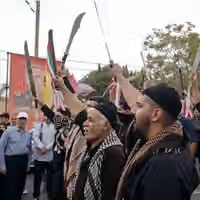
A female supporter of Iran's new supreme leader Mojtaba Khamenei raises a fist during a rally in his support, Tehran, Iran, March 9, 2026

Regional reactions to the appointment of Mojtaba Khamenei as Iran’s new Supreme Leader have revealed growing anxiety about stability, with Tehran’s allies condemning the killing of his father and adversaries hardening their military posture.

Khamenei Jr’s continued absence from public view has fueled speculation among analysts and diplomats about how power is being exercised during the transition.

The message read on his behalf on state television on Thursday was viewed by some observers as closely aligned with the Revolutionary Guards (IRGC) messaging, prompting questions about the balance between formal leadership and the IRGC.

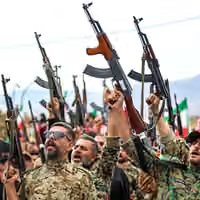
As expected, Tehran’s regional non-state allies in Iraq, Yemen and Lebanon have rallied around the new leader, calling him the “Leader of the blessed Islamic Revolution.” His ascendence to power is perceived by these armed groups as continuity in funding and weapons transfers.

Not many share this view in the region and beyond.

Arab neighbors

Across the Persian Gulf, Mojtaba’s appointment has been met with a mix of defensive military posturing, criticism, and calls for closer security coordination.

Tensions with Saudi Arabia rose sharply after his appointment when an Iranian strike hit a Saudi residential area. Prior reporting in US media, including The Washington Post, indicated Riyadh had privately urged Washington to use significant military force to prevent Iran from emerging stronger after the transition.

Elsewhere in the region, Tehran and its proxies have been blamed for strikes on civilian infrastructure—including a desalination plant in Bahrain.

Arab League Secretary-General Ahmed Aboul Gheit denounced Iran’s “reckless policy,” reflecting broader anxieties among smaller Gulf states.

Reactions from Qatar, Kuwait and the United Arab Emirates have reflected concern about escalation, as the leadership transition coincided with direct attacks on regional infrastructure.

Turkey

In Turkey, President Recep Tayyip Erdogan struck a supportive tone, calling Iranian officials “brothers” and expressing hope they would “get through this trap-filled period.”

Ankara has also criticized US strikes and appears likely to maintain pragmatic engagement with Iran’s leadership to avoid instability along its borders.

Russia, China and the EU

Russia’s President Vladimir Putin was among the first to respond, calling Ali Khamenei’s death a “cynical murder” and describing him as an “outstanding statesman.” His message to President Massoud Pezeshkian emphasized solidarity with Iran during the transition.

China adopted a more cautious tone, stressing respect for Iran’s sovereignty and opposing regime change. Chinese officials framed the succession as a constitutional matter and an internal Iranian process.

The European Union’s reaction has been more fragmented. Diplomats say some member states quietly hope the transition could open space for political change, while others fear instability could widen the conflict. Publicly, EU officials have emphasized de-escalation regardless of who leads Iran.

None of the three powers aligned with Tehran as the United Nations condemned IRGC-linked attacks on regional targets this week.

Israel

Israel was the only country in the region to explicitly question the legitimacy of Mojtaba’s appointment, describing it as a continuation of what it called the IRGC’s “terror regime.”

Even before the appointment, Defense Minister Israel Katz wrote on X that “any leader appointed to continue the plan to destroy Israel will be an unequivocal target for elimination.”

Public reactions across Iran and parts of the Arab world have been mixed. Some early expressions of relief at Ali Khamenei’s death gave way to concern about escalation as Mojtaba’s ties to the IRGC came into focus.

Across the region, officials and analysts say the leadership transition has reinforced fears that an already volatile conflict could widen further in the weeks ahead.

Most Viewed

Can widening the war save Iran’s rulers?
1
ANALYSIS

Can widening the war save Iran’s rulers?

2

Britain bans London Quds Day march run by pro-Islamic Republic group

3

Tehran checkpoints hit in reported drone attacks

4

US Senators urge probe of strike that killed scores of children in Iran

5

UNESCO warns of rising risks to Iran’s historic sites

Banner
Banner

Spotlight

  • Allies rally, rivals brace after Mojtaba Khamenei’s rise
    INSIGHT

    Allies rally, rivals brace after Mojtaba Khamenei’s rise

  • Checkpoint attacks open new front in Iran war
    INSIGHT

    Checkpoint attacks open new front in Iran war

  • Power vs piety: Khamenei Jr inherits legitimacy dilemma of Iran's theocracy
    ANALYSIS

    Power vs piety: Khamenei Jr inherits legitimacy dilemma of Iran's theocracy

  • Can widening the war save Iran’s rulers?
    ANALYSIS

    Can widening the war save Iran’s rulers?

  • Hormuz disruption tests limits of global energy markets
    ANALYSIS

    Hormuz disruption tests limits of global energy markets

  • Inside the dramatic escape of Iranian women footballers seeking asylum
    INSIGHT

    Inside the dramatic escape of Iranian women footballers seeking asylum

•
•
•

More Stories

Iran pays Lebanon parliament speaker $500,000 a month to maintain influence

Mar 12, 2026, 16:33 GMT

Lebanon’s Parliament Speaker Nabih Berri receives more than $500,000 per month from the Islamic Republic in order to support Tehran's interests and those of its allied group Hezbollah in Lebanon, informed sources told Iran International.

Officials in Tehran say the sums are meant to “buy” unity among Lebanon’s Shiite leadership to ensure that they “act in accordance with Iran’s interests, not Lebanon’s interests.”

Nabih Berri did not respond to Iran International’s request for comment. One of his advisers said that Berri would not comment on the matter at this time.

Berri has not publicly opposed Hezbollah’s attacks on Israel in support of Iran, the sources said, because he does not want to risk losing his financial resources.

The 88-year-old politician heads Lebanon's Amal Movement and holds significant sway in Lebanon’s domestic and foreign policy.

The Shiite organization, formed in the 1970s, remains one of the country’s main political actors. It maintains close political ties with Hezbollah, and both belong to Lebanon’s Shiite political camp.

On March 1, Hezbollah targeted Israel in support of Tehran. Israel launched a new military operation in retaliation.

The sources said Berri has been unwilling to support efforts by the Lebanese government to disarm Hezbollah because, in exchange for receiving large sums from Tehran, he must “advance measures in the Lebanese parliament that align with Tehran’s interests.”

In recent months, Lebanon’s President Joseph Aoun and Prime Minister Nawaf Salam have tried to pressure Hezbollah to disarm in order to reduce tensions with Israel and the international community.

Army forces have confiscated Hezbollah weapons in parts of southern Lebanon, but senior Lebanese officials have said that fully implementing the plan could trigger internal tensions, as Hezbollah has refused to hand over its entire arsenal.

Hezbollah Secretary-General Naim Qassem and officials of the Islamic Republic have repeatedly opposed disarming the group.

Following Hezbollah’s attack on Israel, the Lebanese government announced that the group's military activities would be banned.

On March 6, Israeli Defense Minister Israel Katz warned the Lebanese government that if it remains unable to fulfill its commitments regarding Hezbollah’s disarmament, Lebanon will “pay a very heavy price.”

Tehran considers Hezbollah one of the main pillars of the so-called Axis of Resistance—a term used by Iranian officials to refer to allied armed groups such as Hamas, Islamic Jihad, Hezbollah, Iraq’s Popular Mobilization Forces, and the Houthis in Yemen.

The Wall Street Journal reported in November 2025 that Tehran transferred hundreds of millions of dollars in oil revenue to Hezbollah in the preceding year through exchange offices, private companies and a financing network in Dubai.

Israel’s Kan network reported in December 2025 that Tehran had agreed to pay $1 billion to Hezbollah.

Neither report can be independently verified by Iran International.

Iran’s unseen new leader issues first message in writing

Mar 12, 2026, 13:39 GMT

Iran’s new Supreme Leader Mojtaba Khamenei issued his first message on Thursday, calling for continued military resistance and saying the Strait of Hormuz should remain a tool of pressure, even as questions persist about his health and whereabouts.

The message was not delivered in person. Instead, it was read aloud by a state television anchor while a still photograph of Khamenei was displayed on screen, meaning that nearly two weeks after the conflict began, no video or audio recording of the new leader himself has been released.

Iranian authorities have provided no direct evidence of his condition following reports that he may have been injured during the strikes that killed his father and predecessor, Ali Khamenei.

In the written statement attributed to him, Khamenei addressed the war, domestic unity, regional tensions and retaliation against enemies.

War and military pressure

In the message, Khamenei praised Iran’s armed forces and called for continued military resistance against what he described as aggression by the United States and Israel.

“The demand of the masses of the people is the continuation of effective and regret-inducing defense.”

He also said Iran should continue to use the threat of closing the Strait of Hormuz as leverage in the conflict.

“Certainly the lever of blocking the Strait of Hormuz must continue to be used,” he wrote.

Khamenei added that Iranian officials were studying the possibility of expanding the war into additional fronts where adversaries were vulnerable.

“Studies have been conducted regarding the opening of other fronts in which the enemy has little experience and is highly vulnerable,” he said. “Activating them will take place if the state of war continues and if it serves our interests.”

The statement also praised what Iran calls the “Axis of Resistance,” thanking allied armed groups in the region for supporting Tehran.

“We consider the countries of the resistance front our best friends,” he wrote. “The resistance front is an inseparable part of the values of the Islamic Revolution.”

He specifically referred to Yemen’s Houthis, Lebanon’s Hezbollah and armed groups in Iraq, saying they had stood alongside Iran despite obstacles.

Calls for unity and public participation

Much of the message was directed at Iran’s domestic audience, urging unity and mobilization during wartime.

Khamenei said that during the days immediately following the killing of his father, when Iran had temporarily been without a supreme leader or commander-in-chief, the population itself had shown resilience.

“The insight and intelligence of the great nation of Iran in the recent events and its perseverance, courage and presence astonished friends and enemies alike,” he wrote.

He warned that leadership and government institutions could not function effectively without public support, urging Iranians to maintain active participation in society.

“If your power does not appear on the scene, neither leadership nor any of the institutions whose true role is to serve the people will have the necessary effectiveness,” read the statement.

The new leader also called on citizens to continue participating in political and social activities during the war, including rallies and demonstrations.

“I remind you of the importance of participation in Quds Day ceremonies, where the element of confronting the enemy must be emphasized.”

Threat of retaliation

A major portion of the message focused on retaliation against those responsible for deaths during the war.

Khamenei vowed that the Islamic Republic would continue pursuing revenge for those killed in the conflict. “We will not ignore revenge for the blood of your martyrs,” he wrote.

He said retaliation would not be limited to the killing of his father but would extend to all Iranian casualties.

“The revenge we seek is not only for the martyrdom of the great leader of the revolution,” he wrote. “Every member of the nation who is martyred by the enemy becomes an independent case for revenge.”

Khamenei said some retaliation had already occurred but that further actions would continue.

“A limited amount of this revenge has already taken place in practice. But until it reaches its complete extent, this case will remain open above all others.”

Warning to regional governments

Khamenei also issued a warning to governments in the Middle East whose territories host US military facilities.

He said Iranian forces had struck some of those bases during the war and suggested further attacks could follow.

“In the recent attack some military bases were used,” he wrote. “As we had clearly warned, and without attacking those countries themselves, we targeted only those bases.”

He added that Iran would continue striking such installations if they were used against the country.

“From now on we will be forced to continue doing this,” he wrote.

Khamenei urged regional governments to shut down foreign military bases.

“These countries must determine their position toward those who have attacked our homeland and killed our people,” he wrote. “I recommend they close those bases as soon as possible.”

Checkpoint attacks open new front in Iran war

Mar 12, 2026, 13:16 GMT
•
Arash Sohrabi

The Iran war appears to be entering a new phase as attacks increasingly target checkpoints and street-level security units, while witness reports sent to Iran International suggest many of those positions are being moved or dismantled after their locations are exposed.

For days the conflict had focused largely on military bases, missile sites and command facilities, particularly in southern Iran, as part of the wider US-Israeli campaign that has struck thousands of targets across the country since the war began on February 28.

But since Wednesday evening, reported drone strikes on checkpoints in Tehran have pointed to a parallel line of pressure: the local security posts, patrol units and temporary deployments used to enforce control on the streets.

Iranian state-linked media said several checkpoints in Tehran were hit, killing members of the security forces and Basij militia. The reported locations included positions in multiple districts across the capital.

The development suggests the conflict is increasingly intersecting with the structures the state relies on to control neighborhoods rather than only its larger military infrastructure.

  • Tehran checkpoints hit in reported drone attacks

    Tehran checkpoints hit in reported drone attacks

  • Desertions, shortages and army-IRGC rift strain Iran’s military

    Desertions, shortages and army-IRGC rift strain Iran’s military

From fixed bases to moving checkpoints

Since the start of the war, residents across Iran say checkpoints and patrols have multiplied in major cities as authorities attempt to prevent unrest and maintain control.

At the same time, Iran International has received a steady stream of messages from viewers describing the locations of checkpoints, security deployments and temporary bases.

Some reports describe armed units inspecting vehicles at major highway entrances or intersections. Others mention security forces using schools, sports halls and religious institutions as temporary accommodation or staging points.

Messages received in recent days pointed to deployments in locations ranging from major Tehran highways to entrances to cities such as Karaj, Shiraz, Mashhad and Qazvin. Residents also described units stationed beneath highway bridges, near parks or inside parking areas where buses and motorcycles were parked overnight.

In several cases, viewers reported that checkpoints they had previously seen disappeared within hours or days, while others appeared to move to nearby streets or disperse into smaller patrol groups.

Some messages described security forces sleeping inside buses or personal vehicles and conducting mobile patrols rather than remaining in fixed positions.

Others said checkpoints that had been inspecting vehicles were suddenly dismantled, leaving only a few officers nearby.

Such reports cannot be independently verified in each case. But taken together they suggest that many deployments are becoming more fluid, with positions shifting frequently rather than remaining in one place.

The Imam Reza security unit after sustaining damage, part of the IRGC’s Mohammad Rasulullah Corps in Greater Tehran.

A war over control of the neighborhood

The shift reflects a deeper pressure on the state’s local enforcement network.

For years the Islamic Republic has relied on a dense web of Basij, police and Revolutionary Guards positions to control neighborhoods and quickly suppress unrest.

During the recent nationwide protests earlier this year, these same networks formed the backbone of the crackdown that sealed off districts and quashed the demonstrations.

In wartime, those local security units appear to be playing an even more central role.

As larger bases and installations come under pressure from airstrikes, authorities appear to be relying more heavily on mobile checkpoints and temporary deployments to maintain control on the ground.

Now those fallback positions are also being drawn into the conflict.

The result is a battlefield that increasingly overlaps with everyday urban space. Instead of remaining confined to distant military facilities, the war is beginning to touch the street corners, highway entrances and neighborhood patrol routes where the state exerts day-to-day authority.

Iran keeps oil flowing to China as Hormuz pressure forces reserve release

Mar 12, 2026, 11:38 GMT

Iran is still loading about 1.5 million barrels of crude a day in March while China is receiving about 1.25 million barrels daily, Kpler data show, even as days of Iranian pressure around the Strait of Hormuz and rising prices force consuming nations to tap emergency reserves.

The figures suggest Tehran’s oil lifeline has not been cut despite a widening maritime crisis that has already disrupted shipping and shaken energy markets since the war began on February 28.

Instead, the conflict is evolving into a prolonged contest over energy flows: Iran continues exporting oil – largely to China – while simultaneously applying military pressure on one of the world’s most important oil chokepoints.

The Strait of Hormuz, the narrow passage off Iran’s southern coast connecting the Persian Gulf to global markets, normally carries about a fifth of the world’s oil and liquefied natural gas shipments.

Continue reading

Iran keeps oil flowing to China as Hormuz pressure forces reserve release

Mar 12, 2026, 11:22 GMT
•
Arash Sohrabi

Iran is still loading about 1.5 million barrels of crude a day in March while China is receiving about 1.25 million barrels daily, Kpler data show, even as days of Iranian pressure around the Strait of Hormuz and rising prices force consuming nations to tap emergency reserves.

The figures suggest Tehran’s oil lifeline has not been cut despite a widening maritime crisis that has already disrupted shipping and shaken energy markets since the war began on February 28.

Instead, the conflict is evolving into a prolonged contest over energy flows: Iran continues exporting oil – largely to China – while simultaneously applying military pressure on one of the world’s most important oil chokepoints.

The Strait of Hormuz, the narrow passage off Iran’s southern coast connecting the Persian Gulf to global markets, normally carries about a fifth of the world’s oil and liquefied natural gas shipments.

But the waterway has effectively become a war zone.

Since the start of hostilities, at least 16 commercial vessels have been struck or attacked in and around the strait and the wider Persian Gulf, according to a Reuters tally.

The incidents have included attacks on tankers, bulk carriers and container ships, forcing evacuations, halting port operations in parts of Iraq and driving insurers and ship operators to reconsider voyages through the area.

Iran’s Revolutionary Guards have warned that ships passing through the strait could be targeted, reinforcing fears that the waterway is now being used as a pressure point in the wider conflict.

A foreign tanker carrying Iraqi fuel oil damaged after catching fire in Iraq's territorial waters, following unidentified attacks that targeted two foreign tankers, according to Iraqi port officials, near Basra, Iraq, March 12, 2026.

Release of strategic reserves

The growing disruption has pushed the International Energy Agency and major consuming nations to take the extraordinary step of releasing 400 million barrels from strategic reserves, the largest such intervention in the agency’s history.

IEA Executive Director Fatih Birol said the decision had already had a “strong impact” on markets and was aimed at stabilizing supply after the war triggered one of the biggest oil disruptions on record.

The agency estimates global supply could fall by 8 million barrels per day in March as production across the Middle East is curtailed and shipping through Hormuz slows to a fraction of normal levels.

But the reserve release has done little to calm markets.

Oil prices briefly surged above $100 a barrel this week and remain volatile as traders weigh the risk that shipping through the Persian Gulf could remain constrained for weeks or months.

Analysts say the problem is not simply the availability of oil but the difficulty of moving it safely through a militarized sea lane.

Joel Hancock, an energy analyst at Natixis CIB, said markets were questioning how quickly emergency reserves could reach buyers, warning that a market balanced through stock releases would be “far less logistically efficient.”

Shockwaves beyond oil

The war has also begun to ripple through global energy markets beyond crude.

In Europe, gas prices rose sharply as fears grew that tanker attacks in the Persian Gulf could disrupt shipments of liquefied natural gas, around 20% of which normally transits the Strait of Hormuz.

Qatar, one of the world’s largest LNG exporters, has declared force majeure on some shipments, tightening global supplies and raising concerns about Europe’s ability to refill depleted gas storage before next winter.

Financial markets have reacted nervously as well. Rising oil prices have revived fears of inflation and pushed investors to scale back expectations of interest rate cuts by major central banks.

The war’s central energy paradox is that Iran cannot fully shut global oil flows without hurting itself, yet it has shown it can make the Persian Gulf and the Strait of Hormuz dangerous enough to rattle markets and force governments to act, even while keeping a substantial share of its own exports – mainly to China – moving.