• Iran Insight
  • Politics
  • Economy
  • Analysis
  • Special Report
  • Opinion
  • Podcast
All rights reserved for Volant Media UK Limited
volant media logo
  • العربية
  • فارسی
Brand
  • Iran Insight
  • Politics
  • Economy
  • Analysis
  • Special Report
  • Opinion
  • Podcast
  • Iran Insight
  • Politics
  • Economy
  • Analysis
  • Special Report
  • Opinion
  • Podcast
  • Theme
  • Language
    • العربية
    • فارسی
INSIGHT

Iran keeps oil flowing to China as Hormuz pressure forces reserve release

Mar 12, 2026, 11:38 GMT

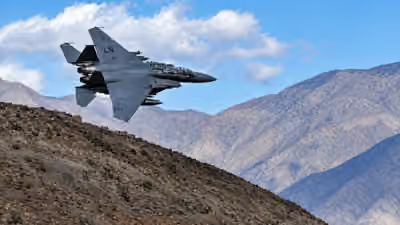
Iran is still loading about 1.5 million barrels of crude a day in March while China is receiving about 1.25 million barrels daily, Kpler data show, even as days of Iranian pressure around the Strait of Hormuz and rising prices force consuming nations to tap emergency reserves.

The figures suggest Tehran’s oil lifeline has not been cut despite a widening maritime crisis that has already disrupted shipping and shaken energy markets since the war began on February 28.

Instead, the conflict is evolving into a prolonged contest over energy flows: Iran continues exporting oil – largely to China – while simultaneously applying military pressure on one of the world’s most important oil chokepoints.

The Strait of Hormuz, the narrow passage off Iran’s southern coast connecting the Persian Gulf to global markets, normally carries about a fifth of the world’s oil and liquefied natural gas shipments.

Continue reading

Most Viewed

A leader no one has seen: The unusual debut of Mojtaba Khamenei
1
ANALYSIS

A leader no one has seen: The unusual debut of Mojtaba Khamenei

2
ANALYSIS

Can widening the war save Iran’s rulers?

3

Britain bans London Quds Day march run by pro-Islamic Republic group

4

Tehran checkpoints hit in reported drone attacks

5

UNESCO warns of rising risks to Iran’s historic sites

Banner
Banner

Spotlight

  • Power vs piety: Khamenei Jr inherits legitimacy dilemma of Iran's theocracy
    ANALYSIS

    Power vs piety: Khamenei Jr inherits legitimacy dilemma of Iran's theocracy

  • System over leader: Tehran broadcasts stability in wartime
    INSIGHT

    System over leader: Tehran broadcasts stability in wartime

  • Can widening the war save Iran’s rulers?
    ANALYSIS

    Can widening the war save Iran’s rulers?

  • Hormuz disruption tests limits of global energy markets
    ANALYSIS

    Hormuz disruption tests limits of global energy markets

  • Inside the dramatic escape of Iranian women footballers seeking asylum
    INSIGHT

    Inside the dramatic escape of Iranian women footballers seeking asylum

  • A leader no one has seen: The unusual debut of Mojtaba Khamenei
    ANALYSIS

    A leader no one has seen: The unusual debut of Mojtaba Khamenei

•
•
•

More Stories

Iran keeps oil flowing to China as Hormuz pressure forces reserve release

Mar 12, 2026, 11:22 GMT
•
Arash Sohrabi

Iran is still loading about 1.5 million barrels of crude a day in March while China is receiving about 1.25 million barrels daily, Kpler data show, even as days of Iranian pressure around the Strait of Hormuz and rising prices force consuming nations to tap emergency reserves.

The figures suggest Tehran’s oil lifeline has not been cut despite a widening maritime crisis that has already disrupted shipping and shaken energy markets since the war began on February 28.

Instead, the conflict is evolving into a prolonged contest over energy flows: Iran continues exporting oil – largely to China – while simultaneously applying military pressure on one of the world’s most important oil chokepoints.

The Strait of Hormuz, the narrow passage off Iran’s southern coast connecting the Persian Gulf to global markets, normally carries about a fifth of the world’s oil and liquefied natural gas shipments.

But the waterway has effectively become a war zone.

Since the start of hostilities, at least 16 commercial vessels have been struck or attacked in and around the strait and the wider Persian Gulf, according to a Reuters tally.

The incidents have included attacks on tankers, bulk carriers and container ships, forcing evacuations, halting port operations in parts of Iraq and driving insurers and ship operators to reconsider voyages through the area.

Iran’s Revolutionary Guards have warned that ships passing through the strait could be targeted, reinforcing fears that the waterway is now being used as a pressure point in the wider conflict.

A foreign tanker carrying Iraqi fuel oil damaged after catching fire in Iraq's territorial waters, following unidentified attacks that targeted two foreign tankers, according to Iraqi port officials, near Basra, Iraq, March 12, 2026.

Release of strategic reserves

The growing disruption has pushed the International Energy Agency and major consuming nations to take the extraordinary step of releasing 400 million barrels from strategic reserves, the largest such intervention in the agency’s history.

IEA Executive Director Fatih Birol said the decision had already had a “strong impact” on markets and was aimed at stabilizing supply after the war triggered one of the biggest oil disruptions on record.

The agency estimates global supply could fall by 8 million barrels per day in March as production across the Middle East is curtailed and shipping through Hormuz slows to a fraction of normal levels.

But the reserve release has done little to calm markets.

Oil prices briefly surged above $100 a barrel this week and remain volatile as traders weigh the risk that shipping through the Persian Gulf could remain constrained for weeks or months.

Analysts say the problem is not simply the availability of oil but the difficulty of moving it safely through a militarized sea lane.

Joel Hancock, an energy analyst at Natixis CIB, said markets were questioning how quickly emergency reserves could reach buyers, warning that a market balanced through stock releases would be “far less logistically efficient.”

Shockwaves beyond oil

The war has also begun to ripple through global energy markets beyond crude.

In Europe, gas prices rose sharply as fears grew that tanker attacks in the Persian Gulf could disrupt shipments of liquefied natural gas, around 20% of which normally transits the Strait of Hormuz.

Qatar, one of the world’s largest LNG exporters, has declared force majeure on some shipments, tightening global supplies and raising concerns about Europe’s ability to refill depleted gas storage before next winter.

Financial markets have reacted nervously as well. Rising oil prices have revived fears of inflation and pushed investors to scale back expectations of interest rate cuts by major central banks.

The war’s central energy paradox is that Iran cannot fully shut global oil flows without hurting itself, yet it has shown it can make the Persian Gulf and the Strait of Hormuz dangerous enough to rattle markets and force governments to act, even while keeping a substantial share of its own exports – mainly to China – moving.

System over leader: Tehran broadcasts stability in wartime

Mar 11, 2026, 16:59 GMT
•
Behrouz Turani

Iran’s state media has moved quickly to frame the leadership transition not as a rupture but as proof of institutional resilience, shifting its messaging from wartime urgency to carefully managed continuity.

Following the death of Ali Khamenei and the elevation of Mojtaba Khamenei, the Islamic Republic of Iran Broadcasting (IRIB) emphasized that the state—not any individual—is the true source of stability.

IRIB’s rolling news channel, IRINN, repeatedly declared: “The Islamic Republic of Iran is not dependent on a single individual. It is a system based on the rule of law and divine values.”

After the Assembly of Experts named Mojtaba leader on March 9, state television pivoted to stressing the decisiveness of the vote.

Despite reports of clerical unease about the process, IRIB described the outcome as reflecting an 85 percent consensus and presented it as both legally sound and religiously sanctioned.

Broadcasts featured pledges of allegiance from the Revolutionary Guards, the military, the diplomatic corps and even the national football team as evidence of unified support.

Because the transition unfolded during an active conflict with Israel and the United States, state television fused the succession narrative with imagery of military strength.

Shortly after Mojtaba’s appointment, IRIB aired footage of missile launches toward Israel under the caption: “At your command, Sayyid Mojtaba,” invoking both his lineage and his role as wartime commander-in-chief.

The messaging aligned with broader official rhetoric, with security chief Ali Larijani and parliament speaker Mohammad Bagher Ghalibaf both rejecting calls for a ceasefire and signaling that Iran would continue strikes.

These narratives circulated even as Mojtaba himself remained absent from public view. His silence fueled speculation about his condition, with some commentators drawing religious analogies to the occultation of the 12th Imam, while others circulated unverified claims about his whereabouts.

At home, the messaging has been accompanied by tighter control. Iran’s police chief warned that anyone taking to the streets after encouragement from US and Israeli leaders would be treated as an “enemy” rather than a civilian protester—a signal that the space for dissent is narrowing further under wartime conditions.

References to dissent or worsening economic conditions have meanwhile largely disappeared from state coverage.

Skepticism about the hereditary nature of the succession has been framed as foreign psychological warfare, while relatively small pro-government gatherings are presented as signs of broad public enthusiasm.

For now, the message is clear: continuity over disruption, system over individual. But the carefully managed narrative also reflects the pressures facing the leadership at a moment of unusual uncertainty.

Inside the dramatic escape of Iranian women footballers seeking asylum

Mar 10, 2026, 21:43 GMT
•
Negar Mojtahedi

Members of Iran’s national women’s football team were closely monitored by security officials linked to the Islamic Revolutionary Guard Corps (IRGC) during their stay in Australia, but several managed a dramatic escape from their hotel to seek asylum.

Despite the pressure, at least seven players managed to escape and seek safety in Australia following a series of events involving planning, outside help and a moment of chaos during the AFC Asian Cup held in Gold Coast.

Their situation became dangerous after players refused to sing the Islamic Republic’s national anthem during a match against South Korea. Soon afterward, Iran's state TV labeled the young athletes “wartime traitors”—a charge that in Iran can carry the death penalty.

Raha Pourbakhsh, an Iran International sports reporter who covered the tournament from London, said the threats quickly escalated.

While the girls faced the threat of persecution back home, defection was not an easy option either.

Iranian athletes—especially members of national teams—are required to submit substantial financial guarantees to the Ministry of Sports before being allowed to travel abroad, a measure aimed at preventing defections.

These guarantees may take the form of large cash deposits or property deeds, which can be confiscated if the athlete fails to return to Iran.

“For this trip, they dramatically increased the bond to 10 billion Tomans (almost $67,000). I received info from inside the camp that their families were being directly threatened,” Pourbakhsh said.

“Some players felt like they were hostages. They were told their families' safety depended on them returning to Iran after the matches,” she said.

The players suspected they were being monitored and avoided direct communication, believing their phones were likely tapped.

According to Pourbakhsh, security officials were embedded with the team to ensure the players remained under control.

“It was a brave move; I know at least three security officers from the IRGC were embedded with the team to control them,” she said.

However, the surveillance could not stop members of the team from leaving.

Raising the alarm

Pourbakhsh said she began alerting international media outlets after Iranian state television figures publicly called for punishment against the players.

“Western media doesn't follow state TV, so I clipped that video, translated it, and sent it to reporters at CNN, Reuters, and Tracy Holmes," who is veteran broadcaster with the Australian Broadcasting Corporation (ABC).

The reporting quickly gained attention.

“Tracy Holmes interviewed the Australian Foreign Minister that same night about the threats occurring on Australian soil,” Pourbakhsh said.

As the situation escalated, Australian authorities became involved. According to Pourbakhsh, the Australian Federal Police were positioned in the team hotel lobby after concerns were raised.

Iran officials blocked from entering Australia

Iranian authorities also attempted to regain control of the situation by sending senior football officials to Australia.

According to Pourbakhsh, Mehdi Taj, president of Iran’s Football Federation and vice president of the Asian Football Confederation, sought to travel to Australia as the crisis unfolded.

Australian authorities, however, denied him a visa due to his alleged ties to the Islamic Revolutionary Guard Corps.

Instead, another federation representative was sent to Australia to ensure the players returned to Iran following the tournament.

Chaos and escape

The turning point came after the team’s third match.

Confusion erupted among Iranian security handlers as several players attempted to slip away.

Video shared by activists on social media showed one Iranian security official frantically searching through the hotel stairwell while activists followed him, shouting that he was linked to the IRGC.

“You’re in Australia—you better run,” one activist can be heard shouting in the footage. “Get the F out of the country, IRGC terrorists.”

Meanwhile, several players were attempting to escape through the hotel car park.

At one point, a fire door that should have remained open was locked, creating further confusion among the handlers.

Amid the chaos, the players managed to reach safety and make contact with authorities.

Desperate scenes

Witnesses described emotional scenes as the team prepared to leave Australia.

Fans gathered outside the hotel with signs reading “Save Our Girls,” fearing the players would face punishment if forced to return to Iran.

According to witnesses, one player was dragged by her collar and shirt in an attempt to force her onto a team bus.

Others flashed SOS signals as they boarded, indicating they did not want to leave.

Before the team’s plane departed for the long journey back toward Iran, several players were seen making distress gestures toward supporters and cameras.

Pourbakhsh said many players felt compelled to return despite the danger.

Their families remained in Iran.

A new life ahead

Seven players ultimately remained in Australia and sought protection.

Their story has drawn sympathy around the world.

A GoFundMe campaign has been launched to help them rebuild their lives in Australia.

The Brisbane Roar Football Club also publicly offered support.

“Like many Australians, everyone at Brisbane Roar FC has been watching the story of the Iran women's national football team players now here in Queensland with immense admiration,” the club wrote on X.

“These are elite footballers — passionate, talented women who love the game just as deeply as we do.”

The club extended a direct invitation to the players.

“To Fatemeh, Zahra, Zahra, Atefeh, Mona, and any of your teammates building a new life here in Australia: Brisbane is home to one of the country’s most passionate football communities, and the Roar family has a big heart.

“We’d be honoured to open our doors and offer you a place to train, play, and belong.

“No politics. No conditions. Just football, community, and a warm welcome.

“Queensland is your home now.”

Satire spreads online as Iranians await new leader unveiling

Mar 10, 2026, 15:08 GMT
•
Arash Sohrabi

Within hours of Mojtaba Khamenei being named Iran’s new Supreme Leader, state institutions responded with solemn messages of loyalty while Persian-language social media filled with satire, as many Iranian users reacted with disbelief, political frustration and dark humor.

Rather than confronting the official narrative head-on, many posts mocked the opaque and unusual circumstances of Mojtaba’s rise – especially the emergence of a leader who, for many Iranians, remains almost entirely unseen.

The jokes fall broadly into several recurring themes.

‘A leader no one has seen'

Many jokes focus on Mojtaba Khamenei’s near-total absence from public life.

Unlike most senior political figures, Mojtaba has rarely appeared in speeches or interviews, and only a handful of recordings of his voice are publicly known.

Some users turned this into a technological joke. One widely shared post said:

“There isn’t even enough audio of Mojtaba Khamenei for AI to train on to make a fake voice of him.”

Others simply pointed to the unusual situation more directly.

“We are entering the second day of Mojtaba Khamenei's leadership, and still nobody has seen him.”

Several posts framed the absence through humor about remote work – a concept familiar to many younger Iranian users.

“If you like working remotely, the best job is Supreme Leader of the Islamic Republic. Nobody asks where you are, what you’re doing, or even whether you’re alive.”

Another post used religious imagery to exaggerate the idea that he has remained invisible.

“We’re in a situation where the appearance of Mahdi is more likely than the appearance of Mojtaba.”

Mahdi – the messianic figure awaited in Shiite Islam – frequently appears in Iranian satire as a way of describing events considered extremely unlikely.

Another viral joke suggested Mojtaba’s leadership was almost abstract.

“In the phrase ‘Mojtaba’s leadership,’ the literary device being used is personification.”

The remark plays on a Persian rhetorical term used in literature classes, implying that leadership is being attributed to something that has not visibly acted.

'The only known quote'

Another recurring joke centers on how little Mojtaba Khamenei has publicly said.

One of the few widely circulated videos attributed to him shows him announcing that his religious classes would be canceled.

That short clip has now become a punchline.

One post summarized the situation: “The only existing quote from Imam Mojtaba Khamenei: ‘Next week there will be no class.’”

The post was accompanied by a parody image styled like the decorative wall murals commonly seen on schools and public buildings in Iran, where passages from religious figures and political leaders are often painted alongside floral designs.

In the satirical version circulating online, however, the wall bears only the mundane line about next week’s class being canceled – recasting an ordinary notice as the supposedly defining quotation of a newly appointed Supreme Leader.

Other jokes focused on Mojtaba’s lack of a public résumé. One post mocked the situation using corporate language:

“You don’t have a résumé, you want to work remotely, you got the job through connections – and you don’t even have a photo for your CV so they have to generate one with AI.”

Another user suggested that even performing a simple task could count as experience.

“At least bury your father so you can have one executive job on your résumé.”

‘Schrödinger’s Khamenei’

A darker strand of satire reflects the uncertainty and speculation that often accompany major political events in Iran.

Some jokes played with the idea that Mojtaba’s status remains ambiguous because he has not appeared publicly.

One widely shared post referenced the famous physics thought experiment known as Schrödinger’s cat:

“I think instead of Schrödinger’s cat we’re dealing with Schrödinger’s Khamenei. Until they show him, we don’t know whether he’s alive or dead.”

Some posts jokingly suggested that naming Mojtaba as leader could solve several political problems at once.

“Announcing Mojtaba as leader was actually smart. You can’t kill someone who’s already dead.”

Another post used similarly blunt humor:

“You know what’s better than one dead Khamenei? Two dead Khameneis.”

Other jokes focused on the strange overlap between the funeral of the late leader and the introduction of the new one. One user wrote sarcastically:

“Right now the Islamic Republic has two leaders on earth – one they won’t bury and another they won’t reveal.”

Even the burial itself became a subject of dark humor.

“The only reason they haven’t buried Khamenei yet is to save funeral costs – they’re waiting a few days to bury Mojtaba too.”

The mood inside Iran as Khamenei's son takes power

Mar 10, 2026, 14:16 GMT
•
Behrouz Turani

Mojtaba Khamenei’s rise to power amid a war with Israel and the United States—in which his parents, wife and a daughter were killed—has led many to wonder whether his leadership will be shaped more by vengeance than by strategy or reconciliation.

Inside Iran, political figures who disappeared from public view after the February 28 strike are gradually re-emerging through statements congratulating him on his elevation to leadership.

Among them are Mohammad Mohammadi Golpayegani, the former leader’s chief of staff, and Asghar Mirhejazi, his powerful security chief, who issued a rare joint message despite earlier reports that Mirhejazi had been killed in the attack.

Former President Mahmoud Ahmadinejad, also rumored to have died in a strike on his home, released a similar message.

These congratulatory notes appeared during one of the most solemn Shiite mourning periods, commemorating Imam Ali. At the same time, part of the country is mourning the former leader, while Mojtaba himself is grieving the loss of close family members.

State officials, including President Masoud Pezeshkian, Majles Speaker Mohammad Bagher Ghalibaf and security chief Ali Larijani, have recently appeared in simple, Zelensky-style military uniforms without insignia. All three have pledged allegiance to Mojtaba.

Social media has filled with dark humor about Ali Khamenei’s death and Mojtaba’s life expectancy.

More serious posts include the resurfacing of an old video circulated widely on X, reportedly with IRGC encouragement, in which reformist politician Faezeh Hashemi says she would prefer Mojtaba to the “fanatic elderly candidates” for leadership. Like others, she suggested he might introduce reforms.

Mojtaba’s record since 2005, however—particularly during elections and protest crackdowns—offers little evidence of reformist tendencies. Many analysts warn that Iran may become even more radicalized under his rule, noting his long-standing ties to vigilante groups involved in suppressing dissent.

Debate over hereditary succession has intensified. Critics argue that dynastic leadership contradicts the Islamic Republic’s founding principles. Others counter that hereditary succession mirrors the lineage of the Twelve Imams.

Members of the first group note that Khomeini’s son Ahmad was never allowed to inherit power—an argument echoed implicitly by some of Khomeini’s descendants, including his great-grandson Ali, on X.

Former IRGC commander Mohsen Rezaei and former state TV chief and tourism minister Ezzatollah Zarghami have both said they have been close friends of Mojtaba for years, describing him as “modest” and “simple.”

Rezaei, who appeared frequently on state television after Khamenei’s death, has promised to share more about Mojtaba in the coming days.

State TV’s IRINN channel has twice acknowledged that Mojtaba’s leadership faced serious resistance within the Assembly of Experts. In an unusual live broadcast comment, one analyst even suggested opposition to Mojtaba might emerge from within his own support base.

Some media outlets, including Khabar Online, cautiously suggested this week that Mojtaba’s rise could signal a more prolonged and unpredictable phase of conflict, reflecting broader uncertainty inside Iran’s political establishment over the direction his leadership may take.