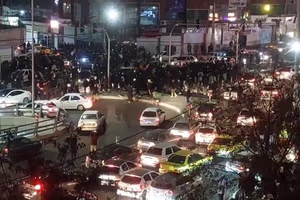
Police opened fire on a family, including a young child, in Hashtgerd in Iran’s Alborz province west of Tehran on January 9 during nationwide protests, wounding the child, an eyewitness told Iran International.
According to the eyewitness, a six- or seven-year-old child was wounded in the leg after being hit by pellet fire during the shooting, causing severe bleeding.
The eyewitness, citing the child’s mother, said the family had just left their home at the time of the incident and were not chanting slogans, but police fired at them as soon as they saw them.
The eyewitness also said the presence of security forces in Hashtgerd increased markedly on January 9.

The future of the Islamic Republic is unresolved, but if and when change comes, Iran’s return to global trade would carry far-reaching consequences for the region’s economy.
A deadly crackdown may have quieted Iran’s streets for now, but the state appears increasingly brittle, with no clear answer to a deepening economic crisis that is eroding living standards and confidence.
External pressures are also likely to intensify after Tehran’s crackdown on protesters, narrowing revenue channels and shrinking the government’s economic room to maneuver.
Left unresolved, those pressures are likely to generate further unrest and, in time, a political transition that seeks normalization with the world.
A normalized Iran—able to trade, borrow, insure cargoes and receive investment like other upper-middle-income economies—would likely enjoy a large upside, given how much of its economy has been operating below potential.
Its advantages are straightforward: scale, in the form of a large domestic consumer market; a relatively diversified industrial base by regional standards; deep energy and petrochemical capacity; and a geographic position that could turn the country into a natural junction linking the Persian Gulf, the Caucasus, Central Asia and Turkey.
The most immediate gains would come from energy exports unleashed from sanctions and sharply lower transaction costs. Over time, however, the larger prize would be productivity. Access to global supply chains and affordable capital, combined with Iran’s labor force, could lift output across all sectors.
None of this would be automatic. The payoff would depend on restoring basic economic credibility: stable money, predictable regulation and a solid banking system.
Turkey stands out as the clearest short-term beneficiary of such a shift in Iran. Proximity, road links and established distribution networks would allow Turkish firms to move quickly, while airlines and tourism operators would likely benefit from a surge in outbound Iranian travel.
Iraq would gain from formal payment channels and more predictable energy trade, easing pressure on the dinar and reducing transaction costs.
Pakistan’s upside would lie in infrastructure: if sanctions risk were removed, long-stalled energy links could become commercially viable, easing power constraints and lowering industrial costs.
The United Arab Emirates would likely lose some of the high margins associated with sanctions-bypass trade but gain as a platform where Iran-bound capital is raised, structured and eventually deployed.
Azerbaijan could benefit if Iran became a reliable bridge to Russia and Eurasia through freight, swaps and grid connections.
Israel could also emerge as a beneficiary. A normalized Iran would lower the region’s risk premium and potentially reduce energy costs, while Israeli firms—particularly in technology and water and agricultural solutions—could potentially compete for contracts in a large, untapped market.
The clearest losers would be producers and hubs that have quietly benefited from Iran’s isolation.
In energy markets, a sanctions-free Iran re-entering at scale would intensify competition between price and market share, leaving oil-dependent exporters such as Saudi Arabia and Kuwait more exposed to revenue volatility and fiscal trade-offs.
In gas, Qatar’s dominance in Asian LNG contracting could face pressure as investment and technology return to Iran’s side of South Pars, potentially narrowing bargaining power and affecting pricing over time.
Iran’s reintegration would also challenge business models built on being indispensable detours. Kuwait, for example, could find that costly hub ambitions become less compelling if Iraq–Iran rail and port combinations offered cheaper trade routes.
More subtly, some early beneficiaries could face second-round competition once Iran begins producing and exporting at scale.
Turkey may initially sell heavily into the Iranian market, but over time a revitalized Iranian manufacturing sector could begin displacing Turkish goods in nearby markets.
For Pakistan, cheaper Iranian energy would be an opportunity, but a fully functional Chabahar and Iran-centered transit corridors could divert trade away from Gwadar unless Pakistan integrates its infrastructure into those routes.
If Iran were to return as a normal economic actor, regional debates would shift from ideology to competition. The central question may no longer be who can contain Tehran, but who can compete with it.
In that environment, the advantage would likely accrue to states that adapt fastest, moving away from protected niches and easy rents toward productivity, technology and integration.
A reopened Iran would not simply add another participant to the regional economy; it would change the structure of the marketplace itself.
Iranian authorities have suspended the Tehran-based reformist daily Ham-Mihan after it published a series of articles on recent unrest, its editor told the news website Khabaronline on Monday.
The website quoted the editor as saying that Iran’s Press Supervisory Board had cited two recent articles as the reason for the decision. One was an editorial titled “From Dey 1357 to Dey 1403,” published on Jan. 25. Dey is a month in the Iranian calendar that roughly corresponds to late December and early January. The year 1357 marks the 1979 Islamic Revolution, while 1403 is the current Iranian calendar year.
The other was an article by journalist Elaheh Mohammadi titled “When the boundaries of treatment were broken,” published on Jan. 17 under the front-page headline “The hospital story from Ilam to Sina,” Khabaronline reported.
In its latest issue, Ham-Mihan also published an account of what it called the “unrest of Dey,” referring to the same period.
The newspaper wrote that the number of dead and wounded was high in the cities of Izeh and Ramhormoz, and that around 10 socially vulnerable people had died in Mashhad. It added that most of those detained were between the ages of 20 and 25, according to Khabaronline.
Ham-Mihan also wrote that what it described as unofficial reports pointed to protests in more than 100 cities across the country.
“Unofficial news suggests that protests took place in more than 100 cities in Iran, from smaller towns such as Marvdasht and Fasa in Fars province, Hafshejan in Chaharmahal and Bakhtiari, Abdanan and Malekshahi in Ilam province, and Junaqan in Isfahan province, to larger cities including Rasht, Mashhad, Tehran, Isfahan, Shiraz, Kish, Qeshm and Bandar Abbas,” the newspaper wrote.
“The scale of the protests, as well as the number of those killed and wounded, remains unclear due to the internet shutdown and the lack of official figures. What we know comes from before the official cutoff and from conversations with residents of these cities,” it added.

Any flare-up of tensions, even a conflict targeting a single country, would have serious consequences for the entire Middle East, Iran’s ambassador to Saudi Arabia warned, as Tehran said it has held intensified contacts with Arab states to prevent a wider confrontation.
Alireza Enayati said in an interview with the Saudi newspaper Okaz that Iran believed dialogue and joint regional action were the most effective ways to preserve stability and avoid broader conflict.
“In recent days, we have witnessed contacts from Arab countries,” Enayati said, adding that foreign ministers from Saudi Arabia, Qatar and Oman had been in close communication with Tehran, alongside a recent visit by Oman’s foreign minister.
“These efforts are aimed at regional stability and strengthening security,” he said, adding that Iran welcomed initiatives to prevent escalation but warned that “the ignition of any tension, even a conflict targeting one specific country, would have serious consequences for the entire region.”
Enayati said Iran remained committed to peaceful solutions for regional crises and viewed dialogue as the only way to address even the most complex issues, while accusing other parties of opting for confrontation instead.
He warned against what he described as plans aimed at weakening countries in the region and said the real threat was Israel’s growing influence in the Middle East.
Israeli Prime Minister Benjamin Netanyahu and at least two other regional leaders support what sources described as an active strategy aimed at toppling Iran’s leadership in the near term, according to a report by Israel Hayom.
“Netanyahu, along with at least two other regional leaders, supports an active approach aimed at toppling the regime in the near term and has committed to providing all necessary support toward that goal,” the newspaper reported.
The report said Netanyahu conveyed that view during recent talks with US President Donald Trump and other regional leaders, even as Washington decided last week not to launch a military strike on Iran.
According to Israel Hayom, intelligence assessments presented to Trump warned that a limited aerial strike would be unlikely to cause the collapse of Iran’s leadership and could carry significant risks.
Other regional intelligence agencies shared the view that Iran’s rulers would not fall quickly, but assessed that Tehran’s ability to respond militarily was weaker than its public rhetoric suggested, the paper said.
Israel Hayom also quoted a source as saying that a major US move against Iran was “not a question of if, but when,” adding that the timing and nature of any action were under constant review.

Comments by British musician Roger Waters saying Iranians do not seek regime change triggered a wave of criticism from Iranian social media users, with some circulating edited images portraying him as a cleric.
Waters, a co-founder of Pink Floyd, made the remarks on Piers Morgan Uncensored on Friday when asked about nationwide protests in Iran.
He said calls for political change were not representative of the public and portrayed the demonstrations as driven by economic pressures such as inflation and currency depreciation.
“The Iranians do not want regime change,” Waters said, adding that protesters were focused on economic pressures rather than political transformation.
Waters also dismissed support for a return to monarchy or any political role for the former shah’s son, Reza Pahlavi, whose name has been chanted by protesters in the streets.
Accusations of distorting protesters’ demands
The comments drew swift pushback from Iranian users online, many of whom said Waters misrepresented the scale and slogans of the protests. Critics accused him of echoing official narratives and downplaying the extent of violence against demonstrators.
In response, activists launched an online petition titled “Show Roger Waters the True Desires of Iranians.” Arash F., the organizer, said Iran was at a critical moment and that Waters’ remarks prompted the campaign to convey what the petition describes as the demands of most Iranians at home and abroad.
“The people of Iran want regime change. The people of Iran are tired of Islam being imposed on them. The people of Iran at this point welcome any means that helps to rid us from these tyrants and thieves that operate our country,” the petition text said.
It urges Waters not to speak on behalf of Iranians and invites him to witness conditions firsthand if he wishes to comment.
Iranian rapper Shahin Najafi also weighed in on X, delivering one of the sharpest rebukes of Waters’ comments.
Najafi wrote that a figure he described as a public defender of Hamas had no legitimacy to comment on what he called the Iranian people’s revolution or their demands, arguing that such remarks amounted to aligning with “terrorist regime” and the Iranian authorities.
“More than twelve thousand Iranians have been killed by the regime’s forces. By justifying this violence, you stand complicit with the Islamic Republic. After Iran is freed from this child-killing terrorist regime, you will owe the Iranian people a clear and public apology,” he wrote.
Iranian musician and television host Arash Sobhani also criticized Waters in a post on X, saying the interview was a reminder that when an artist “replaces truth with ideology,” they stop being an artist and become a propagandist.
Sobhani added that similar images and narratives would likely be used to fire up audiences at Waters’ upcoming concerts, ending his post with a pointed reference to Pink Floyd’s Another Brick in the Wall.
Claims about protest violence
In another part of the interview, Waters attributed the killing of protesters not to state forces but to “organized armed thugs,” which he suggested could be linked to foreign intelligence services including MI6 and the CIA.
“The government sent the police out to protect those grocers, those business owners, those ordinary working people in Iran. They were attacked by gangs of armed thugs who murdered… Armed thugs probably organized by MI6 and the CIA,” said Waters.
The allegation, made without evidence, was widely criticized online as repeating official talking points and minimizing responsibility for the crackdown.
Iran International has previously reported that at least 12,000 people were killed in the largest mass killing in Iran’s modern history, during protests on January 8 and 9 that were carried out largely by the Islamic Revolutionary Guard Corps and the Basij on the orders of Supreme Leader Ali Khamenei.
User reactions remained sharp. One X user wrote that they had once admired Waters but now saw his comments as either naive or financially motivated. Another accused him of “washing away the blood of Iranians” by distorting reality.
Others shared altered images of Waters wearing a clerical turban, depicting him as sympathetic to authoritarian governments and armed groups in the region – posts that quickly spread as a symbol of anger over his remarks.