Israeli Prime Minister Benjamin Netanyahu and at least two other regional leaders support what sources described as an active strategy aimed at toppling Iran’s leadership in the near term, according to a report by Israel Hayom.
“Netanyahu, along with at least two other regional leaders, supports an active approach aimed at toppling the regime in the near term and has committed to providing all necessary support toward that goal,” the newspaper reported.
The report said Netanyahu conveyed that view during recent talks with US President Donald Trump and other regional leaders, even as Washington decided last week not to launch a military strike on Iran.
According to Israel Hayom, intelligence assessments presented to Trump warned that a limited aerial strike would be unlikely to cause the collapse of Iran’s leadership and could carry significant risks.
Other regional intelligence agencies shared the view that Iran’s rulers would not fall quickly, but assessed that Tehran’s ability to respond militarily was weaker than its public rhetoric suggested, the paper said.
Israel Hayom also quoted a source as saying that a major US move against Iran was “not a question of if, but when,” adding that the timing and nature of any action were under constant review.

Comments by British musician Roger Waters saying Iranians do not seek regime change triggered a wave of criticism from Iranian social media users, with some circulating edited images portraying him as a cleric.
Waters, a co-founder of Pink Floyd, made the remarks on Piers Morgan Uncensored on Friday when asked about nationwide protests in Iran.
He said calls for political change were not representative of the public and portrayed the demonstrations as driven by economic pressures such as inflation and currency depreciation.
“The Iranians do not want regime change,” Waters said, adding that protesters were focused on economic pressures rather than political transformation.
Waters also dismissed support for a return to monarchy or any political role for the former shah’s son, Reza Pahlavi, whose name has been chanted by protesters in the streets.
Accusations of distorting protesters’ demands
The comments drew swift pushback from Iranian users online, many of whom said Waters misrepresented the scale and slogans of the protests. Critics accused him of echoing official narratives and downplaying the extent of violence against demonstrators.
In response, activists launched an online petition titled “Show Roger Waters the True Desires of Iranians.” Arash F., the organizer, said Iran was at a critical moment and that Waters’ remarks prompted the campaign to convey what the petition describes as the demands of most Iranians at home and abroad.
“The people of Iran want regime change. The people of Iran are tired of Islam being imposed on them. The people of Iran at this point welcome any means that helps to rid us from these tyrants and thieves that operate our country,” the petition text said.
It urges Waters not to speak on behalf of Iranians and invites him to witness conditions firsthand if he wishes to comment.
Iranian rapper Shahin Najafi also weighed in on X, delivering one of the sharpest rebukes of Waters’ comments.
Najafi wrote that a figure he described as a public defender of Hamas had no legitimacy to comment on what he called the Iranian people’s revolution or their demands, arguing that such remarks amounted to aligning with “terrorist regime” and the Iranian authorities.
“More than twelve thousand Iranians have been killed by the regime’s forces. By justifying this violence, you stand complicit with the Islamic Republic. After Iran is freed from this child-killing terrorist regime, you will owe the Iranian people a clear and public apology,” he wrote.
Iranian musician and television host Arash Sobhani also criticized Waters in a post on X, saying the interview was a reminder that when an artist “replaces truth with ideology,” they stop being an artist and become a propagandist.
Sobhani added that similar images and narratives would likely be used to fire up audiences at Waters’ upcoming concerts, ending his post with a pointed reference to Pink Floyd’s Another Brick in the Wall.
Claims about protest violence
In another part of the interview, Waters attributed the killing of protesters not to state forces but to “organized armed thugs,” which he suggested could be linked to foreign intelligence services including MI6 and the CIA.
“The government sent the police out to protect those grocers, those business owners, those ordinary working people in Iran. They were attacked by gangs of armed thugs who murdered… Armed thugs probably organized by MI6 and the CIA,” said Waters.
The allegation, made without evidence, was widely criticized online as repeating official talking points and minimizing responsibility for the crackdown.
Iran International has previously reported that at least 12,000 people were killed in the largest mass killing in Iran’s modern history, during protests on January 8 and 9 that were carried out largely by the Islamic Revolutionary Guard Corps and the Basij on the orders of Supreme Leader Ali Khamenei.
User reactions remained sharp. One X user wrote that they had once admired Waters but now saw his comments as either naive or financially motivated. Another accused him of “washing away the blood of Iranians” by distorting reality.
Others shared altered images of Waters wearing a clerical turban, depicting him as sympathetic to authoritarian governments and armed groups in the region – posts that quickly spread as a symbol of anger over his remarks.


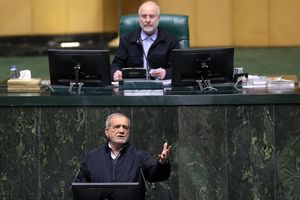
Iran’s parliament has halted impeachment proceedings against several cabinet ministers, a member of the parliament’s presiding board said on Monday, citing guidance from the Supreme Leader to support the administration.
Alireza Salimi said the impeachment process had been suspended but not removed from the parliamentary agenda, according to comments reported by the Tasnim news agency.
He said the decision was taken in light of remarks by Supreme Leader Ali Khamenei calling for cooperation with the government and urging the executive branch to intensify efforts to address the country’s problems.
Salimi said parliament would continue its oversight role and would monitor the government’s performance closely, adding that lawmakers could resume using supervisory tools if the cabinet failed to meet expectations.


According to Tasnim, impeachment motions against the ministers of labor, oil, roads and urban development, energy, culture and Islamic guidance, sports, and agriculture had been referred to the presiding board. Proposals to impeach the ministers of industry and higher education had also been registered and were in the signature-gathering stage.
Separately, an impeachment motion against Labor Minister Ahmad Meydari was referred last week to parliament’s social affairs committee for review, Tasnim reported.
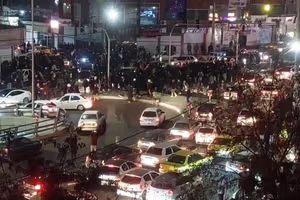
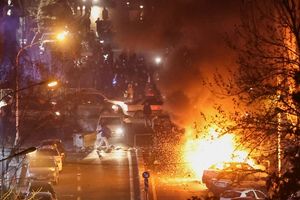
The move comes as protests that began over economic grievances have evolved into calls for regime change, with the country still largely under an internet blackout and reports of more than 12,000 people killed in the ensuing crackdown.

Iran’s Judiciary Chief Gholamhossein Mohseni Ejei said on Monday that authorities would seek to prosecute not only foreign governments but also individuals whom he accused of helping fuel recent unrest, both inside Iran and overseas.
He said those he described as having “caused” the protests, as well as those who he said supported them financially, politically or militarily, would be treated as criminals.
“Those who called for it, those who provided financial support, propaganda support or weapons — whether the United States, the Zionist regime or their agents — are all criminals and each of them must be pursued,” Ejei was quoted as saying by state media.
Iran’s national police chief Ahmadreza Radan said on Monday that authorities would continue to pursue those involved in recent protests, using language that labeled them as “rioters” and “terrorists.”
“We promised the people that we would pursue the rioters and terrorists to the last person,” Radan was quoted as saying by state media.
He said many had already been detained and claimed they had confessed.

Iran’s second-largest mobile phone operator removed its chief executive amid a dispute over enforcement of the government’s internet blackout during widespread protests.
MTN Irancell failed to promptly enforce authorities’ shutdown orders as demonstrations spread, Iranian media reported.
Alireza Rafiei was dismissed after about a year in the job because he “disobeyed orders from security bodies and violated issued regulations under crisis conditions” to restrict internet access during the uprising, IRGC-linked Fars news agency said.
The move could signal “defections at the most senior levels” of the government, Mehdi Saremifar, a science and technology journalist, told Iran International.
The dismissal followed remarks by MP Hamid Rasaei,who criticized what he described as a delay in shutting down the internet during a parliament session on Monday.
Iran cut off communications nationwide on January 8 without warning as calls intensified for anti-government protests across the country.
“While it was clear that riots were about to start and despite a request by the supreme national security council, why was the Internet shut down with delay and at 10:00 pm?” Rasaei said. “If some people had not refused, the losses and casualties would not have reached this level.”
Iran’s authorities have faced sustained criticism from activists, rights groups and some foreign governments for cutting or throttling internet access during protests, a tactic critics say hampers organizing, documentation of abuses and communication with the outside world.
Officials have framed restrictions as necessary for security and public order, while critics say shutdowns isolate communities and heighten risks for protesters during periods of violence and mass arrests.
On Monday, internet monitor NetBlocks said Iran’s nationwide blackout has entered its twelfth day, with national connectivity still at minimal levels.
“In recent days, the filternet has occasionally allowed messages through, suggesting that the regime is testing a more heavily filtered intranet,” NetBlocks added.