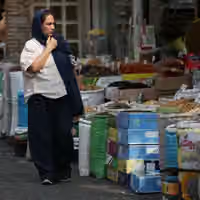
“Honorable merchants; support, support!” When security forces arrived, the most urgent refrain was not yet a political manifesto. It was a promise of mutual protection: “Don’t be afraid, don’t be afraid; we’re all in this together.”
From there, the videos show how quickly what many initially read as an economic protest widened into something explicitly political.
Iran International reviewed 463 clips from the uprising’s first 10 days – recorded in 91 cities, towns and villages – and coded every instance in which chants were clearly audible.
Across the footage, we identified 93 distinct chants heard across 641 recorded chant instances, or occurrences of chants in the videos, not a count of unique slogans or unique events.
The slogans heard across that footage trace a rapid shift: from strike calls and solidarity to direct rejection of the Islamic Republic and, increasingly, calls for the return of monarchy.
That first day, the footage was narrow. Beyond one clip from Shoush market – where merchants chanted, “Pezeshkian, have some shame; give up the presidency” – few other slogans from outside the merchants’ immediate world were clearly audible in the videos we reviewed.
On the second day, strike calls such as “Close up, close up” still echoed through the bazaars – but the protest vocabulary broke decisively into open confrontation with the Islamic Republic.
In Tehran, chants like “Until the cleric is buried, this homeland won’t become a homeland” and “Cannons, tanks, fireworks; mullahs must go” signaled a shift from trade grievance to political defiance.
That same day, a line surfaced that would come to define the first 10 days in our video analysis: “This is the final battle; Pahlavi will return.”
From this point forward, the uprising’s slogans were no longer simply about pressure or protest. They were about power – and what should replace it.
The pro-Pahlavi chant was heard in universities too, surprising some observers and even triggering accusations of video manipulations.
At Allameh Tabataba’i University, students chanted, “Neither Pahlavi nor the Supreme Leader, freedom and equality.” At Beheshti University, a line from the Woman Life Freedom movement of 2022 was heard: “You’re the lecher; you’re the whore; I am a free woman."
As the days went on, the geography widened.
The footage moved beyond Tehran into smaller cities and towns – Kouh-Chenar, Farsan, Asadabad, Juneghan – while protests continued in dormitories as well as streets.
What stood out across these scenes was not only the spread of the demonstrations, but the repetition of two dominant political poles in what people shouted: opposition to the Islamic Republic, and support for the Pahlavi family.
By the middle of the 10-day period, the uprising’s language also began to absorb the weight of mourning. Chants were not only rallying cries, but elegies.
In Kouhdasht, mourners chanted: “This flower has been torn apart; it has become a gift to the homeland.” They also repeated the slogans already familiar from the streets: “Pahlavi will return,” and “Death to the dictator.”
In Fooladshahr, mourners chanted “Death to Khamenei” at the burial of Dariush Ansari, one of the first protesters killed in this round of unrest. In Marvdasht, at the burial of Khodadad Shirvani Monfared, “Long live the Shah” was also chanted.
The uprising was not speaking in one register. It was speaking in many – anger, grief, defiance, and sometimes myth.
In Zahedan, footage recorded “Allahu Akbar” and “Death to Khamenei” after Friday prayers. In a village in Hamedan province, another line appeared: “Wail, Seyyed Ali (Khamenei); Pahlavi is coming.”
In Shiraz University’s dormitory courtyard, students chanted: “The Shah is coming home; Zahhak will be overthrown” – using the mythic tyrant Zahhak as a stand-in for Khamenei.
Toward the end of the 10 days, the volume of videos fell – fewer clips surfaced in our review – yet some of the most intense scenes were recorded in that period.
Funerals in Malekshahi, Ilam province, for Latif Karimi, Reza Azimi, and Mehdi Emami-Pour were marked by chants including “I will kill, I will kill, whoever killed my brother.”
One clip recorded citizens pleading “Police force; support, support” during an attack on a hospital in Malekshahi, even as officers stormed the facility.
Day 9 brought a quieter map but a sharper political profile. In the footage published from eight cities and villages, three chants rose most clearly: “Long live the Shah,” “Death to the dictator,” and “Neither Gaza nor Lebanon; my life for Iran.”
In Chenar-Sheikh (Chenar Sofla), the biggest village in Hamedan province, protests continued, and one line that drew attention – “Khamenei is a murderer; in your dreams” – echoed a Persian-language comment posted by Elon Musk under one of Ali Khamenei’s posts on X.
Then, on the tenth day, the footage suggested renewed momentum. Protests were recorded across 19 cities, with the signature chants against "the dictator" and for Pahlavi leading the chorus.
In some campuses, students continued – sometimes with the simplest insistence of all: “Freedom, freedom, freedom”; sometimes with a pledge of endurance: “Don’t think it’s just today, our appointment is every day.”
Across the footage, one thing is constant: people are not only protesting, but naming an alternative.
The future of this latest round of unrest is not written. But another chapter in Iranians' journey towards an Iran without the Islamic Republic is being drafted, line by line - and in the open.