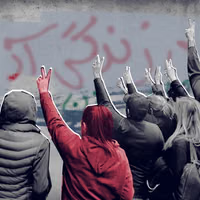
Iranians thanking US President Trump for strikes that killed Ali Khamanei.
As anti-war protesters in Western capitals chant “no war with Iran,” some Iranians inside and outside the country are cheering the US-Israeli strikes and publicly thanking President Donald Trump.
That contrast, several Iran experts told Iran International, exposes a widening divide between Western progressive activism and the lived experience of many Iranians.
Analysts say the reaction among many Iranians is not about ideological loyalty but about seeing any weakening of the Islamic Republic as a rare opportunity to escape decades of repression.
“War is violent, it's terrible and it has started. The people of Iran didn't choose this war — the Islamic government, the Islamic Republic government, chose this war,” said Siavash Rokni, an Iran pop culture expert.
“Iranians will use any opportunity to bypass the Islamic Republic to assure the fall of the Islamic Republic and the institution of a democracy,” Rokni said.
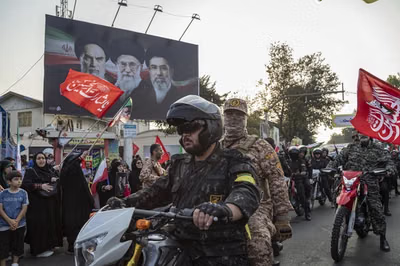
Anti-war protests taking shape in Western capitals have often featured placards supporting the very regime responsible for killing scores of Iranians, with demonstrators holding images of the now-former Supreme Leader, Ali Khamenei — the man ultimately responsible for the killings.
Rokni said one cannot claim to oppose war while supporting the regime responsible for such violence.
This week, clips of Iranians dancing to the Village People’s “Y.M.C.A.” in the exaggerated arm-pumping style popularized by Trump went viral following the confirmed death of Supreme Leader Ali Khamenei.
The cultural irony is striking. “Y.M.C.A.” was released in late 1978 and was charting in early 1979 — the same period Iran’s Islamic Revolution culminated in the fall of the Shah and the rise of the Islamic Republic.
Now, decades later, the disco anthem has resurfaced as a soundtrack for some celebrating what they see as the potential unraveling of that same regime.
Celebrations were reported not only inside Iran but also in diaspora hubs including Los Angeles and London, underscoring that the reaction extended beyond Iran’s borders but largely among Iranians themselves.
Iran International has reviewed footage received directly from inside Iran in the hours following the strikes.
In one clip, explosions can be seen in the background with plumes of smoke rising over Tehran as an Iranian man says: “Thank you Mr. President, thank President Trump, we love you.”
In another video, a woman shouts “Trump!” followed by cheers, clapping and the sound of what appears to be a vuvuzela-style horn as a group of Iranians celebrate.
In a separate clip filmed inside Iran, a woman says in Farsi: “Bibi, we are happy, Netanyahu, Israel, Trump...death to Terrorist, thank you for helping us Hooray.”
Another video, recorded after the bombing of Supreme Leader Ali Khamenei’s headquarters, shows a group of young people flashing peace signs as they welcome the joint US-Israel military strikes.
Khorso Isfahani, an Iran analyst with NUFDI, framed the reaction not as celebration of war itself but as the culmination of decades of struggle.
“Iranians have been on the front line of fighting against Islamist fascist occupation of Iran for the past five decades. We have sacrificed so many lives, but it has always been an uphill battle. Finally the moment has arrived and we are celebrating it.”
David Patrikarakos, a British journalist of part-Iranian origin, said many Western activists fail to grasp that context.
“A lot of people, generally not Iranian — generally unable to find Iran on the map — feel fit to pronounce upon this,” he said, describing much of the protest movement as “signaling your virtue” while “paying no attention to the suffering and the thoughts of people inside Iran.”
He added that for many Iranians, support for Trump or Netanyahu is not ideological devotion but circumstantial.
For those celebrating, analysts say, the moment is not about endorsing war itself but about the possibility that it may mark an inflection point in a decades-long fight for political change.
An illustration showing an ancient Iranian soldier and a Revolutionary Guard member holding a weapon together, displayed during a November 7 ceremony in Tehran where a statue of pre-Islamic Persian King Shapur I was unveiled.
Tehran’s unveiling of a towering statue depicting the Roman Emperor Valerian kneeling before pre-Islamic Persian King Shapur I has renewed criticism of the Islamic Republic’s appeal to nationalist sentiment following the June war with Israel.
For over forty years, the theocracy purged ancient Persian history from schoolbooks, replacing it with post-Islamic narratives. But after the 12-day conflict with Israel, officials have turned to the distant pre-Islamic past to rally a divided society.
From murals of ancient kings and soldiers to patriotic songs added to Shi’ite mourning ceremonies performed before Supreme Leader Ali Khamenei, Tehran now embraces imagery once deemed heretical by its own revolutionary ethos.
The statue unveiled in Tehran's Revolution Square
'Kneel before Iran' campaign
Tehran’s Revolution (Enghelab) Square was the scene of an unusual spectacle on Friday as officials unveiled a massive bronze statue depicting Roman Emperor Valerian kneeling in submission before Sassanid King Shapur I, commemorating Iran’s victory at the Battle of Edessa (260 AD).
The event was held under the slogan “Kneel before Iran,” part of what authorities describe as a campaign to project “national unity and historical pride” following the June war with Israel.
Tehran Mayor Alireza Zakani, a staunch ultraconservative, said on X: “Enmity with Great Iran can only end in kneeling before this historic nation.”
Municipal official Davood Goodarzi said the installation would be accompanied by visual displays depicting “other victories of Iranians over foreign aggressors,” including the defeat of British forces by local commander Rais-Ali Delvari, Mirza Kuchak Khan’s resistance against Russian troops, and Surena’s triumph over Rome at the Battle of Carrhae in 53 BCE.
The goal, Goodarzi said, is “strengthening concepts such as national dignity, social unity, and Iranian identity.”
The statue, he said, would remain temporarily at Revolution Square before being moved to a city gateway “where it will stand as the first emblem of Iran before diplomats and foreign visitors.”
Unveiled women were allowed to attend the unveiling ceremony—an uncommon scene at events organized by Tehran’s ultra-hardline municipality.
The turn to the pre-Islamic past
The sharp reversal also recalls remarks once made by Khamenei. In a 2011 speech, he asserted that “all the great military victories of this nation came after Islam,” dismissing pre-Islamic accounts as “things that are not documented.”
In 1987, he had said that prophets triumphed over kings such as Cyrus and that “nothing remains of these monarchs in history but names remembered with derision.”
Nevertheless, pro-government social media accounts have now gone so far as to circulate posters equating Khamenei himself with Shapur, showing him standing with a staff as Benjamin Netanyahu and Donald Trump kneel before him. The caption reads: “You will kneel before Iran.”
Image circulating by hardliners on social media
'Hypocrisy'
Pro-government figures have hailed the move as a patriotic success. Conservative political reporter Hossein Saremi posted: “Today’s grand Iranian gathering showed that people and the state share one essence: Iran itself. Nothing can take our homeland away.”
Others, however, called the spectacle “hypocrisy.” Journalist Gholamhossein Pashaei wrote on X: “Every year you close Pasargadae to stop people from celebrating Cyrus Day, yet you unveil Shapur’s statue in Enghelab Square with drums and fireworks during Fatimiyya (mourning period)!”
Dissident commentator Hamid Asafi called the ceremony “a perfect snapshot of the Islamic Republic’s contradictions.”
On Telegram he wrote: “A week ago they closed Cyrus’s tomb out of fear of the crowds, and now they glorify Shapur in the same breath. The Islamic Republic fears living history but poses for selfies with its corpse.”
He added: “They know people no longer respond to rosaries and sermons. That’s why they’ve brought history back to the stage—in a controlled costume. If they can’t erase the past, they’ll try to own it.”
The irony deepened as UNESCO formally recognized Cyrus’s Charter as one of the earliest human-rights documents.
President Masoud Pezeshkian wrote on X: “Iran, the cradle of dialogue, justice, and coexistence, can still inspire peace today.”
Users swiftly replied, questioning how such pride could coexist with a government that blocks access to Cyrus’s tomb each year to those wishing to visit it on his birthday.