Iran’s President Masoud Pezeshkian warned that any attack on the country’s Supreme Leader Ali Khamenei would amount to “an all-out war against the Iranian nation,” in a post on X on Sunday.

A 23-year-old Iranian protester, Ariana Arjamandi, was killed in the western city of Borujerd after being shot at close range by security forces while attending protests on Jan. 8, informed sources told Iran International.
Security forces shot Arjmandi in the heart on Takhti Street in Borujerd, Lorestan province, the sources said.
Authorities later pressured Arjamandi’s family to declare him as a “martyr” and claim he was killed by protesters, and asked that he be buried in the southern city of Fasa.
The family rejected both demands, describing them as humiliating.
On Jan. 11, the family was informed they would be allowed to bury his body at midnight without notifying relatives. The burial was carried out within an hour in the presence of security agents.

Mike Johnson, the speaker of the US House of Representatives, said he hoped the United States would not need to take military action in Iran, as he defended President Donald Trump’s “strong show of moral support” for protesters.
In an interview aired by the BBC, Johnson was asked whether the United States was willing to use force to bring Iran’s government to an end after Trump said “help is on the way” and amid reports of protesters being killed.
“We certainly hope that it doesn’t come to that,” Johnson said, adding that Trump’s public comments had encouraged freedom.
Pressed on what Trump was willing to do beyond moral support, Johnson said: “Well, you would have to ask him that.”
Johnson added that under the US constitutional system, Congress has the role of declaring war and said: “I don’t think we’re anywhere close to that or in any necessity of that.”
He also said the “indiscriminate killing of innocent citizens and protesters is detestable” and called on world leaders to speak out.

Iran’s judiciary spokesman rejected as “completely false” a report by Iran International that put the death toll from the recent crackdown at 12,000, and denied claims that families are being charged to receive bodies.
Asghar Jahanagir dismissed the 12,000 figure as a fabrication promoted by what he called anti-Islamic Republic media.
He argued that whatever the number of deaths, responsibility lay with those he accused of inciting unrest.
He also denied reports that money is taken from families to hand over bodies, saying forensic services are provided free of charge.
The United States is responsible for escalating tensions with Tehran, Iran’s foreign ministry spokesman said.
Esmail Baghaei further rejected claims that Iran has threatened the United States or interfered in its affairs.
“It is not Iran that has advanced from the Persian Gulf towards America’s borders or interfered in US internal affairs,” Baghaei said. “It is the United States that interferes in Iran’s affairs and in the region,” Baghaei said.

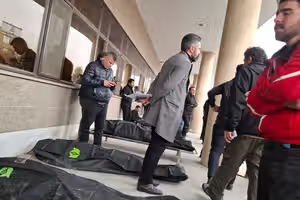
Plainclothes agents have insulted and verbally abused families collecting the bodies of protesters killed in recent unrest in Tehran and Karaj, according to information shared with Iran International.
An eyewitness said that at Kahrizak, when families arrived to identify bodies, plainclothes agents derided the dead and told relatives to “go find the bodies of Mossad mercenaries,” according to the account.
Another resident in Karaj said that at Behesht-e Sakineh cemetery, agents swore at grieving families and urged them to bury the bodies quickly, the report said.
Similar accounts of abusive treatment at Kahrizak have also circulated on social media in recent days.