Iran crackdown left 16,500 dead, 330,000 injured - Sunday Times
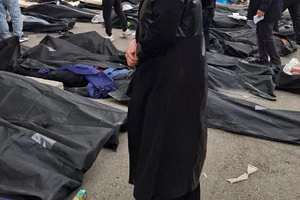
People gather at the Kahrizak facility south of Tehran to collect the bodies of loved ones killed during the protests. (January 2026)
At least 16,500 protesters have been killed and about 330,000 injured during Iran’s unrest, according to a report compiled by doctors inside the country and cited by The Sunday Times, as a near-total internet blackout has made independent verification increasingly difficult.
The report, based on information from a network of medical professionals across Iran, said the injuries included widespread gunshot wounds and severe eye trauma, with hundreds to thousands suffering permanent blindness.
Iran’s Supreme Leader Ali Khamenei acknowledged for the first time on Saturday that “several thousands” had been killed since protests began three weeks ago, blaming the violence on protesters and foreign enemies.
The doctors’ report said most deaths occurred over two days during what it described as the most violent phase of the crackdown in the Islamic Republic’s 47-year history, with most victims believed to be under 30.
Professor Amir Parasta, an Iranian-German eye surgeon and medical director of Munich MED, told The Sunday Times the data was gathered through doctors communicating via smuggled Starlink satellite terminals after internet access was cut on January 8.
“This time they are using military-grade weapons,” Parasta was quoted as saying, adding that doctors were seeing gunshot and shrapnel wounds to the head, neck and chest. He said at least 700 to 1,000 people had lost an eye.
Figures compiled from eight major eye hospitals and 16 emergency departments cited in the report put the number of injured between 330,000 and 360,000. One Tehran eye hospital, Noor Clinic, documented around 7,000 eye injuries alone, according to the report.
An ophthalmologist quoted by The Sunday Times said the volume of pellet-related eye injuries had overwhelmed hospitals. Another witness cited said more than 800 eye removals were performed in a single night in Tehran.
Medical sources said some patients died due to blood shortages, with one surgeon quoted as saying security forces had at times prevented blood transfusions.
Witnesses who spoke to The Sunday Times described security forces firing live ammunition at protesters, including shots aimed at heads, and deploying snipers on rooftops. Accounts also described the use of Kalashnikov rifles and machineguns mounted on vehicles.
•
•
The report said many wounded protesters avoided hospitals out of fear of arrest, while some injured patients were allegedly taken from operating theatres by security forces.
Several witnesses said bodies were removed from streets by security forces and transferred to other cities, while families were pressured to pay large sums to retrieve remains.
Iranian authorities have repeatedly blamed the unrest on foreign powers, including the United States and Israel. In his address, Khamenei described protesters as “foot-soldiers of the United States” and claimed they were armed with weapons imported from abroad.
The protests began in late December over economic grievances and rapidly spread nationwide, intensifying after January 8 following a call to demonstrate by Reza Pahlavi, son of Iran’s late shah.
Despite the scale of reported casualties, the full extent of the violence remains unclear due to the ongoing communications blackout, now in its tenth day, and restrictions on independent reporting.
Human rights activists and medical professionals cited in the report warned that the true toll could be higher, saying many deaths and injuries have gone unrecorded amid fear, secrecy and the continued presence of security forces across Iranian cities.
A senior Iranian diplomat based at the United Nations’ European headquarters in Geneva has left his post and applied for asylum in Switzerland, diplomatic sources told Iran International, amid mounting political unrest in Iran.
Alireza Jeyrani Hokmabad, a senior official at Iran’s permanent mission to the UN in Geneva, sought asylum together with his family after leaving his workplace, the sources said. He held the rank of counsellor and served as minister plenipotentiary, effectively the deputy head of Iran’s mission to the UN and other international organizations in Geneva.
The sources said Jeyrani decided not to return to Iran out of fear of potential repercussions linked to the ongoing political and social upheaval in the country, as well as concerns over the stability of the Islamic Republic’s governing structure.
Swiss authorities have not publicly commented on the asylum request.
Jeyrani joined Iran’s mission in Geneva in 2017 as an adviser and later rose through the ranks, representing Iran in economic bodies affiliated with the United Nations, including forums dealing with trade, development and investment.
Diplomatic sources said that growing international support for Iranian protesters, including statements by European leaders and the European Parliament, has contributed to rising anxiety among Iranian diplomats stationed in Europe.
Several Iranian diplomats have in recent weeks privately contacted authorities in European countries to explore or submit asylum requests, the sources said, speaking on condition of anonymity due to the sensitivity of the matter.
European sources said several governments are reviewing or have decided to more readily accept asylum requests from Iranian diplomats, even in cases where applicants cannot immediately demonstrate a direct threat to their lives.
Defections by Iranian diplomats during periods of domestic unrest are not unprecedented. Following the 2009 protests known as the Green Movement, several Iranian diplomats in Europe resigned and sought asylum, later citing electoral fraud and violent repression by the authorities.
Among those who defected at the time were Iran’s consul in Norway, Mohammad Reza Heydari; its chargé d’affaires in Finland, Hossein Alizadeh; the consul in Milan, Ahmad Maleki; and an embassy official in Brussels, Assadollah Farzad Farhangian.
After Tehran's deadliest crackdown on dissidents in decades and with broad domestic security mobilization and sweeping internet blackout still in place, Tehran now tries to project an image of calm.
That effort is being carried out through the handful of government-owned media outlets still permitted to operate, and increasingly through individuals granted internet access via so-called “white SIM cards,” who portray a peaceful, orderly Iran.
As of midday January 16, state television’s rolling news channel, IRINN, had aired more than two dozen times an old video showing families visiting a ski resort in Chaharmahal and Bakhtiari province near Isfahan. “People are enjoying the beautiful snowfall,” the narrator says.
Nowhere on the channel is the still-simmering nationwide discontent mentioned.
‘No tension, no police’
Other bulletins highlight news of a a “major oil contract”—not with a foreign partner, but with a group of well-connected domestic contractors authorized to sell Iranian oil on the black market using a “ghost fleet” geared toward evading US sanctions.
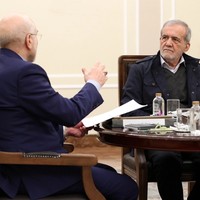
“The sooner this contract bears fruit, the sooner it will be a win-win agreement,” President Masoud Pezeshkian said of the deal in a clip posted on Telegram by the Revolutionary Guards-affiliated Fars News outlet.
On social media, one widely shared clip shows a street on the western edge of Tehran’s Grand Bazaar. Cars move quickly along empty roads, with no pedestrians and no open shops.
“There is no tension in the streets even without security forces present,” the voice in the video says.
The account does not explain why calm streets should appear unusual, though residents note that armored vehicles and machine-gun-mounted vans patrol other neighborhoods openly, especially after dark.
The clip raises another question: how the account’s administrator was able to access the internet while driving in a city that has been largely cut off from the outside world for more than 200 hours by January 16.
‘Cut Trump’s finger’
In another IRINN report, security chief Ali Larijani said he had spoken with his Swiss counterpart “about bilateral ties.”
Around the same time, international media reported that Switzerland—along with several other European countries—had summoned Iran’s ambassador to protest the violent treatment of demonstrators.
State television and state-aligned social media accounts have ignored the suspension of operations by several embassies in Tehran, including that of the United Kingdom, and more recently those of Portugal and New Zealand.
Notably, senior officials have largely disappeared from public view. Airtime has instead been given to former figures such as Mohsen Rezai, the Revolutionary Guards' first commander, who threatened to “cut off Trump’s finger if it is on the trigger” during a televised appearance.
State TV reported that President Pezeshkian thanked Russia for supporting Tehran at the United Nations during a phone call, but otherwise officials remain conspicuously absent.
It may be some time before they reappear. It may take even longer for the public to forget what they did—and failed to say—during the crackdown.
Iranians in exile say few families have been spared by the brutal crackdown back home, describing to Iran International an unprecedented wave of killings as security forces unleash violence under a nationwide communications blackout.
For Alex, an Iranian living in Texas, the violence is no longer something he is witnessing from afar.
His cousin Mehdi was killed on Friday, January 9, in the western Iranian city of Kermanshah after joining nationwide protests following exiled Crown Prince Reza Pahlavi’s call for Iranians to rise up.
Iran International is withholding Alex’s last name to protect family members inside Iran.
“The Basij shot him in the head and the stomach," Alex said, recounting what his aunt told him. "They (Basij) hunted him like a dog."
Authorities later cut internet access across much of the country, severing communication and leaving families unable to confirm who was alive or dead.
Alex only learned what had happened days later, on Wednesday afternoon, when landlines briefly reopened during the blackout. The connection was poor and repeatedly cut out, but he could hear his aunt howling in tears and screaming.
"I only got like three minutes out of the call but what I got out of it was my aunt screaming and she said he's been killed."
Mehdi was 32 years old. Alex said his aunt later identified the body at a forensic center after days of searching. He says his aunt recognized her son by his hair.
"His face was completely unrecognizable," said Alex.
He said authorities are now demanding payment from the family to release Mehdi’s body.
From Texas, Alex said he feels hollow and barely able to function, but believes speaking publicly is the only way to honor his cousin and push back against the silence imposed by the blackout.
"He wanted a free Iran and King Reza Pahlavi."
'Fear and helplessness'
In Canada, Iranian-Canadian Ghazal Shokri described a similar sense of fear and helplessness as she waits for fragile contact with her family inside Iran. She said she has heard her mother’s voice only for seconds and her sister’s for minutes since the violence escalated.
Shokri said the scale of the killings is unlike anything Iranians have experienced before, warning that nearly every family now knows someone who has been killed.
She said she is increasingly worried not only about the physical destruction of the country but about the long-term psychological toll on Iranian society, including widespread trauma, depression and lasting social damage.
“There is every family now in Iran knows a few people got killed," Ghazal said.
"Honestly, it's not easy to talk about it. I mean, as a human being, we haven't been designed for this," she said.
Another Iranian in exile, Sobhan Nofar, said the nationwide communications blackout has intensified fear among Iranians living abroad.
“That silence is terrifying,” he said.
He said the loss of contact with people inside Iran has left many Iranians outside the country sleepless and consumed by anxiety for their families, with every fragment of information feeling like evidence of a growing bloodbath.
Hediyeh, a journalist based in Washington, DC, says she is worried not only about the health of her parents and her husband's family, but also about their financial situation, as they largely relied on allowances the couple sent through friends and relatives.
With the internet shut down, it is no longer possible to send money to the family, leaving Hediyeh concerned about how the elderly parents will make ends meet under Iran’s severe economic conditions.
Iran International has reported that at least 12,000 people were killed in just two days as security forces unleashed what analysts describe as the deadliest wave of state violence in the Islamic Republic’s history. Other estimates suggest the toll may be even higher as the blackout continues to limit verification.
Growing calls for US action
The testimonies come as calls by Iranians inside the country and across the diaspora for US military action have intensified, with demands for targeted strikes against the Islamic Republic’s security and repression apparatus.
For Iranians in exile like Alex, Shokri and Nofar, the debate is no longer abstract. It is shaped by the names and faces of people they knew and by the fear that more families will soon join them in mourning.
"Every piece of news, videos or photos coming from Iran feels like another sense of a blood bath," said Nofar "I'm really scared, deeply scared but I don't allow myself to completely fall apart because I truly believe Iranian people are bigger than this terrorist regime."
As Iran remains largely cut off from the outside world, they say speaking publicly is one of the few ways left to ensure the dead are not reduced to statistics.
Iran’s supreme leader accused the US president of orchestrating unrest and committing crimes against the Iranian nation, escalating his rhetoric against Washington as authorities continue to frame recent protests as a foreign-backed plot.
Ali Khamenei in his Saturday speech blamed the United States for casualties, damage and what he described as slander against Iran, directly targeting President Donald Trump for encouraging unrest and promising support to protesters.
“We consider the US president a criminal for the casualties, damages, and the slander he inflicted on the Iranian nation,” Khamenei said. He further described the recent protests as “an American plot” and accused Washington of seeking to “devour Iran.”
Supreme leader links unrest to Washington
Trump, Khamenei said, had personally intervened, accusing him of making statements that emboldened demonstrators and pledging military backing. “Trump himself intervened in this unrest, made statements, encouraged the rioters, and said we will provide military support,” he added.
The events, he said, were planned by Americans with the aim of asserting control over Iran, repeating a long-standing narrative that external forces are behind domestic dissent. He also accused the US president of misrepresenting those involved in the unrest, saying Trump portrayed “vandals” as the Iranian nation.
At least 12,000 people have been killed in Iran in the largest killing in the country's contemporary history, much of it carried out on January 8 and 9 during an ongoing internet shutdown, according to senior government and security sources speaking to Iran International.
The killing was carried out on the direct order of Supreme Leader Ali Khamenei, with the explicit knowledge and approval of the heads of all three branches of government, and with an order for live fire issued by the Supreme National Security Council, Iran International has learned.
Warning to protesters and alleged backers
Khamenei issued a warning that extended beyond street protests to those he described as "instigators" at home and abroad.
The leader of the Islamic Republic said he does not intend to steer the country toward war but will not let "domestic criminals" go, while also acknowledging that “several thousand people” were killed during widespread protests across Iran.
“The Iranian nation, just as it broke the back of the riot, must also break the back of those who instigated it.”
Authorities and society, he added, would not relent in pursuing those blamed for the unrest. “The Iranian nation will not let go of the domestic and international criminals behind this unrest,” Khamenei said.
Public pressure for a US military strike on Iran has sharpened as President Donald Trump threatens action but holds back, leaving many Iranians torn between demanding intervention and fearing that continued delay will only extend repression and bloodshed.
Among Iranians inside the country and across the diaspora, the pause is increasingly interpreted not as restraint but as a dangerous limbo.
Calls for decisive military action are now openly framed as a necessary step to halt executions and mass violence, while hesitation is seen as compounding an already unbearable strain.
In Persian-language commentary circulating widely online, Trump’s posture is described as calculated ambiguity rather than caution.
Trump’s public gestures, including a post thanking Iran’s leadership and authorities for not executing detained protesters, are dismissed by critics as deliberate misdirection. They say the aim is to buy time while the United States strengthens its offensive and defensive military position in the Persian Gulf.
“The shadow of a Trump attack on Iran has not disappeared. He uses his intelligence for deception more than for anything else. His post thanking Khamenei and the authorities is also deceptive. He is buying time to reach a strong offensive and defensive military position in the Persian Gulf and to decide on a surprise strike at the optimal moment,” wrote a user.
For many, the conclusion is blunt: military confrontation is inevitable.
“A military attack on the clerics is inevitable. You shouldn’t get too caught up in daily noise. The same fluctuations existed before the 12-day war. The only course is to keep documenting the clerics’ crimes and to keep demanding and applying pressure on the United States and Israel for a maximal attack,” wrote another one.
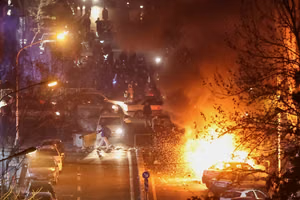
A burned-out car and bus continue to smolder in Saadatabad in northern Tehran on January 10, as crowds gather nearby during an overnight protest.
Trump remarks fuel disbelief and anger
Trump’s own comments have inflamed skepticism. "We have been told that the killing in Iran is stopping, it has stopped, it's stopping," he told reporters in the Oval Office Wednesday afternoon. "And there's no plan for executions or an execution or executions. So, I've been told that on good authority. We'll find out about it."
He also said on Friday: "Nobody convinced me, I convinced myself. You had yesterday scheduled over 800 hangings. They didn't hang anyone. They cancelled the hangings. That had a big impact."
Public reaction to Trump’s remarks was colored by memories of past crises and government narratives that later unraveled.
“Sure, Mr. Trump,” one user wrote, “they also told us they didn’t shoot down the Ukrainian plane.”
The post referenced Flight PS752, which Iranian authorities denied downing in 2020 for several days before acknowledging it was downed by Iranian missiles, hardening skepticism.
Ambiguity seen as tactic to preserve leverage
A recurring theme was Trump’s communication style. “This is Trump’s usual way,” one post read. “Maybe they called me, maybe I’ll negotiate, maybe I’ll attack, maybe I’ll attack first then negotiate. He uses this tactic to confuse his audience.”
An undated photo shows protesters march through a street in Isfahan at night as a small fire burns along their route.
Others argued the statements were designed to establish a record. “Politics is complex,” one user wrote. “He said that so if an attack happens tomorrow, the world won’t grab him asking why you struck. He can say, ‘I warned them and they didn’t listen.’”
Debate over patience, pressure and timing
Social media has also become a forum for strategic debate among Iranians about the role of time, restraint and foreign intervention. “This movement didn’t begin with hope for an American attack,” one wrote. “It shouldn’t end with despair over not getting one.”
Others emphasized endurance. “As long as people remain in the streets, we won’t lose hope,” another post said, arguing that internal pressure, not foreign strikes, would determine outcomes – even if outside action could shorten the path.
A more tactical strand of discussion focused on military logistics. Users pointed to reports of aircraft carrier movements, troop redeployments and regional preparations as signs that delay does not equal abandonment. “All these movements mean money, cost,” one post read. “Even if Trump orders it today, it takes weeks – equipment, transport, doctors, food.”
One argued that an immediate strike could trigger indiscriminate retaliation across the region – from Iraq and the Persian Gulf to Israel – and even false-flag attacks blamed on outside powers, invoking the PS752 precedent. In that view, delay allows for planning aimed at minimizing civilian casualties.
Some took a more psychological angle. “The fact that Trump hasn’t attacked yet has frayed your nerves,” one user wrote, “imagine what it’s doing to the nerves of the security forces.” The argument suggests waiting itself can function as pressure, exhausting those tasked with maintaining control.
Some also expressed relief that no strike had occurred, arguing that a rushed or limited attack could be politically symbolic rather than decisive, allowing leaders to disengage without addressing deeper risks. “Trump isn’t looking for a battle he can’t win,” one post said, suggesting preparation signals calculation rather than retreat.
Protesters gather on Afifabad Street in Shiraz on January 8, 2025 as flames rise in the background during overnight unrest.
For a society already accustomed to crisis, the waiting has become its own ordeal. Each day without action brings more frustration. As one user put it, half-joking and half-resigned, “Until news of an attack on Iran comes directly from Trump’s account, I won’t believe anything anymore.”
In the absence of certainty, Iranians continue to debate, wait and endure at one of the most sensitive moments in the country’s modern history where thousands have been killed.