Iron market traders in Tehran halt work amid rial’s fall
Iron market traders in Tehran stopped work on Sunday, closing their shops to protest worsening economic conditions and the rial’s fall.
Iron market traders in Tehran stopped work on Sunday, closing their shops to protest worsening economic conditions and the rial’s fall.


The satellites were placed into orbit from Russia’s Vostochny Cosmodrome in a multi-payload launch that Iranian officials described as the country’s seventh satellite mission carried out using Russian launch vehicles.
“These satellites were designed and manufactured by Iranian scientists, and both government bodies and the private sector have been involved,” Iran’s ambassador to Russia, Kazem Jalali, said in remarks published ahead of the launch.
“Two of the satellites belong to the government and one belongs to the private sector, and our knowledge-based companies and universities are active in this field.”
Jalali said Iran had continued to advance its space capabilities despite international pressure. “Despite all the threats and sanctions that exist, we have something to say in this field.”
Iran’s space agency chief, Hassan Salarieh, said the launch reflected what he described as Iran’s standing among a small group of countries with end-to-end space capabilities.
“Iran is among 10 or 11 countries in the world that simultaneously possess the capability to design and build satellites, launch vehicles and the infrastructure for launching, receiving data and processing images,” he said.
Salarieh said Iran aimed to expand both the number and precision of its satellites. “What is necessary for us is increasing the number of satellites, improving their accuracy and quality, and developing different classes of satellites,” he said.
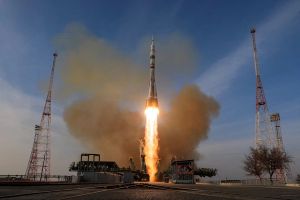
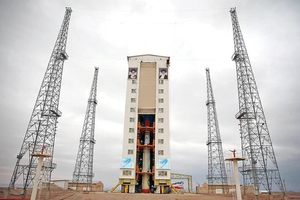
Iranian media identified the satellites as Paya, also known as Tolou-3, Zafar-2, and a prototype satellite called Kowsar-1.5. The spacecraft were launched alongside a large cluster of mainly Russian satellites into a sun-synchronous low Earth orbit.
Paya (Tolou-3), built by the Iranian Space Agency, is Iran’s heaviest Earth-observation satellite to date, weighing about 150 kilograms.
Iranian officials say it is capable of producing black-and-white images with a resolution of about five meters and color images with a resolution of around 10 meters, and is intended for applications including agriculture, water management, environmental monitoring and disaster assessment.
Zafar-2, developed by Iran University of Science and Technology, is also an Earth-observation satellite designed for mapping, environmental monitoring and tracking natural hazards.
Kowsar-1.5 combines imaging and internet-of-things capabilities and is aimed primarily at agricultural and farm-monitoring uses, Iranian officials say.
Jalali described Iran’s space cooperation with Russia as extensive and said Moscow’s experience had played a key role.
“Russia is advanced in the space field, including satellites, launch vehicles and satellite launches, and we have been able to transfer part of the technology and work together,” he said.
He also described the Soyuz rocket as highly reliable. “Before Russia’s relations with the West deteriorated, many Western satellites were launched using Soyuz,” Jalali said.
The launch also carried Russian Earth-observation satellites, internet-of-things platforms and university-built spacecraft, according to launch data, as well as satellites from partner countries including Belarus, Kuwait and Montenegro.
Iran says its space program is civilian and focused on scientific and economic goals, but Western governments argue that satellite launch technology overlaps with systems used to develop intercontinental ballistic missiles.

Hadi Kiadaliri, vice president of Iran’s Forestry Association, said studies show the country now holds the global record for soil erosion, a problem he attributed to unsustainable land use, water-intensive agriculture and weak integration of environmental limits into economic planning.
“Based on the results of one study, restoring soil fertility in the Zagros would require allocating 50% of annual oil income,” Kiadaliri told ISNA news agency, calling the cost a measure of how deeply natural capital has been depleted.
The Zagros range stretches across western Iran and underpins large parts of the country’s water cycle, biodiversity and rural livelihoods. Environmental experts have long warned that erosion, deforestation and overgrazing in the region threaten food security and increase flood and drought risks.
Kiadaliri said Iran’s development path had relied heavily on expanding agriculture despite the fact that about 93% of the country is classified as arid or semi-arid.
Between 2004 and 2020, he said, farmland expanded by around 3.6 million hectares, largely at the expense of forests and rangelands – an average loss of about 500 hectares of natural land per day.
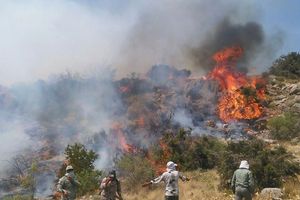
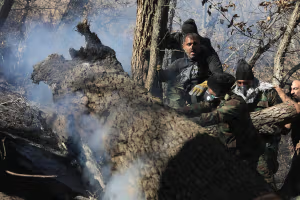
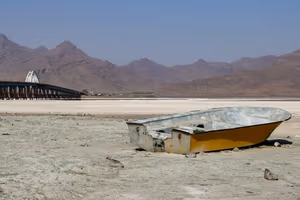
Water resources have also been overexploited to sustain agricultural output, he said, arguing that food security had been narrowly defined as supply rather than resilience. “Environmental resilience is part of food security,” Kiadaliri said, adding that ignoring it has undermined long-term productivity.
He said international experience shows that environmental protection and economic development are not mutually exclusive, pointing out that no highly developed country has achieved sustained growth while degrading its natural environment.
Iranian officials have increasingly acknowledged environmental stress as climate change, drought and land degradation intensify.
The Department of Environment has recently pushed to formally value ecosystem services – such as water regulation, soil protection and carbon storage – a step Kiadaliri said could make environmentally damaging projects economically unviable once their true costs are accounted for.
“If ecosystem services are properly valued, many projects will no longer make financial sense,” he said, arguing that such accounting could curb further environmental damage.
Environmental groups say without structural changes in land management, water use and development planning, Iran’s soil erosion will continue to accelerate, raising long-term economic and social costs far beyond the immediate price of restoration.

The group, known as Handala, said in a post on the social media platform X that it had hacked an iPhone belonging to Braverman and would release documents later in the day related to what it called “Bibi Gate,” an apparent reference to allegations surrounding Netanyahu’s inner circle.
Israel’s Prime Minister’s Office said no breach had been identified. “No breach has been found. The issue is being investigated,” it said in a statement.
Handala has previously claimed responsibility for cyber intrusions targeting Israeli figures and institutions.
Earlier in December, the group said it had accessed data from the phone of former prime minister Naftali Bennett, though Bennett later said his device itself had not been hacked and that unauthorized access had instead been gained to his Telegram account.
On Sunday, the group released what it described as initial files allegedly taken from Braverman’s phone, including lists of phone numbers it said belonged to senior Israeli officials and individuals close to Netanyahu, as well as documents and videos that appeared to relate to official government matters.
In its posts, the group alleged it possessed encrypted communications, financial records and other sensitive information. It did not provide evidence supporting those claims. Iran International could not independently verify the authenticity of the material.
The alleged threat comes amid heightened political tensions in Israel over investigations known collectively as the “Qatargate” affair, in which two advisers to Netanyahu are accused of having worked for Qatar while employed in the prime minister’s office. Netanyahu and his aides have denied wrongdoing.
One of the advisers, Eli Feldstein, has separately admitted leaking classified information to Germany’s Bild newspaper, according to Israeli media, in a case Israeli authorities say is under investigation. Feldstein has alleged that Braverman was aware of an internal military probe into the leak, an accusation Braverman has denied.
Braverman, who has been named as Israel’s next ambassador to Britain, has rejected any link to the scandals.
Cybersecurity researchers and Western officials have widely described Handala as being tied to Iran’s Ministry of Intelligence, though Tehran has not publicly acknowledged any connection.
The group is believed to be part of a broader cyber operation that researchers link to a unit known as “Banished Kitten,” which has been associated with attacks on Israeli infrastructure, public institutions and media organizations.
Handala has also been linked by researchers to cyber operations targeting Iran International, a London-based Persian-language broadcaster critical of the Iranian government.