Hadi Kiadaliri, vice president of Iran’s Forestry Association, said studies show the country now holds the global record for soil erosion, a problem he attributed to unsustainable land use, water-intensive agriculture and weak integration of environmental limits into economic planning.
“Based on the results of one study, restoring soil fertility in the Zagros would require allocating 50% of annual oil income,” Kiadaliri told ISNA news agency, calling the cost a measure of how deeply natural capital has been depleted.
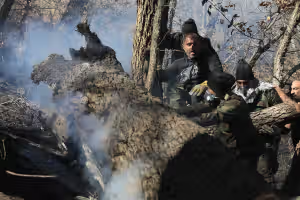
The Zagros range stretches across western Iran and underpins large parts of the country’s water cycle, biodiversity and rural livelihoods. Environmental experts have long warned that erosion, deforestation and overgrazing in the region threaten food security and increase flood and drought risks.
Kiadaliri said Iran’s development path had relied heavily on expanding agriculture despite the fact that about 93% of the country is classified as arid or semi-arid.
Between 2004 and 2020, he said, farmland expanded by around 3.6 million hectares, largely at the expense of forests and rangelands – an average loss of about 500 hectares of natural land per day.
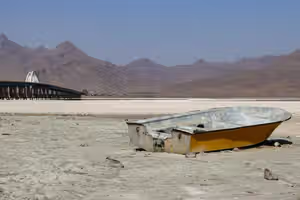
Water resources have also been overexploited to sustain agricultural output, he said, arguing that food security had been narrowly defined as supply rather than resilience. “Environmental resilience is part of food security,” Kiadaliri said, adding that ignoring it has undermined long-term productivity.
He said international experience shows that environmental protection and economic development are not mutually exclusive, pointing out that no highly developed country has achieved sustained growth while degrading its natural environment.
Iranian officials have increasingly acknowledged environmental stress as climate change, drought and land degradation intensify.
The Department of Environment has recently pushed to formally value ecosystem services – such as water regulation, soil protection and carbon storage – a step Kiadaliri said could make environmentally damaging projects economically unviable once their true costs are accounted for.
“If ecosystem services are properly valued, many projects will no longer make financial sense,” he said, arguing that such accounting could curb further environmental damage.
Environmental groups say without structural changes in land management, water use and development planning, Iran’s soil erosion will continue to accelerate, raising long-term economic and social costs far beyond the immediate price of restoration.