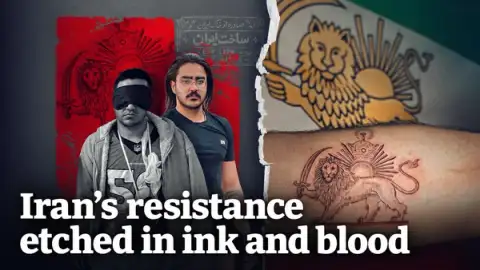
There is a cruel ritual in Iranian opposition politics: some voices abroad constantly interrogate the “purity” of activists inside—why they did not speak more sharply or endorse maximalist slogans, why survival itself looks insufficiently heroic.
What followed the recent detention of several dissidents, including Iranian Nobel Peace laureate Narges Mohammadi, illustrates the phenomenon starkly.
The detention itself was hardly surprising. It was entirely predictable that security forces would crack down on a gathering commemorating a human rights lawyer whose death many suspect was not natural.
What was revealing came afterward.
As debate swirled online over who chanted what at the memorial and which mobile footage proved what—arguments of limited consequence—it gave way to a far uglier spectacle.
A collage circulated featuring more than thirty activists, many of them former political prisoners, some previously tortured, a few still incarcerated. It questioned their credibility, belittled their records, and even deployed openly sexist insults.
Moral inversion
Ironically, the campaign appeared to be driven not by Tehran’s cyber army but by other dissidents—some quite prominent—residing in Europe and the United States. The charge was not collaboration or recantation, but something vaguer and more corrosive: that those targeted were not “radical” enough by the accusers’ measure.
This was not a disagreement over tactics or language. It was a moral inversion. Those who have endured interrogation rooms and solitary confinement were placed on trial by people whose politics have never required them to bear comparable risk.
I was briefly arrested and mistreated in Iran during the widespread protests of 2022—the Woman, Life, Freedom movement that propelled many of these purity police to their current position of influence.
That experience—minor compared with what many others have endured—has nonetheless made political participation more cautious and more difficult, and deepened my appreciation for those who continue to act, speak, and organize inside the country.
Accountability or cruelty?
History offers a familiar rhyme.
During the French Revolution, émigrés who fled abroad did more than oppose events unfolding inside France. From safety, they radicalized the standard of legitimacy itself, denouncing those who remained as insufficiently pure or insufficiently committed.
Distance hardened conviction into absolutism. Survival became evidence of betrayal and bitterness replaced solidarity.
The Iranian version is not identical, but the structure is unmistakable: exile politics rewards clarity, certainty, and denunciation; politics inside the country requires endurance and is shaped by action rather than words.
When the former judges the latter by its own risk-free standards, the result is not accountability but cruelty.
What may be particular to Iranians today is not the instinct to judge from exile, but the speed and savagery with which survival inside the country is treated as a moral flaw. Social media collapses context, erases risk, and turns the language of people still within reach of the state into a referendum on their character.
When even figures whose resistance is beyond dispute are subjected to this logic, the problem is no longer ideological disagreement. It is systemic.
If prison is no longer proof of commitment, if torture earns no moral credit, and if survival itself is suspect, then the line between oppressor and accuser begins to blur.
A politics that demands ever harsher words from those still within reach of the state is not radical. It is parasitic—feeding on risks others are forced to take.
Our grievance with Iran’s theocratic rule is not only repression, but exclusion: the insistence that there is only one legitimate way to think, live, and speak.
The struggle against the Islamic Republic has always been about replacing that narrowness with something more tolerant and plural—something that allows for disagreement, variety, and a fuller expression of life.
Reproducing a different kind of monotone politics, one that polices language and delegitimizes difference, risks undermining that very aspiration.