Iran set to orbit three satellites in joint launch from Russia
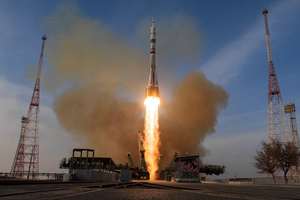
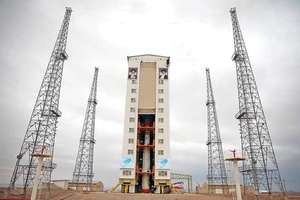
A Russian Soyuz rocket lifts off from a space launch facility.
Iran is set to place three domestically built satellites into low Earth orbit on Sunday in a multi-payload launch from Russia, marking another step in Tehran’s expanding space program, which Western governments say relies on technologies applicable to long-range missiles.
Iranian media said the satellites would be launched at 1648 local time (1318 GMT) aboard a Russian Soyuz rocket from the Vostochny Cosmodrome in Russia’s far east. The payload includes Paya, also known as Tolou-3, Zafar-2 and a prototype satellite known as Kowsar-1.5.
Paya (Tolou-3) is Iran’s heaviest Earth-observation satellite to date, weighing about 150 kg, with imaging resolution of around five meters for black-and-white images and about 10 meters for color imagery, Iranian officials have said.
The satellite, made by the Iranian Space Agency, is designed for applications including agriculture monitoring, water resource management, environmental monitoring and disaster assessment.
Zafar-2, developed by Iran University of Science and Technology, is also an Earth-observation satellite intended for mapping, environmental monitoring and tracking natural hazards.
The Kowsar-1.5 satellite is a combined platform integrating imaging and internet-of-things capabilities, aimed primarily at smart agriculture and farm monitoring.
The Iranian satellites will be launched alongside a large cluster of mainly Russian spacecraft into a sun-synchronous low Earth orbit.
According to launch data, the mission also includes Russian Earth-observation satellites such as Aist-2T and Zorkiy-2M units, multiple Marafon and SITRO satellites designed for internet-of-things and ship-tracking services, as well as university-built and technology demonstration satellites from Russia and partner countries including Belarus, Kuwait and Montenegro.
•
•
Iran says its space activities are civilian and focused on scientific and economic uses, though Western governments argue that satellite launch technologies overlap with those used for long-range ballistic missiles.
Iran has increasingly relied on Russian launch services in recent years, even as it develops domestic launch sites and heavier rockets.
Iran’s foreign ministry spokesperson accused Israel of drawing on a history of covert “false flag” operations to shape international narratives, implicitly suggesting that a recent attack in Sydney may have been linked to Israeli actions without making the allegation explicit.
Baghaei cited the Lavon Affair, which took place in Egypt in 1954, as an example. “The Zionist regime, exploiting Egyptian Jews, carried out a series of bombings and sabotage operations against non-civilian targets linked to the United States and Britain in Alexandria and Cairo, including libraries and post offices. This is a very clear case of a false-flag operation,” he said.
Without directly mentioning last week’s shooting in Australia, he added that “these actions are entirely precedented. The most effective way to counter such behavior is to expose it and inform public opinion about the conduct and crimes of the Zionist regime, which spares no inhumane means to advance its objectives.”
Earlier this month, a mass shooting at a Hanukkah gathering at Bondi Beach in Sydney killed 15 people, including a child. Australian police and intelligence agencies said the attack was linked to Islamic State, and authorities and world leaders said it was motivated by antisemitism.
Following the attack, some Israeli officials and media outlets raised the possibility of Iran’s involvement in the attack, saying the matter was under review. Israel Hayom reported, citing an Israeli official, that in recent months Iran’s activities to target Israeli and Jewish interests worldwide had increased.
Iranian officials and state-linked media, meanwhile, rejected accusations of structural antisemitism or plots to attack Jewish targets, instead seeking to cast Israel as responsible for the Sydney incident.
Ebrahim Azizi, head of parliament’s national security and foreign policy committee, said last week that what he called Israeli officials’ “hasty” remarks about the attack could point to their own role, while lawmaker Esmail Kowsari said: “Enemies have always tried, by hiring agents, to pin responsibility for their actions on the Islamic Republic and the IRGC.”
Separately, a senior Iranian military commander accused Israel on Sunday of carrying out killings abroad for its own political ends.
“The Zionist regime has resorted to self-harm and, in an effort to prevent reverse migration and escape internal turmoil, is assassinating members of the Jewish community and individuals linked to it in other countries,” said Abdolrahim Mousavi, chief of the General Staff of the Armed Forces of the Islamic Republic.
“Israel is playing the victim. This is not the first time; they have repeatedly committed such crimes,” he added.
Mousavi or other Iranian officials provided no evidence for the allegation.
In August, Australia accused Iran of involvement in two antisemitic arson attacks and ordered its ambassador to leave the country within seven days.
No access to Qatar-held funds
Turning to Iran’s frozen assets held in Qatar, Baghaei said Tehran still does not have effective access to billions of dollars transferred under a US-mediated prisoner swap arrangement.
“This issue is one of hundreds of examples of the United States’ failure to honor its commitments. Under the understanding that had been reached, assets belonging to the Iranian people were supposed to be made accessible to the government of the Islamic Republic of Iran. Unfortunately, the American side did not fulfil its obligations, and this breach of commitment continues to this day.”
The funds, previously blocked in South Korean banks after US sanctions in 2018 and later transferred to Qatari banks under a 2023 agreement, remain inaccessible despite assurances they could be used under defined conditions, he said.
Iran has previously said it gained access to funds released from South Korea and transferred to Qatar, following an agreement mediated by Washington.
The $6 billion in Iranian funds was released under a US sanctions waiver as part of a prisoner exchange deal that saw Iran agree to free five Americans, while five Iranians detained in the United States were also released.
US officials said the money, transferred from South Korea to Qatar, could be used only for tightly monitored humanitarian purposes and was not directly accessible to Tehran.
Responding to a question about Israeli and US media reports suggesting Prime Minister Benjamin Netanyahu may urge US president Donald Trump to back renewed military action against Iran over its ballistic missile program, Baghaei said Iran’s missile program was purely defensive and not open to negotiation.
“Iran’s missile program has been developed solely for the defense of the country and is fundamentally not a matter for negotiation,” he said.
Iran's Foreign Ministry Spokesman Esmail Baghaei
“The media hype is also part of a hybrid war that the Zionist regime, with the help of the United States and affiliated media networks, has long designed and pursued against the Islamic Republic of Iran... The armed forces of the Islamic Republic of Iran know well how to defend the country if necessary.”
Baghaei also rejected comments by the Council of Europe that Iran has provided military assistance to Russia in the Ukraine war, calling the comments repetitive.
“From the very beginning of the conflict, we have said disputes must be resolved through dialogue, and that we have had no involvement in this war,” he said, adding that maintaining relations with Russia did not amount to military intervention.
“European countries should genuinely focus on their own responsibilities and act on them, instead of repeatedly levelling accusations against others. European parties need to look at their own track record and examine why the Ukraine conflict emerged in the first place.”
Western governments say Tehran has provided Moscow with Shahed-series drones, which Russia has used extensively to strike Ukrainian infrastructure, particularly energy facilities and urban areas.
Iran has denied direct involvement in the war but has acknowledged supplying drones to Russia before the conflict, a remark disputed by Kyiv and its allies, who say cooperation has expanded since the invasion.
PJAK and regional security
Asked about remarks by Turkey’s defense minister suggesting the Kurdish armed group PJAK had prepared to act against Iran during Tehran's June conflict with Israel, Baghaei said he could not comment officially but described the broader context as indicative of coordinated pressure.
“One point is entirely clear: Israel and the United States had designed a very comprehensive plan to strike at the foundations of Iran,” he said, adding that Iran resisted efforts to undermine its territorial integrity.
Israel told the United States that the recent Iranian missile drills may conceal preparations for a potential strike, Axios said on Sunday, one day after Iran International reported unusual Iranian air activity spotted by Western intelligence agencies.
Israeli Chief of Staff Eyal Zamir raised the issue directly with Brad Cooper, head of US Central Command, warning that recent missile movements could serve as a cover for a surprise operation against the Jewish state.
The warning follows Iran International's report on Saturday which said Western intelligence agencies had identified unusual movements involving the Revolutionary Guard's Aerospace Force, including activity by missile, drone, and air-defence units beyond established patterns.
The developments could be linked to military exercises, Western officials with knowledge of the matter told Iran International but added that the scale and synchronization had drawn closer scrutiny.
Axios reported that Israeli intelligence assessed the movements as taking place within Iran’s borders but said Israel’s military risk tolerance has dropped significantly since Hamas’s surprise attack in October 2023.
"The chances for an Iranian attack are less than 50%, but nobody is willing to take the risk and just say it is only an exercise," the report said citing an Israeli source.
An American source, however, told Axios that the US intelligence currently sees no indication of an imminent Iranian attack.
In his conversation with the CENTCOM chief, Zamir urged closer coordination between Israeli and US forces on defensive preparations.
The phone call was followed by Cooper's visit to Tel Aviv on Sunday, where he met Zamir and top Israeli military officials to discuss the situation.
In June, Israel carried out airstrikes and covert operations against Iranian military and nuclear sites, killing more than 1,000 people including senior officials and nuclear scientists.
Iran retaliated by launching hundreds of missiles and drones at Israel, killing at least 33 people, among them an off-duty soldier.
The United States helped Israel intercept Iranian attacks and later joined the Israeli campaign, bombing three Iranian nuclear facilities on June 22.
Axios said that Israeli intelligence and the Mossad do not believe Iran’s current pace of rebuilding missile capabilities creates an immediate need for military action in the next two to three months, but warned the issue could become more urgent later next year.
Meanwhile, NBC News reported that Israeli officials plan to brief President Donald Trump at the end of the month on options for potential future strikes against Iran, amid concerns that Tehran is rebuilding ballistic missile production facilities and repairing air defenses damaged during the June conflict.
Israel is thinking about regime change in Iran as an option to avoid repeated rounds of conflict, former Israeli consul in Los Angeles said on Sunday.
“Israel is thinking about the regime change in Iran, because otherwise we’ll have to go to a round after round after round,” Yaki Dayan said on Israel’s i24NEWS The Rundown program.
Dayan said Israeli Prime Minister Benjamin Netanyahu will have to do significant convincing when he meets Trump later this month at Mar-a-Lago, particularly on backing further Israeli action against Iran.
"Netanyahu will have a lot of convincing here to do with Trump, not necessarily joining forces in another attack, but going to another attack and getting the defense capabilities from the Americans," he said.
Dayan said Trump is “much more in the peacemaking mode than attacking mode” on Iran and views the nuclear program as a more immediate threat than Iran’s ballistic missile program, which he said Tehran is currently prioritizing.
Dayan's remarks come as Israel Defense Forces’ (IDF) Chief of Staff Lt. Gen. Eyal Zamir said the force will strike its enemies “wherever required, on near and distant fronts alike,” in comments that appeared to allude to the possibility of further action against Iran.
Zamir said Iran had built what he described as a “ring of strangulation” around Israel, a reference to Tehran-backed groups operating across multiple fronts, and warned that the military was prepared to act both close to home and farther afield.
Senator Lindsey Graham on Sunday said the United States should strike Iran again if there is credible evidence that Tehran is rebuilding its nuclear enrichment program or expanding its ballistic missile capabilities following the June strikes.
Speaking to reporters in Tel Aviv, Graham said US and Israeli attacks had destroyed Iran’s nuclear facilities but had not changed the intentions of Iran’s leadership.
“We obliterated the Iranian nuclear facilities. We did not obliterate Iran’s desire to have a nuclear weapon,” he said.
“The regime hasn’t changed at all. They still want to kill all the Jews, consider America the great Satan, and purify Islam,” Graham added.
Graham said there were signs Iran could be attempting to regenerate its capabilities. “Are they regenerating their nuclear capability? Are they building more ballistic missiles that could hurt Europe and Israel? I don’t know, but there’s evidence that, yes, they are,” he said.
He said Washington should act before Iran is able to restore those capabilities.
“If there’s credible evidence that Iran is going back into the enrichment business at other sites, that they’re trying to build more ballistic missiles to terrorize Israel and maybe Europe, that we hit them before they can do that,” Graham said.
In an interview with NBC News on the same day, Graham took a more cautious tone when asked whether additional US strikes against Iran were necessary, saying he would defer to discussions between Israeli officials and President Donald Trump. “I’m going to let the Israelis talk to President Trump about it,” he said.
Graham’s remarks come a day after NBC News reported, citing Israeli officials, that Israel was preparing to brief President Donald Trump on options for possible new military strikes on Iran, amid concerns that Tehran is expanding its ballistic missile program.
The report said Israeli officials believe Iran is rebuilding facilities linked to ballistic missile production and repairing air defenses damaged in June strikes, which they view as more urgent than nuclear enrichment efforts.
Earlier this year, US airstrikes targeted three key Iranian nuclear sites at Fordow, Natanz, and Isfahan, following an Israeli air campaign that began on June 13 against Iranian military and nuclear-related sites.
Iran denies seeking nuclear weapons and has called the attacks illegal.
The United States has demanded Iran renounce domestic uranium enrichment while Tehran maintains its nuclear program is an international right.
Iran’s Supreme Leader has reshuffled senior army commanders overseeing air power and air defense, signaling a shift toward lower-profile, operational figures after wartime losses and rising fears of renewed conflict.
In a series of decrees issued by Ali Khamenei, Iran’s Supreme Leader and commander-in-chief of the armed forces, new commanders have been appointed to sensitive posts within the regular army, particularly in the air force and air defense structures.
These developments are unfolding against a backdrop of mounting economic pressure and widespread anxiety over the prospect of another war – concerns that analysts say have contributed to the sharp recent decline in Iran’s currency.
New commanders
Earlier this week, Khamenei appointed Brigadier General Bahman Behmard as the new commander of the Army Air Force, replacing Brigadier General Hamid Vahedi.
Behmard had served since 2023 as acting deputy chief of operations of the Armed Forces General Staff and effectively assumed that role after Major General Mehdi Rabbani, the former deputy chief of operations, was killed during Israel’s attacks.
Despite his senior operational experience, Behmard has remained a relatively low-profile figure within Iran’s military establishment, with little media exposure compared to some of his predecessors.
His appointment appears to signal a preference for technical and operational credentials over public visibility at a sensitive time for Iran’s air capabilities.
At the same time, Brigadier General Alireza Elhami was appointed as commander of the Khatam al-Anbiya Joint Air Defense HQ as well as the Army’s air defense force.
Elhami previously commanded the Khatam al-Anbiya Air Defense University and is similarly regarded as a little-known figure outside military circles, with most of his career spent in training and operational planning roles rather than public-facing positions.
The Khatam Al-Anbiya Joint Air Defense HQ is responsible for coordinating Iran’s air defense across military branches. It should not be confused with the Central Khatam al-Anbiya HQ, a key pillar of the Armed Forces General Staff tasked with coordinating all military forces during major crises, including wartime.
The two commanders replaced in these posts have been reassigned to roles widely viewed as advisory or ceremonial.
Vahedi was appointed air affairs adviser to the Army commander-in-chief.
Meanwhile, Brigadier General Sabahifard, commander of Army Air Defense since 2019, and Khatam Al-Anbia Joint Air Defense HQ commander since February 2025, was named assistant to the army commander-in-chief for air defense affairs.
The leadership reshuffles extend beyond air power. In November, Army Ground Forces commander Brigadier General Kioumars Heydari was removed and replaced by Brigadier General Ali Jahanshahi, formerly deputy head of evaluation at the Central Khatam al-Anbiya HQ.
Heydari was appointed as acting commander of Khatam Al-Anbia Central HQ a few days later, a significantly more senior post.
That Central HQ has itself seen dramatic changes. IRGC Major General Ali Abdollahi was appointed commander in September after Major General Gholam-Ali Rashid and his successor Major General Ali Shadmani were both killed during Israel's attacks.
Abdollahi’s appointment was not publicly announced until early that month.
Lack of media commentary
Despite the scale of these shifts, Iranian media have offered little to no comment or analysis, largely limiting coverage to headlines that describe the moves as “important changes.”
One notable exception was the news site Khabar Online, which argued that Elhami’s appointment reflected “the army’s policy of relying on in-house commanders with long-term specialized experience,” highlighting his background in both training and operational planning. The outlet also emphasized his “low-profile” career path.
That emphasis may allude to the controversy surrounding an unverified claim during the 12-day war that Iranian air defenses had shot down an Israeli F-35 fighter jet.
The claim, widely circulated by state media including IRIB, was never substantiated. IRIB head Peyman Jebelli acknowledged earlier in December that broadcasting the false report had harmed the organization’s credibility, adding that military officials had provided the information.
Sabahifard, who was air defense commander at the time, had frequently appeared in the media before the war, publicly asserting Iran’s ability to counter advanced aircraft such as the F-35. In one of his final public remarks in late October, he described Israeli damage to Iranian equipment as “natural” and claimed rapid restoration of both hardware and manpower.