Europe has enough grounds to restore UN sanctions on Iran, top senator says
"The IAEA has again confirmed that Iran continues to move ahead with uranium enrichment, which has reached dangerous levels. This is only the latest in a series of violations to Iran’s nuclear obligations," Senate Foreign Relations Committee Chairman Jim Risch said in a post on X on Tuesday.
"I continue to support President Trump’s maximum pressure campaign against the Iranian regime, as well as his efforts to negotiate with them toward an outcome that will put an end to their enrichment for good," the top senator added.
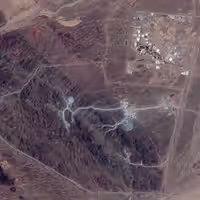
An exiled opposition group on Tuesday accused Tehran of operating a covert nuclear weapons program in the Semnan desert, an assertion that has not been independently verified.
The National Council of Resistance of Iran (NCRI) said the desert zone, now designated a restricted military area, hosts the core of what it called the Kavir Plan—a successor to the earlier Amad project.
The United States accused Iran of seeking a nuclear weapon as part of the shadowy Amad Project scrapped before 2004, an effort Washington says was overseen by Iran’s Organization of Defensive Innovation and Research (SPND).
“Development, testing and nuclear weapons activities (are) hidden deep in the desert, under intense security measures,” the group’s spokesperson said at a press conference in Washington DC.
The announcement came as Tehran and Washington are negotiating over Iran's nuclear program to reach a deal to curb the program in return for the lifting of sanctions.
Washington has assessed that Iran is not building nuclear weapons and its Supreme Leader has not approved them but recent discourse in Tehran urging the acquisition a bomb is emboldening advocates for such a move.
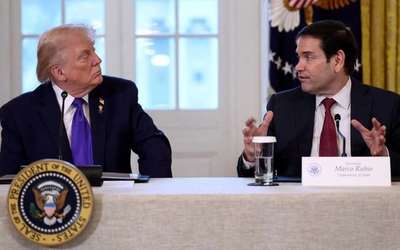
US President Donald Trump on Tuesday said Iranian negotiators have become “much more aggressive” in recent weeks, confirming nonetheless that the sixth round of talks would take place this week.
Kavir Plan
NCRI’s leading faction, the Mojahedin-e-Khalq (MeK), said it had obtained new evidence from inside Iran.
MeK spokesperson Alireza Jafarzadeh said the Kavir Plan involves at least six sites in Semnan province—Shahrud, Eyvanaki, Semnan, Sanjarian, Sorkheh Hesar and Parchin site in coordination with the SPND headquarters in Tehran—all directed by the Ministry of Defense and Revolutionary Guards.
“The Kavir Plan is not just a replacement for the Amad Plan, but it’s a more advanced, more sophisticated and more secure plan than the original one,” Jafarzadeh said.
According to NCRI, SPND serves as the coordinating body for Kavir activities. SPND was named in a 2011 IAEA report and sanctioned by the US in 2014 for proliferation efforts.
Jafarzadeh said over 400 nuclear specialists have been transferred from Iran’s Atomic Energy Organization to SPND operations under the Defense Ministry.
Among the sites, Shahrud was identified as a launch complex for Ghiam-100 solid-fuel missiles, allegedly disguised as a satellite facility. Sanjarian focused on explosive bridge wire (EBW) detonators—components critical for weaponizing a bomb, the opposition group added.
Iran has repeatedly denied pursuing nuclear weapons, dismissing MeK reports as fabrications.
"Building nuclear warheads"
The NCRI maintains that the Kavir Plan mirrors the Amad Plan’s goals—specifically, building five nuclear warheads designed for Shahab-3 missiles.
In 2002, the NCRI revealed for the first time a uranium enrichment facility at Natanz and a heavy water plant at Arak. In 2003, the group also disclosed the Lavizan-Shian Technological Research Center in northeastern Tehran as an undeclared nuclear site.
The Lavizan-Shian site was cited again in the UN nuclear watchdog’s May 2025 report for noncompliance and the presence of undeclared nuclear material.
Shayan Samiee, a national security expert, said the new report would heighten political pressure.
“I doubt that the intelligence and security apparatus of the US and Europe had no clue about this information. Surely they did,” he told Iran International TV.
“This report will put pressure on the House and Senate to push President Trump to either shut down negotiations with Iran or adopt a tougher stance.”
On Monday, Iran’s Supreme National Security Council said it had acquired sensitive documents linked to Israel’s nuclear program.
Tehran warned it will use those files to hit Israel’s clandestine nuclear facilities if the Jewish state attacks Iran.
The arrest of a top cleric’s family members has done little to convince many Iranians that the judiciary’s anti-corruption drive is more than symbolic, despite praise from conservatives and some reformists.
The IRGC-affiliated Fars News Agency reported Sunday that the Revolutionary Guard’s Intelligence Organization had detained two sons of Tehran’s Friday imam, Kazem Sedighi, two weeks earlier.
The report said they were arrested on charges of misconduct and collusion, without further details. On Monday, the outlet issued a correction, saying the detainees were Sedighi’s son and daughter-in-law.
Sedighi responded soon after, saying he would submit to the law if wrongdoing were proven.
Appointed by Supreme Leader Ali Khamenei in 2009, Sedighi previously chaired the Supreme Disciplinary Court for Judges.
He now heads a state body promoting behavior deemed Islamic—the Committee for the Promotion of Virtue and the Prevention of Vice—which includes Iran’s police chief and the ministers of intelligence and interior.
Serious or symbolic?
While some conservatives argue the arrests show corruption is being addressed, many others see them as symbolic.
"Some actions have been taken against corruption, but don’t talk about 'decisive measures'—because the people have not seen any truly decisive action in the fight against economic corruption so far," a popular comment on the conservative Alef website read.
“Even in systemic corruption, some cases are (occasionally) dealt with on a case-by-case, symbolic basis,” reformist journalist and politician Mohammad Sahafi posted on X.
The post echoed a widely held belief that crackdowns lack seriousness.
“(This was) a kind of belated, superficial surgical removal of the countless tumors of corruption within the circle of power,” psychoanalyst Mohammad Reza Ebrahimi wrote on X.
Chief judge wins praise
Since his 2021 appointment, judiciary head Gholam-Hossein Mohseni-Ejei has made anti-corruption central to his image.
Conservatives framed the move as a sign of resolve and an attempt to restore public trust.
Hardliner lawmaker Mojtaba Zarei thanked Mohseni-Ejei on X for “revitalizing the judicial system to combat corruption.”
“The fight against corruption is not a stage for theatrical exposés; the judicial system of the Islamic Republic of Iran is itself at the forefront of the battle against corruption,” he wrote.
Former reformist vice president Mohammad-Ali Abtahi echoed the praise:“Mr. Ejei’s transparency, integrity, persistence, and courage can promote a model of worthy governance.”
“The head of the judiciary, by the nature of his job, is generally not expected to be respected and trusted—but Ejei is. He deserves praise for his impartial fight against the corruption of officials and their relatives,” he added.
Calls for Sedighi to step down
Unlike Ejei, Sedighi faces mounting pressure over the revelations, with many conservatives and some ultra-hardliners urging him to resign.
“Resign from all responsibilities and seek forgiveness for the rest of your life; perhaps you can save your hereafter,” conservative journalist Ahmadreza Danesh posted on X.
Sedighi claimed his signature had been forged. After this proved false, he apologized to Khamenei and the Iranian people in a Friday sermon, calling it negligence.
He was neither prosecuted nor formally investigated.
“Resign unconditionally now if you believe in even a fraction of what you have preached,” conservative politician Seyed Ali Hashemi wrote on X.
“Not because of proven guilt, but out of respect for the people, to preserve the clergy’s reputation, and to prevent the collapse of social trust,” he added.
US State Department Spokeswoman Tammy Bruce, asked on Tuesday whether the expiry of a two-month deadline for US-Iran talks meant they had failed, told reporters the talks were making some progress.
"The President makes that determination ... the funny thing about negotiations and discussions is that things happen and that there are conversations and progress is sometimes made, not tremendous progress, but enough to keep going."
"It is a dynamic, as it would be with any diplomatic consideration, that negotiations are meant to move things forward," she added. "And the good news is, is that, in fact, it would appear that things are moving forward, and that's what we all want."
The next round of talks were due to take place soon, she said, declining to specify a date.
The top US military commander in the Middle East told Congress on Tuesday that Iranian weakness offers Washington a historic opportunity to advance its interests but a vulnerable Tehran may seek deterrence in nuclear weapons.
"We can seize the initiative to optimize our posture to defend the Homeland, strengthen our economic outlook, take back our right to freedom of navigation, and sustain the upper hand against an increasingly desperate Iran," US Central Command (CENTCOM) chief Army General Michael Kurilla said.
"Iranian leadership understands their acute vulnerability, and the precision of Israel’s response demonstrates that Iran will remain critically exposed to future Israeli operations, even if their former defenses are reconstituted," Kurilla said in a statement to the US House Armed Services Committee.
As the sixth round of nuclear talks approaches and earlier hopes of a breakthrough fade, some in Tehran are quietly promoting a limited interim agreement to defuse tensions and avert a deeper crisis.
Former diplomat Ramin Mehmanparast told the reformist Etemad daily that both Iran and the United States may ultimately settle on a limited, temporary agreement since the other two options—a full deal and war— are unlikely and undesirable.
“The third scenario is a middle-ground option: no comprehensive agreement, and no military conflict,” he said, asserting that an interim deal could see Iran addressing concerns about the nature of its nuclear activities in return for sanctions relief.
“(This) is the most likely, as the US believes it can sustain maximum pressure without going to war—tightening sanctions to economically squeeze Iran and force concessions,” he said, adding that Arab states would favor this outcome as it avoids escalation while containing Tehran’s regional power.
The cautious optimism on both sides appears to have faded in recent weeks.
US President Donald Trump on Tuesday said Iranian negotiators have become “much more aggressive” in recent weeks, confirming nonetheless that the sixth round of talks would take place this week.
Mixed assessments
Sensing troubled waters ahead if talks collapse, some moderates in Iran are becoming more vocal in urging flexibility, while hardliners push for an even tougher stance to deter the West.
“Iran must show mild and flexible responses … as confrontation could have destructive consequences,” political analyst and former diplomat Ali Bigdeli was quoted as saying by reformist daily Etemad.
In another interview with the conservative website Nameh News, he urged Tehran to seek Western concessions in return for agreeing to enrichment levels between 1% and 2.5%.
These proposals come as the International Atomic Energy Agency (IAEA) intensifies scrutiny of Iran’s nuclear program.
At the IAEA Board of Governors meeting in Vienna on Monday, Director General Rafael Grossi warned that Iran still has not explained uranium traces found at undeclared sites and has reduced transparency, obstructing monitoring efforts.
Etemad warned in a commentary that a formal IAEA rebuke could revive the six UN Security Council resolutions suspended under the 2015 deal.
In Nameh News, analyst Mohammad Javad Jamali Nobandegani argued that Grossi’s statement marked a first step toward such a resolution, asserting that further pressure could push Iran to quit the Non-Proliferation Treaty altogether.
“If the trigger mechanism is activated,” he warned, “there will be no reason for Iran to cooperate with the IAEA.”
Nobandegani accused the IAEA of calibrating its position based on the status of Iran–US talks, softening when negotiations are active and siding with Israel when they are not.
"Iran must act in a way that the heavy consequences of triggering the snapback mechanism are factored into the calculations of the US and Europe,” he concluded. “If they do not sense any deterrent response, they will move toward reinstating sanctions."