Iran holds press conference at school as concerns grow over use of civilian sites | Iran International
Iran holds press conference at school as concerns grow over use of civilian sites
Iran’s foreign ministry spokesperson Esmail Baghaei during a press conference inside a classroom in Tehran on March 3, 2026
Iran’s foreign ministry spokesperson held a televised press conference on Tuesday from a Tehran classroom that state-linked media said had been damaged in recent strikes, as questions persist over the authorities’ use of civilian sites during wartime.
Images from the briefing showed spokesperson Esmail Baghaei speaking from a podium inside Mahalati School in Tehran. Iranian outlets said the school had been hit in recent attacks and presented the setting as evidence that educational facilities were being targeted.
Holding an official briefing in a classroom also prompted renewed speculation online that some officials may be seeking to operate from civilian buildings.
In recent days, social media users have circulated videos and photographs that appear to show security forces stationed inside schools in Tehran and Shiraz.
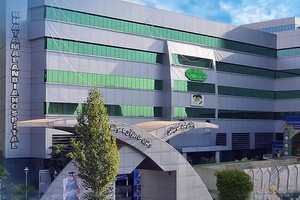
Iran International has also reported on security activity inside medical facilities. In one case, it cited a hospital employee who said military commanders held meetings inside a Tehran hospital.
Military presence in civilian sites
Teachers’ unions have voiced alarm. The Coordinating Council of Iranian Teachers’ Trade Associations published an image a day before US-Israeli strikes began showing what it said was military equipment positioned inside a school, warning that classrooms were being turned into “shields for deadly equipment.”
Uniformed officers sit in a school courtyard beneath an Iranian flag in an image shared on social media on March 3, 2026.
Earlier this week, an image was released from a meeting of the interim leadership council, attended by President Masoud Pezeshkian, Judiciary Chief Gholamhossein Mohseni Ejei and cleric Alireza Arafi.
Hours later, social media posts suggested the meeting had taken place in a ward at Tehran’s Arman Hospital.
Members of Iran’s leadership council meet at an undisclosed location on March 1 with social media users saying the low ceiling and iron door behind them suggest the meeting was held inside Tehran’s Arman Hospital.
International humanitarian law requires parties to distinguish between civilians and combatants, and between civilian objects and military objectives.
Schools and hospitals are protected unless, and for such time as, they are used for military purposes, and the use of civilians to shield military objectives is prohibited.
Disputed strike in Minab
The controversy intensified after Iranian media reported that an elementary and preschool complex in Minab, Hormozgan province, adjacent to an IRGC compound, was struck on February 28, killing more than 160 people.
Asked about the incident, US Secretary of State Marco Rubio said the United States would not deliberately target a school and that its objectives were focused on missiles, related manufacturing and launch capabilities, and drones.
"We would have no interest and frankly no incentive to target civilian infrastructure.”
Security forces gather with motorcycles and armored vehicles inside a school courtyard in an image shared on social media in January ahead of a crackdown.
Israel’s ambassador to the United Nations, Danny Danon, said on Monday he had seen differing accounts of what happened in Minab, including claims that Iran’s Revolutionary Guards were responsible. He said Israel targets military assets and expressed regret for civilian casualties.
“We regret the loss of life of any civilian. And we pray for the people of Iran. But we have the intelligence and we target military assets. That’s what we do. The Iranians, they do exactly the opposite,” he said.
As the conflict deepens, any overlap between official or security activity and civilian sites could increase the risks for densely populated areas and raise further legal and humanitarian concerns.
Iran made a strategic error by expanding its attacks beyond US and Israeli targets to include Persian Gulf states, a move that could pull more countries into the war, former CIA Director David Petraeus told Iran International in an interview on Monday.
“I think that is a big miscalculation on the part of Iran,” Petraeus told 24 with Fardad Farahzad Show, arguing that striking Arab countries that had sought to avoid direct involvement could push them to contribute more directly to regional defense efforts.
US and Israeli forces, Petraeus said, have already “dramatically degraded” Iran’s retaliatory capabilities, though he cautioned it was too early to determine whether the decline in attacks over the past 12 to 24 hours signaled a lasting shift.
“I think it's premature at this point to judge whether or not that will degrade further or if the volume can pick back up,” he said.
Coalition dynamics shift
Petraeus said Tehran’s decision to target regional states – including those that did not allow their bases to be used for operations – may alter the strategic calculus across the Persian Gulf.
Many countries in the region, he said, are already contributing to an integrated air and missile defense network that includes US-supplied Patriot and Terminal High Altitude Area Defense systems, along with naval assets and aircraft capable of intercepting incoming projectiles.
While he stopped short of predicting expanded offensive participation, Petraeus said additional Western powers could also align more closely with the effort. “I’m confident they are all taking part in the defensive efforts that are ongoing,” he said.
Uncertain path to political change
Addressing whether military pressure could lead to political transformation inside Iran, Petraeus said any lasting shift would depend primarily on internal fractures within the security forces and leadership.
“The sad reality in such cases often is that the most guys with the most guns and the most willing to be brutal to the people prevail,” he said, cautioning against assumptions that external air campaigns alone can bring about regime collapse.
Petraeus described exiled Prince Reza Pahlavi as a symbolic presence who has outlined a transition toward an elected government rather than dismantling all existing institutions.
Ultimately, he said, momentum would hinge on whether influential insiders conclude that continued confrontation has become unsustainable, shaping not only Iran’s future but the broader balance of power across the Middle East.
The UN atomic watchdog said on Monday it has no indication that Iran’s nuclear facilities were damaged in recent military attacks, even as Tehran’s ambassador to the agency said the Natanz enrichment site was targeted a day earlier.
“Regarding the status of the nuclear installations in Iran, up to now, we have no indication that any of the nuclear installations, including the Bushehr Nuclear Power Plant, the Tehran Research Reactor or other nuclear fuel cycle facilities have been damaged or hit,” Rafael Grossi, Director General of the International Atomic Energy Agency, told an emergency meeting of the Board of Governors.
“Efforts to contact the Iranian nuclear regulatory authorities through the IEC continue, with no response so far. We hope this indispensable channel of communication can be reestablished as soon as possible,” he added.
The agency’s Incident and Emergency Centre, Grossi said, was fully operational and coordinating with regional safety networks. “So far, no elevation of radiation levels above the usual background levels has been detected in countries bordering Iran,” he said.
Warning against strikes on nuclear facilities
Armed attacks on nuclear sites, Grossi said, carry risks that extend beyond national borders.
“Let me again recall past General Conference resolutions that state that armed attacks on nuclear facilities should never take place and could result in radioactive releases with grave consequences within and beyond the boundaries of the State which has been attacked,” he said.
He urged restraint by all sides. “Consistent with the objectives of the IAEA, as enshrined in its Statute, I reiterate my call on all parties to exercise maximum restraint to avoid further escalation,” Grossi added.
The IAEA chief also said negotiations over Iran’s nuclear program must start again. “To achieve the long-term assurance that Iran will not acquire nuclear weapons and for maintaining the continued effectiveness of the global non-proliferation regime, we must return to diplomacy and negotiations,” he said.
Iran envoy cites Natanz
Separately, Reuters reported that Iran’s ambassador to the IAEA said the United States and Israel attacked Iranian nuclear facilities on Sunday. Asked which facility was struck, the ambassador replied “Natanz,” according to Reuters.
The Natanz nuclear facility is Iran’s main uranium enrichment site and has long been central to international concerns about Tehran’s nuclear activities.
Grossi added that while no radiological release has been detected, the situation remains serious. “Let me underline that the situation today is very concerning. We cannot rule out a possible radiological release with serious consequences,” he said.
Iran calls for IAEA condemnation
During the session, Iran’s ambassador to the IAEA, Reza Najafi, called on the agency to condemn the attacks on Iran’s nuclear facilities.
He rejected that Iran is seeking nuclear weapons, calling them “completely false.”
Najafi said Iran’s response would continue, adding that such measures would remain in place as long as what he described as “aggression” continues.
Israel and the United States have set no timeline for their joint military campaign against Iran, Israel’s foreign minister said on Sunday, describing the strikes that began on Saturday as an effort to weaken the country’s leadership.
Speaking to Euronews, Gideon Sa'ar said the operation would continue without a fixed end date.
“So there is no time like the operation there. There is no timeline that you're looking at. There is no timeline of this operation. Now, we hadn't gave to ourselves timeline,” Sa’ar said.
“Naturally, we want it to be as short as possible. This is clear. But we didn't put to ourselves any timeline,” he added.
Sa’ar described the campaign as coordinated fully with Washington.
“It’s not that they [the United States] support us. They are working with us hand in hand, working together to achieve the same goals we are. It's, it's a, it's a mutual operation,” he said.
Minister urges Iranians to shape future
Sa’ar framed the offensive as aimed at countering what he described as long-term threats to Israel while opening space for change inside Iran.
“I also tell the Iranian people they have an opportunity now. They have an opportunity to regain their freedom, which was denied by this murderous regime that repressed them so cruelly. And I hope they will be able to do it,” he said.
Sa’ar said Israel would not attempt to choose Iran’s next leadership.
“We are not, we are not intervening with who will be the next leader of Iran. That will be decided by the Iranian people themselves, hopefully in like free elections, that's the best thing that can happen,” he said.
“Our only requirement is that anyone who will be in power will not work to eliminate the state of Israel. This is enough for us,” he added.
Sa’ar confirmed that the strikes resulted in the killing of Iran’s Supreme Leader Ali Khamenei, whom he said directed repression at home and backed armed groups hostile to Israel.
Residents watch as a large plume of smoke rises over Tehran following Israeli-US strikes.
“He was the supreme leader of Iran but it was a mega terrorist personally gave order for terror actions around the world,” Sa’ar said.
Sa’ar rejected criticism that the operation violates international law.
“This is totally justified by international law because international law justifies self-defense and someone who is… swearing and acting in order to eliminate another state. This state shouldn't wait until it will happen,” he said.
Duration uncertain
Sa’ar declined to predict how long the campaign would last.
“I don't want to be a prophet and to say how many days we are decisive to reach,” he said.
The Israeli military said on Sunday it would mobilize 100,000 reservists as strikes continue.
Sa’ar argued that any political shift in Iran would depend on domestic will rather than outside orchestration.
“Something is the most important thing here is connected to the will of the Iranian people. It's not something you can orchestrate from outside when you don't have a real will of the Iranian people,” he said.
Concerns over the activation of Iran’s sleeper cells in America have increased after a deadly shooting in Austin involving a suspect with alleged ties to Iran and a separate gun attack on an Iranian dissident’s gym in Canada.
A flag of the Islamic Republic and photographs of Iranian regime leaders were discovered inside the apartment of the suspect in the deadly Austin bar shooting, CBS News reported citing sources.
Authorities identified the suspect as 53-year-old Ndiaga Diagne, a naturalized US citizen originally from Senegal, the Associated Press reported, citing law enforcement officials.
He opened fire early Sunday at a bar in Austin’s West Sixth Street district, killing two people and injuring about 14 others before being shot and killed by police.
The suspect was wearing clothing bearing Islamic references, including a sweatshirt reading “Property of Allah” and a shirt featuring the flag emblem of the Islamic Republic of Iran, and a Quran was found in his vehicle, the report said.
The FBI and the Joint Terrorism Task Force are assisting in the investigation, and officials said there were indicators that could suggest a possible terrorism nexus, according to the Associated Press.
The suspect’s alleged X account shows a reply last year to a post by Iran’s Foreign Minister Abbas Araghchi, who wrote that any strike on Iran would be “immediately reciprocated.” In response, the account identified as Ndiaga Diagne wrote that the “Islamic Revolution is eternal and here to stay until the end of time.”
Canada gym attack
Separately, hours after the announced death of Iran’s Supreme Leader Ali Khamenei following US-Israeli strikes on Tehran, a boxing gym in Richmond Hill, Ontario, run by Iranian-Canadian dissident activist and cruiserweight champion Salar Gholami, was struck by gunfire overnight.
Video shared by Gholami showed multiple bullet holes across the front windows of Saliwan Boxing Club on Yonge Street, some displaying pro-Iranian liberation flags and images. At least two panes were shattered, and an evidence marker was visible above one of the bullet holes.
"Seventeen live rounds were fired randomly at the gym, and it was sprayed with bullets," Gholami told Iran International, describing the shooting as intimidation directed at critics of the Islamic Republic.
"This is the result of shaking hands with the mullahs and delaying action. When the Canadian government leaves the door open for them to enter, this will no longer be a safe place even for Canadians themselves. Seventeen bullets means it could have left behind 17 Canadian bodies."
Salar Gholami's gym in Toronto hit by multiple bullets
Concerns over sleeper cells
Following the US-Israeli strikes on Iran and the killing of Ali Khamenei, retaliatory measures including by Iranian sleeper cells cannot be ruled out, a senior German lawmaker said on Sunday.
“The Iranian regime has repeatedly demonstrated in the past that it carries out its terror beyond its own borders,” Marc Henrichmann told the Sueddeutsche Zeitung newspaper.
Last June, US law enforcement stepped up its monitoring of potential Iran-backed operatives within the United States amid the 12-day Israeli war on Iran which was later joined by the US.
In the days after Israel launched its attacks on Iran, the FBI under its director Kash Patel boosted surveillance over what sources cited by CBS described as Hezbollah-linked sleeper cells.
The CIA helped identify a Saturday morning gathering of Iran’s top leaders in Tehran, including Supreme Leader Ali Khamenei, before Israel carried out a strike that killed him and other senior officials, The New York Times reported.
Citing people familiar with the operation and officials briefed on the intelligence, the newspaper said the agency had tracked Khamenei for months and passed “high fidelity” intelligence on his location to Israel ahead of the attack.
According to the report, US and Israeli officials adjusted the timing of their planned strike to take advantage of intelligence that senior political and military figures would gather Saturday morning at a leadership compound housing the offices of the supreme leader, the presidency and the Supreme National Security Council.
Israel had assessed that those present would include Mohammad Pakpour, commander in chief of the Islamic Revolutionary Guard Corps; Defense Minister Aziz Nasirzadeh; Admiral Ali Shamkhani, head of the Military Council; Majid Mousavi, commander of the IRGC Aerospace Force; and Deputy Intelligence Minister Mohammad Shirazi, among others.
The operation began around 8 a.m. Tehran time, when fighter jets took off armed with long-range precision munitions. About two hours later, in Tehran, missiles struck the compound.
Senior national security officials were in one building, while Khamenei was in another nearby structure, the report said.
An Israeli defense official said in a message reviewed by the newspaper that the strike was “carried out simultaneously at several locations in Tehran,” adding that Israel achieved “tactical surprise” despite Iranian preparations for war.
Iran’s state news agency IRNA confirmed on Sunday the deaths of some of the senior military figures Israel said it had killed, including Shamkhani, Pakpour, and Nasirzadeh.
Last June, as plans were underway to strike Iran’s nuclear facilities, President Trump said the United States knew where Khamenei was hiding and could have killed him.