The top US military commander in the Middle East told Congress on Tuesday that Iranian weakness offers Washington a historic opportunity to advance its interests but a vulnerable Tehran may seek deterrence in nuclear weapons.
"We can seize the initiative to optimize our posture to defend the Homeland, strengthen our economic outlook, take back our right to freedom of navigation, and sustain the upper hand against an increasingly desperate Iran," US Central Command (CENTCOM) chief Army General Michael Kurilla said.
"Iranian leadership understands their acute vulnerability, and the precision of Israel’s response demonstrates that Iran will remain critically exposed to future Israeli operations, even if their former defenses are reconstituted," Kurilla said in a statement to the US House Armed Services Committee.


As the sixth round of nuclear talks approaches and earlier hopes of a breakthrough fade, some in Tehran are quietly promoting a limited interim agreement to defuse tensions and avert a deeper crisis.
Former diplomat Ramin Mehmanparast told the reformist Etemad daily that both Iran and the United States may ultimately settle on a limited, temporary agreement since the other two options—a full deal and war— are unlikely and undesirable.
“The third scenario is a middle-ground option: no comprehensive agreement, and no military conflict,” he said, asserting that an interim deal could see Iran addressing concerns about the nature of its nuclear activities in return for sanctions relief.
“(This) is the most likely, as the US believes it can sustain maximum pressure without going to war—tightening sanctions to economically squeeze Iran and force concessions,” he said, adding that Arab states would favor this outcome as it avoids escalation while containing Tehran’s regional power.
The cautious optimism on both sides appears to have faded in recent weeks.
US President Donald Trump on Tuesday said Iranian negotiators have become “much more aggressive” in recent weeks, confirming nonetheless that the sixth round of talks would take place this week.
Mixed assessments
Sensing troubled waters ahead if talks collapse, some moderates in Iran are becoming more vocal in urging flexibility, while hardliners push for an even tougher stance to deter the West.
“Iran must show mild and flexible responses … as confrontation could have destructive consequences,” political analyst and former diplomat Ali Bigdeli was quoted as saying by reformist daily Etemad.
In another interview with the conservative website Nameh News, he urged Tehran to seek Western concessions in return for agreeing to enrichment levels between 1% and 2.5%.
These proposals come as the International Atomic Energy Agency (IAEA) intensifies scrutiny of Iran’s nuclear program.
At the IAEA Board of Governors meeting in Vienna on Monday, Director General Rafael Grossi warned that Iran still has not explained uranium traces found at undeclared sites and has reduced transparency, obstructing monitoring efforts.
Etemad warned in a commentary that a formal IAEA rebuke could revive the six UN Security Council resolutions suspended under the 2015 deal.
In Nameh News, analyst Mohammad Javad Jamali Nobandegani argued that Grossi’s statement marked a first step toward such a resolution, asserting that further pressure could push Iran to quit the Non-Proliferation Treaty altogether.
“If the trigger mechanism is activated,” he warned, “there will be no reason for Iran to cooperate with the IAEA.”
Nobandegani accused the IAEA of calibrating its position based on the status of Iran–US talks, softening when negotiations are active and siding with Israel when they are not.
"Iran must act in a way that the heavy consequences of triggering the snapback mechanism are factored into the calculations of the US and Europe,” he concluded. “If they do not sense any deterrent response, they will move toward reinstating sanctions."
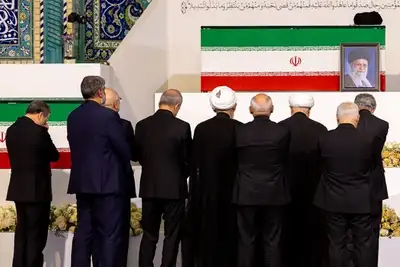

Tehran will rename a street named after the Islamist assassin of Egyptian President Anwar Sadat in 1981 as part of the Islamic Republic's efforts to improve diplomatic relations with Egypt.
Khalid Al-Islambuli was a member of the Egyptian military who was executed after leading the assassination of Sadat during a military parade in Cairo.
The street in northern Tehran was named after Islambuli in the early 1980s, drawing repeated protests from Cairo and contributing to strained ties. Egyptian officials have long viewed the gesture as a provocation and a major obstacle to normalization.
The decision to rename the street was announced on Tuesday by Tehran's City Council.
"Following coordination with the Ministry of Foreign Affairs, the street naming committee has discussed the renaming of Khalid Al-Islambuli Street, also known as 'Vozara', and several replacement suggestions have been put forward," the Council's spokesman said.
While no particular name has been announced yet, the IRGC-affiliated Tasnim says Hassan Nasrallah, the late leader of Lebanon's Hezbollah, is among the names being considered.
Thaw after 45 years
Tehran's decision to change the controversial street name comes after the Iranian foreign minister’s recent visit to Cairo, signaling progress toward healing one of the region's deepest rifts, which has lingered from the 1979 Revolution in Iran and Egypt's peace treaty with Israel.
Relations between the Sunni Muslim heavyweight and the Shi'ite theocracy has been in a deep freeze ever since.
Following Araghchi’s June 2 meeting with Abdel Fattah al-Sisi, the top Iranian envoy himself wrote in an Arabic post on X that diplomacy between Iran and Egypt had entered a new phase.
Egypt is a close US ally and maintains official relations with Israel. For Iran, mending the 45-year rift with Egypt could signal a softening of its revolutionary-era, anti-American posture.
Ayatollah Ruhollah Khomeini famously called for the Egyptian people to rise up and overthrow Anwar Sadat after he normalized ties with Israel.
It would also send a strong message across the region that longstanding hostilities and rivalries can give way to cooperation.

The top US military commander in the Middle East told Congress on Tuesday that Iranian weakness offers Washington a historic opportunity to advance its interests but a vulnerable Tehran may seek deterrence in nuclear weapons.
"We can seize the initiative to optimize our posture to defend the Homeland, strengthen our economic outlook, take back our right to freedom of navigation, and sustain the upper hand against an increasingly desperate Iran," US Central Command (CENTCOM) chief Army General Michael Kurilla said.
"Iranian leadership understands their acute vulnerability, and the precision of Israel’s response demonstrates that Iran will remain critically exposed to future Israeli operations, even if their former defenses are reconstituted," Kurilla said in a statement to the US House Armed Services Committee.
Israel launched air strikes on Iran in October in response to a missile attack on its soil, in an operation it said knocked out Iranian air defenses and missile production capacity.
"Significantly weakened, Iran finds itself with fewer options," Kurilla added. "In addition to an active chemical weapons program, there is one remaining pillar the Regime may consider its best chance at restoring deterrence and imposing its will on the Region – the threat of developing a nuclear weapon."
The US intelligence community assesses that Iran is not building a nuclear weapon nor has such a move been authorized by its Supreme Leader yet but that a taboo on discussing the bomb in public discourse was eroding.
Iran's proxies in Middle East
Kurilla said Tehran's attempt to capitalize on the Palestinian armed group Hamas's attack on Israel on Oct. 7, 2023 has largely failed after serial military setbacks.
"After Hamas's attack on Israel, Iran operationalized its entire proxy network and arsenal of standoff capabilities – two pillars of their strategic approach – in pursuit of one goal: to seize a once-in-a-generation opportunity to reshape the region to its advantage."
Iran's losses could be the United States' gain, Kurilla suggested, without mentioning any specific course of action.
"We now have an unprecedented opportunity to advance the vision of a
prosperous and integrated Middle East in which US national interests are advanced
and Iran’s violent attempts to upend this peaceful order are defeated."
Iran has become "much more aggressive" in ongoing nuclear talks, US President Donald Trump told Fox News in an interview.
"Iran is acting much differently in negotiations than it did just days ago," Fox News quoted Trump as saying. "Much more aggressive. It’s surprising to me. It’s disappointing, but we are set to meet again tomorrow – we’ll see."
Fox News cited senior administration officials as saying they believe Iran is delaying the talks as concrete progress remain lacking while it advances its nuclear program.
Republican advocates of a harder line on Iran are increasingly clashing with US President Donald Trump's more non-interventionist MAGA movement over nuclear talks with Tehran, Politico reported on Tuesday.
Influential conservatives are ramping up a lobbying campaign to end a push for a nuclear deal with Tehran and instead allow its nemesis Israel to strike Iran's nuclear sites, Politico reported citing informed sources.
Those lines were advocated by popular right-wing talk show host Marc Levin in a private lunch with Trump at the White House on Wednesday also attended by the US envoy for the talks Steve Witkoff - whom Levin has frequently criticized.