Senior US Lawmaker Slams UN Nuclear Chief's Upcoming Visit To Iran
US House Foreign Affairs Committee Chairman Michael McCaul
The Chairman of the US House Committee on Foreign Affairs, Michael McCaul, has criticized a reported trip by Rafael Grossi, the Director General of the International Atomic Energy Agency (IAEA) to Iran.
Grossi is set to attend a conference in Isfahan, Iran next week.
"I am concerned by reports the IAEA Director-General plans to participate in an international nuke conference in Iran next week. This risks legitimizing Iran’s illicit nuclear activity. Focus instead needs to be on holding Iran to account for NPT-related violations," he wrote on X.
The IAEA has confirmed that Grossi’s visit on May 6 aims to engage with officials and participate in the 'International Conference on Nuclear Science and Technology.'
The visit comes just days after Grossi said that Iran was "weeks, not months" from acquiring the material needed for a nuclear weapon.
Ties between Iran and the IAEA have deteriorated, with Grossi in February acknowledging a "drifting apart" as Iran becomes defiant.
He also mentioned that the country is still enriching uranium to 60 percent purity at a rate of around 7 kg per month reaching levels close to those used for producing weapons.
Iran's uranium enrichment vastly exceeds the limits of the 2015 JCPOA agreement, which restricted Iran's uranium enrichment to 3.67 percent. Following the US withdrawal from the deal in 2018 during former President Donald Trump's administration and the subsequent reimposition of sanctions Iran began to exceed these limits in 2021.
The International Atomic Energy Agency (IAEA) has indicated that the 2015 nuclear pact has essentially collapsed, sparking concerns about Iran acquiring nuclear weapons capabilities.
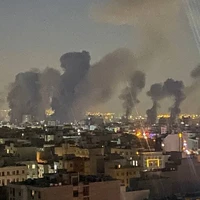
Israel carried out an airstrike on a target near Damascus Thursday night, in what seems to be the first such attack since the one on Iranian consulate which led to an unprecedented escalation of hostilities between the two countries.
There has been relative calm in the past few weeks, after both Iran and Israel directly hit the other country, showing their fire power albeit in entirely different ways: Iran launching hundreds of missiles and drones to overwhelm the Israeli defense system, and Israel surgically taking out the central component of Iran’s defense system near a nuclear facility.
Both governments could claim victory and step back from the edge, momentarily perhaps, and under pressure from the United State, which is worried an all out war can break out in the region and drag in American forces.
The airstrike Thursday night had no IRGC casualties, unlike the attack on the consulate. Eight Syrian soldiers were injured in a building operated by Syrian security, according to the Syrian defense ministry. Reuters quoted a source that the site struck was not operated by Iranian units or Hezbollah – but it sat south of the Sayyeda Zeinab shrine, where Hezbollah and Iranian forces are entrenched.
That airstrike was above all a reminder that the fundamentals of power politics in the region remain the same, and another crisis could emerge at any time.
As if another reminder was required, the Islamic Resistance in Iraq, an umbrella term for a number of armed groups backed by Iran, claimed Thursday night that they had launched multiple cruise missiles towards Israel, including (for the first time) at the capital Tel Aviv.
Israel has not commented on the reports, but it’s more or less a given that all such attacks are neutralized by the Israeli defense system mid-air.
Thursday night’s event suggests that the existing calm may be a quiet overture to yet another storm, especially as reports have emergedthat an armed group in Bahrain has claimed responsibility for a drone attack on Israel last week.
The Islamic Resistance in Bahrain – almost certainly backed and equipped by Iran – said in a statement Thursday night that it had targeted an Israeli logistics company in Eilat on 27 April. Also known as the Ashtar Brigades, the group published a short video purporting to show the launch of the drone towards Israel. Its statement said its operation was in solidarity with “the patient people in resisting Gaza”.
This is the first time that a group based in Bahrain has claimed responsibility for an attack on Israel. If true, the attack raises many questions not just about the group and its capabilities, but also about Iran’s capacity and its intentions in the region, as the Biden administration attempts to avert war and even make deals –public and private.
“Iran is pursuing a strategy in which they hope we continue to pretend like we don't understand what the return address is for all this violence,” former US national security advisor HR McMaster told Sky News “And in a horrible, cynical way, Iran is willing to expend every Arab life, if necessary, to accomplish its objectives of pushing the United States, the United Kingdom and our allies out of the region as the first step in establishing hegemonic power in the region and destroying Israel."
A former Iranian regime operative and ideologue, currently residing in Canada, has proposed that opposition forces both abroad and within Iran unite to topple Supreme Leader Ali Khamenei’s rule.
This suggestion has sparked widespread discussion among the Iranian public this week, eliciting divergent reactions. Mehdi Nasiri, the proponent of this contentious idea, previously served as Khamenei’s representative at the hardline newspaper Kayhan and was its chief editor during the late 1980s and early 1990s.
While some view the proposalas an outreach effort by Iran's reformists to forge an alliance with the country's opposition abroad, others speculate it may have originated from within the regime's inner circle to exploit both factions for Khamenei’s benefit.
Nasiri specifically mentioned several reformist figures inside Iran, including Nobel Peace Prize laureate Narges Mohammadi, former president Hashemi Rafsanjani's daughter Faezeh Rafsanjani, and former deputy Interior Minister Mostafa Tajzadeh, all currently imprisoned in Tehran. He also cited former Prime Minister Mir Hossein Mousavi, who is under house arrest. On the other end of the spectrum, Nasiri referenced Prince Reza Pahlavi, heir to the pre-1979 monarchy, now residing in exile in the United States. He portrayed these individuals as representing opposing poles of the political spectrum capable of forming an alliance against Khamenei.
Mehdi Nasiri, the former editor of the conservative flagship Kayhan Daily
One of the things that sounds odd about the suggestion is that Nasiri neither represents Prince Reza Pahlavi nor the reformists in Iran. Although he has been criticizing Khamenei during the past two years, he is ultimately a regime insider whose track record includes nothing other than hardline conservatism. He is a man who often claims to have been sending messages directly to Khamenei about the affairs of the state.
Neither the prince, nor the reformists in Iran have shown any reaction to Nasiri's interview. But politicians and social media users in Iran and abroad have expressed their views about Nasiri's initiative. According to the reformist daily Etemad, Nasiri's critics have called him a “super hardliner who now offers suggestions for regime change," and charged that "Nasiri used to offer guidelines to the regime for suppressing the critics. "
Mahmoud Sadeghi, a former reformist MP, who like Nasiri used to be a cleric but shed his turban and robe and chose to wear a suit, said in a critical tweet that "Tajzadeh, as a pro-democracy reformist who opposes centralized power, has nothing in common with the prince who believes in hereditary succession."
Another prominent figure in the reformist camp, Mohammad Ali Abtahi, who served as the chief of staff to former President Mohammad Khatami, offered his perspective on Nasiri's proposal, stating: "As a former staunch hardliner, Mehdi Nasiri has the right to express his views and transition into a leading opposition figure. However, neither his previous hardline stance managed to undermine the reformist movement, nor does the reform camp require a newcomer like him. Contrary to his assertion, there is little likelihood of collaboration between Prince Reza Pahlavi and Mostafa Tajzadeh, nor does Tajzadeh express any interest in such cooperation. Furthermore, the individuals Nasiri mentioned are currently incarcerated in various forms. It appears someone may be misleading him."
Iranian Rreformist politician Mostafa Tajzadeh
Yet another reformist figure close to the Reform Front, Javad Emam pointed out that "a return to the constitutional monarchy would be a step back. Approaching the prince will be a move in the wrong direction by Iran’s reformists."
Politicians who belong to the so-called reform camp in Iran are mostly former Islamist or leftist revolutionaries, who are critical of Khamenei but except in a few cases have hardly called for dismantling the Islamic Republic.
On social media, a twitter user who tweets under the alias name Noah's Wise Son wrote: "It appears that the Islamic Republic and its reform front have no winning card to play. When the Islamic Republic started to groom Nasiri in diaspora media as a reformed Islamic intellectual it was evident that it was a plot to deceive political activists."
The user suggested that the Islamic Republic and reformists in Iran who have lost their social base, are trying to benefit from the prince's popularity in Iran. He charged that "those who cooperated with the Islamic Republic to suppress intellectuals and patriotic people wish to cleanse their criminal record by approaching the prince as a popular figure now that the regime is doomed to fall."
Nasiri says he is visiting his son who is a student in Canada and will return to Iran at a later date, but if what he says is his genuine idea, he can hardly get away with its consequences once he sets foot in Tehran.
A different scenario neither Iranian politicians, nor social media users have thought of is the possibility of Nasiri being a messenger from Khamenei who is either trying to save a regime that has lost the nation's support and trust or in a more complicated game, he is tasked by Khamenei to discredit both the royalists and the reformists.
The United States Commission on International Religious Freedom (USCIRF) urged the US government to assist Iranians amid worsening crackdowns on minorities and dissidents.
In its annual report, the USCIRF stated in Iran, “officials systematically harassed, arrested, detained, sexually assaulted, raped, and tortured protesters, including minors.”
The USCIRF also emphasized the increased enforcement of compulsory hijab laws throughout 2023, along with increased surveillance and secret funding of a morality patrol to “harass uncovered women.”
“In 2023, religious freedom conditions in Iran remained extremely poor. Protests against mandatory hijab laws and other restrictions on freedom of religion or belief continued despite security forces’ violent repression … During the year, Iran executed at least eight protesters on religiously grounded charges,” read the commission’s 2024 annual report.
The report comes amid a crackdown on women from last month under the regime’s new initiative called Nour which has since seen social media flooded with footage of morality police using violence against women rebelling against the hijab, with allegations of police extortion, theft, and harassment prevalent.
Additionally, the report mentions the regime's suppression of religious minority groups, including Sunni Muslims and Baha'is. The latter lacks recognition as a legitimate religion by Iran's Shiite clerical regime, resulting in systematic and longstanding violations of Baha'is' rights in the country where only Islam, Judaism and Christianity are legally recognized religions.
“In 2023, authorities conducted individual and mass arrests of Baha’is across Iran, taking them to undisclosed locations and imposing excessively long prison sentences. Iranian security officials beat and brutalized Baha’is during raids and searches of private homes,” the report added.
It is estimated that there are approximately 300,000 Baha'is in Iran, one of the most persecuted minorities in the country. Harassment, forced displacement from residences and businesses, and unequal treatment in government employment and higher education are some of the challenges the group faces in the midst of the country's already deepening economic crisis.
USCIRF also pointed out that Iran's government continues to impose repressive policies abroad, including harassment of religious dissidents and targeting of Jewish sites. The report mentions three instances in Greece, Cyprus, and Brazil last year where the Islamic Revolutionary Guard Corps (IRGC) planned to attack Israeli targets.
On Teacher's Day, the Supreme Leader of the Islamic Republic often boasts that teachers "are the architects of Iran's future."
In Ali Khamenei's myopic worldview, this future likely entails today's young Iranians carrying on the torch of the 1979 Islamic Revolution, along with its tenets of political Islam.
But, the ruler's decades-long endeavor to indoctrinate and shape post-revolution generations of Iranians through the education system and dozens of state and religious propaganda outfits has failed, tarnishing the legacy of the Islamic Republic.
From widespread secularization to the populace's resolute anti-regime stance and protests, Iran has witnessed profound transitions over the past decade. In the process, it's evident that the people have turned their backs to the aspirations of both Supreme Leaders.
Today's youth, thoroughly detached from the state, often lead dual lives: experiencing pervasive oppression at schools and universities while encountering contrasting narratives of pre-revolutionary life at home. Despite crackdowns on internet access amid protests, Generation Z has found a window into life in the West, solidifying their rejection of their daily reality.
But, Khamenei can’t take all the credit for this rejection – after all, he is only the second Supreme Leader. His predecessor, Ruhollah Khomeini, did his share to try and forcibly imprint his worldview onto Iranian youth through school curriculums.
Iran's Supreme Leader Ali Khamenei waves during a meeting with teachers in Tehran, Iran May 1, 2024.
Khamenei, though, is unlikely to cease his efforts. Recently, the regime's education officials havehinted at several overhauls, indicating a further tightening of control over what is taught to children and students.
Here is a brief overview of what you need to know about the Islamic Republic’s quest to mold the future Iranian generations through schools and universities – and how they failed in their goal to establish Iran as a successful example of political Islam.
Islamic ‘Revolutionary’ Overhaul of Iran's Education System
Let’s take a step back.
For a period after the revolution in 1979, after the ouster of Iran’s monarch Shah Mohammad Reza Pahlavi, Iranian universities were shut down to completely alter the country’s education system according to the new government's ideological framework.
“Iran's new revolutionary authorities are engaged in a massive upheaval of the country's educational system from the primary grades through the universities,” reads a Washington Post article from 1980.
Literature textbooks would start with songs and slogans of the Islamic revolution – and instead of reading the great Persian poets, young children would learn chants like “Khomeini, Khomeini, you are light from God” and "This American shah should be executed."
In directives that could be called revisionism, history textbooks were rewritten to promote Islamic principles and so-called revolutionary values, with hardly any mention of the ancient kings of Persia.
The Islamic Republic’s first Supreme Leader Rouhollah Khomeini early on saw the potential in using the education system to pass on the ideals articulated with the birth of Islam 14 centuries ago.
Conversely, Shah Mohammad Reza Pahlavi’s “White Revolution” in the 60s and 70s had aimed to modernize Iran through means that included educational advances – including the deployment of teachers to villages that had no schools. The educational system was secular and mostly based on the European models, although students had a weekly hour about the White Revolution and modernization.
Schools Under Siege by Radical Indoctrination and Political Islam
Several studiesshow that over the last decades, the Iranian school curriculum for Grades 1 - 12, has promoted radical ideological indoctrination.
“Gender discrimination permeates Iran's textbooks. Women are accorded little importance as individuals, and their contributions to society outside the home are largely ignored. This attitude toward women is justified in the textbooks through numerous references to the Koran and the lives of prophets and Imams,” an extensive Freedom House study bySaeed Paivandireads.
Textbooks advocate for the destruction of Israel, glorify child martyrdom and jihad, while fostering animosity toward the US. School materials also venerate past Iranian empires and promote false narratives in history textbooks.
“Iran largely continues to educate students for the prospect of a global war, and the spreading of the Islamist-Khomeinist revolution. There is a greater focus on Iran’s desire to export its global Islamic Revolution to the Arab Middle East compared to past curricula, with students encouraged to engage in militant activity to achieve Iranian hegemony,” astudy by IMPACT-se read, which evaluated Iranian school materials for UNESCO peace and tolerance criteria.
In line with Khamenei's anti-Western stance, measures have included prohibiting primary students from studying English and removing the requirement for older students to learn English. Arabic, however, remains compulsory "as the language of the Qur'an" for first and second-year secondary students, as per education officials.
In a nod to the government’s close economic dependance and ties to Beijing, Iranian authorities are reportedly seriously discussing the possibility of adding Chinese to the foreign languages taught in the nation's schools.
In some universities, the flags of Israel and the US are painted at entrances, a regime tactic to force students to walk over them as a sign of disrespect. Yet, social media videos often show Iranian students carefully avoiding to walk on the flags – highlighting their resistance and the failure of Khamenei's policies.
Schools, Universities as Battlegrounds Against Regime
Since 1979, schools and universities have emerged as focal points of unrest and opposition to the regime.
From prominent activist Majid Tavakoli’s historic speech in 2009 on the steps of Amir-Kabir University on the Day of students, bravely and directly attacking Supreme Leader Khamenei, to Iranian schoolgirls in 2022 ripping out images of Khomeini and Khamenei from their textbooks, while chanting “Death to the dictator” – the youth has shown their opposition to the regime’s doctrine.
Following the most recent round of nationwide anti-regime protests in 2022 and 2023, security forces unleashed a fresh wave of crackdowns at universities – using both verbal and physical assault to suppress the student opposition movements.
Amid protests, tens of thousands were arrested – including at least hundreds of students, teachers and professors.
The state has kept up its pressure and tactics to target teachers who joined demonstrations, including arrests, threats, expulsions, and forced retirements.
Regime's Repression Targets Iranian Schoolgirls
Girls’ school particularly became a focal point for unrest after the killing of Mahsa Jina Amini in September 2022, while she was in the custody of the so-called morality police for a hijab violation.
Amid and following those protests, thousands of schoolgirls were reportedly poisoned – with human rights activists and Iranian journalists blaming the regime in Tehran for another “form of gender-based attacks in the country.” Activists also suggest that the wave of attacks were a reprisal for the students’ participation in nationwide protests.
Strengthening those arguments, are the fact that it took Khamenei three months to comment on the attacks and that no arrests have been made in connection with the reported poisonings.
Last year, IranWire exclusively reported that Iranian schoolgirls have been forced to watch pornographic videos at school, aimed at deterring them from joining anti-government protests.
These sessions, conducted by the regime’s security forces, used the explicit content to argue that the protesters' demands would lead to moral decay.
“A cleric accompanied by a woman wearing a hijab and men in uniforms and civilian clothes visited the school and gathered students in 10th, 11th and 12th grades in a classroom. The visitors forced them to watch videos with porn scenes, including rapes and sexual intercourses between humans and animals, in a bid to convince the children that the protesters’ demands would lead to sexual decadence in Iran,” the report read.
The incident caused significant distress among the students, with one student suffering a nervous breakdown and needing to be hospitalized for two days.
Universities at the Heart of Regime’s Foreign Policy Strategy
Universities in Iran have also played an integral role in the Islamic Republic’s foreign policy strategy – which includes recruiting foreign students as ideological ambassadors. These students, often from influential families, are trained to promote Iran’s agenda globally under the guise of "cultural secretaries."
Iran’s Al-Mustafa International University plays a key role in this strategy, receiving substantial funding to educate foreign students and spread the regime’s Shiism worldwide. The institution has students from China, African countries and Latin America. The university has faced international sanctions for allegedly recruiting combatants for conflicts like the war in Syria.
Tehran’s Sharif University for instance, is also under international financial sanctions and known for its close ties to the military and being engaged in military and ballistic missile-related projects for the Iranian government.
Iran's Teachers Confront Hostility and a Failing Educational System
While the Supreme Leader has verbally revered the role of teacher’s in the country, teachers themselves have been met with hostility by the regime.
Their jobs have been hampered by severely low salaries, poor working and living conditions – and in return, placated with unfulfilled promises.
Recently, teacher’s have warned that the regime’s brand of ideological curriculum means a “dead end” for children – and that the authorities have failed in the education sector.
Teachers report that students are rejecting the mandated school curriculum, which is heavily dominated by ideological and religious content, even within science subjects. They say this has led to a significant loss of interest among students.
The regime's security forces have also oftenattackedgatherings of parents voicing their concerns about the significant qualitative shortcomings of the country's educational system, including a shortage of staff.
Among its shortcoming, an expert reportpublished last year by the ‘reformist’ news outlet Etemaad, showed several significant qualitative deficiencies in Iran's education system – including a lack of justice in providing educational opportunities and a legitimacy gap, stemming from disparities between students' expectations and authorities' ideological perspectives.
Amid fears of more hostage-taking by the Iranian government, Tehran said expatriates can access an online service to check their “security” status.
According to Foreign Minister Hossein Amir-Abdollahian, Iranian expatriates can check online to see whether they will be arrested by the regime’s security forces in case they travel to their homeland as many have before them, such as high profile cases including British-Iranian Nazanin Zaghari-Ratcliffe, arrested on a visit home to her family in 2016 as part of a long-running debt Iran claimed the UK owed.
Though the online system has been in place for two years, the latest update comes amid growing concerns of Iranians abroad, many of whom have been subject to intimidation and threats to their lives from state security forces for supporting the 2022 uprising.
“The few Iranians who are at times worried about coming to Iran under the influence of certain hostile media outlets, can be assured of having trouble-free travel to the country by consulting the ‘Porseman-e Taradod’ system,” Amir-Abdollahian claimed.
Back in January, Alireza Bigdeli, Deputy Foreign Minister for Consular Affairs, vowed that the online system will provide “honest” answers to Iranian expatriates before their travel to the country.
Multiple cases of dual-nationals in Iranian prisons are ongoing such as Swedish-Iranian Ahmadreza Djalali, German-Iranians Nahid Taghavi and Jamshid Sharmahd and French-Iranian Fariba Adelkhah. In March, Iran demanded $2.5 billion for the release of US-Iranian Jamshid Sharmahd, who is on death row.
Iran has long used a policy of hostage taking to leverage power over Western governments. Last year, the United States allowed the release of $6 billion of Iran's blocked funds in South Korea in exchange for the release of five US-Iranian hostages.
As Iran becomes even more emboldened, it has expanded its hostage taking to public figures, including the arrest and imprisonment of an EU representative, Johan Floderus, amidst an ongoing dispute with Sweden which has sentenced a regime insider to life in prison on terror charges.