Republican Senator Ted Cruz appearing on Eye for Iran.
US Senator Ted Cruz told Iran International this week that the US-Israel military campaign aims to remove the Islamic Republic from power and diminish Tehran’s ability to “terrorize” or harm its neighbors.
“It is not simply enough to degrade part of their arsenal,” Cruz told Eye for Iran podcast, adding that strikes have weakened Iran’s military capabilities and limited its ability to project force abroad.
Asked whether victory would mean regime change, he said: “Yeah, I believe this regime needs to be removed from power,” and argued that doing so would serve US national security interests and support Iranians seeking freedom.
Cruz said the United States and Israel had acted in coordination in recent days.
"We've seen the United States working hand in hand with Israel taking out, number one, the Ayatollah, number two, the senior military leaders of the regime, number three, a great percentage of the missile reserves of the drones,” he said.
“We have seen steadily the regime's ability to project force, to terrorize the Iranian people, to murder their neighbors, to murder Americans, all of those have been reduced dramatically.”
His comments come as the Trump administration signals the campaign could intensify. US Defense Secretary Pete Hegseth said this week the United States has “only just begun to fight,” while Iran’s Revolutionary Guards warned attacks across the region would escalate.
Freedom “on the doorstep”
Cruz argued that removing Iran’s ruling regime would serve both US national security interests and the aspirations of Iranians living under the tyrinical government.
“Removing from power a government that is seeking to kill Americans is overwhelmingly in America's interest,” he said, adding that it was also “overwhelmingly in the interest of the people of Iran of 92 million people who have suffered under tyranny and oppression for 47 years… and I believe freedom is on the doorstep and it is in sight before us.”
More than 36,500 Iranians were killed by security forces during the January 8-9 crackdown on nationwide protests, making it the deadliest two-day protest massacre in history.
The Republican Senator also suggested Iran’s military response across the region is backfiring and strengthening opposition to the regime.
“Well, Iran is doing a great job of building a coalition against this regime,” Cruz said. “You look at their military strategy, their military strategy appears to be try to murder as many people as possible and in as many countries as possible.”
Iran’s missile and drone attacks have spread across the region in recent days, with projectiles reported over or targeting Israel, the United Arab Emirates, Qatar, Bahrain, Kuwait, Jordan, Iraq, Saudi Arabia, Syria and Cyprus.
Some strikes and falling debris have also hit residential areas, highlighting how the conflict is spilling beyond military targets and affecting civilians across the region.
Limited ground engagement possible
Cruz also addressed speculation about whether the United States could deploy ground troops, saying he does not foresee an Iraq-style invasion but did not rule out limited ground action.
“Look, what we're not going to see is an extended presence of American troops on the ground. We're not going see a replay of what happened in the war in Iraq. That is not on the table,” he said.
“The president has been clear he has not ruled out some limited ground engagement… I could envision it is possible the president will order some sort of limited ground engagements, but I would expect the overwhelming majority of the American engagement on this to be in the air through bombs and missiles and other means.”
Iran’s leadership question
The question of Iran’s leadership has taken on new urgency following the death of Supreme Leader Ali Khamenei.
Iran’s clerical body, the Assembly of Experts, has elected Mojtaba Khamenei — the son of the late supreme leader Ali Khamenei — as the Islamic Republic’s new Supreme Leader, according to informed sources who spoke to Iran International.
The decision would keep power firmly within the ruling system of the Islamic Republic and extend the authority of the clerical establishment that has governed Iran since 1979.
President Donald Trump signaled strong opposition to Mojtaba Khamenei assuming power.
“Khamenei's son is a lightweight. I have to be involved in the appointment, like with Delcy Rodriguez in Venezuela,” Trump said.
“We want someone that will bring harmony and peace to Iran.”
Asked during his interview about who should lead Iran next, Cruz said he would not speculate about specific figures but noted there were multiple possible contenders.
“Look, I don't know, and I think that's a decision for the people of Iran to make. And so there are various contenders,” Cruz said.
Cruz said he believes Iran’s current ruling system should ultimately be replaced by leadership chosen by the Iranian people.
“Yeah, I believe this regime needs to be removed from power,” he said.
“What I would like to see is a free and fair election, let the people of Iran choose their leaders.”
Message to the Iranian people
Cruz also spoke about his personal connection to people who have lived under authoritarian rule.
“My father was born and grew up in Cuba. My father fought in the Cuban revolution. My father was imprisoned and tortured in Cuba,” he said. “My family knows suffering the people of Iran have experienced.”
He ended with a message to Iranians protesting the government.
“My message to the Iranian people is your courage is inspiring… You have a moment to reclaim your country, to reclaim your future and to move into an era of prosperity.”
UNICEF called on all parties in the Iran conflict to protect civilians, warning that children were increasingly bearing the toll of the fighting with reports of rising casualties.
“UNICEF is deeply concerned about the deadly impact the ongoing military escalation in Iran is having on children,” the agency said in a statement. “Approximately 180 children have reportedly been killed and many more injured.”
The organization said 168 girls were killed when a strike hit the Shajareh Tayyebeh girls’ elementary school in Minab, in southern Iran, on Feb. 28 while classes were in session.
Reports indicated that most of those killed were between 7 and 12 years old.
UNICEF also said 12 other children were killed in separate incidents at schools across five locations in Iran and warned that at least 20 schools and 10 hospitals had reportedly been damaged.
Reuters reported Thursday evening that US military investigators believe it is likely that US forces were responsible for the strike.
The report cited two officials who said the investigation was not completed and "new evidence could emerge that absolves the U.S. of responsibility and points to another responsible party in the incident."
The New York Times also said on Thursday that it had verified video footage and satellite imagery showing the Minab school was struck during US-led attacks near an Iranian naval facility, making it one of the deadliest incidents of the campaign.
It said the building had long functioned as a clearly defined civilian school despite its proximity to a former military complex.
US officials have said the War Department is investigating reports of civilian casualties but have neither confirmed nor denied responsibility for the Minab strike.
Strikes began last week as US and Israeli forces targeted sites across Iran, with Tehran retaliating with missile and drone attacks across the region.
“These child casualties are a stark reminder of the brutality of war and violence on children, which impacts families and communities for generations,” UNICEF said, adding that schools and children are protected under international humanitarian law and must remain places of safety.
President Donald Trump said on Wednesday that Iran was seeking negotiations but warned it was “too late” as US-led strikes intensified in a widening conflict now entering its sixth day.
“They’re calling. They’re saying, how do we make a deal?” Trump said in remarks to reporters. “I said, you’re being a little bit late, and we want to fight now more than they do.”
The comments came after nearly a week of escalating exchanges in which US and Israeli forces struck targets across Iran while Tehran retaliated with missile and drone attacks across the region, raising fears of a broader Middle East war.
Trump framed the campaign as a decisive military effort, boasting of American power and claiming Iran had suffered sweeping losses.
“Their navy is gone,” he said. “Their anti-aircraft weapons are gone. So they have no Air Force. They have no air defense.”
Earlier Wednesday, Iran’s foreign minister, Abbas Araghchi, said Tehran was not seeking a ceasefire and saw no reason to negotiate.
“We are not asking for ceasefire. We don’t see any reason why we should negotiate when we negotiated with them twice and every time they attacked us in the middle of negotiations,” Araghchi told NBC News.
He also challenged Washington to attempt a ground invasion, saying Iran was prepared to confront US forces.
Araghchi later wrote on social media that Washington had squandered a diplomatic opening.
“Plan A for a clean rapid military victory failed, Mr. President. Your Plan B will be even bigger failure,” he said, adding that a “unique deal” had been lost after what he called the intervention of an “‘America Last’ cabal.”
Trump also urged defections from within Iran’s security establishment, calling on members of the Revolutionary Guards, military and police to lay down their arms and promising immunity to those who did so.
He said he wanted to see Iranians “take back” their country and added that the United States would ensure whoever leads Iran next “will not threaten America or its neighbors.”
The exchange underscored the widening gap between Washington and Tehran as diplomacy gives way to a fast-moving military confrontation whose scope continues to expand.
An Israeli military spokesperson said on Thursday Iran could build up an arsenal of up to 8000 ballistic missiles by 2027 if it continued rebuilding its missile program following the June 2025 war.
Speaking in an online press conference for Persian-language media outlets abroad, the spokesperson said Israel observed that Tehran had resumed rebuilding its missile production systems after the June 2025 conflict and continued pursuing its nuclear program.
According to the spokesperson, Iran had around 3000 missiles before the June 2025 war, many of which were used or destroyed during that conflict.
“By Saturday, when Operation Lion's Roar began, it had managed to rebuild 2500 missiles through renewed and mass production.”
“If this trend had continued, the regime could have reached 8000 ballistic missiles by 2027.”
Israel and the United States launched coordinated strikes across Iran on February 28 under what Israel calls Operation Lion’s Roar, targeting military and strategic sites.
The airstrikes killed nearly 40 high-ranking Iranian officials including Supreme Leader Ali Khamenei in the first 24 hours, and continue to destroy Iran's military capabilities, according to the Israeli military.
Two-thirds of Iran launchers destroyed
The spokesperson said Israeli forces had struck hundreds of targets inside Iran since the start of the current war.
“So far we have attacked 700 regime targets,” he said. “300 launchers out of Iran’s total 450 missile launch platforms have been disabled or destroyed.”
He said the Israeli Air Force had flown more than 7000 operational hours during the campaign and that Israeli forces had also carried out strikes in Lebanon.
“At the same time as the operation in Iran, we destroyed more than 320 Hezbollah terrorist infrastructures in Lebanon.”
According to the spokesperson, Israel has mobilized 110000 reservists and will continue its operations until threats against the country are eliminated.
Why Iran war was necessary
The spokesperson said Israel launched its current military campaign to counter what he described as long-term threats posed by the Islamic Republic, which had sought Israel’s destruction for decades.
“The overall and fundamental objective of Israel’s operation is to strike the terrorist targets of the Islamic Republic regime and especially to remove serious and operational threats that have been carried out against Israel over the long term,” the spokesperson said.
“The Islamic Republic has for 47 years dreamed of the destruction of Israel and has repeatedly stated in its own media at various times that the destruction of Israel is at the top of its political, security and ideological objectives. For this reason it was necessary to begin this operation.”
“In just the past year they transferred about $900 million or even up to $1 billion to their proxy groups in the region such as Hezbollah and the Houthis.”
Civilian casualties
Asked about reports of an airstrike on an elementary and preschool complex in Minab, southern Iran where over 160 people were killed, the spokesman denied any Israeli involvement, saying "the Israeli army had no operation in the Minab area and it was not within its operational zone."
“I'm not accusing anyone, but in many cases such as the Ukrainian airplane shootdown in 2020 we have seen that the regime itself made a mistake but accused others.”
The spokesperson added: “I express my sympathy and condolences to the people of that region. It is painful when one sees those scenes. No war can be pleasant or without casualties.”
The spokesman said Israel uses precision-guided munitions and issues evacuation warnings before strikes. “Israel only targets strategic objectives and uses the most precise precision-guided munitions so that only the intended area is struck."
“We are the only army in the world that issues evacuation warnings before attacks to prevent civilian casualties. In contrast, Iran cuts the internet so people cannot access those warnings.”
He also referred to the Israeli casualties in Iran's missile strikes, saying, “In Iranian missile attacks on residential and civilian areas so far, 12 Israeli civilians have been killed and more than 370 have been wounded."
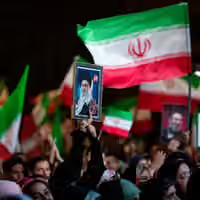
Iranians have flooded social media with dark humor and mocking comments about the delayed burial of Supreme Leader Ali Khamenei after authorities on Wednesday canceled a planned procession and what they described as a public farewell to his body due to security concerns.
The situation triggered a wave of posts across social media platforms, particularly on X, many of them sarcastic, angry or openly celebratory.
One widely shared comment drew a comparison with the authorities’ treatment of families whose relatives were killed during protests.
More than 36,500 Iranians were killed by security forces during the January 8-9 crackdown on nationwide protests, making it the deadliest two-day protest massacre in history, according to documents reviewed by Iran International.
“In the past two months a man named Ali Khamenei did not allow families of people killed on his orders to hold funerals,” one user wrote. “Now for five days the body of that same man has been kept in a refrigerator and they cannot even issue permission for his burial. What goes around comes around.”
Iranian media have released images showing preparations at Tehran’s prayers ground for the placement of the body of Iran’s late Supreme Leader Ali Khamenei.
Another post mocked the uncertainty surrounding funeral arrangements. “The funeral procession for Khamenei will be held online through the Shad platform,” a user wrote, referring sarcastically to the government-linked education app used by Iranian schools when classes move online during crises.
Some comments echoed remarks previously made by a state television host who had mocked the deaths of protesters.
Public anger erupted last month after a presenter on Ofogh TV, a channel run by the state broadcaster IRIB and affiliated with the Revolutionary Guards, referred to reports that thousands killed during the January crackdown were transported in refrigerated trailers. The program made a multiple choice question about where to keep the bodies of protesters. The show aired a segment posing a multiple-choice question about where the bodies of protesters should be kept.
“Which refrigerator do you think they are keeping Khamenei’s body in?” one user wrote, listing options such as “Netanyahu’s refrigerator,” “an ice-cream factory freezer,” and “the freezers of Antarctica.”
Others used darker language. “The stench of Khamenei’s corpse has spread across the Middle East and they still do not dare bury it,” one user wrote.
Another post said: “Six days have passed and the rotten body of Ali Khamenei is still lying on the ground.”
Some users circulated images of a dead rat with captions claiming sarcastically that the first photo of Khamenei’s body had finally been released.
Many posts framed the mockery as a form of symbolic revenge.
“Khamenei left a deep wound in people’s hearts and denied grieving families the right to mourn,” one user wrote. “His agents buried bodies secretly. Now after days his own body is still on the ground.”
Others referenced reports that some families had been asked to pay for the bullets used to kill their relatives in order to receive their bodies.
“I heard Khamenei’s body has started to rot with worms,” one user wrote. “If you don’t have money for bunker-buster bombs, at least bury him.”
Another post revived a Persian saying about burial rites. “They used to say a corpse never stays on the ground,” the user wrote. “Even if someone has no one, eventually the municipality will bury them. But six days have passed and the body of Ali Khamenei is still lying there.”
“Israel said to return the body of Ali Khamenei, the Islamic Republic must pay for the missiles it fired, or his family must admit he was part of a Mossad spy team,” one post read, referring sarcastically to reports that families were sometimes asked to sign papers declaring their children Basij members in order to receive their bodies and permission for burial ceremonies.
Others suggested that authorities might abandon plans for a burial altogether.
“It seems they have given up burying Khamenei,” one user wrote. “Maybe they are waiting for the US Navy to throw the carcass into the sea.”
“Khamenei’s body should be bombed again,” another post said. “I’m still not satisfied.”
Britain’s charity regulator issued fresh guidance on Thursday warning charities to exercise caution in their activities related to Iran as tensions in the region intensify, and said it would act on any evidence of links to extremism or terrorism.
The Charity Commission said charities could be affected in different ways by the “volatile situation” in Iran and the wider Middle East and urged trustees to carefully assess the risks of political activity, public statements and overseas operations.
The watchdog said organizations working in or commenting on Iran should be mindful that individuals and groups in the country are subject to sanctions and other restrictions under UK law.
“As a civil regulator we will respond robustly to evidence of links between charities and extremism or terrorism,” a Charity Commission statement said. “We will make referrals to other agencies where appropriate including where there is evidence of criminality.”
Trustees were reminded that any political activity must directly support a charity’s stated purpose and comply with regulations governing campaigning and social media use.
“In the current context, the Commission urges charities to be careful to ensure that any political activity they are involved in furthers their charity’s objects and complies with our guidance,” the regulator said.
The statement comes amid longstanding concerns in Britain that networks connected to Iran have used charities and religious organizations to promote political influence.
Several UK-based charities have faced investigations in recent years over alleged links to groups aligned with Tehran.
In 2024, the Charity Commission opened a compliance case involving the London-based Dar Alhekma Trust and the Abrar Islamic Foundation following a dossier alleging connections to organizations backed by Iran. Both groups deny wrongdoing.
Other organizations have drawn political criticism over activities seen by some lawmakers as promoting narratives aligned with the Islamic Republic. Conservative MP Bob Blackman last year accused Iran-linked groups of exploiting Britain’s charity sector to expand influence and “sow discord” in local communities.
Security officials and lawmakers have also warned that Tehran has used networks in Europe to extend ideological influence, even as regulators emphasize the need to balance scrutiny with protections for lawful religious and charitable activity.