Amid international pressure to slow war efforts, Israel's PM is standing firm in his mission to rid Gaza of Iran-backed militia Hamas, urging the international community to instead pressure Iran, the region's biggest state sponsor of terror.
Addressing the international community, Benjamin Netanyahu urged a shift in focus towards the true threats in the region. "Instead of putting pressure on Israel, which is fighting a just war, against an enemy that cannot be more cruel, direct your pressure against Hamas and its patron, Iran," he urged.
Netanyahu and his ally of decades, Joe Biden, have endured increasing strains on their relationship in the wake of the Gaza war, in which Hamas claims over 30,000 civilians have been killed and the UN claims Gaza is on the brink of starvation.
"Since the beginning of the war, we have been fighting on two fronts - the military front and the political front," Netanyahu stated on Sunday at the opening of the State Security Cabinet. "There are those in the international community who are trying to stop the war now, before all its goals are achieved."
Netanyahu appeared to reference recent remarks from US Democrat leaders, including President Joe Biden and Senate Majority Leader Chuck Schumer, whom he accused of attempting to impede Israel's efforts to both rescue the more than 130 hostages still in Gaza, and to wipe out Iran-backed terror group Hamas.
"They do this by making false accusations against the IDF, against the Israeli government and against the Prime Minister of Israel," Netanyahu claimed. "And they do this because they know that elections now will stop the war and paralyze the country for at least six months."
Netanyahu reiterated the need to continue with the country's military mission, "If we stop the war now, before all of its goals are achieved, it means that Israel has lost the war, and we will not allow that."
While the US was quick to support Israel's right to defend itself in the wake of the atrocities of Hamas's invasion on October 7, when 1,200 mostly civilians were murdered and 250 more taken hostage in Gaza, the massive death toll and international backlash has seen Biden step back, with threats to slow the flow of arms to Israel.
A US Air Force airman marshals an F-16 Fighting Falcon aircraft assigned to the 480th Fighter Squadron, at the 86th Air Base near Fetesti, Romania, February 17, 2022.
Renowned Tehran academic Mohammad Fazeli suggests that Iran could incur a loss of 35 quadrillion rials (roughly $60 billion) if the United States were to target its power plants in an attack.
Fazeli, responding to a hypothetical scenario during an interview with Khabar Online website in Tehran regarding a potential US attack on Iran's infrastructure, estimated a loss of roughly $60 billion specifically in the area of power generation. The question stemmed from alleged suggestions by some Iranian opposition figures urging US officials, particularly during the Trump Administration before 2020, to target Iran's infrastructure.
The sociologist expressed skepticism about whether the Iranian people would welcome such an attack. "I would not readily embrace such a notion. Do those proposing such actions believe that the world will rebuild power plants for Iranians after an attack?" questioned Fazeli.
Most among Iranian opposition groups and individuals demand regime change in Iran and demand that sanctions be maintained and strengthened against the Islamic Republic. A few might have even suggested in the past that military strikes may hasten the regime’s fall.
Fazeli went on to remark, "I cannot claim that my own over 150,000 followers represent the entirety of the Iranian populace." He emphasized, "Advocating for strikes on Iran and speaking in such terms normalizes malevolence. An attack on Iran is unequivocally evil. History shows that attacks on countries have never brought happiness to their people."
Academic Mohammad Fazeli
"If such an attack were to occur on any country, it would regress to the Stone Age; without electricity, there would be no water, internet, television, refrigeration, or anything," the sociologist remarked, continuing, "America attacked Iraq 20 years ago. Inquire with those who pilgrimage to Iraq. Ask them if Iraq is a developed country. Also, consider Libya. Even after 30 years since the war with Iraq, Khoramshahr and Abadan in Iran have yet to be rebuilt." Fazeli reiterated, "In the 21st century, the destruction of infrastructure signifies eternal ruin." Additionally, he suggested that reforming the system and rectifying the status quo without further fatalities and destruction is less costly than a destructive attack that leads to foreign humiliation. "We should not transition from a dire situation to absolute evil."
Moreover, Fazeli had previously drawn parallels between Iran's current state and the pre-revolution period of 1979, noting a high demand for political participation coupled with limited opportunities, which he believes could lead to instability.
Transitioning from hypothetical scenarios to real-world negotiations, former Iranian influential lawmaker Heshmatollah Falahatpisheh asserted that US-Iran talks primarily served to assuage President Biden's concerns about the upcoming election. Falahatpisheh disclosed that the discussions in Oman aimed to address Biden's electoral worries, with the US agenda dictating the terms while Iran had minimal input.
Falahatpisheh lamented missed opportunities for détente between Iran and the US, suggesting that Tehran sacrificed potential reconciliations with America over its involvement in conflicts like Ukraine. Despite ongoing talks in Oman facilitated by Omani intermediaries to curb Houthi attacks on Red Sea shipping, Falahatpisheh observed that Iran had made few gains.
The prospects for Iran remain bleak, with scant progress made in negotiations. However, amidst these discussions, Iraq secured approval from Washington to pay in hard currency for Iranian electricity and natural gas it imports.
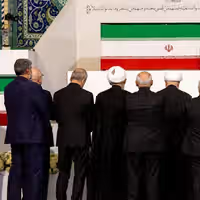
Iran’s Vice President Mohammad Mokhber (top right) and Oil Minister Javad Owji (top left) watching over as CEO of the National Iranian Oil Company (NIOC) Mohsen Khojasteh Mehr (2nd right) signs a contract with CEO of Dasht Azadegan Arvand consortium Hossein Zanganeh for development of the southwestern Azadegan oilfield, Tehran, March 17, 2024
A week after signing a $20 billion natural gas extraction contract with domestic companies, Iran has granted a new $13 billion deal to the same group for expanding production at six oil fields.
These contracts, announced on Sunday, aim to increase the country’s oil production capacity by 200,000 barrels per day. However, most of the contracts are associated with a highly complex project that has awaited Western technology for years.
The largest of these contracts involves the development of the Azadegan oil field, which is shared with Iraq (known as Majnoon in Iraq). China's Sinopec began work on this field but left it half-finished in 2018 after the United States imposed sanctions on Iran. Azadegan is Iran’s largest oil reserve, but its structure is extremely complex, with only a 6% recovery rate. In simpler terms, under normal conditions, only 6% of its oil reserves can be extracted, leaving 94%, equivalent to 31 billion barrels worth $2.6 trillion, inaccessible without advanced Western technology.
On March 17, the Iranian oil ministry signed an $11.5 billion contract with 11 domestic firms, led by Advand Azadegan Company. This entity, established only in December 2022, lacks a significant track record in oil exploration and extraction. Another contract pertains to Masjid Soleyman, Iran's oldest oil field, which began producing oil 113 years ago but has faced a significant decline in production. Despite still holding 5 billion barrels of oil reserves, it requires increased pressure and recovery rate enhancement.
Masjedsoleyman's productivity has declined sharply from 170,000 b/d in 2017 to 5,000 in 2023. The new contract aims to add only 9,000 b/d to the current level, with 80% of its reserves remaining untapped. Iran's oil fields, with 650 billion barrels of oil in situ reserves, typically have a recovery rate of about 20%, highlighting the need for advanced Western technology to boost extraction rates.
Each 1% increase in the oil recovery rate translates to $550 billion more in revenue for Iran. However, it remains unclear what technology domestic companies will employ for these developments. Moreover, the question arises: if domestic firms possess this capability, why were these complex fields not entrusted to them earlier?
About 80% of Iran’s active oil fields are in the latter half of their life cycle, experiencing an annual productivity decline of 8-12%. To maintain production levels, Iran requires 300 million cubic meters of gas injection into these fields, yet it only injects 30 mcm/d due to natural gas shortages.
Other four contracts
In addition to these two fields, contracts for the development of Azar, Somar, Saman, and Delavaran oil fields will also be signed with domestic companies. Previously, Iran had contracted the development of the Azar oil field with Russia's Gazprom, but the company's delays led to the cancellation of the contract last year. Similarly, over two decades ago, the government had signed the same contract with IRGC’s Khatam-al Anbiya Construction Headquarters, yielding no results. Subsequently, a memorandum of understanding was signed with Polish PGNiG in 2017, also without any tangible progress.
Iran’s oil ministry announced the signing of three contracts to develop the Somar, Saman, and Delavaran oil fields on March 17. However, Mehdi Heidari, CEO of the Iranian Offshore Oil Company, responsible for operating these fields, stated in June 2022 that domestic companies were already engaged in their development.
Participants posing for a group photo at a signing ceremony to develop several Iranian oil and gas fields, Tehran, March 17, 2024
$20-billion worth gas contract
Iran's Oil Ministry finalized a $20-billion agreement with multiple domestic firms on March 10 to erect 28 platforms, each weighing 7,000 tons, and install 56 compressors to enhance pressure at South Pars. This move is made despite Iranian companies' lack of experience in manufacturing such equipment, and even Chinese firms lack the requisite technology. Chinese CNPC, previously part of the Total-led South Pars Phase 11 development consortium, exited the deal a year after Total. Notably, half of the $5-billion contract value for the South Pars Phase 11 development was allocated to constructing a 20,000-ton platform with two massive compressors, a task surpassing the capabilities and technological know-how of the Chinese company.
Until recently, the wellhead pressure in the Iranian sector of South Pars remained steady at an average of 210 bars. However, since 2023, its pressure has started declining by 7 bars annually, resulting in a loss of 10 bcm each year. Significant pressure fall in Phase 12, the largest phase of South Pars, has already begun in recent years, with output levels declining from 65 mcm/d in 2018 to the current 43 mcm/d, according to a report from the National Iranian Gas Company, as reported by Iran International.
Iran had ambitious plans to produce 85 mcm/d of gas from Phase 12 by launching three platforms. However, due to erroneous drilling engineering at the location of the third platform, a substantial portion of its production turned out to be brackish water instead of natural gas. Consequently, production from this phase was slashed to 65 mcm in 2018 and dropped to 34% in 2023. Ultimately, Iran relocated the third platform from Phase 12 entirely to Phase 11 of South Pars last summer.
Across the 24 phases constituting the Iranian section of South Pars, approximately 10 wells have encountered engineering mishaps, resulting in the production of more brackish water than gas. In an effort to salvage production levels, Iran initiated Phase 11 of South Pars in August 2023 and launched a drilling spree. Additionally, the Iranian Ministry of Petroleum inked a deal in November 2023 to drill 35 new wells with domestic companies. However, while additional drilling may sustain gas production levels from South Pars in the short term, it is anticipated to hasten pressure decline in the Iranian section.
Iran's only recourse lies in the installation of 20,000-ton platforms equipped with massive compressors—a technology monopolized by Western companies. Currently, all 24 phases of the Iranian side of the field are operational, leaving no room for the introduction of a new phase to bolster production or offset output declines from other phases.
Hossein Razzagh, a political activist and dissident who was imprisoned until recently, has lodged a formal complaint against authorities within the Ministry of Intelligence at Evin Prison.
Razzagh's complaint, as reported on his Telegram channel, cites multiple instances of "repeated physical assaults" endured in Section 209 of the prison, which falls under the jurisdiction of the Ministry of Intelligence.
Razzagh, known as one of the founders of the "Azadi Square" discussion room on the Clubhouse social network, was arrested in December 2021 at his residence in Amol. His complaint outlines his mistreatment during the 19 months of imprisonment. Particularly alarming was an incident on October 7, 2023, when Ministry of Intelligence officials and agents subjected him to severe beatings following insults and harassment.
According to the report, after the assault, Razzagh was chained with his hands and feet bound together and confined to the airlock of the detention center for several hours.
The ordeal endured by Razzagh, compounded by the confirmation of multiple physical illnesses by forensic medicine, underscores the ongoing concerns regarding prisoner torture within Iran's judicial and security apparatus.
This case adds to the broader narrative of systemic abuse, wherein prisoners face various forms of coercion, punishment, and deprivation of rights, as detailed by human rights organizations and former detainees. The urgent need for accountability and reform within Iran's prison system remains a pressing concern for international observers.
Mahmoud Najafi Arab, the head of the Tehran Chamber of Commerce, has sounded the alarm over the dire state of Iran's pharmaceutical industry, declaring it engulfed in crisis.
He attributed the situation to the Central Bank's contract system in the field of medicine currency supply, exacerbating capital shortages across various industries, including pharmaceuticals.
Arab highlighted the plight of numerous pharmaceutical companies struggling to meet their financial obligations, particularly in paying employees' salaries and end-of-year bonuses.
“These challenges stem from the same capital scarcity affecting all sectors, further deepening the crisis in the pharmaceutical industry,” he noted.
Shortages have disrupted the production of essential medicines, raising widespread concerns among pharmaceutical companies.
Local media reports indicate a scarcity of common medicines and crucial drugs essential for hospitals amid global sanctions, intensifying the healthcare crisis.
Iran's economic woes, exacerbated by a plethora of sanctions, have strained the government's capacity to allocate foreign currencies.
With inflation hovering around 50 percent, Iran faces a complex economic predicament directly impacting the healthcare sector and citizens' well-being.
Amid Iran's deteriorating healthcare system, the nation's muscular dystrophy support association cautioned in December that numerous Iranians afflicted with the disease have been compelled to seek sanctuary overseas for access to complimentary medical treatment.
Kazem Sedighi (left) during Tehran’s Friday prayer on the last Friday of the Iranian year on March 15, 2024
A case of a large land grab by Tehran’s interim Friday prayer Imam, Kazem Sedighi, has sparked uproar in Iran, adding to the growing list of corruption scandals implicating regime insiders.
Sedighi, a cleric trusted by Supreme Leader Ali Khamenei, found himself embroiled in controversy following the publication of documents in recent days revealing that he and his sons took over a 4,200-square-meter (45,200 sq feet) garden at a prime location in northern Tehran through a family company.
The lot, estimated to be worth approximately $20 million, is adjacent to a seminary that Sedighi founded about 20 years ago and has presided over ever since. The land was originally owned by the seminary and was transferred to the family company owned and led by Sedighi and his two sons. Other people from Sedighi’s close circle, including his daughter-in-law Rezvaneh Ghavam and the chief of his security detail Fazlollah Beigverdi, hold positions in the company, established in June 2023.
The documents were leaked by Yashar Soltani, a well-known whistle blower who has exposed numerous high-ranking officials of the Iranian government, ranging from Revolutionary Guard generals such as the slain Quds Force commander Qasem Soleimani, to lawmakers such as parliament speaker Mohammad Bagher Ghalibaf.
An aerial photo of the land (circled in red) and Sedighi’s seminary (in orange)
Sedighi has asserted that he was unaware of the land's title transfer, reopening an old wound that many Iranians know all too well from countless similar cases. The hardline cleric stated on Sunday that his signature was forged, sparking outrage online. People argue that a forged signature is used to obtain something from someone without their consent or awareness, rather than providing it to them.
Journalist Behnam Gholipour has dug up a series of Sedighi’s remarkable statements in the past about the metaphysical realm, pointing out that the cleric tells anecdotes beyond the physical world, but claims ignorance about a piece of land owned by him. Sedighi has famously claimed that Khamenei has contact with a figure in Shiite Islam believed to be in occultation since 941 CE. Sedighi also claimed that his late teacher, Ayatollah Mohammad-Taqi Mesbah Yazdi, momentarily came back to life in the morgue.
Another argument circulating online is that even if he had no prior knowledge of the transaction that granted him the land, now he does. People question why he has not taken steps to return the land.
Iran's recent history is marked by myriads of corruption cases implicating a broad spectrum of the regime's top brass and dignitaries, who wield significant influence over the country's laws and regulatory bodies with impunity.
Last year, it was revealed that Ayatollah Ahmad Alamolhoda -- the firebrand Friday prayer Imam of Mashhad and the father-in-law of President Ebrahim Raisi, who controls one of Iran's biggest religious endowments -- was pocketing a monthly cut of approximately $200,000 for at least seven years.
Kazem Sedighi leading Tehran’s Friday prayer on the last Friday of the Iranian year on March 15, 2024
Another high-profile case was Ayatollah Kazem Nourmofidi, the representative of Khamenei in the northern Golestan province, whose control over the province’s forest exploitation has always been known among locals. He owns the largest wood businesses in the region and his offspring are involved in at least 20 wood companies. Nourmofidi, who is the brother-in-law of another great ayatollah Mohammad Fazel Lankrani, is pocketing hundreds of thousands of dollars per month for wood smuggling from the lush forests of northern Iran. Another Friday imam who is taking advantage of his relationship with Khamenei is Zeinolabedin Ghorbani, the former representative in Gilan province. He started a shopping mall project in the city and pre-sold the units but never delivered them. People who paid found no remedy in courts controlled by clerics. These were only a few cases revealed in 2023.
The Friday Prayer Imams, Khamenei's regional representatives pushing the regime's ideology and rhetoric, are infamous for enjoying immunity from the law. There are more than 900 Friday Prayer Imams across Iran, as well as 290 members of the parliament, 31 provincial governors, thousands of judges and thousands of senior IRGC members.