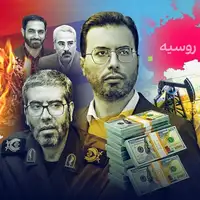
Hard To Deal With Massive Corruption In Iran, Says Whistleblower

A well-known whistleblower and investigative journalist in Iran says people in the Islamic Republic political system are not accountable for their performance.
A well-known whistleblower and investigative journalist in Iran says people in the Islamic Republic political system are not accountable for their performance.
Yashar Soltani, who has spent some time in jail in 2016 for disclosing financial corruption at Tehran Municipality under current parliament speaker Mohammad Bagher Ghalibaf, added in an interview with Etemad Online that the way government treats financial corruption is woefully disappointing.
The multi-billion dollar case involving the former mayor, a figure close to Supreme Leader Ali Khamenei, ended in the arrest of Isa Sharifi, one of Ghalibaf's deputies and was finally pushed under the carpet although Khamenei in 2018 called for investigation into the case. Sharifi's name came up once again in February 2022 along with Ghalibaf's in a major corruption case at the IRGC, which also remained inconclusive after a few weeks of controversy stirred by rival political factions in Iran.
The controversy about the IRGC corruption case was silenced soon possibly because even former IRGC Qods Force Commander Qasem Soleimani was also involved, as revealed in an audio tape that was leaked in the public domain presumably by those who benefitted from the revelations.
As a whistleblower who has been exposing financial corruption in Iran since the 1990s, Soltani says that corrupt individuals have never left the system even after their performance was exposed, and corruption is constantly on the rise. He added that the Iranian justice system discriminates in favor of corrupt individuals when they are close to the core of the regime, namely Khamenei's household.
He said: "Fighting corruption is part of the people's demands as the magnitude of government corruption is so high that the regime has no way but to try to control it through introducing reforms in the system." However, he acknowledged that most of the rhetoric about fighting government corruption is just a show, often with the intention of winning the people's attention at election times or to calm the situation when there are major protests.
Soltani pointed out that while corruption trials were held openly and the people could watch hearings on live TV in the 1990s, corruption cases are now shrouded in an aura of secrecy. Soltani reiterated that as long as talk about corruption is aimed at beatifying the political system or garnering support for a group of candidates, there will be no hope in controlling it.
Nonetheless, there seems to be some progress in the process. "When I disclosed the astronomical real estate case [in Tehran municipality] in 2016, I was jailed immediately, but five years later I was called for consultation for writing a new law to prevent that kind of corruption as part of which the Municipality gave land and buildings to influential individuals to garner their support," Soltani recalled.He added that regardless of his help, the Iranian Judiciary has been summoning him during the past 11 years to subtly warn him about his whistleblowing activity.
"They ask why me and not the intelligence agencies investigate a case. Well, the intelligence agencies did their own research but what they got nowhere because there are flaws in the structure of the government," he said, adding that, "There are only four or five people who continue as whistleblowers, and all of them like me work single-handedly without any support from anyone in the system."
Referring to the problems in the system, he said the corruption case at the Petrochemical Complex (PCC) was a major case. But there were a few stage-managed court sessions and nothing more happened.
He was referring to a case of hundreds of million of dollars embezzled by officials who were tasked to sell Iran’s petrochemical products through obscure channels and return the money to the treasury during international sanction in 2010-2013.
Soltani concluded: "There are so many inconclusive cases about financial corruption in Iran. In a corrupt structure you cannot claim to be dealing with corruption."