Iran Teachers Boycott Sham Election To Protest Against Lack Of Democracy
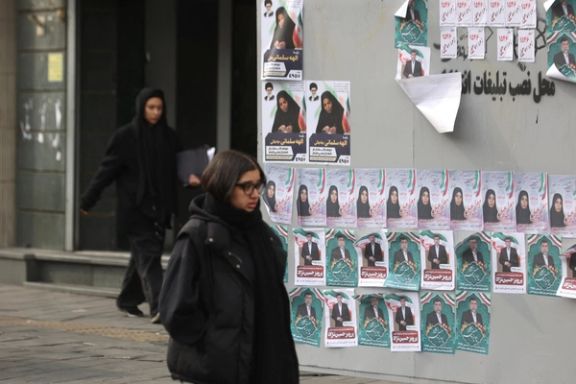
Iranian teachers have vowed to boycott Friday’s parliamentary elections, joining a widespread protest against the lack of true democracy.

Iranian teachers have vowed to boycott Friday’s parliamentary elections, joining a widespread protest against the lack of true democracy.
In a statement, the Coordination Council of Teachers Associations in Iran announced its decision to abstain from participating in the vote.
The council cited concerns over the control of “all aspects of the economy, politics, culture, security, and judiciary by the subordinate branches of appointed institutions”.
It comes as a growing number of political, social, and cultural activists have also vowed to join the boycott, with over 275 people having already declared their intention to abstain from the March 1 elections for the parliament and the Assembly of Experts.
Prisoners of conscience who have been jailed for their opposition views have also declared they will not vote.
In response to the growing boycott, Mustafa Rostami, the head of the Office of the Supreme Leader's Representative in Universities, urged the public to take part in the elections.
He said on Thursday: "Those seeking to disintegrate Iran will receive a strong response through public participation in elections."
He added in an extraordinary outbust: "Opponents of participation in elections are those who support the killers of women and children in Gaza and do not value the people's votes."
The backdrop to the political climate includes widespread opposition among Iranian voters to the regime's foreign policy, particularly its support for Israel. The dissent is fuelled by dissatisfaction with domestic governance, disillusionment with the political system's lack of accountability, and disapproval of Iran's involvement in conflicts abroad.
Iran's political landscape is characterized by significant authoritarianism, with power concentrated in the hands of Supreme Leader Ayatollah Ali Khamenei and unelected bodies like the Guardian Council. The lack of political competition and accountability further discourages participation in the electoral process.


On the eve of the elections in Iran, the regime has drastically stepped up its measures to target dissidents and critics and simultaneously, to lure the unwilling citizens to vote.
It comes as the Islamic Republic has launched a renewed crackdown on citizens and dissidents advocating a boycott of the vote.
Iran’s parliamentary and the Assembly of Experts elections will be held on March 1. On Wednesday, Mohammad Hossein Poursani, Deputy Minister of Education, announced the recruitment of students as “representatives of the governor” in the voting.
Government officials had previously repeatedly warned about the presence of students in cyberspace, but as the election nears they seem to be taking a softer approach at least temporarily.
Praising youngsters’ technological awareness, Poursani said: “Students today are those of cyberspace, Artificial intelligence (AI) and the Metaverse, and they live in an atmosphere maybe several years ahead of us.”
He added that the Shad educational application, which is used by millions of school students across Iran to access educational materials, has been employed for election campaigns.
According to the latest data, more than 16 million students are enrolled in the current school year.
The regime has tried to use students to reach out to their families and neighbors in a bid to bring them to the polls.
In his Wednesday speech for the youth voting for the first time, Iran’s Supreme Leader Ali Khamenei urged them to encourage their classmates, parents, friends and relatives to participate in the elections.
Some government institutions, including the University of Tabriz, have vowed to give presents to the first-time voters.
Soldiers Who Vote Will Be Granted Incentive Leave
Meanwhile, military authorities in Iran have tried to capitalize on soldiers and officers in order to increase the voter turnout.
Iran's infamous police chief Ahmad-Reza Radan said that the soldiers serving in the police force will be granted four days of incentive leave in exchange for participating in the elections.
As the election security is ensured, it is the “duty” of the citizens to vote, Radan went on to say.
Threatening And Arresting Dissidents
While political activists, opposition parties and large sections of the public have pledged to boycott the elections, Iran’s security and intelligence institutions have mounted their pressure to prevent boycott campaigns.
According to West Azarbaijan police force commander Rahim Jahanbakhsh, 50 political dissidents in the province posting calls online for a boycott of upcoming elections were arrested.
Any calls to boycott the elections will be dealt with, he threatened.
Some activists also reported that they received threatening text messages from Iran’s judiciary over launching or supporting boycott campaigns on their social media pages.
Manipulation Of The Voting Process
Some government efforts to engineer elections have focused on the voting process.
Iran’s Election Office has announced that the ballots for both parliamentary and the Assembly of Experts elections are given to the voters in one sheet. This means that those who choose to vote in one election will necessarily have to participate in another as well.
Unlike the previous elections, citizens will not have to carry their birth certificates to vote. According to the regime officials, those eligible to vote can participate in the elections only by showing their passports, national identifications or military service cards.
Moreover, stamping the birth certificate has been removed from the voting process.
A Statistical Leap In Government-Backed Polls
Polls conducted or reported by government agencies indicate a sharp increase in voter turnout.
Iranian Students Polling Agency (ISPA), affiliated with the Supreme Council of the Cultural Revolution, reported a projection of 50% turnout.
This is while ISPA had said two months ago that only 28% of the Iranians were expected to vote.
Meanwhile, the Islamic Republic of Iran Broadcasting (Seda va Sima), whose head is appointed by the Supreme Leader, announced 70% of the electorate will participate in the elections.
These statistics counter the results of independent polls. A telephone poll conducted from abroad by Washington-based Stasis Consulting revealed that turnout in Iran’s upcoming parliamentary elections is set to hit a new record low of just 34 percent.
The projection is 9% down on the last elections four years ago, already the lowest turnout at the time.

The US government censured Iran’s electoral system as “opaque” and “undemocratic”, just hours before polls opened in the country’s parliamentary elections on Friday.
"I suspect that a great number of Iranians have no expectation that those elections will be free and fair," the state department spokesman Matthew Miller told reporters.
This will be the first election after the widespread 2022 protests in Iran, which deepened and widened the rupture between the regime and ordinary Iranians. There’s very little appetite for participation in what many people consider an "official show." The turnout will likely be low, especially in major cities and urban areas.
"As you probably already know, thousands of candidates were already disqualified in an opaque process,” Miller said, “The world has long known that Iran's political system features undemocratic and non-transparent administrative, judicial and electoral systems.”
Candidates are heavily vetted before they can stand for election. The 12-member Guardian Council, whose members are either appointed or suggested by the leader Ali Khamenei, bars anyone that it thinks may not be fully loyal to the core of the regime.
The vetting process seems to be stricter than ever, leaving the voters with no real choice. But many Iranians seem to not care even about the vetting, having lost hope in the system’s willingness or capacity to change through elections.
Over its past few terms, the Iranian parliament (aka Majles) has become more and more subservient to the two real sources of authority in the Islamic Republic: the Leader and the Revolutionary Guards –who make the key decisions that concern the US and its allies.
Most observers, including US officials, seem to have realized that the parliament is more or less irrelevant to the key decisions.

Twelve women's rights activists who were arrested last year for alleged involvement with planned unrest in Iran are awaiting the verdict after being tried in a regime court.
Activists including Sara Jahani, Hooman Taheri, Yasamin Hashdari were charged with offences including "anti-establishment propaganda" and "membership in an illegal group".
They faced proceedings under Judge Mehdi Rasekhi in a revolutionary court in the northern city of Rasht on Thursday
The defendants were represented by their lawyers Mustafa Nili, Ramin Safarnia, and Mohammad Ali Kamfirouzi.
Sources reported that at the conclusion of the court session, the judge announced that the trial had ended, and the activists would await the verdict.
The women were detained by security institutions of the Islamic Republic in cities including Rasht, Fooman, Anzali, and Lahijan on August 16. The Intelligence Office of Gilan Province confirmed their arrest, alleging their involvement with "foreign elements" and planning to incite unrest and sabotage on the anniversary of the 2022 uprising against regime in Gilan and Kordestan.
After spending approximately two months in custody, the activists were temporarily released from Lakan Prison in Rasht upon posting bail.
The Islamic Republic has faced criticism for its consistent detention and imprisonment of civil and political activists. The nationwide uprising against the Islamic Republic since September 2022 has seen intensified suppression of dissenting voices by the government, with activists continuing to face harassment and imprisonment.

A former leading Iranian lawmaker has claimed the alliance between Tehran and Moscow has led to a “betrayal” of the national interest.
Heshmatollah Falahatpisheh, who was head of the Iranian parliament’s foreign policy committee, said Iran’s hopes for success in nuclear negotiations had been “crushed under the boots of the Russians”.
He was speaking after Foreign Minister Hossein Amir-Abdollahian admitted in an interview with the Hezbollah-affiliated news channel Al-Mayadeen that the talks had been adversely affected by Vladimir Putin’s war against Ukraine.
In comments that suggested Russia’s invasion had harmed Iran negotiations, Amir-Abdollahian said: “We had serious negotiations with other parties but at one point, the outcome of our discussions was affected by the atmosphere of the Ukraine war.”
But in response to the foreign minister’s comments, Falahatpisheh said it is too late to confess that the interests of Iran had been sacrificed to Russia.
“I had already warned that the JCPOA nuclear accord and other national interests could be crushed under the boots of the Russians and it finally happened. Unfortunately, more betrayals [from Moscow] are to come,” added Falahatpisheh.
Diplomatic observers believe Russia has exploited the negotiations over Iran’s nuclear programme in an attempt to pressure the West and for concessions over Ukraine.
Iranian dissidents have accused the regime in Tehran of ignoring national interests and providing unconditional support to its allies Russia and China in the international arena.
Last week, Ahmad Khorram, former Roads and Transportation Minister under President Mohammad Khatami, criticised Tehran’s policy of giving multiple concessions to Beijing and Moscow.
He said past experience shows that both China and Russia collaborated with the US in banning Iran’s nuclear program and were the first states to back Security Council resolutions against Iran.

Two candidates vying for the Assembly of Experts election in Tehran suggest that Supreme Leader Ali Khamenei opposes the notion of naming his son, Mojtaba, as his successor.
However, the timing and context of these statements on Wednesday, just two days before the March 1 elections, raise questions about their authenticity and purpose.
For many years, Iranians and Iran watchers have wondered if Khamenei has been grooming his son to succeed him, especially with presenting him as a religious scholar, a trait seen as important for the future ruler.
The Assembly has the constitutional role of selecting the next ruler after Khamenei’s passing and its composition important for the Supreme Leader.
Mahmoud Mohammadi Araghi, a cleric close to Khamenei and a current Assembly of Experts member, stated in an interview with the Iranian Labor News Agency (ILNA) that Khamenei has voiced his disapproval of the committee's suggestion to appoint his son as the next leader. The committee which includes President Ebrahim Raisi is composed of three Assembly of Experts members to identify suitable successors for Khamenei and to introduce them to him for consideration.

Similarly, Mostafa Pourmohammadi, another candidate for the AoE election whose credentials were first rejected by the Guardian Council and then approved at the last minute, has also reiterated that Khamenei is against the idea of hereditary succession.
However, Pourmohammadi emphasized his readiness to support any candidate deemed fit to succeed Khamenei, irrespective of their familial ties.
The timing of these remarks and Iranian officials including Khamenei's concerns about an expected low turnout that endangers the regime's legitimacy gives rise to speculations about these remarks having been dictated by Khamenei to tell the voters that their voting will not be meaningless and that his successor has not been chosen beforehand.
On the other hand, Mohamadi Araghi's account of Khamenei's opposition to hereditary succession dates back to nearly three decades ago when Khamenei was not as confident and arrogant as the present time.
The remarks made by the two candidates about Khamenei's opposition to hereditary succession come only a few days after several AoE members confirmed that the committee of three has already made its decision about the succession. One Assembly of Experts member who was sure about the process of selecting the next leader having been completed, said that his name will not be revealed as officials fear that foreign agents might assassinate him!
Despite the suggestions about Khamenei's opposition to hereditary succession, some clerics such as Qom Seminarian Sadeq Mohammadi insisted that Khamenei's son Mojtaba is still one of the choices for succession.
Mohamadi Araghi also made other controversial statements apparently aimed to pacify disgruntled voters to go to the polls for the parliamentary and AoE elections on Friday. He said the Islamic Republic's former and current leader have always preferred non-clerics as President and cabinet ministers. However, five of Iran's eight presidents since 1979 have been clerics.
Asked about why he thinks the Guardian Council barred former President Hassan Rouhani from running for a seat on the Assembly, Mohammad Araghi said the rejection of Rouhani's qualifications was probably related to matters other than his religious and academic credentials, but he refused to say what those matters were.
Rohani had said earlier that the next round of the Assembly of Experts is more important than the previous rounds as it might be time for the Assembly to make tough decisions about succession. Mohammad Araghi also said that Khamenei is aging and most probably electing the next Supreme Leader will have to be done by the new Assembly of Experts.
However, if the committee and Khamenei have already chosen the successor, the Assembly will become redundant, and its decision may not be needed. To be on the safe side, like several other AoE members, Mohammadi Araghi also said that he hopes Khamenei will be alive until the Shiites' hidden Imam emerges from occultation, where they believe he has been for nearly 14 centuries.