Activists Boycott Elections In Iran Questioning Legitimacy

Over 275 political, social, and cultural activists have announced their decision to abstain from participating in the forthcoming elections in Iran.

Over 275 political, social, and cultural activists have announced their decision to abstain from participating in the forthcoming elections in Iran.
They argue that the polls have been manipulated to undermine the public's right to governance.
In a joint statement issued on Sunday, the activists stressed the urgency of reforming the electoral system to ensure genuine participation and representation.
The upcoming elections for the parliament and the Assembly of Experts, scheduled for March 1, are encountering boycotts from various sectors of society including notable figures, political factions, and even people incarcerated for their dissenting views.
"The failed politics of participation and presence in the elections, in any case and at any cost, has never succeeded, as evidenced by repeated trials and bitter historical experiences in recent decades," reads the statement.
Amidst growing skepticism, Ali Khamenei, the Supreme Leader of Iran, has called for public engagement in the elections. However, recent polls reveal significant disillusionment, with over three-quarters of Iranians expressing their intention to abstain from voting.
“Without a genuine revival of the electoral institution, real participation and presence will not occur,” added the statement.
In the previous elections for the parliament, over half of Iranians refrained from participating. Experts anticipate that the upcoming elections may witness historically low turnout rates, reflecting widespread disillusionment with the Islamic Republic's governance.

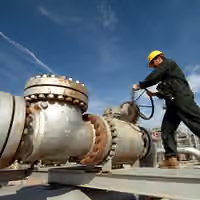
Iran and Pakistan once again are aiming to revive a gas pipeline project that has been languishing for more than a decade, amid sanctions and bilateral issues between the two neighbors.
The Iran-Pakistan gas pipeline, commonly known as the Peace pipeline or IP Gas, is a complex initiative influenced by geopolitical tensions, economic factors, and international sanctions. Initially designed to transport natural gas from Iran to Pakistan, the project has encountered numerous challenges since its inception.
In March 2013, Presidents Zardari and Ahmadinejad inaugurated the project near Iran's Chabahar port, signaling the start of the USD 7.5 billion venture. However, progress stalled due to US sanctions on Iran, despite Iran completing its portion of the pipeline. Negotiations must conclude by March 2024 to avoid legal complications, with Islamabad having until September 2024 to fulfill its obligations. Both nations are exploring strategies to complete the pipeline outside the scope of US sanctions, emphasizing the project's importance for their national interests.
Pakistan has employed various legal and diplomatic means to avoid penalties and has requested a waiver from the US regarding the project. The completion of the pipeline is crucial for Pakistan's energy security and to meet its growing energy needs, fostering economic and commercial ties between the two countries.

Challenges
In order to meet Pakistan's growing energy demands and guarantee energy security, the pipeline is considered essential.
Despite resistance from Western partners, Pakistan has made progress in advancing the pipeline project. The initial phase, covering 80 kilometers from Gwadar to the Iranian border, has received government approval and funding. However, securing financing remains a significant obstacle, with speculation that China and Russia may provide funding for the Pakistani segment of the pipeline.
However, several challenges hinder the Iran-Pakistan gas pipeline project, including US sanctions, financial constraints, geopolitical conflicts, and operational delays. Overcoming these obstacles requires strategic planning and collaboration between the two nations.
Its projected expenses of USD 7.5 billion are causing delays in obtaining sufficient finance. Because regional dynamics influence progress and decision-making, geopolitical conflicts introduce an additional degree of complication.
Iran’s natural gas shortage
Iran faces domestic natural gas shortages, impacting its energy exports and oil production. The reliance on gas exports despite scarcity and rising local demand poses economic challenges and threatens internal energy security. Resolving Iran's energy crisis and easing international sanctions are essential for the pipeline's feasibility and completion.
Reduced gas output poses a danger to Iran's oil production, which is hampered by low investments and technological constraints. Iran's ability to maintain its oil production is threatened by its gas shortage and continuous exports, since the country must pump about 300 million cubic meters of gas per day into its aging oil reservoirs to maintain production.
Iran's oil fields face peril, with its domestic sector strained by the nation's heavy reliance on gas exports amid scarcity and mounting local demand. This predicament underscores Iran's challenge in balancing energy needs between exports and internal consumption amid gas shortages. The economic repercussions of Iran's gas scarcity extend beyond harming businesses and income sources, posing a threat to the country's internal energy security. Addressing Iran's expanding energy requirements demands substantial financial investments, advancements in science, and efficient energy management practices.
The expansion of QatarEnergy's liquefied natural gas (LNG) production further underscores the competitive landscape in the global energy market. Iran's ability to address its energy shortages and navigate international sanctions will determine the future of the Iran-Pakistan gas pipeline project. Despite ongoing efforts to address challenges, uncertainties persist regarding the project's viability until Iran's energy situation improves and sanctions are lifted.
The feasibility of the Iran-Pakistan gas pipeline project hinges on Iran's ability to address its domestic natural gas shortages and the lifting of international sanctions. The project's future remains uncertain without resolving Iran's energy challenges and sanction removal. Despite ongoing efforts through project management and diplomatic channels, numerous barriers persist. While completing the pipeline could benefit both nations by meeting Pakistan's energy needs and enhancing bilateral ties, its progression depends on Iran's energy situation and the removal of sanctions.

On the eve of upcoming elections, the identity of Iran's future leader remains top secret, with a member of the Assembly of Experts citing security concerns amid assassination risks.
Mohammad Ali Jazayeri, the former representative of Khamenei in Khuzestan, admitted there is potential risk of assassination if the identity is revealed amid the country's worst civil unrest since the founding of the Islamic Republic in 1979.
On Wednesday, an official disclosed that President Ebrahim Raisi is one of three individuals designated by Supreme Leader Ali Khamenei to select the future leader of the Islamic Republic. Hassan Ameli, an Assembly of Experts member, confirmed Raisi's inclusion in the committee tasked with the decision, further solidifying Khamenei's confidence in Raisi's future role.
With Raisi initially the sole candidate from South Khorasan Province in the March 1 Assembly of Experts elections, the addition of a second candidate suggests formalities in the election process. However, questions remain regarding the Assembly of Experts' role in selecting the successor, as the committee of three is primarily tasked with this responsibility.
Following Ali Khamenei's tenure, an election for Iran's third Supreme Leader is slated. Succession to Khamenei has long been a sensitive issue in Iran. The Assembly of Experts holds the constitutional duty of selecting the next leader.
Khamenei has not publicly addressed his replacement. According to Iran's Constitution, the Assembly of Experts must convene to appoint a successor if the incumbent Supreme Leader dies or is removed. A Provisional Leadership Council, comprising the President, Chief Justice, and a cleric from the Guardian Council chosen by the Expediency Discernment Council, assumes leadership duties until a permanent successor is chosen.

Iran's foreign minister arrived in Geneva on Sunday to address the UN's Human Rights Council and participate in the disarmament conference amid the regime's ongoing repression back home.
Hossein Amir-Abdollahian's being given a platform amid the worst rights abuses since the Islamic Republic was founded in 1979, has led to criticism of the rights body with many activists boycotting events for which he is scheduled to attend, and calling for those attending to leave on his planned address.
Ladan Boroumand, an Iranian human rights activist and co-founder of the Abdorrahman Boroumand Foundation, said, "You can't stand still and listen to [the] torrents of lies he will unleash to fill [the] UN Human Rights' Council with an abominable alternative reality."
Iranian rights activist Nazanin Boniadi also urged US officials to boycott the session.
Iran is one of the few countries worldwide for which the UN Human Rights Council has appointed a special rapporteur. However, in November, widespread criticism ensued when the presidency of the two-day UN Human Rights Council Social Forum was handed over to the ambassador of Iran.
Iran has a history marred by severe human rights violations including crackdowns on political dissent, arbitrary arrests, torture, and executions. Religious and ethnic minorities, as well as women and LGBTQ+ people, face ongoing discrimination and persecution.
Freedom of expression and assembly are heavily restricted, with journalists, activists, and peaceful protestors frequently targeted. The regime's use of force to suppress protests and dissent has led to hundreds of deaths and injuries.

A former Iranian minister said the government’s recent deals with Chinese companies to build residential units in the capital are an "insult to Iran's engineering community" while the local economy is in freefall.
“We have given China privileges that are unprecedented in our country,” said Ahmad Khorram, former Roads and Transportation Minister under President Mohammad Khatami, in an interview with Jamaran News website.
Earlier this month, Tehran’s municipality announced that China will soon start building housing units in the capital. Mayor Alireza Zakani said several contracts have been signed with Chinese companies to revamp the capital’s infrastructure, including construction and transportation projects, at the expense of local businesses amidst a crippling economic crisis.
According to Khorram, such decisions are like “punching Iranian people in the face” and do not serve their interests. “Our private-sector companies are much smarter and much more specialized than the Chinese ones … If they [Tehran’s municipality officials] give this concession to Iranian contractors, they will run with enthusiasm to get the project off the ground.”

Lambasting the close ties between Tehran and Beijing, the reformist politician stressed that China has undertaken the projects in return for buying Iran’s sanctioned oil 30 percent below the global price.
“The 30 percent oil money they don’t pay is all profit for them. For 25 or 30 percent of the rest of the oil money, they export goods to Iran, and by giving us goods, they make more than 50% profit,” he pointed out.
According to reports, China’s importation of oil from Iran increased by 60 percent in 2023, with Tehran selling 90 percent of its oil to Beijing. International tanker tracking companies say a huge amount of Iranian oil is sold to China via middlemen and brokers and by ship-to-ship transfers which take place in international waters. The cargoes are mostly rebranded as Malaysian oil but apparently Malaysia does not interfere.
Khorram further noted that building housing units will also guarantee a profit of over 100 percent for the Chinese companies. According to the former minister, Tehran provides Beijing with all these privileges to guarantee its support in the UN Security Council.
Both China and Russia have collaborated with the US over banning Iran’s nuclear program and were the first countries to back the Security Council’s resolutions against Iran, he went on to say.
Earlier in February, economic journalist Reza Gheibi told Iran International that Chinese encroachment into Iran's construction sector would have adverse effects related to opacity in the financial details of the scheme and its impact on local companies. There has been no word from the Chinese side confirming such a deal.
Tehran grapples with severe housing and transportation challenges, characterized by exorbitant real estate prices that are beyond the means of ordinary Iranians, who can barely afford rent.
According to Iran's leading economic daily Donyaye Eqtesad (World of Economy), owning a home in the Iranian capital Tehran has become virtually impossible while key indicators of quality of life are also in decline. The average time people need to save money to be able to buy a residence in Tehran has increased to a staggering 112 years, from about 22 years in 2005, the report added.

Over 20 collaborative research papers have been published in the past year between Australian universities and Iranian institutes, the Guardian reported.
This comes as Australian Foreign Minister Penny Wong earlier urged university leaders to halt joint projects with Iranian entities due to concerns over human rights abuses in Iran.
“I urge you to join with the Government to put on hold existing cooperation with Iranian entities, including … universities, and to refrain from any proposed new engagement,” Wong wrote.
While some collaborations focus on benign subjects like cancer research and renewable energy, others delve into critical technologies such as artificial intelligence and biotechnology, raising fears of potential military and surveillance applications in repressive regimes, says a report published by The Guardian.
The Iranian government's tight control over academic direction and research priorities, particularly through entities like the Islamic Revolutionary Guard Corps (IRGC), exacerbates such concerns.
Rana Dadpour, a former Iranian university teacher turned migration researcher at James Cook University, highlighted the state's direct influence on research agendas noting potential implications for surveillance and military purposes. Despite the warnings and insights, the extent of Australian university leaders' compliance with the government's request remains undisclosed.
“They have direct control over academic direction and research priorities,” she told the Guardian. She also added that some research areas would be directed by Iran’s Islamic Revolutionary Guard Corps (IRGC) and could be used for “surveillance or military purposes”.