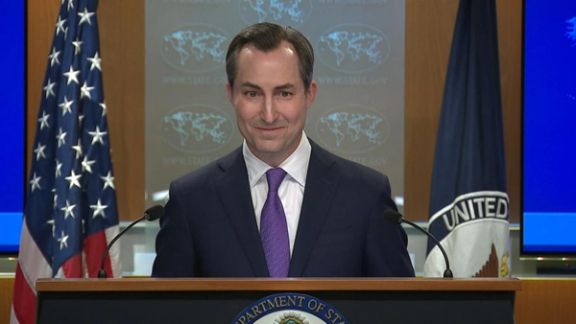
The US government censured Iran’s electoral system as “opaque” and “undemocratic”, just hours before polls opened in the country’s parliamentary elections on Friday.
"I suspect that a great number of Iranians have no expectation that those elections will be free and fair," the state department spokesman Matthew Miller told reporters.
This will be the first election after the widespread 2022 protests in Iran, which deepened and widened the rupture between the regime and ordinary Iranians. There’s very little appetite for participation in what many people consider an "official show." The turnout will likely be low, especially in major cities and urban areas.
"As you probably already know, thousands of candidates were already disqualified in an opaque process,” Miller said, “The world has long known that Iran's political system features undemocratic and non-transparent administrative, judicial and electoral systems.”
Candidates are heavily vetted before they can stand for election. The 12-member Guardian Council, whose members are either appointed or suggested by the leader Ali Khamenei, bars anyone that it thinks may not be fully loyal to the core of the regime.
The vetting process seems to be stricter than ever, leaving the voters with no real choice. But many Iranians seem to not care even about the vetting, having lost hope in the system’s willingness or capacity to change through elections.
Over its past few terms, the Iranian parliament (aka Majles) has become more and more subservient to the two real sources of authority in the Islamic Republic: the Leader and the Revolutionary Guards –who make the key decisions that concern the US and its allies.
Most observers, including US officials, seem to have realized that the parliament is more or less irrelevant to the key decisions.
A collage of women’s rights activists tried in Rasht, northern Iran, February 2024
Twelve women's rights activists who were arrested last year for alleged involvement with planned unrest in Iran are awaiting the verdict after being tried in a regime court.
Activists including Sara Jahani, Hooman Taheri, Yasamin Hashdari were charged with offences including "anti-establishment propaganda" and "membership in an illegal group".
They faced proceedings under Judge Mehdi Rasekhi in a revolutionary court in the northern city of Rasht on Thursday
The defendants were represented by their lawyers Mustafa Nili, Ramin Safarnia, and Mohammad Ali Kamfirouzi.
Sources reported that at the conclusion of the court session, the judge announced that the trial had ended, and the activists would await the verdict.
The women were detained by security institutions of the Islamic Republic in cities including Rasht, Fooman, Anzali, and Lahijan on August 16. The Intelligence Office of Gilan Province confirmed their arrest, alleging their involvement with "foreign elements" and planning to incite unrest and sabotage on the anniversary of the 2022 uprising against regime in Gilan and Kordestan.
After spending approximately two months in custody, the activists were temporarily released from Lakan Prison in Rasht upon posting bail.
The Islamic Republic has faced criticism for its consistent detention and imprisonment of civil and political activists. The nationwide uprising against the Islamic Republic since September 2022 has seen intensified suppression of dissenting voices by the government, with activists continuing to face harassment and imprisonment.
Russian President Vladimir Putin shakes hands with Iranian President Ebrahim Raisi during a meeting in Moscow, Russia December 7, 2023.
A former leading Iranian lawmaker has claimed the alliance between Tehran and Moscow has led to a “betrayal” of the national interest.
Heshmatollah Falahatpisheh, who was head of the Iranian parliament’s foreign policy committee, said Iran’s hopes for success in nuclear negotiations had been “crushed under the boots of the Russians”.
He was speaking after Foreign Minister Hossein Amir-Abdollahian admitted in an interview with the Hezbollah-affiliated news channel Al-Mayadeen that the talks had been adversely affected by Vladimir Putin’s war against Ukraine.
In comments that suggested Russia’s invasion had harmed Iran negotiations, Amir-Abdollahian said: “We had serious negotiations with other parties but at one point, the outcome of our discussions was affected by the atmosphere of the Ukraine war.”
But in response to the foreign minister’s comments, Falahatpisheh said it is too late to confess that the interests of Iran had been sacrificed to Russia.
“I had already warned that the JCPOA nuclear accord and other national interests could be crushed under the boots of the Russians and it finally happened. Unfortunately, more betrayals [from Moscow] are to come,” added Falahatpisheh.
Diplomatic observers believe Russia has exploited the negotiations over Iran’s nuclear programme in an attempt to pressure the West and for concessions over Ukraine.
Iranian dissidents have accused the regime in Tehran of ignoring national interests and providing unconditional support to its allies Russia and China in the international arena.
Last week, Ahmad Khorram, former Roads and Transportation Minister under President Mohammad Khatami, criticised Tehran’s policy of giving multiple concessions to Beijing and Moscow.
He said past experience shows that both China and Russia collaborated with the US in banning Iran’s nuclear program and were the first states to back Security Council resolutions against Iran.
Supreme Leader Ali Khamenei during a meeting with his provincial representatives in Tehran
Two candidates vying for the Assembly of Experts election in Tehran suggest that Supreme Leader Ali Khamenei opposes the notion of naming his son, Mojtaba, as his successor.
However, the timing and context of these statements on Wednesday, just two days before the March 1 elections, raise questions about their authenticity and purpose.
For many years, Iranians and Iran watchers have wondered if Khamenei has been grooming his son to succeed him, especially with presenting him as a religious scholar, a trait seen as important for the future ruler.
The Assembly has the constitutional role of selecting the next ruler after Khamenei’s passing and its composition important for the Supreme Leader.
Mahmoud Mohammadi Araghi, a cleric close to Khamenei and a current Assembly of Experts member, stated in an interview with the Iranian Labor News Agency (ILNA) that Khamenei has voiced his disapproval of the committee's suggestion to appoint his son as the next leader. The committee which includes President Ebrahim Raisi is composed of three Assembly of Experts members to identify suitable successors for Khamenei and to introduce them to him for consideration.
Mahmoud Mohammadi Araghi, a member of Iran's Assembly of Experts
Similarly, Mostafa Pourmohammadi, another candidate for the AoE election whose credentials were first rejected by the Guardian Council and then approved at the last minute, has also reiterated that Khamenei is against the idea of hereditary succession.
However, Pourmohammadi emphasized his readiness to support any candidate deemed fit to succeed Khamenei, irrespective of their familial ties.
The timing of these remarks and Iranian officials including Khamenei's concerns about an expected low turnout that endangers the regime's legitimacy gives rise to speculations about these remarks having been dictated by Khamenei to tell the voters that their voting will not be meaningless and that his successor has not been chosen beforehand.
On the other hand, Mohamadi Araghi's account of Khamenei's opposition to hereditary succession dates back to nearly three decades ago when Khamenei was not as confident and arrogant as the present time.
The remarks made by the two candidates about Khamenei's opposition to hereditary succession come only a few days after several AoE members confirmed that the committee of three has already made its decision about the succession. One Assembly of Experts member who was sure about the process of selecting the next leader having been completed, said that his name will not be revealed as officials fear that foreign agents might assassinate him!
Despite the suggestions about Khamenei's opposition to hereditary succession, some clerics such as Qom Seminarian Sadeq Mohammadi insisted that Khamenei's son Mojtaba is still one of the choices for succession.
Mohamadi Araghi also made other controversial statements apparently aimed to pacify disgruntled voters to go to the polls for the parliamentary and AoE elections on Friday. He said the Islamic Republic's former and current leader have always preferred non-clerics as President and cabinet ministers. However, five of Iran's eight presidents since 1979 have been clerics.
Asked about why he thinks the Guardian Council barred former President Hassan Rouhani from running for a seat on the Assembly, Mohammad Araghi said the rejection of Rouhani's qualifications was probably related to matters other than his religious and academic credentials, but he refused to say what those matters were.
Rohani had said earlier that the next round of the Assembly of Experts is more important than the previous rounds as it might be time for the Assembly to make tough decisions about succession. Mohammad Araghi also said that Khamenei is aging and most probably electing the next Supreme Leader will have to be done by the new Assembly of Experts.
However, if the committee and Khamenei have already chosen the successor, the Assembly will become redundant, and its decision may not be needed. To be on the safe side, like several other AoE members, Mohammadi Araghi also said that he hopes Khamenei will be alive until the Shiites' hidden Imam emerges from occultation, where they believe he has been for nearly 14 centuries.
People listen to Hezbollah leader Hassan Nasrallah's speech through a screen during a gathering in Tehran, Iran, November 3, 2023.
Iran has given Hezbollah the go-ahead to escalate attacks along Israel's northern border, according to reports.
The proxy militia in Lebanon backed by Iran is said to be poised to increase its cross-border assaults should it become certain Israel will invade the city of Rafah in the south of Gaza.
Hezbollah and Israeli forces have exchanged fire repeatedly in the months since the Gaza war began following the Hamas attack on Israel on October 7.
However, the Lebanon-based Shia militia have stopped short of all-out conflict with the Israeli Defence Forces (IDF) until now.
According to a report by the Arabic Post on Wednesday, high-level Iranian and Lebanese sources disclosed that Tehran has set conditions for Hezbollah, ordering the group to launch a large-scale attack on Israel only after confirming Israel's intentions to invade Rafah.
A meeting between Hezbollah Secretary-General Hassan Nasrallah and Iran's IRGC Quds Force commander Esmail Qaani was held to discuss “the latest developments,” a source from Iran's Revolutionary Guard revealed to Arabic Post.
Nasrallah reportedly expressed certainty about Israel's intentions to launch an assault on Hezbollah in Lebanon and sought Iran's support in responding effectively. "Nasrallah said that he is completely certain of [Israel's] intention to launch a large-scale attack on Lebanon, and he asked Qaani to give him complete freedom in how he intends to attack," a diplomatic source in Iran disclosed.
The report also highlighted Tehran's disapproval of Hezbollah's recent uncoordinated rocket launch on the northern Israeli city of Safed. The attack, which resulted in civilian and military casualties, led to Iranian calls for Hezbollah to exercise strategic patience.
The escalation in tensions underscores the volatile situation in the region, with fears of broader conflict looming large as Hezbollah gears up for potential retaliation against Israel.
The leader of the Islamic Revolutionary Guard Corps (IRGC) has made a desperate plea for Iranians to vote in Friday’s elections as the regime fears a record low turnout.
Speaking ahead of the parliamentary election on March 1, IRGC commander-in-chief Hossein Salami said: "Each vote is like a missile being fired at the heart of the enemies."
Speaking at the burial site of former IRGC Quds Force Commander Qasem Soleimani in Kerman, he said: "Today, the votes make the enemy hopeless and give hope to the people and the revolutionary front."
Salami's comments come amidst ongoing international concern over Iran's missile program. While Iran defends its development and testing of ballistic missiles as defensive measures, critics, particularly the United States and its allies, view the program as a threat to regional stability and security.
One factor is disillusionment among certain segments of the population with the political process and the perceived lack of genuine choice within the electoral system. Many Iranians, particularly the young, express frustration with what they see as limited options and believe that their participation in the electoral process may not yield meaningful change.
Economic challenges, including high unemployment rates and inflation, have also contributed to widespread discontent among Iranians. Despite official promises, economic conditions for have remained stagnant or worsened over time, fuelling a sense of alienation from the political establishment.